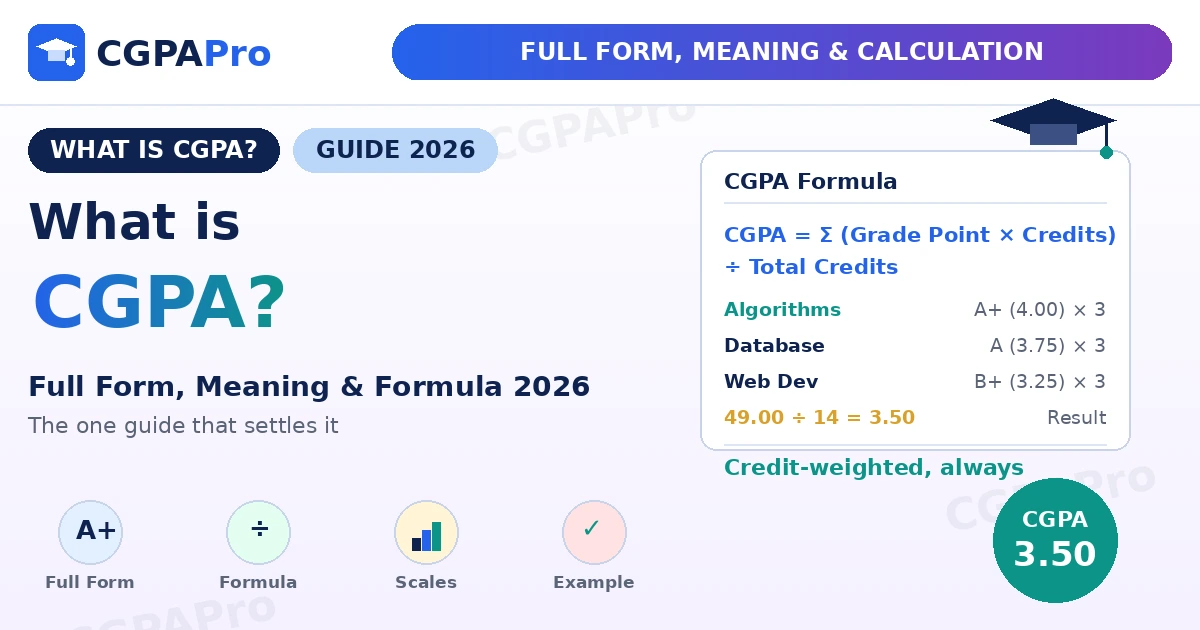
CGPA stands for Cumulative Grade Point Average. In plain words, it is a single number that summarises your entire academic record — every course, every semester — on a scale your university defines, usually 4.0 or 10. The formula is CGPA = Σ (grade point × credit hours) ÷ Σ (credit hours), which means it is a credit-weighted average, not a simple average. That one detail — the weighting — is where most students go wrong, and it is exactly what this guide fixes with real, checkable numbers.
Try it on the calculator first
You don’t need to take the arithmetic on faith. Run your own numbers through the free CGPA calculator on our homepage while you read — everything below matches what it computes:
- Open the homepage calculator and choose the Semester GPA mode.
- Add one row per course: the grade you earned and the course’s credit hours.
- Hit calculate. The tool multiplies each grade point by its credits, adds everything up, and divides by total credits — the exact formula from the next section.
- Switch scales (4.0, 10-point, percentage) to see how your result translates across systems.
CGPA full form, broken down word by word
The acronym hides three ideas, and each one matters. Universities could have chosen a simpler number — say, the average of your percentages — but they deliberately built a system that respects how much work each course represents. A full-year core module and a half-semester elective are not the same commitment, and the CGPA’s design refuses to pretend they are.
- Cumulative — it covers your whole record, not one term. Every semester you complete folds into this number and stays there. A weak first year keeps pulling on your average long after you’ve improved.
- Grade Point — each letter grade is converted to a number. On a 4.0 scale an A might be 4.00 or 3.75 depending on your university’s table; on India’s 10-point scale an A is 8. Points make different subjects comparable.
- Average — a weighted average, where a 4-credit course counts roughly twice as much as a 2-credit one. Equal marks in an easy 1-credit lab and a brutal 4-credit core course do not move your CGPA equally.
The formula, explained step by step
Write this down once and you’ll never forget it:
CGPA = (Grade Point × Credits) added over all courses ÷ total credits
In symbols: CGPA = Σ(GPᵢ × Cᵢ) / Σ(Cᵢ), where GPᵢ is the grade point in course i and Cᵢ is that course’s credit hours. The top half — grade points times credits — is sometimes called “quality points”. Three steps, that’s all:
- Multiply every course’s grade point by its credit hours (quality points).
- Add up all the quality points.
- Divide by the total credit hours.
Notice what this means: credits are weights. A 4-credit course influences the result twice as much as a 2-credit course with the same grade. This is the entire game — and the reason the “shortcut” below quietly gives you the wrong answer.
The trap most students fall into: the simple average
Here’s the mistake almost everyone makes at least once. You finished two semesters: GPA 3.20 in semester 1, GPA 3.80 in semester 2. So your CGPA is (3.20 + 3.80) ÷ 2 = 3.50. Right?
Wrong — unless both semesters carried exactly the same number of credits. That shortcut is a simple average, and CGPA is a weighted average. This is the single most common CGPA error students make; one blogger even built an entire article around how the wrong formula keeps spreading. Let’s do the real numbers.
Say semester 1 was 18 credits at GPA 3.20, and semester 2 was 12 credits at GPA 3.80:
| Semester | GPA | Credits | Quality points (GPA × credits) |
|---|---|---|---|
| Semester 1 | 3.20 | 18 | 3.20 × 18 = 57.60 |
| Semester 2 | 3.80 | 12 | 3.80 × 12 = 45.60 |
| Total | — | 30 | 57.60 + 45.60 = 103.20 |
True CGPA = 103.20 ÷ 30 = 3.44 — not 3.50.
The shortcut overstated the result by 0.06, because it gave the 12-credit semester equal say with the 18-credit one. In a scholarship cutoff of 3.45, that’s the difference between funded and unfunded. The heavier semester always pulls the average toward itself.
Cumulative drag is the same idea stretched across your degree. One weak semester doesn’t fade — it stays in the total. Take a student with 3.80 in semester 1 (17 credits) and 2.60 in semester 2 (16 credits):
| Semester | GPA | Credits | Quality points |
|---|---|---|---|
| Semester 1 | 3.80 | 17 | 3.80 × 17 = 64.60 |
| Semester 2 | 2.60 | 16 | 2.60 × 16 = 41.60 |
| Total | — | 33 | 64.60 + 41.60 = 106.20 |
CGPA = 106.20 ÷ 33 = 3.22 (106.20 ÷ 33 = 3.2181…, rounded to 3.22). That single rough semester dragged a near-perfect 3.80 start all the way down to 3.22.
Now the recovery question every student asks: what would it take to get back to 3.50? Suppose 34 credits remain. You’d need a target total of 3.50 × (33 + 34) = 3.50 × 67 = 234.50 quality points. You already have 106.20, so you need 234.50 − 106.20 = 128.30 more points across 34 credits: 128.30 ÷ 34 = 3.77 per credit. That’s the honest math — a sustained 3.77 average for two full semesters just to claw back. Doable, but now you see why protecting your CGPA early is worth far more than repairing it late.
Worked example on the 4.0 scale
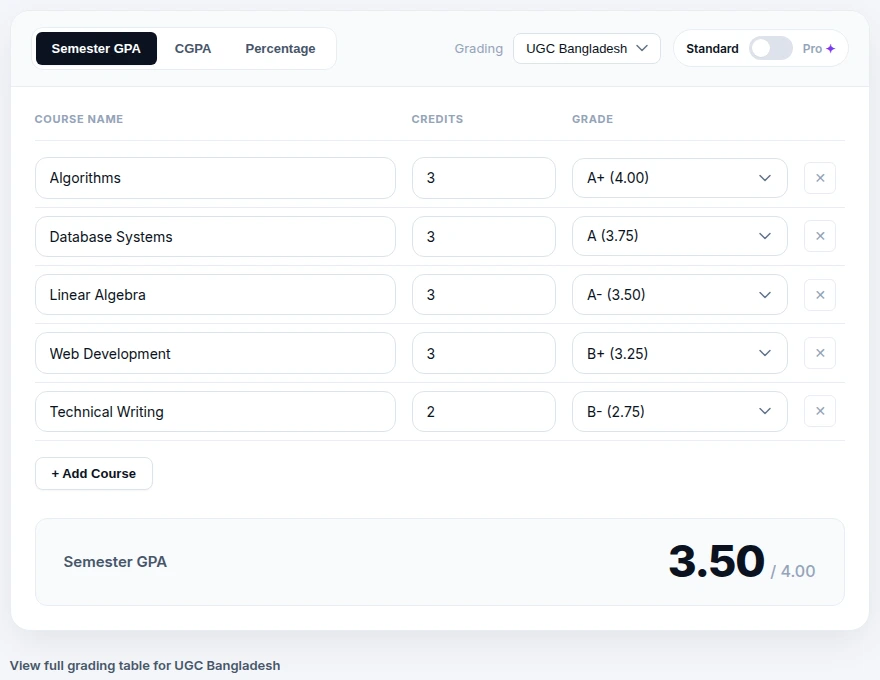
Let’s compute one full semester properly, on the 4.0 scale used in Pakistan (HEC), Bangladesh (UGC), Malaysia and the US. Using this grade table: A+ = 4.00, A = 3.75, A− = 3.50, B+ = 3.25, B = 3.00, B− = 2.75:
| Course | Credits | Grade | Grade point | Quality points |
|---|---|---|---|---|
| Algorithms | 3 | A+ | 4.00 | 3 × 4.00 = 12.00 |
| Database Systems | 3 | A | 3.75 | 3 × 3.75 = 11.25 |
| Linear Algebra | 3 | A− | 3.50 | 3 × 3.50 = 10.50 |
| Web Development | 3 | B+ | 3.25 | 3 × 3.25 = 9.75 |
| Technical Writing | 2 | B− | 2.75 | 2 × 2.75 = 5.50 |
| Total | 14 | — | — | 49.00 |
Check the addition: 12.00 + 11.25 = 23.25; + 10.50 = 33.75; + 9.75 = 43.50; + 5.50 = 49.00. Total credits: 3 + 3 + 3 + 3 + 2 = 14.
Semester GPA = 49.00 ÷ 14 = 3.50. This is the exact result shown in the calculator screenshot above — try the same five rows yourself and you’ll get 3.50. Note how Technical Writing’s B− barely dented the average: at only 2 credits, it carried the least weight of any course on the list.
One semester’s GPA becomes one line in your cumulative record. When the next semester lands, you repeat this exact process across all courses so far — or, equivalently, combine semester GPAs weighted by their credit totals, exactly as we did in the trap example.
Worked example on India’s 10-point scale
Indian universities commonly use a 10-point scale where O (Outstanding) = 10, A+ = 9, A = 8, B+ = 7, B = 6, C = 5, and F = 0. The formula is identical — only the point values change. Three courses:
| Course | Credits | Grade | Grade point | Quality points |
|---|---|---|---|---|
| Mathematics | 4 | A | 8 | 4 × 8 = 32 |
| Physics | 3 | B+ | 7 | 3 × 7 = 21 |
| English | 2 | O | 10 | 2 × 10 = 20 |
| Total | 9 | — | — | 73 |
32 + 21 = 53; 53 + 20 = 73 quality points over 9 credits. CGPA = 73 ÷ 9 = 8.11 (8.111…, rounded to two decimals).
A quick note for CBSE Class 10 students: the board’s official conversion is percentage = CGPA × 9.5. So 8.11 × 9.5 = 77.05%. But CBSE itself calls this an indicative equivalence — a rough approximation, not an exact identity. Treat it as a ballpark, never as a precise score. For a deeper walkthrough, see our percentage-to-CGPA conversion guide.
CGPA scales around the world
CGPA is universal; its scale is not. The same performance reads very differently depending on the country:
| Country / system | Scale | Top grade | What “good” looks like |
|---|---|---|---|
| Pakistan (HEC), Bangladesh (UGC) | 4.00 | A+ / A (4.00) | 3.5+ excellent, 3.0+ very good |
| Malaysia | 4.00 | A / A+ (4.00) | 3.5+ (First Class), 3.0+ strong |
| United States | 4.00 | A (4.0) | 3.5+ excellent, 3.0+ competitive |
| India (universities) | 10-point | O (10) | 8.0+/10 strong, 9.0+ outstanding |
| India (CBSE Class 10) | 10-point | A1 / 10 | 9.0+ excellent; ×9.5 ≈ percentage |
| United Kingdom | Degree classification | First Class | Not a CGPA — First / 2:1 / 2:2 / Third |
The UK row deserves emphasis: British universities award degree classifications (First, Upper Second, Lower Second, Third), not a CGPA number. If you’re converting for a UK application, you map your CGPA to a classification band — there is no native British CGPA scale to “convert” with a formula. A broader country-by-country breakdown is available at Collegedunia’s CGPA guide.
GPA vs CGPA: the one-paragraph version
GPA and CGPA use the same formula — the difference is only the window. GPA covers one semester; CGPA covers your entire record. Your semester GPA is a snapshot; your CGPA is the running total. We’ve written a full comparison with worked side-by-side numbers: CGPA vs GPA vs SGPA — difference explained (2026).
Where your CGPA actually matters
- Graduate admissions. Most programmes publish a minimum — commonly 3.0 on a 4.0 scale — and competitive ones effectively want 3.5+. International applicants usually go through credential evaluation (like WES) first, and evaluators recompute your average from raw transcripts, so a self-reported number that ignored credit weighting can get quietly corrected downward.
- Jobs and internships. Many large employers, especially in tech, finance and consulting, screen CVs at 3.0+. Some never ask; others auto-filter below the line before a human ever reads your projects.
- Scholarships. Merit awards are the strictest of all — cutoffs like 3.5 or 3.67 are common, and they’re rarely negotiable. Remember the trap example: a 0.06 shortcut error is the difference between funded and unfunded.
- Studying abroad. Universities compare applicants from different scales, so your raw number gets converted or evaluated. Keep official transcripts and your university’s grading policy handy — admissions officers distrust numbers they can’t trace back to a scale.
- Academic standing. Below roughly 2.0, most universities put you on probation — and below that, suspension. Your CGPA is also the number on your final degree transcript, the one employers see for years. Unlike a bad interview, it doesn’t fade from memory; it stays printed.
5 common CGPA mistakes (and how to avoid them)
1. Taking a simple average of semester GPAs
The trap from above. (3.20 + 3.80) ÷ 2 = 3.50 feels right and is wrong whenever credit loads differ. Always weight by credits: true answer there was 3.44.
2. Mixing scales mid-calculation
Never average a 4.0-scale semester with a 10-point one, or blend one university’s A = 4.00 with another’s A = 3.75. Convert everything to a single scale first, then calculate.
3. Forgetting that failed courses count as zero
An F contributes 0 grade points — but its credits still sit in the denominator. A 3-credit F on a 4.0 scale doesn’t just “not help”; it actively drags the average down exactly like a 3-credit course scored at zero. Retaking helps only if your university’s policy replaces the old grade; many average both attempts.
4. Rounding too early
Rounding each course’s quality points before adding them up can shift the final result by a few hundredths — enough to matter at a cutoff. Keep two or three decimals through the working, and round only the final answer.
5. Treating CBSE’s ×9.5 as exact
CBSE’s own formula (percentage = CGPA × 9.5) is explicitly indicative. An 8.4 CGPA × 9.5 = 79.8% is a reasonable estimate of your board percentage, not a certified figure. Don’t quote it to three decimal places as if it were.
How to raise your CGPA
The math above already told you the strategy: front-load effort into high-credit courses, because that’s where the weights are. A one-grade improvement in a 4-credit core course moves your CGPA roughly four times more than the same improvement in a 1-credit lab. Beyond that — retake policies, grade replacement rules, and a semester-by-semester targeting plan — read the full playbook: How to Improve CGPA in 2026.
Frequently asked questions
What is the full form of CGPA?
CGPA stands for Cumulative Grade Point Average — a credit-weighted average of all the grades you have earned across your entire programme, expressed on your university’s scale (commonly 4.0 or 10).
What is the exact CGPA formula?
CGPA = Σ(grade point × credit hours) ÷ Σ(credit hours). Multiply each course’s grade point by its credits, add all of those up, and divide by total credits. It is a weighted average, not a simple one.
Is CGPA just the average of my semester GPAs?
Only if every semester had identical credit loads — which almost never happens. The correct method weights each semester’s GPA by its credits. In our example, (3.20 + 3.80) ÷ 2 gave 3.50, but the true credit-weighted CGPA was 3.44.
What is a good CGPA?
On a 4.0 scale: 3.5+ is excellent, 3.0–3.49 is very good, and 3.0 is the common minimum for employers and graduate schools. On India’s 10-point scale: 8.0+ is strong, 9.0+ outstanding.
How do I convert CGPA to percentage?
There is no universal formula — it depends on your board or university. CBSE Class 10 uses percentage = CGPA × 9.5 (indicative only). Many universities publish their own conversion; otherwise a credential evaluator does it for you.
Does the UK use CGPA?
No. UK universities award degree classifications — First Class, Upper Second (2:1), Lower Second (2:2), Third — not a CGPA number. For UK applications you map your CGPA onto a classification band rather than converting it with a formula.
The bottom line
CGPA is one number with real consequences — admissions, jobs, scholarships, the transcript that follows you for years. The formula takes thirty seconds to learn and the weighting takes one worked example to respect. The students who understand credit weighting early protect their heavy courses, plan their recoveries with real arithmetic, and never lose a scholarship to a 0.06 shortcut error. Calculate it properly, protect the heavy-credit courses, and check your number on the calculator before anyone else does.