The Quick Answer
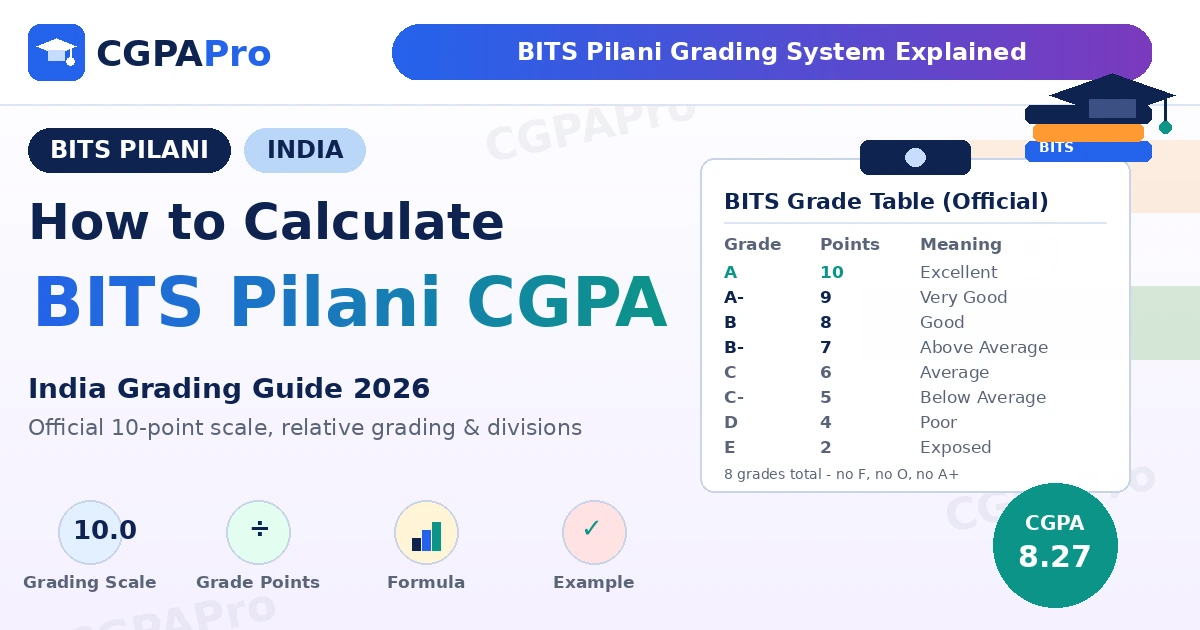
BITS Pilani grades on a 10-point scale with eight letter grades: A (10), A− (9), B (8), B− (7), C (6), C− (5), D (4), E (2). There is no F, no O, and no A+. Grading is relative — your letter grade depends on where you land against your classmates in that course, not on fixed percentage cutoffs. Your SGPA (semester) and CGPA (cumulative) are credit-weighted averages of your grade points. To stay enrolled in an Integrated First Degree programme you must keep your CGPA at or above 4.5 with no more than one E in any semester.
If that already cleared up your biggest confusion, the rest of this guide goes deeper: the official grade table with the meanings BITS actually assigns, exactly how relative grading works (with a real classroom example), a hand-worked calculation, and the wrong grade tables floating around the internet that you should never trust.
How to Calculate Your BITS Pilani SGPA Online
The fastest way to check a semester is CGPAPro’s general calculator. Here’s the routine:
- Open the calculator and make sure the grading dropdown is set to a scale you understand.
- Click + Add Course for every course in the semester.
- Type the course name, its credit value, and pick the letter grade you earned (or expect).
- Read your Semester GPA from the result panel.
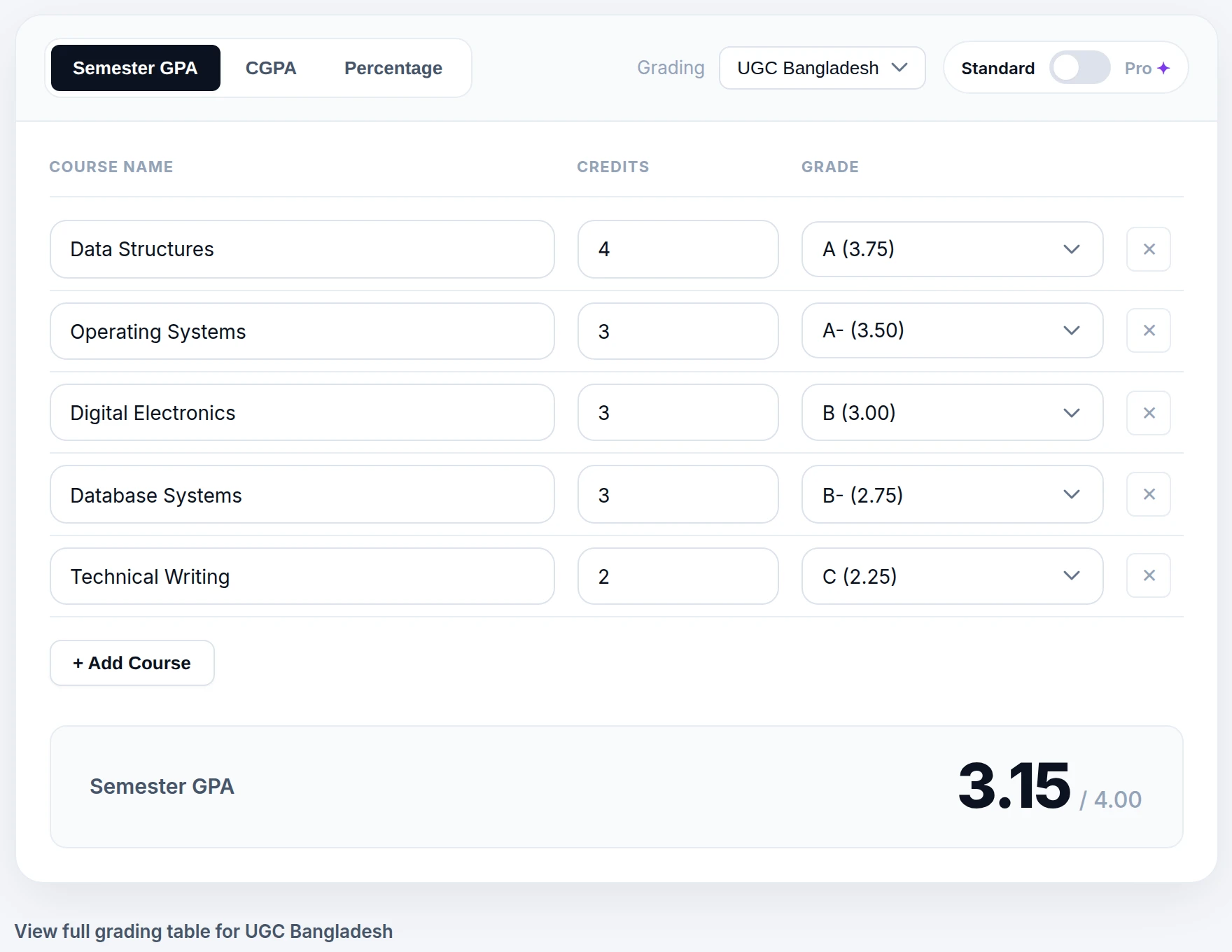
One critical warning before you trust any calculator: CGPAPro’s homepage calculator — like almost every generic calculator online — does not carry BITS Pilani’s exact grade table. I ran a five-course semester through it, and the screenshot below shows what it produced. Read the caption carefully; it explains exactly where the numbers differ from BITS’s official table and how to get the true figure.
The Official BITS Pilani Grading Table
This table is verified against BITS Pilani’s own documents — the official grading-procedure filing, the institute Bulletin, and the admissions office’s education-process document. If any website shows you a different table for BITS Pilani, that website is wrong.
| Letter Grade | Grade Points | Official Meaning |
|---|---|---|
| A | 10 | Excellent |
| A− | 9 | Very Good |
| B | 8 | Good |
| B− | 7 | Above Average |
| C | 6 | Average |
| C− | 5 | Below Average |
| D | 4 | Poor |
| E | 2 | Exposed |
A few things about this table surprise almost every newcomer:
- There is no F. The lowest letter grade is E, worth 2 points — not zero. Anyone who earned a grade at all has “successfully completed” the course in the institute’s terminology, though an E drags your average hard and triggers continuation rules (more on those below).
- “Exposed” is the real official word for E. It sounds strange — like the grade caught you with your preparation down. That’s roughly the spirit: your performance was laid bare as inadequate.
- A D (4) is a completed course. It counts, it earns credits, and it enters your CGPA at 4 points. Don’t treat it like a fail.
- The minus grades are full citizens. A−, B− and C− each have their own point value. This is exactly where generic calculators go wrong — many drop the minus grades entirely or assign them made-up values.
Beyond the letter grades, BITS uses a few other markings you should know:
- Non-letter grades — EXCELLENT, GOOD, FAIR, POOR — are awarded for dissertation, thesis, seminar and project-type work instead of letter grades.
- NC (Not Cleared) is a report, not a grade. An instructor issues it when a student gives “inadequate opportunity for evaluation” — for example, skipping most evaluation components. It carries no grade points.
- RRA (Require to Register Again) is another report: you must re-register for the course.
- None of NC, RRA, or the non-letter grades has a number attached. They are not zeros; they are not grades at all.
How Relative Grading Actually Works at BITS
This is the part that confuses every fresher, so let’s walk through it slowly — because BITS’s official documents describe the procedure in unusual detail, and it’s more mechanical than mysterious.
At the end of the semester, for each course, the instructor adds up every student’s total marks (quizzes, assignments, mid-semester exam, comprehensive exam — typically three evaluation components per course). Fractional totals are rounded up to the next whole number, no matter what — 79.2 becomes 80 just as 79.6 does. The pre-comprehensive totals are displayed on the notice board so you can verify your own numbers before the final exam.
Then the totals for the whole class are sorted from highest to lowest and plotted as a histogram. The instructor records the class average, the highest, and the lowest marks, and then draws the dividing lines between grades where the natural gaps (clusters) in the histogram fall. BITS’s official procedure states plainly: “In a class of large size, the C band will usually include the average mark.” It adds that this is not a hard rule — small classes or skewed histograms produce exceptions.
Here’s what that means in practice, with a real example students report: in a tough electrical course out of 200 marks, the class average might sit around 50 — and scoring 50 earns you a C, sometimes even a B, depending on the instructor’s cluster lines. In an easier economics course where the average is 130 out of 200, that same 130 gets you a C or a C−. The same marks can be a B in one course and a C− in another. Your absolute score matters less than your position relative to the class.
For borderline cases — the student sitting exactly on a dividing line — the instructor decides case by case, officially considering your consistency through the semester, whether you improved as the course progressed, an exceptionally good comprehensive exam, and your regularity and class participation. So the last two weeks of a course genuinely can move a borderline B− to a B.
One more consequence worth internalizing: a brutal question paper does not destroy your grade. If everyone found the paper hard, the average drops with you, and the cluster lines move down too. What kills you in relative grading is not a hard paper — it’s the fifteen classmates who found it easy.
Step-by-Step: Calculating Your SGPA
The formula is the same weighted average used everywhere, applied to BITS’s grade points:
SGPA = Σ (course credits × grade points) ÷ Σ (course credits)
- List every course you took this semester with its credit value.
- Convert each letter grade to its official grade point (A = 10, A− = 9, B = 8, B− = 7, C = 6, C− = 5, D = 4, E = 2).
- Multiply each course’s credits by its grade points. These are your quality points.
- Add up all quality points and all credits.
- Divide total quality points by total credits. That’s your SGPA, on the 10-point scale.
Your CGPA uses the identical formula, except it runs over every course you have taken since enrolling — it is cumulative from semester one. BITS issues a grade sheet each semester and a final transcript at the end of the programme.
Worked Example: The Screenshot’s Five Courses, Done Officially
Let’s take the exact five courses from the calculator screenshot above and compute them the BITS way — mapping each letter to the official 10-point table instead of the calculator’s 4.0 scale.
| Course | Credits | Grade | BITS Points | Quality Points |
|---|---|---|---|---|
| Data Structures | 4 | A | 10 | 4 × 10 = 40 |
| Operating Systems | 3 | A− | 9 | 3 × 9 = 27 |
| Digital Electronics | 3 | B | 8 | 3 × 8 = 24 |
| Database Systems | 3 | B− | 7 | 3 × 7 = 21 |
| Technical Writing | 2 | C | 6 | 2 × 6 = 12 |
| Total | 15 | 124 |
SGPA = 124 ÷ 15 = 8.27.
Compare: the generic calculator showed 3.15/4.00 for the same letters. Both numbers describe the same performance — 8.27 on BITS’s 10-point scale is the one that goes on your grade sheet. This is why the “just use any CGPA calculator” advice fails for BITS students: the letters are the same, the points behind them are completely different.
SGPA vs CGPA: Don’t Just Average Your Semesters
SGPA covers one semester; CGPA covers everything since day one. The trap students fall into is averaging their SGPAs: (7.20 + 8.60) ÷ 2 = 7.90 looks right, but it’s wrong whenever semesters carry different credit loads. Watch:
| Semester | Credits | SGPA | Quality Points |
|---|---|---|---|
| Semester 1 | 18 | 7.20 | 18 × 7.20 = 129.6 |
| Semester 2 | 24 | 8.60 | 24 × 8.60 = 206.4 |
| Total | 42 | 336.0 |
CGPA = 336.0 ÷ 42 = 8.00 — a full tenth higher than the naive average of 7.90, because the stronger semester carried more credits. Always weight by credits; your CGPA is a weighted average of all your courses, not an average of averages.
This also explains why one bad semester feels so sticky. Your CGPA is cumulative, so a weak first year keeps pulling the average down until enough good semesters dilute it. Students on the repeat-and-recover path should run the numbers before assuming a comeback is one semester away.
Your BITS Calculator May Be Lying to You
When I researched this article, I opened the top-ranking “BITS Pilani grading system” pages and checked their grade tables against BITS’s official documents. The results were grim enough to deserve their own section.
- One popular results portal lists A = 10, B = 8, C = 6, D = 4, F = 0 — deleting the minus grades entirely and inventing an F worth zero. On BITS’s real table, a C− is worth 5 and an E is worth 2. A student converting their grades with this table miscalculates every single course.
- A college-results article gets the letters right but declares E = 0 (“Fail”). Officially E carries 2 points. It also invents I, GA and RC grades and claims NC means “not cleared for audit courses” — officially, NC is issued when a student gives the instructor inadequate opportunity for evaluation.
- A CGPA-to-percentage tool publishes this fantasy: C → D = 5, E (Pass) = 4, F (Fail) = 0. None of those mappings exist at BITS.
- An admissions-content site lists O (10), A+ (9), A (8), B+ (7), B (6), C (5), F (0) — a generic Indian scale that has nothing to do with BITS — and claims the continuation floor is 6.0. The official floor is 4.5.
Even CGPAPro’s own homepage calculator can mislead you here: its “10.0 Scale (India)” dropdown option uses A = 8, B+ = 7, B = 6, C = 5, F = 0 — a generic Indian 10-point scale, not BITS’s table. And IIT’s system, for comparison, really is a different beast — see our IIT grading and CPI guide to see how differently two Indian institutes can define “10-point”. The rule is simple: for BITS Pilani, the only table that matters is A 10 / A− 9 / B 8 / B− 7 / C 6 / C− 5 / D 4 / E 2. If a calculator doesn’t let you set those exact values, use it for the arithmetic and map the letters yourself, exactly as the worked example above does.
Staying Enrolled: The 4.5 Rule, E Grades and the ACB
BITS doesn’t do “probation” the way many universities do — it has minimum academic requirements for continuation, enforced at the end of every semester:
- Integrated First Degree (BE, MSc, BPharm): CGPA of at least 4.5 at the end of each semester, and no more than one E grade in any single semester.
- Higher Degree and PhD: CGPA of at least 5.5, and no E grades at all.
Fall short and you’re placed under the Academic Counselling Board (ACB), which supervises your programme and directs your rehabilitation. These are Senate-appointed committees with real teeth: they can terminate your enrollment or transfer you to another programme. A 4.4 CGPA at BITS is not “close enough” — it’s a committee meeting.
Note what BITS does not stipulate: there is no minimum attendance percentage in the official documents. The institute expects you to be regular — and an instructor can still issue an NC if you give them nothing to evaluate — but no rule says “75% or you fail.” Any site claiming otherwise for BITS is inventing it. (Our dean’s list and probation thresholds guide covers how other universities handle the same situations.)
Degree Divisions: What Your Final CGPA Gets Called
For Integrated First Degree programmes, your final CGPA decides your degree classification — three bands, no fine print:
| Division | CGPA Required |
|---|---|
| Distinction | 9.00 and above |
| First Division | 7.00 to below 9.00 |
| Second Division | 4.50 to below 7.00 |
Higher Degree and PhD programmes award no divisions. And remember the placement reality students report: many companies set CGPA cutoffs around 7.0–8.0 for shortlisting, which makes the First Division band (7.00+) the practical line that matters for campus placements — our guide on whether a given CGPA is “good” walks through how recruiters actually read these numbers.
Repeating a Course: What Happens After an E or NC
If you land an E or an NC, the course isn’t over — BITS’s regulations include the RRA (Require to Register Again) report, which means exactly what it says: you re-register for the course and take it again. Your new grade then enters the CGPA computation.
What I could not verify in the official documents is a general “improvement exam” system for courses you already passed — the kind some universities offer to lift a C to a B. BITS’s published regulations for regular programmes describe re-registration for failed or not-cleared courses, not voluntary repeats of passed ones. If you’re hoping to retake a passed course purely to raise your CGPA, check the current Academic Bulletin for your campus and year, or ask your ACB counsellor — don’t assume the option exists.
Common Mistakes BITS Students Make
- Using F in calculations. There is no F at BITS. The bottom of the table is E at 2 points. Every “F = 0” in a generic calculator silently deletes 2 points per failed course from your math.
- Borrowing someone else’s 10-point table. VIT, SRM and Anna University all run 10-point systems with different letters and values — compare with our VIT grading guide and you’ll see why “10-point” tells you nothing by itself. Only BITS’s eight grades and eight values count.
- Assuming fixed percentage cutoffs. “90% = A” is not a BITS rule. In a hard course, 65% might be an A; in an easy one, 85% might be a B. The histogram decides, fresh, every semester.
- Averaging SGPAs instead of credit-weighting. Covered above — it cost our example student a tenth of a point.
- Treating D as a fail. D (4) is a completed course. It hurts, but it counts toward your degree and your credits.
- Forgetting that E still counts. An E enters your CGPA at 2 points and counts toward the one-E-per-semester continuation limit. It is not a neutral event.
Tips for Protecting (and Raising) Your BITS CGPA
- Aim above the class average, not at a percentage. In relative grading, the average is the C line. Beating the average by a comfortable margin is the only reliable route to B-range grades.
- First year counts double for dual-degree students. Your MSc-to-BE branch allotment runs on first-year CGPA, and students report indicative cutoffs around 8.2+ for Computer Science, ~7.8 for EEE and ~7.3 for Electronics & Instrumentation. Treat first year as the highest-stakes year of your degree.
- Finish strong in every course. Borderline cases are decided on consistency, improvement trajectory and comprehensive-exam performance — the official procedure says so. A strong final exam can genuinely pull a borderline grade up.
- Check your pre-comprehensive totals. BITS’s own procedure recommends displaying them for verification. Catching a totalling error before final grading is free marks.
- Never let E grades accumulate. More than one E in a semester breaches the continuation rules outright. One bad course is recoverable; two in one semester is a committee.
Frequently Asked Questions
How does relative grading work at BITS Pilani?
Your total marks in a course are plotted against the whole class on a histogram. The instructor draws grade boundaries where natural gaps appear in the distribution, using the class average, highest and lowest marks as anchors. In large classes the average typically falls in the C band. Your grade reflects your rank in the class, not a fixed percentage — so the same marks can earn different grades in different courses.
What marks do I need to get an A at BITS Pilani?
There is no published marks cutoff — it varies by course, instructor and semester, because the histogram is drawn fresh each time. Roughly, you need to be near the top cluster of the class distribution. Seniors’ estimates for a specific instructor’s past courses are the best guide, but they’re estimates, not promises.
Does BITS Pilani have an F grade?
No. The eight letter grades are A, A−, B, B−, C, C−, D and E. E (2 points, “Exposed”) is the lowest grade. NC (Not Cleared) is a report issued when a student gives inadequate opportunity for evaluation — it is not a grade and carries no points.
What is the minimum CGPA required to continue at BITS Pilani?
For Integrated First Degree programmes (BE, MSc, BPharm): CGPA of at least 4.5 at the end of each semester, with no more than one E grade per semester. For Higher Degree and PhD programmes: CGPA of at least 5.5 with no E grades allowed. Falling short puts you under the Academic Counselling Board, which can terminate enrollment.
How do I convert my BITS CGPA to a percentage?
BITS does not issue percentages — your transcript carries the 10-point CGPA. The widely used approximation is percentage = CGPA × 10 (so 8.27 ≈ 82.7%). Treat it as an approximation for forms that demand a percentage, not an official conversion. For US applications, see our 10-point CGPA to 4-point GPA conversion guide, which explains why a straight divide-by-2.5 misleads.
What is a good CGPA at BITS Pilani?
Students and alumni generally call 7.0+ respectable — it keeps most placement and higher-study paths open. Campus placement shortlists commonly use cutoffs of 7.0, 7.5 or 8.0 depending on the company, so 8.0+ is the comfortable zone. Below 7.0, you’ll need strong projects, internships or skills to compensate. For the degree itself: 9.0+ is Distinction, 7.00–8.99 is First Division.
Can I repeat a course to improve my grade at BITS?
Courses with an E or NC are cleared by re-registering (the RRA — Require to Register Again — route). A general improvement system for re-taking passed courses to lift the grade is not documented in the official regulations I verified for regular programmes, so check the current Academic Bulletin or your ACB counsellor before planning around it.
Conclusion
BITS Pilani’s grading system rewards a specific kind of student: not the one who chases percentages, but the one who consistently beats the class average. Eight letter grades, a 10-point scale, relative grading drawn fresh every semester, a 4.5 continuation floor and degree divisions at 9.0, 7.0 and 4.5 — that’s the whole machine. The same rules apply across the Pilani, Goa, Hyderabad and Dubai campuses.
The single most valuable habit is also the simplest: do every calculation against the official table — A 10, A− 9, B 8, B− 7, C 6, C− 5, D 4, E 2. Generic calculators and ranking-site tables get BITS wrong with depressing regularity, and a wrong table doesn’t just mislead you — it misleads you confidently. Map the letters yourself, weight by credits, and you’ll always know exactly where you stand.