VIT’s grading system is a 10-point letter-grade scale — S, A, B, C, D, E for passes and F for fails — with grade points 10 down to 5. Semester GPA and cumulative CGPA are weighted averages of grade points by credits. What confuses most students: theory courses use relative grading (your grade depends on your class’s mean and standard deviation), and the official absolute bands are D 55–59 and E 50–55 — not the 50–59/40–49 figures most third-party calculators show. This guide breaks down the official FFCS Academic Regulations (Version 4.0), with worked examples for GPA, CGPA, and relative grading.
How to Calculate Your VIT GPA With the Calculator
The fastest way to check where you stand is to run your actual grades through a calculator built on VIT’s real scale:
- List every course you registered this semester — name and credit value (check your course registration on VTOP for exact credits).
- Enter the letter grade VIT awarded you for each course (S through F). Use the grade on your official result, not your raw marks.
- Add any N-graded courses too — they carry 0 points and drag your GPA until cleared. (Withdrawn W courses stay out.)
- Read your semester GPA, then switch to the CGPA mode and add past semesters to see your cumulative number.
Here’s what that looks like for a typical first-year semester — Data Structures (4 cr, A), Operating Systems (3 cr, B), DBMS Lab (2 cr, S), Digital Electronics (3 cr, C), Soft Skills (2 cr, B):
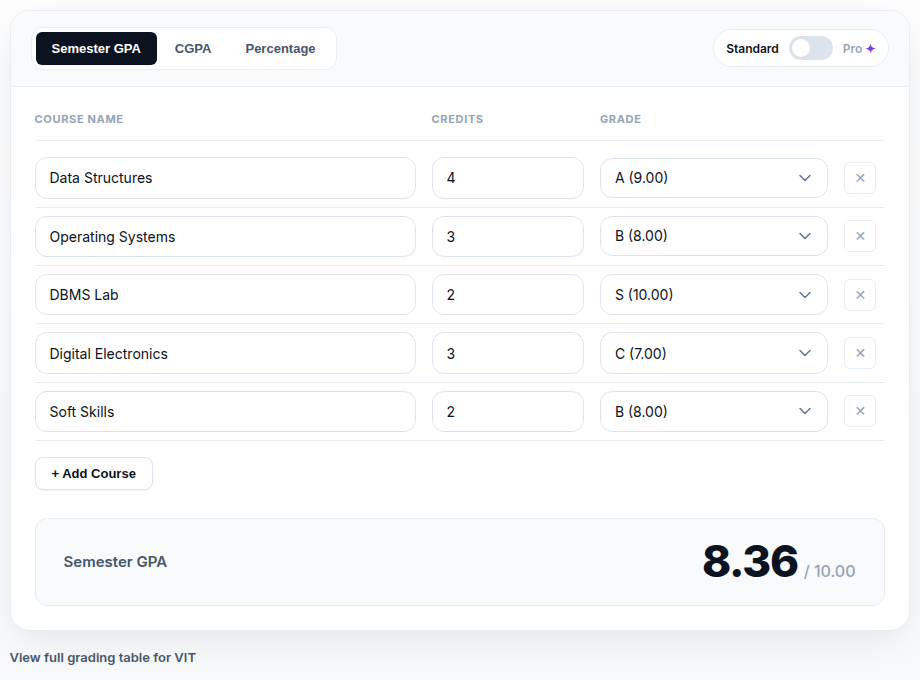
Figure: semester GPA 8.36 on VIT’s 10-point scale, computed as (4×9 + 3×8 + 2×10 + 3×7 + 2×8) / 14 = 117 / 14. Try your own grades on the VIT CGPA calculator.
The Official VIT Grading Scale (Grade Points)
VIT’s official regulations use these letter grades. S, A, B, C, D, E and P are the performance grades — they all mean you passed the course.
| Letter Grade | Grade Point | Meaning |
|---|---|---|
| S | 10 | Outstanding — pass |
| A | 9 | Excellent — pass |
| B | 8 | Very good — pass |
| C | 7 | Good — pass |
| D | 6 | Pass |
| E | 5 | Pass (minimum passing grade) |
| F | 0 | Fail — must reregister |
| N | 0 | Incomplete — failed components, attendance debar, absent in FAT, or malpractice |
| W | — | Withdrawn — no points, excluded from GPA |
| U | — | Audit course completed |
| P | — | Passed a pass-fail course |
Two details most guides get wrong. First, E is a pass. An E (5 points) clears the course — it is not a fail, though it will hurt your GPA and placement shortlists. Second, under VIT’s official absolute grading the bands are D = 55–59 and E = 50–55, with F below 50. Several popular CGPA tools show D as 50–59 and E as 40–49; those figures do not match VIT’s regulations. The complete absolute table used for labs, soft-skills courses, project courses, and any class of 10 or fewer students is:
| Grade | S | A | B | C | D | E | F |
|---|---|---|---|---|---|---|---|
| Marks (out of 100) | 90+ | 80–89 | 70–79 | 60–69 | 55–59 | 50–55 | below 50 |
Absolute vs Relative Grading at VIT
This is the part of VIT’s system that genuinely surprises students. Your grade is assigned two different ways depending on the course:
- Relative grading — all theory components of courses where the class strength is more than 10. Grades follow the class average, not fixed marks.
- Absolute grading — laboratory-only courses, soft-skills courses, project courses, NGCR courses, and any theory course with 10 or fewer students. Fixed bands (the table above).
Relative grading exists to neutralize easy papers and strict evaluators. The class average becomes the midpoint of the B grade, and every other grade is placed relative to it using the class standard deviation:
| Total marks | Grade |
|---|---|
| at least mean + 1.5 sigma (with a minimum of 90%) | S |
| at least mean + 0.5 sigma and below mean + 1.5 sigma | A |
| at least mean − 0.5 sigma and below mean + 0.5 sigma | B |
| at least mean − 1.0 sigma and below mean − 0.5 sigma | C |
| at least mean − 1.5 sigma and below mean − 1.0 sigma | D |
| at least mean − 2.0 sigma and below mean − 1.5 sigma | E |
| below mean − 2.0 sigma | F |
Two safeguards keep this fair. If the formula produces no S grade (or the S boundary lands above 100), the top 3 students — or top 5% of the class — still get S. And grand totals are rounded up to the next integer before the bands are applied.
Worked relative-grading example
Say your Data Structures class has a mean of 72 and a standard deviation of 8:
- S: at least 72 + 12 = 84, but the 90% minimum applies, so 90 and above
- A: at least 72 + 4 = 76, and below 90, so 76–89
- B: at least 68 and below 76, so 68–75
- C: at least 64 and below 68, so 64–67
- D: at least 60 and below 64, so 60–63
- E: at least 56 and below 60, so 56–59
- F: below 56
Notice what happened: the same 70 marks that earn a plain B under absolute grading earn a B here too — but a 58 lands you an E pass under relative grading while it would be a D under absolute. The grade your raw marks produce depends entirely on the class. This is why VIT students are told to watch their standing in the class, not just their marks — and why comparing raw marks across sections is meaningless.
Read more: relative grading isn’t unique to VIT — see how IITs use relative grading for CPI and SPI.
VIT Pass Criteria — the Rules Nobody Tells You
VIT does not let you pass on internals alone. For every course, all of these apply:
- Theory FAT: at least 40% marks in the theory Final Assessment Test alone. You can have excellent internals and still fail the course if your FAT falls short.
- Lab/project components: at least 50% of the marks awarded to laboratory and project components.
- Grand total: at least 50% of the grand total for all course types except theory-only courses, whose pass is decided by the relative-grading band.
- No minimum is set for continuous assessments (CATs, digital assignments) themselves.
One more curveball: in an unusually high-scoring class, the relative formula can technically put marks above 50 into the F zone. When that happens, VIT awards an E and declares you pass — the regulations explicitly protect students from failing with decent marks. Similarly, if the computed F-band boundary falls below 50, that boundary (not 50) becomes the grand-total pass check.
VIT GPA and CGPA Formula
VIT calls the semester number GPA and the running total CGPA:
GPA = sum of (credits x grade points) / sum of credits, over every course registered in the semester after add/drop/withdrawal. CGPA is the same calculation over every course registered since the first semester. Both are reported rounded to two decimals.
Special cases the regulations spell out:
- Courses with F or N grades count with 0 points — they drag the average until cleared.
- If you failed a course twice or substituted it, its credits appear only once in both numerator and denominator.
- Pass-fail (P), audit (U), and Minor/Honours courses are excluded from GPA and CGPA entirely.
- Your consolidated grade sheet and degree certificate show only the CGPA — no “class” or division is mentioned.
Worked semester-GPA example
| Course | Credits | Grade | Points | Credits x Points |
|---|---|---|---|---|
| Data Structures | 4 | A | 9 | 36 |
| Operating Systems | 3 | B | 8 | 24 |
| DBMS Lab | 2 | S | 10 | 20 |
| Digital Electronics | 3 | C | 7 | 21 |
| Soft Skills | 2 | B | 8 | 16 |
| Total | 14 | 117 |
GPA = 117 / 14 = 8.357, reported as 8.36
Worked CGPA example
Take that semester (8.36, 14 credits) plus a second semester: 16 credits at GPA 7.94 (127.04 grade points). CGPA = (117 + 127.04) / (14 + 16) = 244.04 / 30 = 8.13. Note the weighting: the 16-credit semester pulls the CGPA more than the 14-credit one. CGPA is not the average of your semester GPAs — (8.36 + 7.94) / 2 would give 8.15, which is wrong.
F, N and W Grades: What Actually Happens Next
F grade. You failed to meet the pass criteria. There is no makeup or re-exam that converts an F — you must reregister the course in a subsequent semester and complete it with a performance grade. The F (0 points) stays in your GPA history until then.
N grade. N means “incomplete”: you didn’t clear one or more components, were debarred from the FAT for low attendance, were absent in the FAT, or faced a malpractice/indiscipline finding. N also carries 0 points. The important exception: if you missed the FAT for valid medical reasons, the N is temporary — you can apply for a Re-FAT, and the N converts to a performance grade once you write it. Miss the Re-FAT for any reason, and the N stays — reregistration is then the only path.
W grade (withdrawal). If your CAT-I went badly, you can withdraw the course registration — VIT opens a 3-instructional-day withdrawal window after CAT-I marks are finalized. Withdrawal below 16 credits is generally not allowed, and reregistered courses usually can’t be withdrawn. A W has no grade points, never touches your GPA or CGPA, appears only on the semester grade sheet — not on your consolidated sheet. Used wisely, it is the cleanest escape from a course that is about to become an F.
And one hard rule: improvement of marks is not permitted by repeat exam or any other means. You can reregister a whole course for grade improvement, but there is no re-sitting just to bump a C to a B.
Read more: how retaking a course affects your CGPA — the math of replacing a bad grade.
CGPA to Percentage: the Only Official Formula
VIT’s regulations give exactly one official conversion: percentage = CGPA x 10. An 8.75 CGPA is officially equivalent to 87.5%. The Controller of Examinations will issue you a certificate stating this equivalence when you need it for applications — ask for it rather than converting by hand on official forms.
You’ll also hear about other formulas on placement slides and forums (CGPA x 9.5 and similar). Those are company- or context-specific rough conversions, not VIT’s official rule. When a form asks for “aggregate percentage,” use the official grade sheet from VTOP — and if it demands a percentage number, CGPA x 10 is the defensible answer.
The 75% Attendance Rule — and the 9-Pointer Exemption
VIT requires 75% attendance in every course to write CAT-I, CAT-II, and the FAT. Fall below it and you’re debarred from the exam — which converts to an N grade and a mandatory reregistration. (Prolonged illness beyond the 25% absence is handled through a formal Break of Study, not by exemptions.)
Here’s the rule almost no guide mentions: students with a CGPA of 9.00 or above and no current backlogs are exempt from the minimum attendance requirement. VIT maintains a dynamically generated “ninepointers” list, applied fresh before each exam component’s debarred list. The moment your CGPA dips below 9.00, the 75% rule applies to you again — and the exemption never extends to summer or weekend-intrasemester courses.
GPA vs CGPA at VIT
At VIT, GPA means your semester number — the weighted average of one semester’s courses. CGPA is the weighted average across all courses registered since you joined. Both use the same formula; the only difference is the window. A strong final year can lift your CGPA meaningfully because later semesters often carry more credits — and a single F in a 4-credit core course costs roughly 0.1–0.2 CGPA points until you clear it.
Common Mistakes VIT Students Make
- Treating E as a fail. E (5 points) is a pass. Panicking over an E is unnecessary; the real issue is what it does to your average — one E in a 4-credit course costs you about 0.14 semester-GPA points versus a C.
- Using the wrong D/E bands. D is 55–59 and E is 50–55 officially. Third-party tools showing D as 50–59 or E as 40–49 will mislabel borderline marks.
- Ignoring the FAT 40% rule. Strong CATs and assignments mean nothing if your theory FAT drops below 40% — the course fails regardless.
- Averaging semester GPAs for CGPA. CGPA weights by credits. Always do sum of (grade points x credits) / sum of credits across all semesters.
- Comparing raw marks across sections. Under relative grading, your grade is your position in the class. A 76 in a tough section can outrank an 82 in an easy one.
- Sleeping through the withdrawal window. If CAT-I went badly, those 3 instructional days are your cheapest exit — a W is invisible on your consolidated sheet; an F is not.
How to Improve Your CGPA at VIT
- Weight your effort by credits. A 4-credit core course moves your GPA twice as much as a 2-credit lab. Under FFCS you choose your course load — front-load effort into high-credit theory courses.
- Protect the FAT. The FAT is 40% of the course weight and has its own 40%-of-theory pass floor. CAT-II is open-book — use it to bank marks cheaply.
- Chase S grades strategically. In relative-graded courses, beating the mean by 1.5 sigma (with the 90% minimum) is the S formula — know your class standing.
- Clear N and F grades fast. A 0-pointer sitting in your history costs you every semester it remains. Reregister at the first opportunity; the old grade’s credits count once.
- Use the withdrawal window, not hope. If CAT-I plus realistic FAT projections put you below the pass band, withdraw inside the 3-day window rather than collecting an F.
- Aim for the 9.00 line. Beyond placements and pride, CGPA of 9.00 or above with zero backlogs buys you the attendance exemption — one less constraint on internships, conferences, and workshops.
Frequently Asked Questions
Is VIT CGPA out of 4 or 10?
Out of 10. VIT uses a 10-point scale (S=10 down to E=5, F=0). Do not enter VIT grades into a 4.0-scale calculator — an 8.5 at VIT is strong.
Is E grade a fail at VIT?
No. E is the minimum passing grade (5 grade points). You clear the course with an E, though it lowers your GPA and most placement shortlists filter well above it.
Can I get an F with good marks because of relative grading?
In theory the formula can place marks above 50 in the F zone in an extremely high-scoring class — but the regulations explicitly convert that to an E and declare you pass. You cannot fail with genuinely good marks; the worst relative grading can do to you is an E.
How do I convert VIT CGPA to percentage?
VIT’s official rule: percentage = CGPA x 10. So 8.36 CGPA = 83.6%. The Controller of Examinations issues equivalence certificates on request.
Does a W (withdrawn) course affect my CGPA?
No. Withdrawn courses carry no grade points, are excluded from GPA/CGPA math, and don’t appear on your consolidated grade sheet — only on that semester’s sheet.
What is an N grade and can it be removed?
N means incomplete — missed components, attendance debar, absent FAT, or malpractice. If it came from a missed FAT for valid medical reasons, apply for the Re-FAT to convert it to a real grade. Otherwise, reregister the course.
What CGPA do I need for VIT placements?
It varies by company — product and consulting firms often shortlist around 8.0+, while core engineering roles may accept lower CGPA with strong projects. E grades and backlogs hurt shortlists more than a slightly lower CGPA does. Check your programme’s placement report for realistic targets.
Conclusion
VIT’s grading system rewards students who understand its mechanics: a 10-point scale where E still passes, relative grading that grades your class position rather than your marks, a hard 40% FAT floor, a forgiving withdrawal window, and an official CGPA x 10 percentage rule. Run your real grades through the VIT CGPA calculator to see exactly where you stand — and if you’re comparing with friends at other Indian universities, the Anna University grading guide shows how different a 10-point scale can look elsewhere. Browse more India university calculators to plan your semesters with the real math.