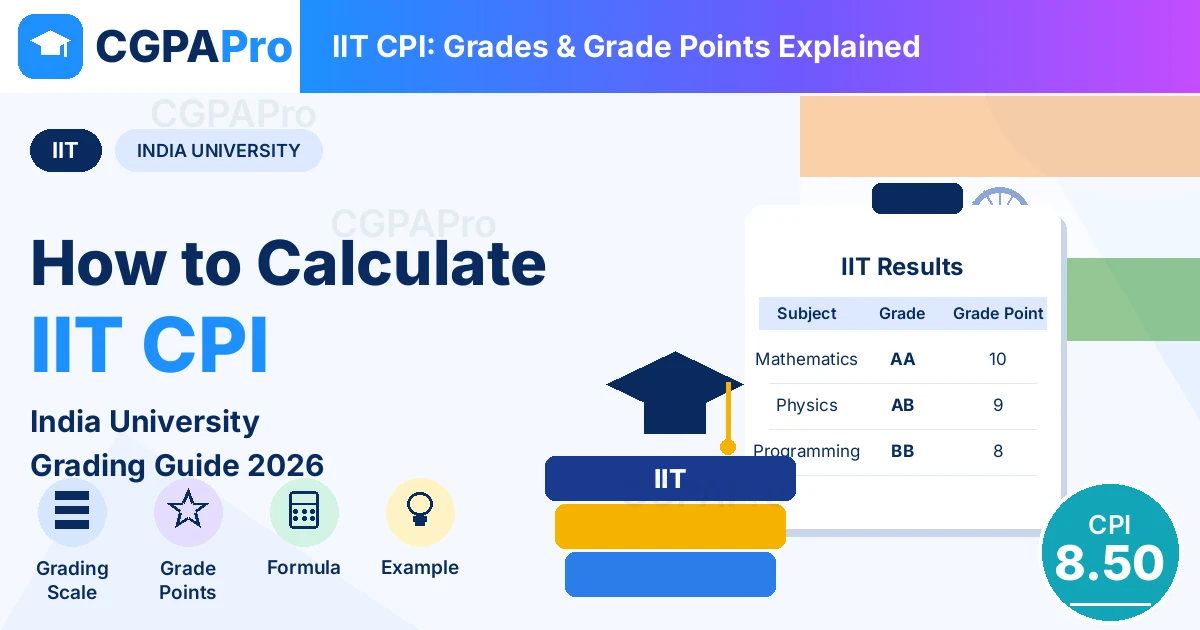
IIT Grading System 2026: The Complete Guide to CPI, SPI and Letter Grades
Got your first IIT grade card and wondering what any of it means? You are not alone. The IIT grading system uses letters like AA, AB, BB and BC instead of the A+ and A grades most students are used to, and it measures performance with two indices – the SPI and the CPI – instead of the SGPA and CGPA you see at other universities.
Here is the short version: IITs grade you on a 10-point scale. Your SPI (Semester Performance Index) is the weighted average of one semester; your CPI (Cumulative Performance Index) is the weighted average of everything since you joined. The passing grades run from AP (10) down to DD (4). At IIT Bombay the official terms are SPI and CPI; at IIT Delhi the official terms are SGPA and CGPA – and the two campuses even use different letter grades. This guide explains both systems with the official tables, a fully worked calculation, and answers to the questions IIT students actually ask.
Calculate Your CPI in Minutes
The fastest way to get your number right is to use a calculator built for the exact IIT grading table. The guide below teaches you the full math, but if you want the answer now:
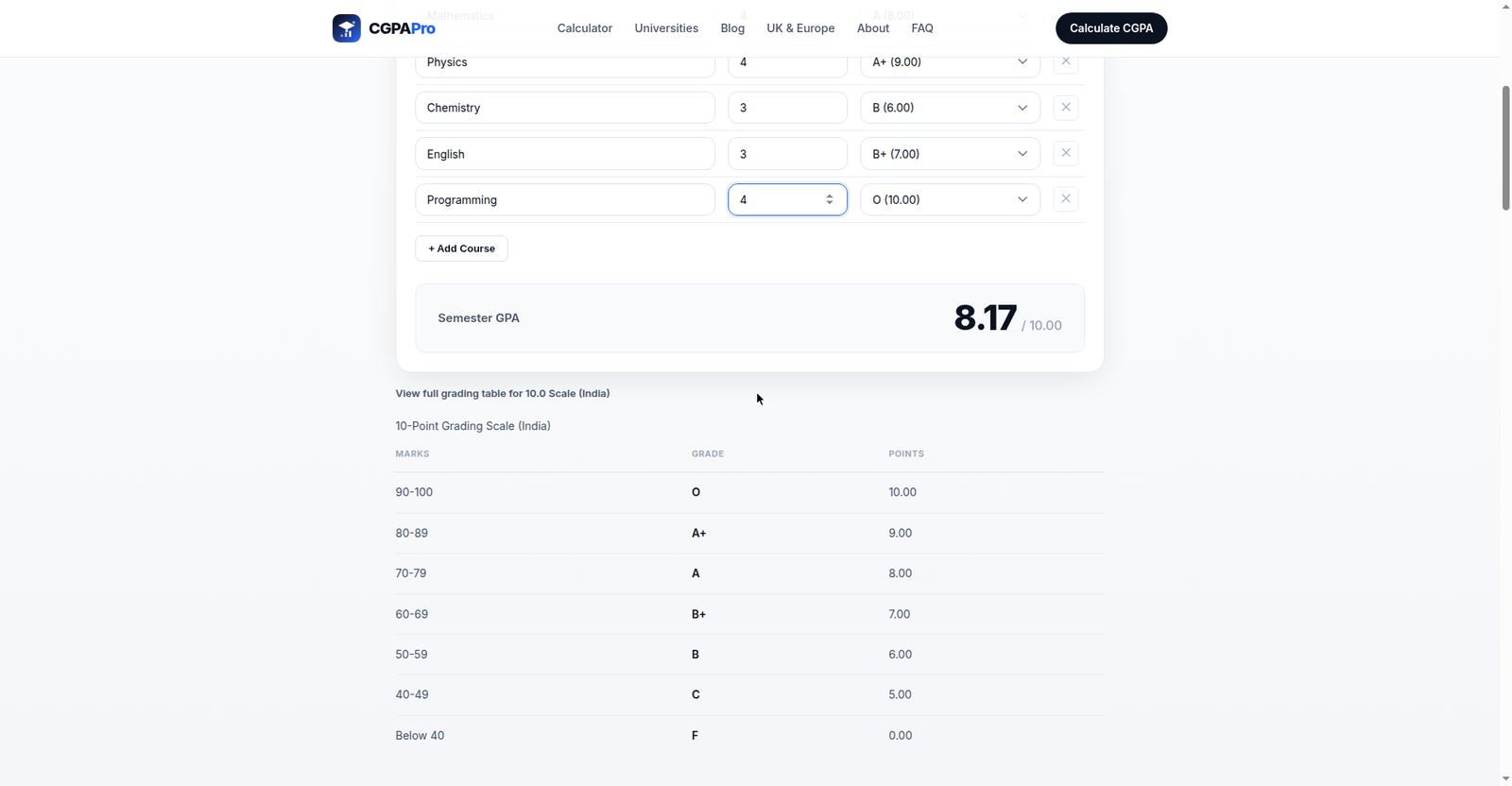
For IIT Delhi grades, enter your courses in the IIT Delhi SGPA/CGPA calculator – note its grade options follow the generic India 10-point scale, so match by grade point (A = 10, A- = 9, B = 8, B- = 7, C = 6, C- = 5, F = 0) rather than by letter name. For IIT Bombay grades (AA, AB, BB, BC, CC, CD, DD), use the IIT Bombay SPI/CPI calculator instead. One common mistake students make is mixing up the two letter systems, and that is exactly what these separate calculators prevent.
SPI and CPI vs SGPA and CGPA: The Terminology Map
This is the single biggest source of confusion, so let us clear it up first. There is no single “IIT grading system”. Each IIT’s Senate decides its own academic rules, including what the performance indices are called:
- IIT Bombay officially uses SPI (Semester Performance Index) and CPI (Cumulative Performance Index). You will see these exact words on your grade card.
- IIT Delhi officially uses SGPA (Semester Grade Point Average) and CGPA (Cumulative Grade Point Average). Its orientation material defines SGPA as the index for one semester and CGPA as the index for everything since the first semester.
- Both work exactly the same way mathematically: a credit-weighted average of grade points on a 10-point scale.
When students say “CGPA” at an IIT Bombay mess or “CPI” in an IIT Delhi classroom, everyone understands. Recruiters and universities abroad understand both too. But on official documents, use the right term for your campus.
Official IIT Bombay Grading Table (Verified Against the UG Rule Book)
The following table is verified against the official IIT Bombay UG Rule Book (acad.iitb.ac.in) and the institute’s published grading chart. A student passes a course with any grade from AP down to DD, and fails with FF, FR or DX.
| Letter Grade | Grade Point | What It Means |
|---|---|---|
| AP | 10 | Outstanding (rarely awarded) |
| AA | 10 | Excellent |
| AB | 9 | Very good |
| BB | 8 | Good |
| BC | 7 | Above average |
| CC | 6 | Average |
| CD | 5 | Below average, but a pass |
| DD | 4 | Minimum pass |
| FF | 0 | Fail – reappear in exam or repeat the course |
| FR | 0 | Fail – must repeat the course (FR is replaced on repetition per MR 5.1.1) |
| DX | 0 | Detained – attendance shortage |
Two things trip students up here. First, FF vs FR: an FF grade can be cleared by reappearing in the exam, while an FR grade means you must repeat the whole course – and when you repeat, the new grade replaces the FR in the CPI computation. Second, there is no E or F in the middle of this table the way IIT Delhi has; DD (4 points) is the lowest passing grade at IIT Bombay.
Official IIT Delhi Grading Table (From the Institute’s Orientation Material)
IIT Delhi uses a different letter system and different index names. The table below comes from the institute’s official academic orientation material – confirm it against the current Courses of Study for your entry year, because the Senate can revise it.
| Letter Grade | Grade Point | What It Means |
|---|---|---|
| A | 10 | Outstanding |
| A- | 9 | Excellent |
| B | 8 | Very good |
| B- | 7 | Good |
| C | 6 | Average |
| C- | 5 | Below average |
| D | 4 | Marginal pass |
| E | 2 | Exposed – allowed to reappear |
| F | 0 | Fail |
Notice the differences from IIT Bombay: IIT Delhi has an E grade (2 points) that lets you reappear, single letters instead of doubles, and the official terms are SGPA and CGPA rather than SPI and CPI. The math is identical – a credit-weighted average on a 10-point scale.
How to Calculate SPI and CPI: Step by Step
The formula is the same at every IIT, whatever the terms:
SPI = (sum of [course credits x grade points]) / (total credits in the semester)
CPI = (sum of [course credits x grade points] across ALL semesters) / (total credits across all semesters)
Step by step:
- List every course you took this semester with its credit value.
- Write down the grade point for the letter grade you earned (use your OWN campus table – AA is 10 at IIT Bombay but does not exist at IIT Delhi).
- Multiply credits by grade points for each course.
- Add all the products, then divide by the total credits. That is your SPI.
- For CPI, do the same across every semester since you joined.
Worked Example: A Real Semester, Computed by Hand
Take a first-year IIT Bombay student with 5 courses in semester 1:
| Course | Credits | Grade | Grade Points | Credits x Points |
|---|---|---|---|---|
| Mathematics | 6 | AA | 10 | 60 |
| Physics | 6 | AB | 9 | 54 |
| Chemistry | 5 | BB | 8 | 40 |
| Programming | 6 | AB | 9 | 54 |
| Workshop | 4 | BB | 8 | 32 |
SPI = (60 + 54 + 40 + 54 + 32) / (6 + 6 + 5 + 6 + 4) = 240 / 27 = 8.89. Wait – let me recompute: 60+54=114, +40=154, +54=208, +32=240. 240/27 = 8.89. This student starts with an SPI of 8.89 – a strong first semester.
Now suppose semester 2 is weaker: 27 credits, total of 196 grade points, giving SPI = 196/27 = 7.26. The CPI is the weighted average of BOTH semesters: (240 + 196) / (27 + 27) = 436 / 54 = 8.07. That is how one bad semester drags the CPI down – and why early semesters carry so much weight.
What Counts as a Good CPI at an IIT?
Students ask this constantly, so here is the honest answer:
- 9.0+ CPI: exceptional. Department topper territory. Branch-change eligible (where branch change still exists) and a strong profile for MS abroad.
- 8.0 – 9.0 CPI: very good. Most core-company placement cutoffs sit at 7.0 – 7.5, so an 8+ keeps every door open, including day-1 recruiters and top MS programs.
- 7.0 – 8.0 CPI: solid. Above nearly all placement cutoffs; fine for most jobs and higher studies with good projects.
- 6.0 – 7.0 CPI: average. You clear most cutoffs, but competitive shortlists (consulting, quant, top MS admits) get harder.
- Below 6.0: the danger zone. The minimum CPI to graduate without backlog issues is institute-specific, and academic probation rules kick in at the bottom of the scale.
The famous question “is 8 CPI good at IIT?” – yes, an 8.0 CPI is genuinely good. It beats the vast majority of placement cutoffs and signals consistent strong performance.
Branch Change Rules (2026 Update)
This is where old blog posts actively mislead students. Historically, IIT Bombay allowed branch change with a CPI of 8.0+ (9.0+ for Computer Science), and many articles still quote those numbers. But IIT Bombay’s Senate voted to DISCONTINUE branch change for recent batches (the 256th Senate decision; the January 2025 UG rule book, Section 8, governs current rules). If you joined in 2023 or later, branch change at IIT Bombay is no longer available – verify this against the current rule book for your entry year, because this is exactly the kind of rule that gets misreported.
At other IITs, branch-change rules still exist but vary by institute and year – there is no all-India rule. Always check your own institute’s current academic rules rather than a blog post from 2019.
Converting CPI to Percentage (For Jobs and Applications)
IITs officially certify a simple conversion: percentage = CPI x 10. IIT Bombay and IIT Delhi both issue official certificates stating this formula for students who need a percentage for applications. So an 8.5 CPI officially converts to 85%. Do not use the CBSE-style 9.5 multiplier or any other formula – for IITs it is x10, and that is what goes on the official certificate.
Common Mistakes IIT Students Make
- Mixing up the two letter systems. AA/AB/BB is IIT Bombay; A/A-/B is IIT Delhi. Using the wrong table gives a wrong SPI.
- Counting failed courses in the denominator wrong. FF/FR/F grades carry 0 grade points but their credits still count in the total – that is what drags the average down.
- Forgetting Minor/Honours courses. At IIT Bombay, grades from Minor and Honours programs do not count toward the CPI. Students who include them inflate their own estimate.
- Using old branch-change numbers. The 8.0/9.0 CPI cutoffs are obsolete at IIT Bombay for recent batches.
- Converting CPI to percentage with the wrong multiplier. It is x10 at IITs, certified officially.
Tips to Improve Your CPI
- Front-load effort. Because CPI is cumulative, a strong first year compounds – a 9 in semester 1 protects you through a 7 in semester 5.
- Repeat strategically. At IIT Bombay, repeating a course replaces an FR grade in the CPI computation – one targeted repeat can lift your CPI more than grinding every course a little harder.
- Know your grading scheme. Many IIT courses use relative grading – your grade depends on your position in the class. Ask the instructor how the course is graded in week 1, not week 14.
- Protect the high-credit courses. A 6-credit Mathematics course moves your SPI three times as much as a 2-credit lab. Allocate effort by credit weight.
- Clear backlogs fast. An uncleared FF/FR keeps contributing 0-point credits to every CPI computation until it is replaced or cleared.
For placements and higher studies, also read Is 3.5 CGPA Good? Jobs, Scholarships & MS Abroad to see how your CPI translates into real opportunities.
Frequently Asked Questions
Is 8 CPI good at IIT?
Yes. An 8.0 CPI at an IIT is genuinely good – it clears nearly every placement cutoff (which usually sit at 7.0 – 7.5) and signals consistent strong performance across semesters.
What is the difference between SPI and CPI?
SPI (Semester Performance Index) covers one semester; CPI (Cumulative Performance Index) covers everything since you joined. Both are credit-weighted averages on a 10-point scale. IIT Bombay uses these official terms; IIT Delhi calls the same things SGPA and CGPA.
How do I convert my IIT CPI to a percentage?
Multiply by 10. IIT Bombay and IIT Delhi officially certify percentage = CPI x 10, and the institutes issue certificates stating exactly this for students who need a percentage.
Can I change my branch at IIT Bombay with a high CPI?
For recent batches, no – IIT Bombay’s Senate discontinued branch change (256th Senate decision). The old 8.0/9.0 CPI cutoffs you see on older blogs are obsolete. Check the current UG rule book for your entry year.
What happens if I fail a course at an IIT?
At IIT Bombay, an FF grade means you reappear in the exam; an FR grade means you must repeat the entire course, and the new grade replaces the FR in your CPI (per MR 5.1.1). At IIT Delhi, the E grade lets you reappear while an F is a fail. Either way, failed credits count at 0 grade points until cleared.
Do IITs use relative grading?
In most courses, yes – grades reflect your relative position in the class, and the exact scheme is announced by the instructor. Because of this, the same raw marks can earn different grades in different courses. Confirm the scheme for each course in week 1.
Which grading system does MY IIT use?
Each IIT’s Senate sets its own rules. This guide covers IIT Bombay (AA/AB/BB with SPI/CPI) and IIT Delhi (A/A-/B with SGPA/CGPA) in detail. If you are at another IIT, check your institute’s academic rules page – the 10-point credit-weighted math is the same everywhere, but the letter grades and index names differ.
The Bottom Line
The IIT grading system looks intimidating on the first grade card – AA, AB, SPI, CPI – but it is just a credit-weighted average on a 10-point scale. Learn your own campus’s letter table, compute your SPI every semester before the grade card arrives, and protect your early semesters because the CPI never forgets. An 8+ CPI keeps every door open; a 9+ puts you in topper territory.