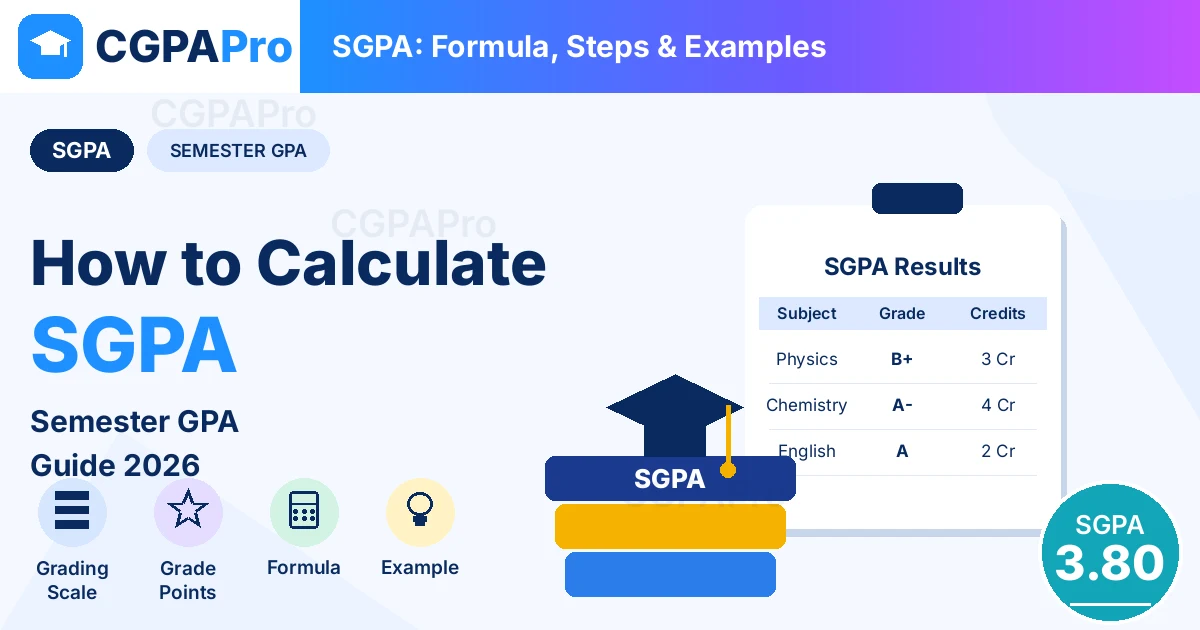
Your semester result is out, and there it is on your marksheet: an SGPA of 7.42 (or 3.28, depending on your country). But how did your university arrive at that number? And more importantly — if you want to raise it next semester, where exactly should your effort go?
This guide shows you how to calculate SGPA from scratch: the official formula, a step-by-step method you can do by hand, and two fully worked examples — one on the 4.0 scale used in Pakistan and Bangladesh, one on the 10-point scale used in India. Then comes the part most guides skip: how to work backwards and figure out exactly what SGPA you need next semester to hit a target CGPA. Every number below has been hand-checked, because some of the most popular articles on this topic quietly get their own arithmetic wrong.
How to Calculate SGPA (Quick Answer)
SGPA (Semester Grade Point Average) is the credit-weighted average of the grade points you earned in a single semester. In plain words: multiply each course’s grade point by its credit hours, add those products up, and divide by your total credits.
SGPA = Σ (credit hours × grade point) ÷ total credit hours
This is the procedure recommended by the University Grants Commission (UGC) in its Choice Based Credit System guidelines, and the same credit-weighted logic is used by HEC-style 4.0 systems in Pakistan and Bangladesh. It means a 4-credit course moves your SGPA twice as much as a 2-credit course — which is exactly why picking where to put your study hours matters.
Calculate Your SGPA with the Free Calculator
If you don’t want to do the math by hand, the CGPAPro calculator at cgpacalculatorpro.com does it for you. Enter each course’s credit hours and the grade you received, and it applies the credit-weighted formula instantly — on 4.0, 10-point, or custom scales.
- Open the SGPA/CGPA calculator on CGPAPro.
- Add one row per course: course name, credit hours, and your grade or grade point.
- Select your grading scale (4.0 for Pakistan/Bangladesh-style systems, 10-point for India-style systems).
- Read your SGPA immediately — and tweak individual grades to see how much each course is pulling your average up or down.
That “tweak a grade” trick is genuinely the fastest way to build intuition for the formula below. Change your 4-credit course from a B to an A and watch the SGPA jump; change a 1-credit lab instead and watch it barely move. Now let’s do the same thing on paper so you understand what’s happening behind the screen.
The SGPA Formula, Explained Properly
The official UGC formulation is: SGPA(Si) = Σ(Ci × Gi) / ΣCi, where Ci is the number of credits of the i-th course and Gi is the grade point you scored in that course. UGC also specifies that SGPA is rounded to 2 decimal places on transcripts.
Three things inside this formula trip students up:
- “Credit hours” is a weight, not a score. Credits measure how much teaching time a course carries — typically 3 or 4 for a theory course, 1 or 2 for a lab. A 4-credit A is worth more than a 2-credit A. That’s the whole point of the multiplication step.
- “Grade point” is not your marks. It’s the numeric value your university assigns to your letter grade. On the Indian 10-point scale, an A is worth 8 grade points; on the Pakistani 4.0 scale, an A is worth 4.00. You never plug raw percentages directly into the SGPA formula.
- The denominator is total credits, not total courses. This is the single most common hand-calculation mistake. You divide by the sum of all credit hours (e.g. 16 or 20), not by the number of subjects (e.g. 6).
How to Calculate SGPA: Step-by-Step Method
- List every course you took this semester with its credit hours. Your marksheet or course registration slip has these.
- Convert each grade to its grade point using your university’s official grading table (the tables later in this article cover the two most common systems — but always cross-check your own university’s handbook, because grade boundaries vary).
- Multiply each course’s credit hours by its grade point. These products are called credit points (or quality points).
- Add up all the credit points into one total.
- Add up all the credit hours into one total.
- Divide total credit points by total credit hours. Round to 2 decimal places. That’s your SGPA.
Notice there is no shortcut that skips a step — and that’s deliberate. Each step answers a real question: what did I take (step 1), what is each result worth (step 2), how much does each course weigh (step 3), what’s my total haul (step 4), and what’s it divided across (steps 5–6).
Worked Example 1: SGPA on a 4.0 Scale (Pakistan / Bangladesh)
Most universities in Pakistan and Bangladesh use a 4.0 system derived from HEC-style grading policies. Here’s the standard conversion table, per HEC’s draft policy guidelines for the uniform semester system:
| Letter Grade | Grade Point | Marks Range (%) |
|---|---|---|
| A | 4.00 | 85 and above |
| A− | 3.70 | 80–84 |
| B+ | 3.30 | 75–79 |
| B | 3.00 | 70–74 |
| B− | 2.70 | 65–69 |
| C+ | 2.30 | 61–64 |
| C | 2.00 | 58–60 |
| C− | 1.70 | 55–57 |
| D | 1.00 | 50–54 |
| F | 0.00 | Below 50 |
Say you’re a first-year CS student in Lahore with this result:
| Course | Credits | Grade | Grade Point | Credit Points (C × G) |
|---|---|---|---|---|
| Programming Fundamentals | 4 | A | 4.00 | 4 × 4.00 = 16.00 |
| Calculus I | 3 | B+ | 3.30 | 3 × 3.30 = 9.90 |
| Physics Lab | 1 | A− | 3.70 | 1 × 3.70 = 3.70 |
| English Composition | 3 | B | 3.00 | 3 × 3.00 = 9.00 |
| Islamic Studies | 2 | A | 4.00 | 2 × 4.00 = 8.00 |
| Discrete Mathematics | 3 | C+ | 2.30 | 3 × 2.30 = 6.90 |
Now follow the steps:
Step 1 — Total credit points: 16.00 + 9.90 + 3.70 + 9.00 + 8.00 + 6.90 = 53.50
Step 2 — Total credits: 4 + 3 + 1 + 3 + 2 + 3 = 16
Step 3 — Divide: SGPA = 53.50 ÷ 16 = 3.34375 → 3.34
Look at what’s happening here. The C+ in Discrete Mathematics cost real damage because it’s a 3-credit course (6.90 points out of a possible 12.00 — a loss of 5.10 points). The A− in the 1-credit Physics Lab, meanwhile, barely registers. If this student had one extra study week to spend, Discrete Mathematics — not the lab — was the place to put it. That’s the strategic insight the weighted formula gives you: your highest-credit weakest grades are where SGPA is won or lost.
Bangladeshi students will notice their universities use similar 4.0 tables with slightly different boundaries — for example, NSU and IUB publish their own letter-to-point mappings. Our detailed breakdown of one such system is in the NSU grading system guide, which walks through that university’s exact scale with its own worked example.
Read More: NSU Grading System & GPA/CGPA Guide (2026) — the full 4.0-scale letter table, passing rules, and a worked NSU calculation.
Worked Example 2: SGPA on a 10-Point Scale (India)
Indian universities following UGC’s Choice Based Credit System use this 10-point letter scale:
| Letter Grade | Grade Point | Marks Range (%) |
|---|---|---|
| O (Outstanding) | 10 | 90–100 |
| A+ (Excellent) | 9 | 80–89 |
| A (Very Good) | 8 | 70–79 |
| B+ (Good) | 7 | 60–69 |
| B (Above Average) | 6 | 50–59 |
| C (Average) | 5 | 40–49 |
| F (Fail) | 0 | Below 40 |
Now a second-semester engineering student in Pune:
| Course | Credits | Grade | Grade Point | Credit Points (C × G) |
|---|---|---|---|---|
| Data Structures | 4 | A | 8 | 4 × 8 = 32 |
| Operating Systems | 4 | B+ | 7 | 4 × 7 = 28 |
| DBMS | 3 | A+ | 9 | 3 × 9 = 27 |
| Web Technology Lab | 2 | O | 10 | 2 × 10 = 20 |
| Mathematics III | 4 | B | 6 | 4 × 6 = 24 |
| Environmental Studies | 3 | C | 5 | 3 × 5 = 15 |
Step 1 — Total credit points: 32 + 28 + 27 + 20 + 24 + 15 = 146
Step 2 — Total credits: 4 + 4 + 3 + 2 + 4 + 3 = 20
Step 3 — Divide: SGPA = 146 ÷ 20 = 7.30
The pattern repeats: the two 4-credit courses where the student scored B+ and B (28 and 24 points) are the drag on this SGPA. Even the perfect O in the lab contributes only 20 points because it carries just 2 credits. Roughly speaking, lifting Mathematics III from B to A (6 → 8 grade points on 4 credits = +8 credit points) would move the SGPA to 154 ÷ 20 = 7.70 — a jump of 0.40 from a single course. That’s the math behind smart semester planning.
As a sanity check, this matches UGC’s own published illustration of the method: in the official CBCS guidelines, a sample student earns 139 credit points across 20 credits, giving SGPA = 139 ÷ 20 = 6.95 (see the UGC guidelines on adoption of the Choice Based Credit System, section 7). If your hand calculation follows the same shape, you’re doing it right.
SGPA vs GPA vs CGPA: What’s Actually Different?
These three get mixed up constantly, so let’s settle it with a table:
| SGPA | GPA | CGPA | |
|---|---|---|---|
| Full form | Semester Grade Point Average | Grade Point Average | Cumulative Grade Point Average |
| Coverage | One semester only | Usually one term/semester (US-style usage) | All semesters completed so far |
| Resets? | Yes — recalculated fresh every semester | Same as SGPA in most contexts | No — it accumulates across your whole degree |
| Formula | Σ(credits × grade points) ÷ semester credits | Same credit-weighted method | Σ(semester SGPA × semester credits) ÷ total credits |
| Used for | Semester results, tracking term progress | Applications abroad, resumes | Placements, final degree, scholarships, MS applications |
A few clarifications worth making explicit, because forums are full of confusion on exactly these points:
- SGPA and GPA are often the same number. In South Asia, “GPA” on a semester transcript usually means the semester GPA — i.e., your SGPA. The term “SGPA” just makes the scope explicit. Confusion arises because US universities say “GPA” for what is effectively a cumulative figure.
- CGPA is not simply the average of your SGPAs — not exactly. The correct formula weights each semester’s SGPA by that semester’s credits: CGPA = Σ(Si × Ci) / ΣCi. Only if every semester carries identical credits does the simple average give the right answer. Many popular guides skip this caveat.
- A bad semester doesn’t “reset”. Your next SGPA starts fresh, but your CGPA carries every credit point you’ve ever earned. The next section shows how to quantify exactly what that means for your targets.
The Missing Piece: What SGPA Do You Need NEXT Semester? (Target-CGPA Planner)
Here’s the question students actually lose sleep over, and the one no ranking article answers: “My CGPA is 6.85 after three semesters. I need a 7.0 to sit for placements. What SGPA must I score next semester?”
You can solve this by running the CGPA formula backwards. Here’s the method:
- Compute your earned credit points so far: for each completed semester, multiply SGPA × semester credits, and add them up.
- Add next semester’s credits to your completed credits → your new total credits.
- Multiply your target CGPA by the new total credits → the total credit points you need overall.
- Subtract your earned points (step 1) from the required total (step 3) → points you must earn next semester.
- Divide by next semester’s credits → the SGPA you need.
Let’s work it with real numbers. A student has completed 3 semesters:
- Semester 1: SGPA 6.8, 20 credits → 6.8 × 20 = 136.0 points
- Semester 2: SGPA 7.2, 22 credits → 7.2 × 22 = 158.4 points
- Semester 3: SGPA 6.5, 21 credits → 6.5 × 21 = 136.5 points
Current position: 136.0 + 158.4 + 136.5 = 430.9 credit points across 63 credits. Current CGPA = 430.9 ÷ 63 = 6.84.
Target: CGPA 7.0 after Semester 4, which carries 22 credits.
Required total points = 7.0 × (63 + 22) = 7.0 × 85 = 595.0
Points still needed = 595.0 − 430.9 = 164.1
Required Semester 4 SGPA = 164.1 ÷ 22 = 7.46
So this student needs a 7.46 next semester — meaningfully above their current 6.84 average. Now you can sanity-check scenarios: if they score 8.0, their CGPA becomes (430.9 + 176.0) ÷ 85 = 606.9 ÷ 85 = 7.14. If they only manage 7.0, it lands at (430.9 + 154.0) ÷ 85 = 584.9 ÷ 85 = 6.88 — still short of the target.
Two lessons fall out of this arithmetic. First, early semesters weigh heavily: with 63 credits banked, each new semester moves the needle less — that’s why recovering from a weak start gets harder the longer you wait. Second, the target is only reachable if it’s mathematically reachable: had this student needed a 9.5 next semester, they’d know immediately to adjust the goal or the timeline rather than hoping. Run your own numbers with a calculator — enter your completed semesters, then experiment with the next one until the cumulative figure hits your target.
Common Mistakes When Calculating SGPA
1. Taking a simple average of grade points
Adding up your grade points (say 8 + 7 + 9 + 10 + 6 + 5 = 45) and dividing by 6 subjects gives 7.50 — but the correct credit-weighted SGPA in Example 2 was 7.30. The unweighted average overstates your result whenever your weaker grades sit in high-credit courses. If your hand calculation doesn’t match your marksheet, this is the first thing to check.
2. Dividing by the number of courses instead of total credits
Same family of error: 146 ÷ 6 courses = 24.33, which is nonsense. The denominator must be the sum of credit hours (20), because the numerator is a sum of credit-scaled points. Units have to match.
3. Using marks or percentages as grade points
Scoring 82% in a course does not mean 8.2 grade points on every scale. Convert through your university’s official letter table first — on the UGC 10-point scale, 82% is an A+ worth 9; on the HEC 4.0 scale, 82% is an A− worth 3.70.
4. Mixing two scales in one calculation
Never combine a 4.0-scale grade point with 10-point-scale grade points in the same SGPA. Some students convert “approximately” between scales mid-calculation (e.g., treating a 4.0-scale 3.3 as 8.25 on the 10-point scale). Pick one scale per semester and stay on it.
5. Forgetting that failed courses still count in the denominator
An F carries 0 grade points, but its credits stay in the denominator. A 3-credit F contributes 0 × 3 = 0 to the numerator while adding 3 to the divisor — that’s why one failed course can crater an otherwise decent SGPA. (Some universities exclude retaken-and-cleared courses on the second attempt; check your handbook.)
6. Trusting the “average of SGPAs” shortcut for CGPA
As shown above, CGPA = Σ(SGPA × semester credits) ÷ total credits. The simple average of SGPAs only matches when all semesters have equal credits — which is often not true, since later semesters tend to carry project and lab credits.
Tips to Actually Raise Your SGPA
- Rank courses by “recoverable points”, not by difficulty. For each course, compute (max grade point − your expected grade point) × credits. That’s the SGPA upside sitting in that course. Attack the biggest numbers first — usually high-credit courses where you’re currently weakest.
- Protect the heavy courses before chasing the light ones. Moving a 4-credit course from B to A on the 10-point scale adds 8 credit points; moving a 1-credit lab from B to O adds 4. Same effort, half the payoff. Schedule revision time proportionally to credits.
- Know your grade boundaries. On the HEC 4.0 scale, the jump from B (3.00) to B+ (3.30) starts at 75%. If you’re sitting at 73% in a 4-credit course, two marks are worth more than ten marks anywhere else. Find out exactly where each boundary lies.
- Recalculate after every internal assessment. Mid-semester marks let you project your likely SGPA while there’s still time to change it. Plug realistic expected grades into a semester GPA calculator mid-term, identify the danger courses, and redirect your effort — that’s the practical use of everything in this guide.
- Don’t neglect the 1-credit courses entirely. They’re small individually, but three neglected labs at C-grades quietly subtract from your numerator all semester. “Free” grade points are still grade points.
SGPA FAQs
What is the formula to calculate SGPA?
SGPA = Σ (credit hours × grade point) ÷ total credit hours. Multiply each course’s credits by its grade point, add all the products together, and divide by the total credits for the semester. This is the procedure recommended in UGC’s Choice Based Credit System guidelines, and the same credit-weighted logic applies to 4.0-scale systems.
Is SGPA the same as GPA?
In most South Asian universities, yes for practical purposes: the “GPA” printed on a semester transcript is the semester GPA, which is exactly what SGPA measures. The word “semester” just makes the scope explicit. In US-style usage, “GPA” can also mean a cumulative figure, which is closer to CGPA — so always check whether a number covers one term or your whole degree.
How do I convert SGPA to percentage?
Use your university’s official conversion — there is no universal one. On the UGC 10-point system, the standard formula is Percentage = (SGPA × 10) − 7.5, so an SGPA of 8.0 ≈ 72.5%. Many universities also use SGPA × 9.5. On 4.0 systems, universities publish their own equivalence tables. Our full walkthrough is here: How to Convert CGPA to Percentage (2026).
Can one bad semester ruin my CGPA?
It hurts, but the damage is quantifiable — not mysterious. Because CGPA is credit-weighted, a weak semester’s impact shrinks as you bank more credits. The target-CGPA planner method in this article lets you compute exactly what SGPA you need next semester to recover to any goal. The earlier in your degree the bad semester happens, the more semesters you have to dilute it — which is also why a weak final year is the hardest to fix.
Do failed (F grade) courses count in SGPA?
Yes. An F contributes 0 grade points but its credits remain in the denominator, which drags the SGPA down significantly. A 3-credit F in a 20-credit semester effectively caps your maximum possible SGPA for that term. Some universities let a cleared retake replace the F in later CGPA computations — check your program handbook for the exact retake policy.
How is SGPA different from CGPA?
SGPA covers a single semester and is recalculated fresh each term; CGPA accumulates every semester of your degree. Mathematically, CGPA = Σ(semester SGPA × semester credits) ÷ total credits across all semesters. Employers, scholarship committees, and foreign universities almost always ask for CGPA; SGPA is your tool for tracking and fixing term-by-term performance.
Can I convert a 10-point SGPA to a 4.0 GPA?
Only approximately — there is no official linear conversion. The rough approximation GPA(4.0) ≈ (SGPA ÷ 10) × 4 is widely used informally (e.g., 8.2 → ~3.28), but credential evaluators like WES do their own course-by-course assessment and don’t accept self-converted figures. For applications abroad, report both numbers transparently, e.g. “SGPA 8.2/10 (≈ 3.28/4.0)”, and let the evaluator do the official conversion.
Read More: How to Convert CGPA to Percentage (2026) — every major conversion formula (×9.5, ×10−7.5, HEC tables) with worked examples.
Final Word
Learning how to calculate SGPA is a fifteen-minute skill that pays off every semester: once you can run the numbers yourself, you stop guessing where your grades stand and start allocating effort where the formula rewards it most — the high-credit courses where you’re currently weakest. Calculate this semester’s SGPA by hand once to internalize the method, then use the CGPAPro calculator to project next semester’s scenarios in seconds. And if you’re chasing a specific CGPA for placements or admissions, run the target-planner math now rather than hoping — the numbers will tell you exactly what “try harder next semester” actually has to look like.