
UiTM Grading System 2026: Grades, GPA & CGPA Guide
If you’re a student at Universiti Teknologi MARA — Malaysia’s largest public university, with campuses across the country — your entire academic life runs on one number: your pointer. And at UiTM, that number comes from a 13-grade official table with exact marks bands, from A+ (90–100) all the way down to F (0–29). Most of the calculator websites students use only show 8 or 9 of those grades, which quietly hides the grades that matter most when you’re near the edge: the C−, D+, and E bands that decide whether you pass, repeat, or get dismissed.
Here’s the short version. Your GPA is your semester average: every grade converted to a grade point (A = 4.00, F = 0.00), multiplied by each course’s credit hours, summed up, and divided by total credits attempted. Your CGPA is the same calculation run across every semester you’ve completed. You need a CGPA of 2.00 to stay in good standing and graduate — fall to 1.80–1.99 and you’re on probation (P1, then P2) with a 12-credit limit and two chances before dismissal. Fail the same course three times and UiTM can dismiss you under the D4 rule, even with a decent pointer. Score a GPA of 3.50+ with at least 12 credits in a regular semester and you land on the Dean’s List. And if you repeat a failed course, the new grade replaces the old one — the previous attempt is annulled from the CGPA.
This guide walks through the full official grade table (all 13 rows, verified against UiTM’s academic regulations), the GPA and CGPA formulas with real worked examples, the marks-band traps students keep falling into (79 vs 80 marks is a bigger deal than you think), the complete D1–D7 dismissal statuses nobody else explains, the probation and Dean’s List rules, the repeat/replacement policy with the double-counting mistake most students make, and a recovery calculator example for climbing back from a low pointer. Everything below is grounded in UiTM’s published regulations — not calculator-blog folklore.
The Short Answer: UiTM Grades at a Glance
- Grade scale: 13 grades, A+ to F, on a 4.00 scale. A+ and A are both worth 4.00 — there is no 4.00+ ceiling to chase.
- GPA = Σ (grade point × credit hours) ÷ total credits attempted this semester. CGPA = same thing across all semesters.
- Good standing: CGPA ≥ 2.00. Probation: CGPA 1.80–1.99 (P1, then P2). Below that, or two failed probations, risks dismissal.
- Dean’s List: GPA ≥ 3.50 in a regular semester with at least 12 registered credits.
- Repeat: repeating a course replaces the old grade in the CGPA — the previous grade point and credits are annulled, and the latest attempt counts.
- Graduation floor: you must finish with CGPA ≥ 2.00. Pass every course but sit at 1.95, and you still can’t graduate (the D6 rule).
Calculate It Yourself: The CGPAPro UiTM Calculator
Before the theory, here’s the practical shortcut. CGPAPro’s UiTM CGPA calculator is built on the same scale used in this guide — enter each course, its credit hours, and your grade, and it computes your GPA and projected CGPA instantly. Use it alongside the worked examples below to check your own numbers.
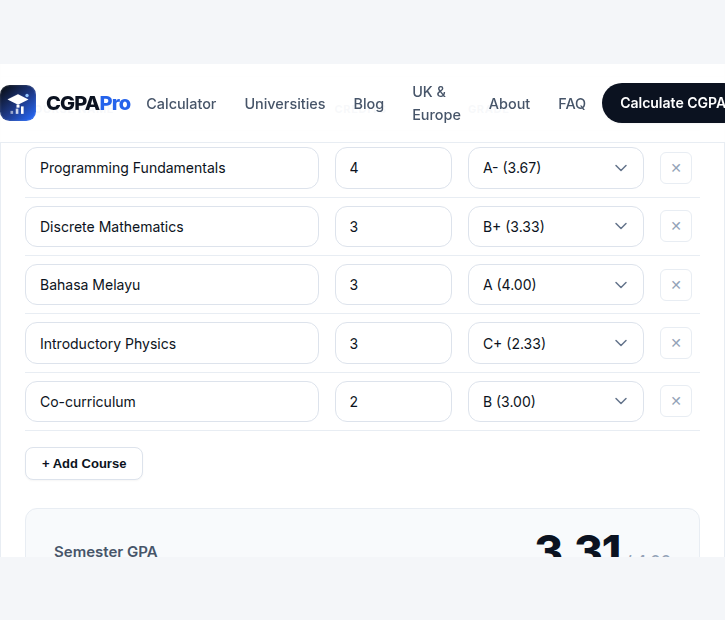
Screenshot: a real 5-course semester modelled on the CGPAPro UiTM calculator — credit hours and grades in, semester GPA out. The worked example in the next section uses exactly these numbers so you can verify the math by hand.
The general CGPA calculator works too if you want to model “what-if” scenarios — enter your current CGPA and completed credits, add this semester’s expected grades, and see your projected pointer before the results are even out.
Read More: How to Calculate SGPA: Formula & Examples (2026) — the credit-weighted formula behind every number in this guide, explained step by step.
The Official UiTM Grade Table (All 13 Grades)
This is the full table from UiTM’s academic regulations. Compare it against any calculator tool you’re using — if it shows only 8 or 9 grades, it’s missing the exact rows that decide borderline cases.
| Marks | Grade | Grade Point | Meaning |
|---|---|---|---|
| 90 – 100 | A+ | 4.00 | Excellent |
| 80 – 89 | A | 4.00 | Excellent |
| 75 – 79 | A− | 3.67 | Excellent |
| 70 – 74 | B+ | 3.33 | Good |
| 65 – 69 | B | 3.00 | Good |
| 60 – 64 | B− | 2.67 | Good |
| 55 – 59 | C+ | 2.33 | Satisfactory |
| 50 – 54 | C | 2.00 | Satisfactory |
| 47 – 49 | C− | 1.67 | Marginal pass |
| 44 – 46 | D+ | 1.33 | Marginal pass |
| 40 – 43 | D | 1.00 | Marginal pass |
| 30 – 39 | E | 0.67 | Fail — must repeat |
| 0 – 29 | F | 0.00 | Fail — must repeat |
Three things about this table trip students up every semester:
1. A+ is worth exactly the same as A: 4.00. There is no 4.33, no bonus, no “above 4.0” at UiTM. Scoring 95 instead of 85 buys you the same pointer. If you’re already sitting on an A, the extra effort to push it to an A+ is pointer-neutral — spend that energy on the course where you’re at a B− instead.
2. The C−/D+/D band is a marginal pass, not a comfortable one. A D (1.00) technically passes the course, but a string of D grades drags your CGPA toward the 1.80 probation line fast. And the E grade is the real trap: 0.67 grade points looks like “something” but E is a fail — you must repeat the course, and until you do, those 0.67 points per credit sit in your denominator weighing down your GPA while contributing almost nothing.
3. The band edges are where pointers are won and lost. Every grade band is exactly 5 marks wide (except the top). One mark can be worth 0.33 grade points per credit. The next section shows what that means in real numbers.
How GPA and CGPA Are Calculated at UiTM
The formula is credit-weighted — a 4-credit course counts double a 2-credit one:
GPA = (sum of grade point × credit hours for every course this semester) ÷ (total credit hours attempted this semester)
CGPA = (sum of grade point × credit hours for all courses across all semesters) ÷ (total credit hours attempted across all semesters)
Worked example: a real 5-course semester
Meet Aina, a first-semester diploma student. Her results:
| Course | Credits | Marks | Grade | Grade Point | Points (GP × credits) |
|---|---|---|---|---|---|
| Programming Fundamentals | 4 | 77 | A− | 3.67 | 14.68 |
| Discrete Mathematics | 3 | 71 | B+ | 3.33 | 9.99 |
| Bahasa Melayu | 3 | 84 | A | 4.00 | 12.00 |
| Introductory Physics | 3 | 56 | C+ | 2.33 | 6.99 |
| Co-curriculum | 2 | 66 | B | 3.00 | 6.00 |
- Total grade points: 14.68 + 9.99 + 12.00 + 6.99 + 6.00 = 49.66
- Total credits attempted: 4 + 3 + 3 + 3 + 2 = 15
- GPA = 49.66 ÷ 15 = 3.31 (this is also her CGPA, since it’s her first semester)
Notice where the damage is: the 3-credit Physics C+ contributes only 6.99 points. If Aina had pushed that C+ (2.33) to a B (3.00) — one grade step — she’d gain (3.00 − 2.33) × 3 = 2.01 points, lifting her GPA from 3.31 to 3.44. That’s the credit-weight effect: fixing your weakest heavy course is always the highest-leverage move.
Worked example: semester 2 and the running CGPA
Next semester Aina takes 17 credits and earns a GPA of 3.55 (60.35 grade points). Her CGPA is not the average of 3.31 and 3.55 — it’s credit-weighted:
- Cumulative points: 49.66 + 60.35 = 110.01
- Cumulative credits: 15 + 17 = 32
- CGPA = 110.01 ÷ 32 = 3.44
The common student mistake is averaging the two GPAs (3.31 + 3.55) ÷ 2 = 3.43 — close here, but wrong, and the error grows whenever semesters have different credit loads. Always weight by credits.
The Marks-Band Traps: Where One Mark Costs Real Pointer
Because every band is 5 marks wide and each step is 0.33 grade points, the edges of the bands are the most expensive marks in the whole system. Three scenarios students face every results season:
The 79/80 cliff. 79 marks = A− (3.67). 80 marks = A (4.00). In a 4-credit course, that’s 14.68 vs 16.00 grade points — a 1.32-point swing from a single mark. In a 3-credit course it’s 0.99 points, roughly 0.06 GPA on a 15-credit semester. If your coursework total has you sitting at 78–79 with the final exam still ahead, that exam is worth fighting for.
The 49/50 line. 49 marks = C− (1.67). 50 marks = C (2.00). That 0.33-per-credit gap is worth 1.32 points in a 4-credit course — and crossing from C− into C can also matter for faculty-specific progression rules, so check your program handbook. One mark here is worth more than a week of studying for a course you’re already comfortable in.
The 39/40 line. 39 marks = E (0.67) — a fail you must repeat. 40 marks = D (1.00) — a marginal pass. One mark is the difference between “passed, move on” and “repeat the entire course next semester.” If you’re projected at 37–39 before the final, every available mark of coursework — attendance, quizzes, assignments — is worth more than any other studying you could do.
Read More: How to Convert CGPA to Percentage in 2026 — if you need your UiTM pointer in percentage form for job or scholarship applications, the conversion formulas and country-wise conventions are all here.
Academic Standing: KB, P1, P2 — and the D1–D7 Dismissal Statuses
This is the part of UiTM’s system that no calculator website explains, and it’s the part that actually decides whether you stay enrolled. At the end of every regular semester, UiTM assigns you an academic standing based on your CGPA:
| Standing | CGPA | What it means |
|---|---|---|
| KB (Kedudukan Baik) — Good standing | 2.00 and above | Proceed normally to the next semester. |
| P1 (Probation 1) | 1.80 – 1.99 | First probation. Credit limit: max 12 credit hours next semester. |
| P2 (Probation 2) | 1.80 – 1.99 (second time) | Second probation. Same 12-credit cap. Last chance. |
Probation is UiTM’s warning system, and it has teeth. Students on probation may register for at most 12 credit hours — the university deliberately lightens your load so you can focus on climbing back above 2.00. You get two probation chances (P1, then P2). The dismissal statuses below show what happens when those chances run out.
The D1–D7 dismissal statuses, in plain language
UiTM’s regulations define seven dismissal (D = “Diberhentikan”) statuses. Here’s what each one actually means for a student:
| Status | Trigger | Plain-English meaning |
|---|---|---|
| D1 | CGPA below 1.80 | Your pointer fell below the probation floor entirely — immediate dismissal. |
| D2 | CGPA below 1.80 while on P1 | You were already on first probation and dropped below 1.80 — dismissed. |
| D3 | CGPA below 2.00 while on P2 | Two probation chances used up and you’re still under 2.00 — dismissed. |
| D4 | Failed the same course three times | Three strikes on one course — dismissed regardless of your overall CGPA. |
| D5 | CGPA below 2.00 at the end of the maximum study period, with courses incomplete | Ran out of time without finishing — dismissed. |
| D6 | Passed all required courses but CGPA below 2.00 | The cruelest one: you finished everything, but your pointer is under 2.00, so you cannot graduate and are dismissed. |
| D7 | Did not sit for any registered examination in the semester without university approval | Vanished from exams without permission — dismissed. |
D4 deserves special attention: failing the same course three times gets you dismissed even if your overall CGPA is fine. If you’ve failed a course twice, the third attempt is not just another semester — it’s your enrollment on the line. Treat it accordingly: lighter semester, different lecturer if possible, and every support service your faculty offers.
And D6 is the reason this guide keeps repeating the 2.00 floor: passing your courses is not the same as graduating. A student with forty passed courses and a 1.95 CGPA is dismissed, not graduated. If your pointer is drifting toward 2.00 from below with semesters running out, the repeat strategy in the next section is your most realistic rescue.
Dean’s List: The 3.50 Rule
UiTM awards the Dean’s List each regular semester to students who meet all of these conditions:
- GPA of 3.50 or above in that semester (not CGPA — it’s the semester GPA that counts)
- Registered for at least 12 credit hours in the semester
- It’s a regular semester — short/special semesters and industrial-training semesters don’t count
- No disciplinary action against you
The award is recorded on your transcript and examination result slip, which is why employers and scholarship panels ask about it. Note the interaction with the worked examples above: Aina’s 3.31 first semester misses it; her 3.55 second semester (17 credits) makes it. And because it’s semester GPA, one bad semester doesn’t disqualify the next — every regular semester is a fresh shot at 3.50.
Repeating a Course: The Replacement Rule (and the Mistake Everyone Makes)
At UiTM, when you repeat a course, the latest grade replaces the old one in your CGPA — the previous grade point and its credit count are annulled, and only the new attempt counts. This is more generous than it sounds, and most students calculate it wrong.
Worked example: the repeat that rescues a semester
Danial’s first semester: 15 credits, GPA 2.60 — total 39.00 grade points. Buried in there is a 3-credit course he failed with an F (0.00 points). He repeats it next semester and earns a B (3.00).
Correct calculation (replacement):
- Remove the old attempt: 39.00 − (0.00 × 3) = 39.00
- Add the new attempt: 39.00 + (3.00 × 3) = 48.00
- Credits counted stay 15 (the course counts once)
- Corrected semester record: 48.00 ÷ 15 = 3.20 — a +0.60 jump from one repeat
The mistake students make (double counting): adding the new B on top of the old F without removing it: (39.00 + 9.00) ÷ (15 + 3) = 48.00 ÷ 18 = 2.67. Students who calculate it this way conclude “repeating barely helps” and give up — when the real math says it helps enormously. In your CGPA, a successful repeat is as if the failed attempt never happened (it still shows on your semester record, but the CGPA math uses only the latest).
The strategic lesson from student forums is blunt: a C− or D+ you’re stuck with drags your pointer for the rest of your degree, while a repeated course costs one semester and resets the math. If a course is a graduation requirement or a heavy-credit core course, repeating a marginal grade is often the rational move — run both scenarios in the UiTM calculator before deciding.
Read More: How Retaking a Course Affects Your CGPA (2026 Guide) — the full decision framework for when a retake is worth the fee, with worked examples for best-grade vs latest-grade counting rules.
Graduation: The 2.00 Floor and Maximum Study Period
To graduate from UiTM you must:
- Pass all courses required by your programme curriculum
- Finish with a CGPA of at least 2.00
- Complete everything within the maximum period of study for your programme
The D5 and D6 statuses exist precisely for students who miss the second and third conditions. D6 — passed everything, CGPA under 2.00 — is the scenario the repeat rule exists to prevent: if you’re in your final year sitting at 1.9x, repeating your worst 2–3 courses (not taking new electives) is the fastest mathematical path across the line, because a repeat swaps bad points out without growing your credit denominator.
Pointer Recovery: The Math of Climbing Back
Students on probation always ask the same question: “what GPA do I actually need this semester to get back to 2.00?” The formula:
Required semester GPA = (target CGPA × total credits after − current points) ÷ this semester’s credits
Worked example: from 1.85 back to safety
Siti has completed 45 credits with a CGPA of 1.85 (on P1 probation, 12-credit cap). She registers the maximum 12 credits next semester and wants to reach 2.00:
- Current points: 1.85 × 45 = 83.25
- Target points after: 2.00 × (45 + 12) = 114.00
- Points needed this semester: 114.00 − 83.25 = 30.75
- Required GPA: 30.75 ÷ 12 = 2.56 — roughly a B− average. Achievable.
Now the harder version: Siti wants 2.50 after that same semester. Target points: 2.50 × 57 = 142.50; needed: 142.50 − 83.25 = 59.25; required GPA: 59.25 ÷ 12 = 4.94 — impossible. The lesson: recovery is a multi-semester project. With two 12-credit semesters (69 total credits), reaching 2.50 needs (2.50 × 69 − 83.25) ÷ 24 = (172.50 − 83.25) ÷ 24 = 3.72 per semester — hard but possible with mostly A grades. Set the target in stages: 2.00 first (survival), then climb.
Common Mistakes UiTM Students Make
- Using the wrong grade table. Most online UiTM calculators show 8–9 grades. If yours doesn’t have C−, D+, and E with the marks bands above, your projection is wrong on every borderline course.
- Double-counting repeats in the CGPA. The old attempt is annulled — count the course once, with the latest grade. (See the worked example above.)
- Averaging GPAs instead of weighting by credits. (3.31 + 3.55) ÷ 2 is not your CGPA when the semesters had different credit loads.
- Chasing A+ instead of fixing B−. A+ = A = 4.00. Moving a B− (2.67) to a B (3.00) in a 4-credit course gains 1.32 points; moving an A to an A+ gains zero.
- Ignoring the E grade. E (0.67) is a fail that must be repeated — students see “0.67, not zero” and assume it counts as a pass. It doesn’t.
- Assuming passed courses = graduation. The D6 rule: CGPA under 2.00 with all courses passed still means no graduation.
- Sleeping on the third attempt. Fail the same course twice and the next attempt carries D4 dismissal risk — never take it in your heaviest semester.
Tips to Protect and Raise Your Pointer
- Front-load continuous assessment. Coursework marks are the cheapest route across band edges — the 79→80 and 49→50 cliffs are often decided by a quiz or assignment, not the final exam.
- Rank your courses by (grade gap × credits). Every study hour should go to the course where one grade step buys the most points: biggest credit load × closest to the next band edge.
- Use the repeat rule deliberately. A failed or marginal core course repeated early costs one semester and resets the CGPA math; the same grade left in place taxes every future semester’s average.
- Guard the 12-credit probation semesters. If you’re on P1/P2, the cap is a feature — 12 focused credits at a 3.00 average climbs faster than 18 scattered ones.
- Track your pointer every semester with the UiTM CGPA calculator — students who discover they’re at 1.85 in semester 5 have far fewer options than students who catch it in semester 2.
Frequently Asked Questions
What is a good CGPA at UiTM?
2.00 is the survival line (good standing and graduation minimum). 3.00+ is solid and competitive for most jobs. 3.50+ puts you on the Dean’s List each semester you hit it and is the informal threshold for top scholarships and postgraduate applications. For degree classification, Malaysian universities typically award First Class Honours around 3.70+, though you should confirm your faculty’s exact bands.
My CGPA is 1.9 — will UiTM dismiss me?
Not immediately. A CGPA of 1.80–1.99 puts you on probation (P1 the first time), with a maximum of 12 credit hours next semester and two chances (P1, then P2) to climb back to 2.00. Dismissal (D1–D3) comes if you fall below 1.80 or exhaust both probation chances still under 2.00. Use the recovery formula above to plan the climb.
If I repeat a failed subject, does the old F still count in my CGPA?
No. The latest grade replaces the old one — the previous grade point and credits are annulled from the CGPA calculation, and the course counts once. The old attempt still appears on your semester record, but the CGPA math uses only the new grade. Don’t make the double-counting mistake in the worked example above.
Is an A+ better than an A for my CGPA?
No — both are worth 4.00 grade points at UiTM. The ceiling is flat at 4.00, so there’s no pointer difference between scoring 82 and 96. Prioritise lifting your lowest grades instead.
What GPA do I need for the Dean’s List?
A semester GPA of 3.50 or above, with at least 12 registered credit hours, in a regular semester (not a short semester or industrial-training semester), with no disciplinary action. It’s recorded on your transcript.
What happens if I fail the same course three times?
That’s the D4 dismissal status — UiTM can dismiss you regardless of your overall CGPA. If you’ve failed a course twice, treat the third attempt as the highest-stakes course of your degree: light semester, maximum preparation, and use every academic support service available.
Can I graduate if I passed all my courses but my CGPA is 1.95?
No. That’s the D6 rule — graduation requires a minimum CGPA of 2.00 alongside passing all required courses. Your realistic fix is repeating your worst-graded courses (the replacement math in this guide), not taking new electives, since repeats swap bad points out without growing your credit denominator.
The Bottom Line
UiTM’s grading system rewards students who understand three things: the exact marks bands (because one mark at 79/80 or 49/50 is worth 0.33 grade points per credit), the credit-weight effect (fix your weakest heavy course first — A+ chasing gains you nothing over an A), and the standing rules (2.00 is the floor for everything, probation gives you two structured chances, and the D-statuses show exactly where the cliffs are).
Run your own numbers before results season, not after: plug your courses into the UiTM CGPA calculator, model the repeat scenarios with the replacement math from this guide, and know which band edge is worth fighting for in your final exam. The students with the best pointers aren’t always the hardest workers — they’re usually the ones who did the arithmetic earliest.
Grade table and academic-standing rules verified against UiTM’s published academic regulations (BHEA, Academic Regulations for Diploma and Bachelor Programmes) and the UED102 GPA/CGPA calculation guide, October 2026. Faculty-specific progression rules can add conditions on top of the university baseline — confirm anything unusual in your program handbook before making enrollment decisions.