Knowing how to convert CGPA to percentage correctly matters every time a job application, government form, or foreign university asks for marks instead of grade points.
“My CGPA is 3.42 — but the job application asks for percentage. What do I write?”
This is one of the most-asked questions by students across South Asia, and the confusion is understandable: universities award CGPA on a 4.00 scale, but employers, government forms, and foreign universities often demand a percentage. Get the conversion wrong and you either undersell yourself or — worse — get flagged for misrepresentation.
This guide gives you the exact formulas used in Pakistan, Bangladesh, India, and Malaysia, worked examples for each, the official-vs-unofficial distinction you must know, and the mistakes that get applications rejected.
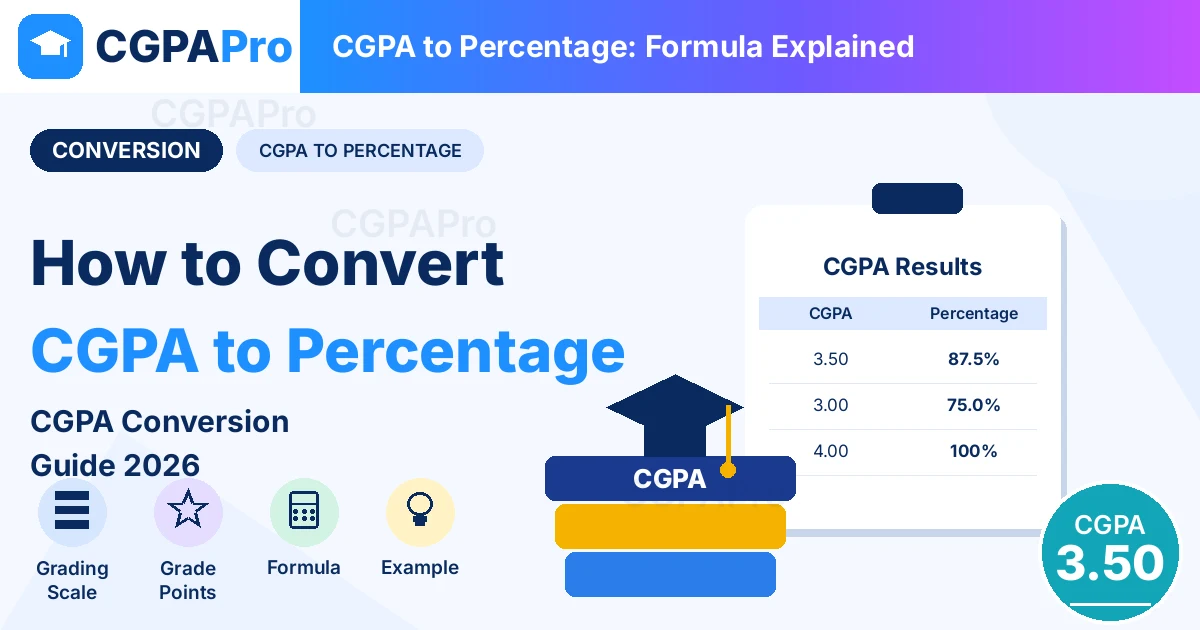
Quick answer: The most widely used formula is Percentage = (CGPA ÷ 4) × 100. So a 3.50 CGPA = 87.5%. In Pakistan, HEC commonly uses this equivalence; in India, many universities use CGPA × 9.5 (on a 10-point scale). Always check whether your institution or the receiving body prescribes its own formula — an official formula always beats a generic one.
Click Here: Free CGPA Calculator — GPA, Percentage & Semester Grades
How to Use the CGPA Calculator for Conversions
Our main calculator handles CGPA computation and percentage conversion in one place:
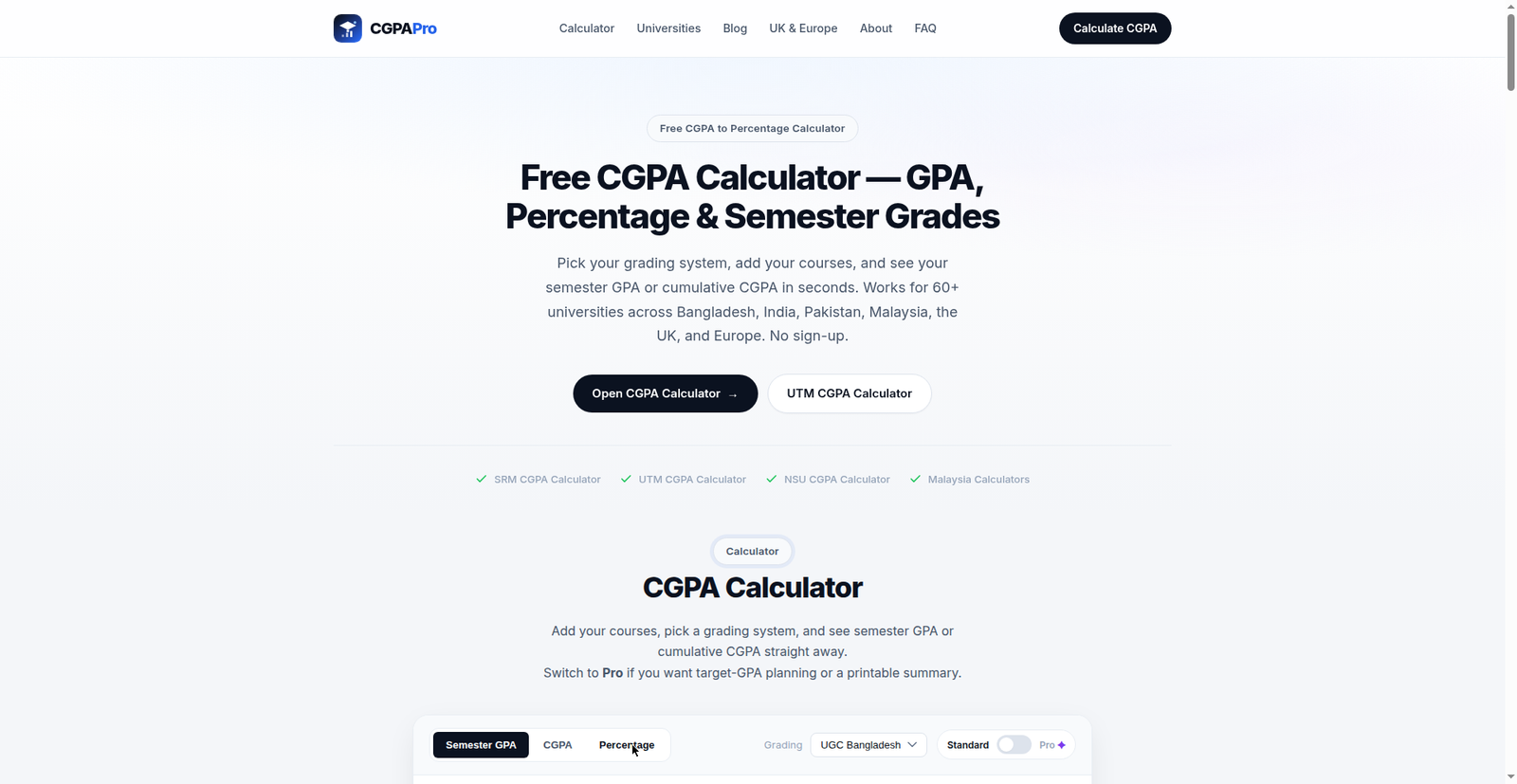
- Enter your courses with credit hours and letter grades to compute your CGPA.
- Switch to percentage mode to convert the result using your country’s formula.
- Compare formulas — see how (CGPA ÷ 4) × 100 differs from institution-specific conversions.
- Save your result for job applications and admission forms.
Quick Tip: Never invent a conversion on a form. If the application doesn’t specify a formula, use your university’s official one — and note which formula you used if there’s a comments field.
Why CGPA-to-Percentage Conversion Is Tricky
There is no single universal formula, because CGPA scales differ by country and institution. A 4.00-scale CGPA (Pakistan, Bangladesh) and a 10-point CGPA (India) need completely different math. Even within one scale, universities sometimes publish their own conversion tables that override generic formulas.
The golden rule: institution-specific formula > country convention > generic formula. Always work down that priority list.
The Standard Formula (4.00 Scale)
Percentage = (CGPA ÷ 4) × 100
This is the most widely used conversion for 4.00-scale CGPAs across Pakistan and Bangladesh, and it’s the equivalence HEC commonly applies. The logic is simple proportionality: your CGPA as a fraction of the maximum, expressed as a percent.
| CGPA (4.0 scale) | Calculation | Percentage |
|---|---|---|
| 4.00 | (4.00 ÷ 4) × 100 | 100% |
| 3.75 | (3.75 ÷ 4) × 100 | 93.75% |
| 3.50 | (3.50 ÷ 4) × 100 | 87.50% |
| 3.33 | (3.33 ÷ 4) × 100 | 83.25% |
| 3.00 | (3.00 ÷ 4) × 100 | 75.00% |
| 2.67 | (2.67 ÷ 4) × 100 | 66.75% |
| 2.50 | (2.50 ÷ 4) × 100 | 62.50% |
| 2.00 | (2.00 ÷ 4) × 100 | 50.00% |
Country-wise Conversion Guide
Pakistan (HEC)
Pakistan’s universities use the 4.00 HEC scale. The standard equivalence is (CGPA ÷ 4) × 100. HEC also publishes division bands: 3.50+ CGPA ≈ First Division, which employers map to roughly 87.5%+.
Worked example: A NUST graduate with 3.29 CGPA → (3.29 ÷ 4) × 100 = 82.25%.
Bangladesh (UGC)
Bangladeshi private universities (NSU, IUB, BRACU) use the 4.00 scale with the same (CGPA ÷ 4) × 100 proportionality. Class bands: 3.00+ = First Class (≈75%+), 2.50–2.99 = Second Class, 2.00–2.49 = Third Class.
Worked example: An NSU student with 3.50 CGPA → (3.50 ÷ 4) × 100 = 87.50% — First Class.
India (10-point scale)
Indian universities typically use a 10-point CGPA scale, where the common conversion is Percentage = CGPA × 9.5. (Some universities use ×10 or their own factor — always check your university’s rule.)
Worked example: 8.75 CGPA → 8.75 × 9.5 = 83.13%.
Malaysia
Malaysian universities generally use the 4.00 scale, so (CGPA ÷ 4) × 100 applies. Some institutions publish their own classification bands (First Class Honours typically 3.67+).
Step-by-Step: Convert Your CGPA
| Step | What to Do | Example |
|---|---|---|
| 1. Confirm your scale | Is your CGPA on 4.00 or 10.00? | 4.00 (NUST) |
| 2. Check for an official formula | Your university or the receiving body may prescribe one | HEC equivalence |
| 3. Apply the formula | (CGPA ÷ scale max) × 100 | (3.29 ÷ 4) × 100 |
| 4. Round sensibly | Two decimals max on formal documents | 82.25% |
| 5. Note the formula used | If the form allows, state your conversion basis | “per HEC equivalence” |
CGPA to Percentage: Full Worked Examples
Example 1 — Pakistani student (4.0 scale)
CGPA 3.67 → (3.67 ÷ 4) × 100 = 91.75%. First Division, comfortably above most scholarship cutoffs.
Example 2 — Bangladeshi student (4.0 scale)
CGPA 3.10 → (3.10 ÷ 4) × 100 = 77.50%. First Class in the Bangladeshi system.
Example 3 — Indian student (10-point scale)
CGPA 8.20 → 8.20 × 9.5 = 77.90%. Note: do NOT use the ÷4 formula here — it would give a wildly wrong 205%.
Common Mistakes in CGPA Conversion
Using the wrong scale’s formula
The classic disaster: applying (CGPA ÷ 4) × 100 to a 10-point Indian CGPA. An 8.5 becomes “212.5%” — an instant credibility killer. Always confirm your scale first.
Ignoring your university’s official table
Some universities publish their own CGPA-to-percentage tables that differ slightly from the generic formula. On official documents, the university’s table wins — always.
Over-rounding
Reporting 87.5% as 88% on a formal application is misrepresentation, however innocent. Keep two decimals; let the reader round.
Converting semester GPA instead of CGPA
Forms asking for “percentage equivalent” want your cumulative figure, not your best semester. Converting a single 3.9 semester while your CGPA is 3.2 is misleading.
Forgetting to state the formula
When a form has a remarks field, write “converted per (CGPA÷4)×100” or “per university table.” Transparency protects you if anyone rechecks.
What Your Converted Percentage Means
| Percentage | CGPA (4.0) | Typical standing |
|---|---|---|
| 87.5%+ | 3.50+ | Distinction / First Division / First Class (Honours) |
| 75–87.4% | 3.00–3.49 | First Class / First Division — the employer benchmark |
| 62.5–74.9% | 2.50–2.99 | Second Class / Second Division |
| 50–62.4% | 2.00–2.49 | Third Class / Pass |
Tips for Using Converted Percentages
- Match the form’s expectation. Pakistani government forms usually expect the HEC equivalence; foreign universities may want your transcript’s own scale — read the instructions.
- Keep both numbers handy. Write “CGPA 3.50/4.00 (87.5%)” — giving both is always safer than converting silently.
- Scholarship cutoffs are strict. If a scholarship needs 85%, a 3.40 CGPA (85.00%) qualifies but 3.39 (84.75%) doesn’t — compute precisely.
- Recheck with the calculator. One transcription error (3.59 vs 3.95) changes everything — verify before submitting.
Frequently Asked Questions
How do I convert CGPA to percentage?
On a 4.00 scale: (CGPA ÷ 4) × 100. On India’s 10-point scale: CGPA × 9.5 (check your university’s rule). Always prefer your institution’s official formula when one exists.
What is 3.5 CGPA in percentage?
(3.5 ÷ 4) × 100 = 87.5%.
What is 3.0 CGPA in percentage?
(3.0 ÷ 4) × 100 = 75% — the First Class / First Division threshold in both Pakistan and Bangladesh.
Is the HEC CGPA-to-percentage formula official?
HEC commonly applies the (CGPA ÷ 4) × 100 equivalence, and it’s the standard convention across Pakistani universities. For attestation or legal purposes, HEC/IBCC issues its own equivalence certificates — those override any self-conversion.
How do I convert 8.5 CGPA (Indian scale) to percentage?
8.5 × 9.5 = 80.75% under the common Indian convention. Confirm your university’s multiplier first.
Can I just multiply my CGPA by 25?
(CGPA ÷ 4) × 100 is mathematically identical to CGPA × 25 — both are fine. The ×25 shortcut only works on the 4.00 scale.
Which is better: CGPA or percentage?
Neither — they’re the same achievement expressed differently. Use whichever the form asks for, converted with the correct formula for your scale.
Do employers verify converted percentages?
Serious ones do, against your transcript. That’s why you should convert accurately, keep two decimals, and note your formula where possible.
Conclusion
Converting CGPA to percentage is simple arithmetic wrapped in one critical judgment call: which formula applies to you. Confirm your scale (4.00 vs 10-point), prefer your university’s official conversion, fall back to (CGPA ÷ 4) × 100 for 4.00-scale or CGPA × 9.5 for the Indian 10-point scale, and always report both numbers when you can. Compute your CGPA first with the free CGPA calculator — then convert with confidence, not guesswork.