RUET Grading System 2026: Grades, GPA & CGPA Guide
If you’re a RUET student, here’s something that will sound wrong the first time you read it: your F grades don’t drag your GPA down. Not a little — they don’t enter the calculation at all. RUET’s official Academic Ordinance (§13.1) says it plainly: “F grades do not count for GPA calculation.” The failed course stays permanently on your transcript, and you still earn no credit for it — but your SGPA is computed only over the courses you passed.
This is the single most misunderstood rule at Rajshahi University of Engineering & Technology, and it breaks almost every generic GPA calculator on the internet. Most tools quietly count your F as zero points times its credit hours in the denominator, which can shave nearly a full point off your real GPA. On top of that, RUET runs its own rulebook in several other ways: the pass mark is just 40%, you graduate only if your CGPA is at least 2.20, backlog exams cap your grade at B no matter how well you write, a D grade can be repeated only if your CGPA has fallen below 2.20, and the CGPA-to-percentage conversion follows RUET’s own official formula — not the (CGPA ÷ 4) × 100 shortcut every calculator shows you.
This guide fixes all of that. It explains the official RUET grading system for 2026: the exact grade table straight from RUET’s Academic Ordinance for Undergraduate Studies, the F-exclusion rule with a worked side-by-side example, how SGPA and CGPA are really computed, backlog and short-semester rules, the 2.20 graduation floor, degree classifications, the VC’s List, the gold medal criteria, and the honest CGPA-to-percentage conversion.
The Short Answer
- RUET uses the UGC Bangladesh 10-grade scale: A+ at 80% and above (4.00) down to D at 40–45% (2.00). Anything below 40% is an F.
- Passing marks are 40% (D grade) — among the lowest pass lines of any major engineering university in Bangladesh.
- F grades are excluded from GPA calculation entirely (§13.1). GPA = Σ (credit hours × grade points) ÷ Σ (credit hours) over passed courses only. The F stays permanently on your transcript, but it never enters the number.
- You graduate only with CGPA ≥ 2.20 — not 2.00. Below that, a D-grade repeat is your only grade-improvement route.
- Backlog exams cap your grade at B (3.0) no matter what you score; the short semester (once in your whole academic life) caps at B+ (3.25).
- CGPA to percentage follows RUET’s own formula: 44 + 20 × (CGPA − 2.00) for CGPA 2.20–3.75, and 79 + 84 × (CGPA − 3.75) for 3.75–4.00. The generic (CGPA ÷ 4) × 100 overstates your percentage by ten points or more.
- Degree classes: CGPA ≥ 3.75 is First Class with Honors, 3.00–3.75 is First Class, 2.20–3.00 is Second Class.
Calculate Your RUET CGPA the Fast Way
The fastest way to see where you stand is to run your semester through a calculator that knows RUET’s scale. CGPAPro’s RUET CGPA calculator has the official RUET grading scale built in — pick your grades, enter your credit hours, and your GPA appears instantly. (The main CGPA calculator also carries a RUET scale in its dropdown if you prefer the full multi-university tool.)
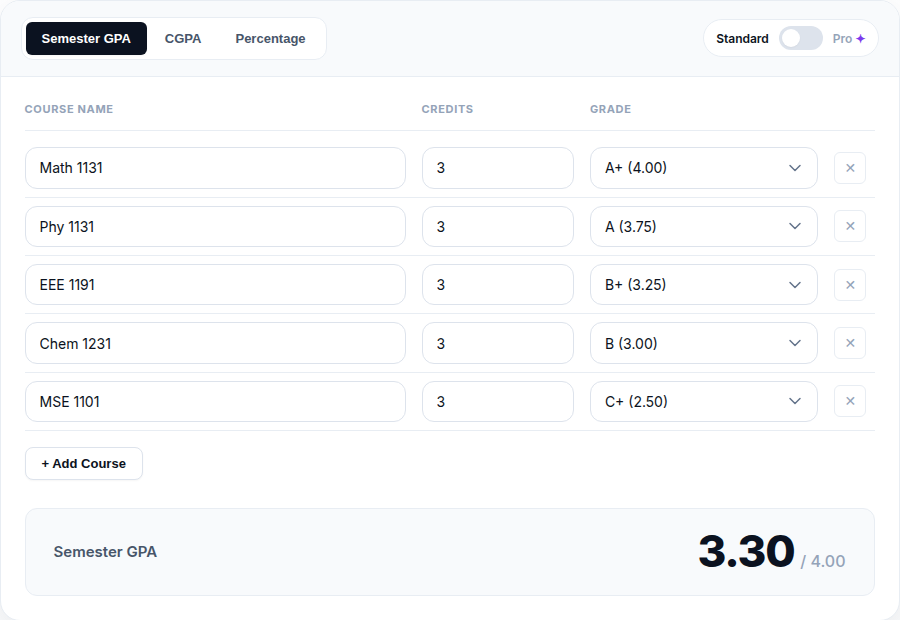
Screenshot: the CGPAPro calculator with the RUET scale selected and a worked semester example. Add your own courses to see your real SGPA in seconds.
One caution before you trust any calculator — including ours — for your official number: most calculators count an F as zero grade points over its full credit hours. At RUET, that is wrong. Read the next section, then verify your number by hand once so you know exactly what your transcript will say.
Read More: How to Calculate SGPA: Formula & Examples (2026) — the credit-weighted formula explained step by step with four worked scenarios.
The Official RUET Grade Table (2026)
This is the undergraduate letter-grade table from RUET’s Academic Ordinance for the Undergraduate Studies (§13), read from the official RUET document. Every RUET transcript you will ever receive is built on this table:
| Numerical Grade | Letter Grade | Grade Points |
|---|---|---|
| 80% or above | A+ | 4.00 |
| 75% to less than 80% | A | 3.75 |
| 70% to less than 75% | A− | 3.50 |
| 65% to less than 70% | B+ | 3.25 |
| 60% to less than 65% | B | 3.00 |
| 55% to less than 60% | B− | 2.75 |
| 50% to less than 55% | C+ | 2.50 |
| 45% to less than 50% | C | 2.25 |
| 40% to less than 45% | D | 2.00 |
| Less than 40% | F | 0.00 |
Three details most websites get wrong about this table:
1. The grade points move in 0.25 steps. This is the standard UGC Bangladesh scale: 4.00, 3.75, 3.50, 3.25, 2.75, 2.50, 2.25, 2.00. Don’t confuse it with Pakistan’s 3.67/2.67-style steps (COMSATS, NUST) or the rounded 4.0/3.7/3.3 scales some generic calculators use. At RUET, an A is exactly 3.75 and a B− is exactly 2.75 — there is no rounding to two different-looking decimals.
2. The bands are written “75% to less than 80%” — and that wording matters at the edges. Exactly 80.0% is an A+, not an A. Exactly 75.0% is an A, not an A−. Most websites write “75–79”, which is fine for whole numbers but wrong for fractional marks. If your paper totals 79.6%, you’re at A− (3.50); at 80.0%, you’re at A+ (4.00). A quarter of a percent can be worth 0.5 grade points.
3. There is also an “I” (Incomplete) grade. It’s awarded for courses like project and thesis or design work in the odd semester that continue through to the even semester. It carries no grade points and doesn’t enter your GPA.
The Rule That Changes Everything: F Doesn’t Count in Your GPA
Let’s say this again slowly, because it decides real numbers on real transcripts. RUET’s ordinance §13.1 defines the GPA as the sum of (credit hours × grade points) divided by the sum of credit hours for the courses the student passed. Failed courses are simply not in either sum.
Here’s what that means in practice. Take a 5-course semester where four courses went well and Chemistry (3 credit hours) ended in an F:
- What RUET does: GPA is computed over the 4 passed courses only. If those earned 51.375 quality points over 15 credit hours, your SGPA is 3.43. The F earns no credit, sits permanently on your transcript, and you must clear the course as a backlog — but it does not touch the GPA number.
- What most online calculators do: they add the F as 0.00 × 3 credit hours, computing 51.375 ÷ 18 = 2.85. That’s 0.58 lower than your real GPA — the difference between First Class and Second Class.
This is why you should always sanity-check a calculator result against the hand method shown below, at least once. And it’s why the “official” answer from a generic tool can quietly mislead you about probation, graduation eligibility, and scholarship cutoffs.
How SGPA and CGPA Are Calculated at RUET
The ordinance formula is the standard credit-weighted one, with the F-exclusion twist:
SGPA = Σ (credit hours × grade points) ÷ Σ (credit hours) — where both sums run over the courses you passed in that semester.
CGPA = total grade points accumulated to date ÷ total credit hours earned — across all semesters, again over passed courses.
Both GPA and CGPA are rounded to the second place of decimal for reporting. You can see this on RUET’s own published result notices, which always show SGPA and CGPA to two decimals.
A practical note on sessional (lab) courses: they carry fractional credit hours (a 3-hour-per-week sessional is 1.5 credits). Include the exact credit value from your department’s curriculum — rounding a 1.5-credit sessional to 2 credits will silently shift your GPA.
Worked Example: Calculating SGPA Step by Step
Let’s compute a realistic first-year RUET semester — 7 courses, 18 credit hours — using the exact official grade points. (If you want the general method first, the SGPA formula guide walks through the credit-weighted calculation with four worked scenarios.)
| Course | CH | Marks | Grade | GP | Quality Points |
|---|---|---|---|---|---|
| Differential & Integral Calculus | 3 | 82 | A+ | 4.00 | 12.000 |
| Physics | 3 | 77 | A | 3.75 | 11.250 |
| Electrical Circuits I | 3 | 67 | B+ | 3.25 | 9.750 |
| Chemistry | 3 | 62 | B | 3.00 | 9.000 |
| Engineering Materials | 3 | 52 | C+ | 2.50 | 7.500 |
| Circuits Sessional | 1.5 | 72 | A− | 3.50 | 5.250 |
| Physics Sessional | 1.5 | 76 | A | 3.75 | 5.625 |
| Total | 18 | 60.375 |
SGPA = 60.375 ÷ 18 = 3.354… → reported as 3.35. That’s comfortably in First Class territory.
Now watch what happens to this same semester if Chemistry had been an F instead of a B. RUET drops it from the calculation entirely: quality points become 60.375 − 9.000 = 51.375, credit hours become 18 − 3 = 15, and SGPA = 51.375 ÷ 15 = 3.43. Notice the counterintuitive result — the semester GPA is higher than 3.35 because the weak course vanished from the average. A generic calculator would have given you 51.375 ÷ 18 = 2.85 and a needless panic attack. The F still costs you: no credit earned, a permanent mark on your transcript, and a backlog exam you must sit — but your GPA number survives.
Worked Example: CGPA Across Semesters
CGPA is the same credit-weighted average, stretched across every semester. Say your first four semester SGPAs were:
| Semester | SGPA | Credit Hours | Grade Points |
|---|---|---|---|
| 1st | 3.10 | 20 | 62.0 |
| 2nd | 3.35 | 20 | 67.0 |
| 3rd | 3.42 | 20 | 68.4 |
| 4th | 3.28 | 20 | 65.6 |
| Total | 80 | 263.0 |
CGPA = 263.0 ÷ 80 = 3.2875 → 3.29. Two observations: first, every semester counts by its credit hours, not equally — a heavy 21-credit semester moves your CGPA more than a light one. Second, 3.29 sits in the First Class band (3.00–3.75). You’re 0.46 short of First Class with Honors, which is a realistic two-semester target if your remaining semesters average around 3.6.
Passing, Backlog and Repeat Rules
RUET doesn’t run a US-style probation system. Instead it uses a course-based pass/fail structure with backlogs. Here’s how it works:
Passing a course. D (40%) or higher earns you the credits. F earns nothing. An F in a core course must be repeated — there is no way around it. An F in an optional course can be repeated or replaced with a substitute course if your department offers one.
The F stays forever. Backlog courses never leave your grade sheet. Even after you clear the course, the original F remains permanently on your transcript — it just never enters your GPA.
Backlog examinations. Held after the even-semester results are published, backlog exams are only for F-grade courses. The rules students ask about most: you may sit a maximum of 3 backlog courses per academic year (fourth-year students may pick 3 from their accumulated backlogs), your original class-test marks count toward the backlog total, and — this is the sting — the maximum grade you can earn in a backlog exam is B (3.00), even if your paper deserves an A+.
Repeating a D is restricted. This surprises almost everyone. The ordinance allows a D-grade repeat for grade improvement only if your CGPA has fallen below 2.20. If your CGPA is 2.20 or above, that D is permanent — you cannot re-sit it just to polish your average. (If you do qualify and repeat, you keep the better of the two outcomes; fail the repeat and the old D stands.)
Short Semester: the Once-in-a-Lifetime Option
For students near the end of their degree who are short a handful of courses, RUET offers a short semester — but the conditions are tight. It’s available only to 4th and 5th-year students who have at most 5 incomplete courses (including sessional, project and thesis work), it’s arranged within 10 weeks of the final-year backlog results, and it can be used exactly once in your entire academic life. The maximum grade counted from a short semester is B+ (3.25). If you still can’t complete your requirements, the route is readmission into the final year.
The 2.20 Line: Graduation, Classification and What Happens Below
The number that decides whether you get your degree at RUET is 2.20 — the minimum CGPA for graduation (§§17, 23), alongside at least 160 credits for 4-year degrees (200 for Architecture). This is higher than the 2.00 floor at most private universities, and students who transfer the “2.0 is enough” assumption from elsewhere get an ugly surprise in their final year.
Your degree classification is set by the same scale:
| CGPA | Class |
|---|---|
| 3.75 and above | First Class with Honors |
| 3.00 to below 3.75 | First Class |
| 2.20 to below 3.00 | Second Class |
| Below 2.20 | Does not graduate |
Two more hard rules sit behind this. Your degree must be completed within 7 academic years (8 for Architecture) — run out the clock without the credits and CGPA, and your name is struck off with no eligibility for readmission. And if your CGPA is below 2.20 at the end of any semester, your academic adviser is required to keep special contact with you — that’s the ordinance’s version of an early-warning system, and it’s also the trigger that unlocks the D-grade repeat option described above.
VC’s List and the Gold Medal
RUET doesn’t call it the Dean’s List — it’s the VC’s List. You make it by earning an SGPA of 3.75 or above in both regular semesters of an academic year. One F in either semester disqualifies you, even if your average clears 3.75. It’s a consistency prize, not just a peak prize.
The University Gold Medal sets a bar almost nobody clears: all A or better grades in every course you ever attended, plus the full credit requirement for graduation. A single B+ anywhere in four years ends the conversation. Worth knowing about, but plan your goals around the VC’s List — it’s the realistic stretch target.
Read More: Is 3.5 CGPA Good? Jobs, Scholarships & MS Abroad — what a strong CGPA actually unlocks for jobs, scholarships and foreign admissions.
CGPA to Percentage: RUET’s Own Formula
Here’s where generic calculators mislead RUET students the most. Almost every tool on the internet converts your CGPA with (CGPA ÷ 4) × 100. At RUET, the official equivalent-marks formula is piecewise — and the two methods disagree by a lot:
- CGPA 3.75 – 4.00: Equivalent Marks = 79 + 84 × (CGPA − 3.75)
- CGPA 2.20 – 3.75: Equivalent Marks = 44 + 20 × (CGPA − 2.00)
Work it through: a CGPA of 3.32 gives 44 + 20 × (3.32 − 2.00) = 70.40%. The generic formula would claim 83% — more than twelve points higher. A CGPA of 3.85 gives 79 + 84 × (3.85 − 3.75) = 87.4%. A CGPA of 2.60 gives 44 + 20 × (2.60 − 2.00) = 56%, not 65%.
Why the gap? The generic formula pretends a 4.0 CGPA means 100% marks, but at RUET a 4.00 means “80% and above” — the scale is compressed at the top by design. If a job application, scholarship form, or foreign university asks for your percentage, use RUET’s formula, not a calculator’s guess. One honest caveat: this formula is corroborated by multiple independent sources citing RUET’s Academic Council, but we could not locate it on an official ruet.ac.bd page — treat it as the established RUET convention and confirm with your department for high-stakes applications.
Read More: How to Convert CGPA to Percentage in 2026 — formulas, country-wise tables and the WES pitfalls to watch for.
Postgraduate Grading Is a Different Scale
If you’re heading for an M.Sc. or Ph.D. at RUET, reset your expectations: postgraduate grading uses a 6-grade scale, not the undergraduate 10-grade one. It’s 90%+ for A+ (4.0), 80–90% for A (3.5), 70–80% for B+ (3.0), 60–70% for B (2.5), 50–60% for C (2.0), and below 50% is F. There are no A−, B−, C+ or D grades at all — and note that a PG “A” is worth 3.5, not 3.75. The continuation rules are harsher too: three or more F grades in a semester, or a first-semester GPA below 2.50, ends the program. Undergrads planning postgraduate study should know they’re entering a stricter system, not a looser one.
Attendance and How Your Marks Are Split
Your final percentage in each course is built from fixed components, so you can always compute exactly what you need on the semester final:
Theory courses (100 marks): class participation and attendance 8 + class tests 20 + semester final exam 72. The best 3 of your 4 class tests count — one bad test day doesn’t have to haunt you.
Sessional / design / field work (100 marks): attendance 8 + quizzes and viva voce 20 + board viva (compulsory) 25 + performance and reports 47.
Project & thesis (100 marks): viva voce committee 30 + supervisor (internal examiner) 50 + external examiner 20.
The 8 attendance marks follow their own table: 90%+ attendance → 8 marks; 85–90% → 7; 80–85% → 6; 70–80% → 5; 60–70% → 4; below 60% → zero. And two attendance cliffs can end your semester before the exam: fall below 50% attendance and you’re barred from the semester final, and below 75% in any theory or sessional course makes you ineligible for any scholarship, stipend or grant in the following academic session.
Common Mistakes RUET Students Make
1. Trusting a generic calculator’s GPA. If you have any F on your record, most calculators understate your real GPA by counting the F as zero. Always apply the F-exclusion rule.
2. Assuming 2.00 is enough to graduate. RUET’s floor is 2.20. The “2.0 is fine” wisdom comes from private universities and doesn’t apply here.
3. Planning to “improve” a D later. D repeats are locked unless your CGPA drops below 2.20. Treat every course as one-shot.
4. Writing off backlog exams. Since backlog grades cap at B, clearing a backlog protects your transcript — but it can never fully repair your GPA the way a first-attempt pass would have.
5. Using (CGPA ÷ 4) × 100 on applications. It inflates your percentage by 10+ points. Use RUET’s official piecewise formula.
6. Ignoring the attendance cliffs. The difference between 61% and 59% attendance is 4 marks versus zero; the difference between 51% and 49% is sitting the final versus not sitting it at all.
7. Expecting PG grading to match UG. The postgraduate scale is a different, harsher 6-grade system — plan your M.Sc. ambitions accordingly.
7 Tips to Protect Your RUET CGPA
1. Guard the 80/75/70 boundaries. Because bands are “to less than”, a single extra mark at a boundary is worth 0.25–0.50 grade points. Prioritize revision on courses sitting near a boundary.
2. Never sacrifice a sessional. Sessionals carry 1.5 credits of nearly-guaranteed high grades (attendance + performance are largely in your control). They quietly subsidize weaker theory courses.
3. Take all 4 class tests seriously, then drop the worst. With best-3-of-4 counting, one bad test is free — but only one. Skipping two tests to “focus on the final” is how students lose the 20-mark cushion.
4. Keep attendance above 75% everywhere. It protects your 8 marks, keeps you eligible for the semester final, and preserves scholarship eligibility — three birds, one habit.
5. Clear F’s in the very next backlog window. A backlog caps at B, but an uncleared F blocks credits you need for the 160-credit graduation requirement and eats one of your 3-per-year backlog slots.
6. If your CGPA slips under 2.20, act immediately. That’s your adviser’s mandatory-contact trigger — and your only window for D-grade repeats. Don’t wait for it to recover on its own.
7. Compute your own GPA by hand once a semester. Use the exact 0.25-step points, exclude F courses, round to two decimals. Ten minutes with a spreadsheet removes every surprise from result day.
Frequently Asked Questions
What is the passing percentage at RUET in 2026?
40% — a D grade. Anything below 40% is an F and earns no credit. This is one of the lowest pass marks among Bangladesh’s engineering universities.
Does an F affect my CGPA at RUET?
No — and this is RUET’s most unusual rule. Per §13.1 of the Academic Ordinance, F grades do not count for GPA calculation: the GPA is computed over passed courses only. The F stays permanently on your transcript and earns no credit, but it never enters the GPA number. Most online calculators get this wrong by counting the F as zero.
What is the minimum CGPA to graduate from RUET?
2.20, along with at least 160 credits (200 for Architecture) and completion within 7 academic years (8 for Architecture). Below 2.20, you do not graduate — this is stricter than the 2.00 floor at most private universities.
Can I repeat a course to improve my grade at RUET?
A failed (F) core course must be repeated; a failed optional course can be repeated or substituted. But a passed course with a D can only be repeated for improvement if your CGPA is below 2.20. Backlog exams cap your grade at B (3.00), and the short semester — usable once in your academic life — caps at B+ (3.25).
How do I convert my RUET CGPA to percentage?
Use RUET’s official piecewise formula, not (CGPA ÷ 4) × 100: 44 + 20 × (CGPA − 2.00) for CGPA 2.20–3.75, and 79 + 84 × (CGPA − 3.75) for 3.75–4.00. Example: CGPA 3.32 → 70.40%.
What CGPA do I need for First Class at RUET?
3.00–3.75 earns First Class; 3.75 and above earns First Class with Honors; 2.20–3.00 earns Second Class. The VC’s List requires SGPA ≥ 3.75 in both regular semesters of the year, and the University Gold Medal requires all A or better grades in every course.
Is the grading scale the same for postgraduate studies at RUET?
No. Postgraduate programs use a 6-grade scale: A+ 4.0 (90%+), A 3.5 (80–90%), B+ 3.0 (70–80%), B 2.5 (60–70%), C 2.0 (50–60%), F below 50%. Three or more F grades in a semester, or a first-semester GPA below 2.50, discontinues the program.
Conclusion
RUET’s grading system rewards students who understand its quirks. The F-exclusion rule means one bad course doesn’t define your GPA — but the permanent transcript mark, the backlog B-cap, and the locked D-repeat rule mean every course still counts. The 2.20 graduation floor is higher than most students assume, the 40% pass mark is lower than most assume, and the CGPA-to-percentage conversion follows RUET’s own math, not the internet’s.
Run your numbers through the RUET CGPA calculator, verify the result once by hand using the exact 0.25-step grade points, and keep your attendance above 75%. Do that every semester, and result day will never surprise you.