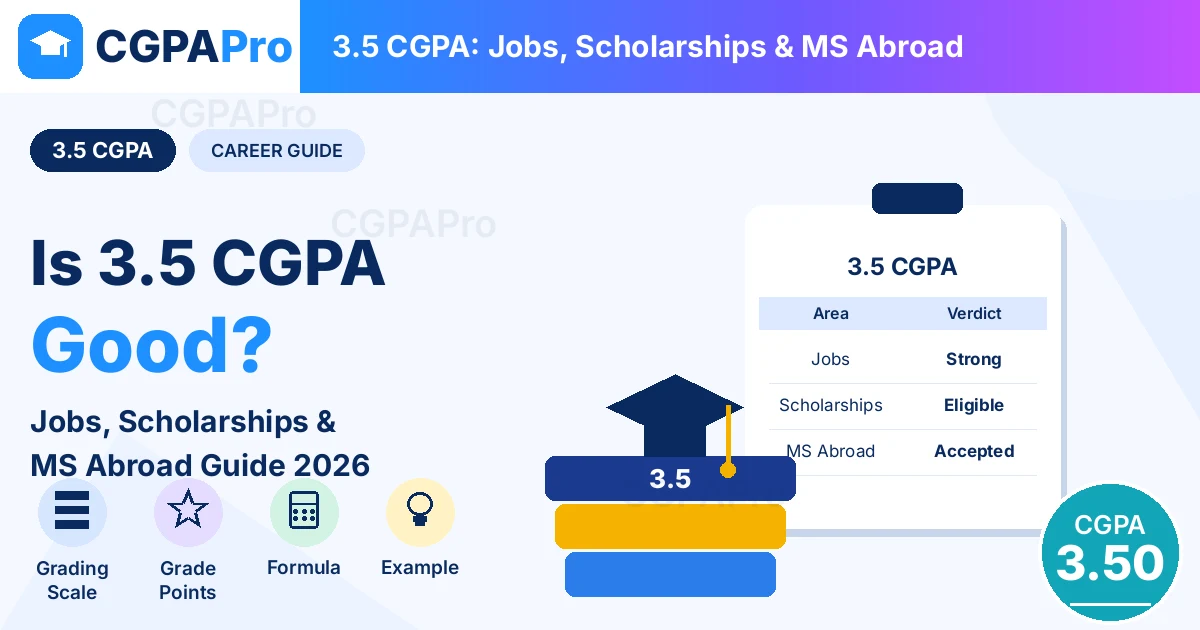
Short answer: yes — a 3.5 CGPA is genuinely strong. It clears the academic bar for most jobs, most scholarships, and most MS programs abroad. But “strong” is not the same as “guaranteed,” and the difference between those two words is exactly what this guide is about. Below, you’ll find the real numbers: the actual cutoffs used by Fulbright, Commonwealth, DAAD, and Chevening, what US, UK, German, Canadian, and Australian universities expect, where employers actually filter on CGPA — and a concrete playbook if you’re sitting below 3.5 and want to know what to do next.
If you’re still studying, the first useful step is knowing your exact number — not the one you hope it is, but the one a university or employer will calculate. A CGPA calculator does that in about two minutes.
Step 1: Check Your Real CGPA Before Anything Else
Don’t plan your applications around a rough guess. Pull up your transcripts and enter every course, grade, and credit hour into the free CGPA calculator at cgpacalculatorpro.com. It weights each course by its credit hours — the way universities actually compute it — instead of just averaging your semester GPAs, which is the mistake most students make.
Once you have your number, confirm which scale your university uses. A 3.5 on a 4.0 scale is a very different thing from a 3.5 on a 10-point scale (in India, 3.5/10 would be a disaster — on a 4.0 scale it’s a B+/A- average). The rest of this guide assumes the 4.0 scale unless stated otherwise.
What a 3.5 CGPA Actually Means, in Plain Numbers
A CGPA of 3.5 out of 4.0 means you’ve averaged roughly a B+ to A- across your degree. Here’s how that translates across the systems you’ll actually encounter:
| System | 3.5 CGPA equivalent | What it signals |
|---|---|---|
| 4.0 scale | 3.5 (B+/A- average) | Above-average to strong performance |
| Naive percentage (×25) | ≈ 87.5% | First Division in Pakistan (HEC); distinction-level |
| 10-point scale (India) | ≈ 8.75 CGPA | First Class with Distinction territory at most Indian universities |
| UK degree classification | High 2:1, borderline First | Meets the 2:1 bar every major UK scholarship asks for |
| German grade system | ≈ 1.6 (“good”) | Via the modified Bavarian conversion formula |
One honest caveat: multiplying by 25 to get 87.5% is a rough conversion, not an official one. Credential evaluators like WES don’t do simple multiplication — they look at your actual grades, your university’s grading scale, and where those grades sit relative to your institution’s own standards. So treat 87.5% as a communication shortcut, not a certified number. If you need to explain your CGPA to an employer or on a form, our CGPA-to-percentage conversion guide walks through which conversion method to use and when.
Also worth knowing: grading standards differ wildly between universities. A 3.5 in engineering from a notoriously strict department often impresses admissions officers more than a 3.8 from an easy-grading one — which is exactly why Fulbright’s selection panel reviews transcripts holistically rather than on the number alone.
Jobs: Where 3.5 Clears the Cutoff (and Where It Doesn’t)
Let’s be blunt: for most jobs, a 3.5 CGPA is a non-issue. The real question is whether you clear the automated filters companies use at the first screening stage.
Bangladesh
Multinational companies, banks, and large local groups in Dhaka typically set their fresher filters at 3.0–3.25 CGPA. At 3.5, you’re comfortably above every standard filter. Government jobs (BCS and similar) work on division-based criteria, not CGPA cutoffs, so your 3.5 puts you in First Division territory with room to spare. After your first job, almost nobody asks — experience and skills take over within two to three years.
Pakistan
Corporate recruiters in Karachi and Lahore commonly use 3.0 as the minimum screen. A 3.5 clears it and lands you in HEC’s First Division bracket (3.0–4.0), which is the classification most government application forms expect when they ask for “division.” One practical headache: many Pakistani government and bank forms still ask for percentage instead of CGPA, so keep your conversion handy.
India
India uses the 10-point scale, and your 3.5/4.0 converts to roughly 8.75/10 — which is where the numbers get fun:
- TCS (Ninja): minimum 60% / 6.0 CGPA — cleared with enormous margin
- Infosys: minimum 65% / 6.5 CGPA — cleared
- Wipro: minimum 60% — cleared
- Premium tracks (Infosys Power Programmer, TCS Digital, Cognizant GenC Next): 7.0–7.5 cutoffs — cleared
- Google / Microsoft / Amazon: 8.0+ cutoffs — you’re above 8.0, but these companies also screen heavily on coding tests and interviews; CGPA alone won’t carry you
The pattern is consistent across all three countries: 3.5 clears every standard corporate cutoff. The only places it falls short are the most selective graduate schools and the most competitive full-merit scholarships. For jobs, CGPA matters most at campus placement and your first job — after that, it’s your work that talks.
Scholarships: The Real GPA Bars
This is the section every other “is 3.5 CGPA good” article gets wrong by being vague. Here are the actual criteria, as published for recent cycles. Always check the current cycle’s official page before applying — criteria shift year to year.
| Scholarship | Published CGPA/academic bar | Does 3.5 clear it? |
|---|---|---|
| Fulbright (Pakistan, via USEFP) | No official minimum GPA — holistic review; strong undergraduate record expected; GRE carries heavy weight | Yes — comfortably |
| Commonwealth (HEC Pakistan) | First-division 16-year bachelor’s + HAT ≥ 60/100; CSC requires at least UK upper second-class (2:1) honours | Yes |
| Chevening (UK) | Degree equivalent to UK 2:1 — “usually a strong First Class or CGPA 3.0+/4.0” — plus 2 years’ work experience | Yes |
| DAAD (Germany) | No strict fixed GPA; roughly 2.5–3.0/4.0 expected; 3.0+ competitive; EPOS requires above-average record | Yes |
| Australia Awards | Academic excellence assessed in context; competitive applicants typically hold strong first-class records | Likely — verify current criteria |
Fulbright (Pakistan)
The Fulbright Degree Program administered by USEFP is the scholarship Pakistani students ask about most — and it’s the one with the most misunderstood criteria. There is no official minimum GPA to apply. The selection panel looks at your transcripts holistically: where you studied, what courses you took, how you performed in your major subjects, and the fact that grading standards differ across Pakistani universities. In practice, successful Fulbrighters have strong undergraduate records, and a 3.5 puts you squarely in that group. The harder filter is the GRE — a 300+ combined score is commonly recommended, and a strong GRE can compensate for a weaker CGPA. (For a detailed breakdown of the application steps, see this guide to applying via USEFP.)
Commonwealth Scholarship (UK)
For the 2027–28 cycle, HEC Pakistan requires a first-division 16-year bachelor’s degree (3.5 is firmly First Division) and a HAT score of at least 60 out of 100. The Commonwealth Scholarship Commission itself requires a first degree of at least upper second-class (2:1) honours standard — and a 3.5/4.0 sits at high 2:1 to First Class level, so the academic bar is cleared. Selection is competitive beyond that, weighing your HAT score, study plan, and development impact. (Criteria summary: moawin.pk’s Commonwealth 2027 guide.)
Chevening (UK)
Chevening wants a degree equivalent to a UK upper second-class (2:1) honours — described as “usually a strong First Class or a CGPA of 3.0+ out of 4.0.” Your 3.5 exceeds that. But note what Chevening really selects on: leadership potential and two years of work experience. A 3.5 with a thin profile loses to a 3.2 with a strong one. If Chevening is your target, your CGPA is already fine — invest your energy in the experience and essays.
DAAD (Germany)
DAAD doesn’t publish a hard GPA cutoff for most programs. The working expectation is roughly 2.5–3.0 on a 4.0 scale, with 3.0+ being genuinely competitive — and a 3.5 is well into competitive territory. For the EPOS development-related postgraduate courses, the requirement is an above-average degree plus two years of relevant professional experience. Many German Master’s programs are fully English-taught, so don’t let the language question stop you; IELTS 6.0+ or an MOI (medium of instruction) certificate is commonly accepted. (DAAD GPA breakdown: mygermanuniversity.com’s DAAD guide.)
The honest summary: a 3.5 CGPA makes you academically eligible for every major scholarship program. From there, selection turns on test scores, work experience, essays, and recommendations — not on squeezing out another 0.2 of CGPA.
MS Abroad With a 3.5 CGPA: Country by Country
Admissions expectations vary more by country than most students realize. Here’s a realistic map:
United States
A 3.5 is considered strong for US graduate admissions, and 3.0 is the minimum for most programs. The honest split: mid-tier and good state universities will welcome a 3.5 happily. Top-20 programs (Stanford, MIT, and peers) admit at averages around 3.7–3.9+, so a 3.5 alone won’t carry you there — but a 3.5 with a 320+ GRE, research experience, and strong recommendations absolutely keeps you in the conversation. Funded MS/PhD positions care more about research fit than about the difference between 3.5 and 3.7.
United Kingdom
UK universities think in classifications, not CGPA. A 3.5/4.0 lands at roughly a high 2:1 (some universities will map it to a First). That clears the 2:1 requirement that covers the vast majority of taught Master’s programs. Only a handful of programs (Oxbridge, LSE, Imperial in competitive fields) demand a First — and even those assess international qualifications in context.
Germany
German public universities charge little to no tuition, which makes Germany the best value-for-money destination on this list. Most Master’s programs require a first-division bachelor’s (roughly 7.0–7.5/10 for Indian applicants, or the equivalent). Your 3.5/4.0 converts to approximately German grade 1.6 using the modified Bavarian formula — that’s a solid “good” (gut) in the German system, comfortably above what most programs require. Competitive programs in Munich, Aachen, and Berlin may still be picky, but the grade is not your problem there.
Canada
Most Canadian universities ask for a minimum of 3.0/4.33 (or the equivalent) for Master’s admission, with competitive programs wanting 3.3+. A 3.5 is competitive for the large majority of programs. Funded thesis-based Master’s and PhD positions weigh supervisor fit and research background heavily — grades get you past the cutoff, but the research proposal and references decide.
Australia
Australian Group of Eight universities typically look for the equivalent of 3.0–3.5 for Master’s entry. A 3.5 is at the top of that band. Australia Awards scholarships assess academic excellence in context alongside leadership and development impact, so a 3.5 with a strong story is a credible application.
Read More: How to Convert CGPA to Percentage (2026 Guide) — the conversion method universities, WES evaluations, and scholarship forms actually expect.
Below 3.5? Your Recovery Playbook
If you’re reading this with a 3.2 or a 3.0, here’s the part nobody else writes: a concrete, honest action plan. Not “study harder” — specific levers you can actually pull.
1. Retake your worst courses (if your university allows it)
Many universities — including NSU and most private universities in Bangladesh — let you retake courses where you scored a D or C, and the new grade replaces or averages with the old one. A single retaken 3-credit course (D → A) can move a 120-credit CGPA by nearly 0.1. Check your university’s grading rules — retake policies differ, and some only allow it below a certain grade.
2. Weight your remaining credits ruthlessly
Your final-year project or thesis often carries 6 credits — double or triple a normal course. One A in a 6-credit project counts as much as two A’s in regular courses. Prioritize high-credit courses in your remaining semesters; that’s where the math works hardest for you.
3. Let a strong GRE/GMAT do the talking
Fulbright’s own guidance is explicit: strong test scores can balance a moderate CGPA. A 320+ GRE signals academic ability independently of your transcript. If your CGPA is 3.0–3.3, a 320+ GRE is the single highest-leverage move you can make for US admissions and Fulbright.
4. Take the work-experience route
Several major scholarships don’t just tolerate work experience — they require it. Chevening requires two years. DAAD EPOS requires two years of relevant professional experience. Two years in a relevant job plus a 3.2 CGPA is a stronger Chevening application than a 3.8 with no experience. If scholarships are your goal and your grades are average, experience is the great equalizer.
5. Build an upward trend and explain it
Admissions officers read transcripts, not just the final number. A student who went 2.8 → 3.2 → 3.6 → 3.8 tells a story of growth; use your statement of purpose to frame it. “My first year was X, here’s what changed” is a legitimate narrative — reviewers see it every cycle.
6. Target programs with 2.75–3.0 minimums
Most US universities publish their minimums. Thousands of solid, well-ranked programs list 3.0 as the requirement. Apply where your 3.0–3.4 is comfortably above the bar instead of only aiming at programs that admit at 3.8.
7. Consider a credential evaluation
If your university grades strictly (common in Pakistan’s public universities and Bangladesh’s national universities), a WES or similar evaluation sometimes maps your record more favorably than a naive conversion — because evaluators account for institutional grading norms.
How to Raise Your CGPA: A Worked Example
Let’s do the actual math, because wishful thinking doesn’t move CGPAs. Suppose you’ve completed 80 credits with a 3.3 CGPA and have 40 credits left (roughly three semesters). What semester GPA do you need to graduate at 3.5?
The formula: Required GPA = (Target CGPA × Total Credits − Current CGPA × Completed Credits) ÷ Remaining Credits
Required GPA = (3.5 × 120 − 3.3 × 80) ÷ 40 = (420 − 264) ÷ 40 = 156 ÷ 40 = 3.9
So you’d need a 3.9 average across your remaining 40 credits — essentially straight A’s with maybe one A-. That’s hard, but it’s not fantasy. It’s a concrete target you can plan around: protect your high-credit courses, retake one weak course, and treat the final-year project as the 6-credit lever it is.
What if you aim for 3.4 instead? Required GPA = (3.4 × 120 − 264) ÷ 40 = (408 − 264) ÷ 40 = 3.6 — very achievable. And remember the country map above: 3.4 still clears every scholarship bar and most admissions minimums. The difference between 3.4 and 3.5 matters far less than the difference between 3.4 and a strong GRE score or two years of experience.
Read More: NSU Grading System & GPA/CGPA Guide (2026) — retake rules, grade points, and how NSU computes CGPA, with worked examples.
Frequently Asked Questions
Is 3.5 CGPA good enough for the Fulbright scholarship?
Yes. Fulbright (via USEFP in Pakistan) has no official minimum GPA — selection is holistic. In practice, successful candidates have strong undergraduate records, and a 3.5 is comfortably in that range. The GRE matters a great deal in Fulbright selection, so a strong GRE score alongside your 3.5 makes a solid application. Always check the current cycle’s criteria on USEFP’s official page.
Is 3.5 CGPA good for jobs in Bangladesh and Pakistan?
Yes. Most corporate and bank fresher filters in both countries sit at 3.0–3.25 CGPA, so a 3.5 clears them with margin. Government jobs use division-based criteria, and 3.5 falls in HEC’s First Division bracket (3.0–4.0). After your first job, employers stop asking about CGPA almost entirely.
What is 3.5 CGPA in percentage?
Roughly 87.5% using the common ×25 conversion — but that’s an approximation, not an official formula. For scholarship forms and credential evaluations, check our CGPA-to-percentage guide for which conversion method to use in each situation.
Can I get into a top-100 US university with a 3.5 CGPA?
Yes, at many of them — 3.5 is considered strong for US graduate admissions, and 3.0 is the minimum for most programs. For the top 20 (Stanford, MIT, and peers), admitted averages run 3.7–3.9+, so a 3.5 needs support from a strong GRE, research experience, and recommendations to be competitive there.
Is 3.5 CGPA enough for DAAD or the Commonwealth Scholarship?
Yes. DAAD expects roughly 2.5–3.0/4.0 with 3.0+ being competitive, so 3.5 is well into competitive territory. The Commonwealth Scholarship (via HEC) requires a first-division bachelor’s plus a HAT score of at least 60/100, and the CSC requires at least a UK 2:1 — a 3.5 meets the academic bar for both. Confirm the current cycle’s criteria before applying.
I have a 3.2 CGPA. Can I still study abroad?
Absolutely. Thousands of good universities list 3.0 as their minimum. Strengthen the rest of your profile: a 320+ GRE, relevant work experience, strong recommendations, and an upward grade trend. Chevening and DAAD EPOS actively require two years of work experience, which can matter more than the CGPA gap.
Should I put a 3.5 CGPA on my CV?
Yes, for your first job and for campus placements — it clears automated filters and signals strong academics. List it as “CGPA: 3.5/4.0” so recruiters see the scale. Once you have two to three years of experience, drop it from your CV; your work history replaces it.
The Bottom Line
A 3.5 CGPA is not “good enough” — it’s genuinely strong. It clears the academic requirements for Fulbright, Commonwealth, Chevening, DAAD, most MS programs in the US, UK, Germany, Canada, and Australia, and every standard corporate cutoff in Bangladesh, Pakistan, and India. The students who lose out with a 3.5 aren’t losing on grades — they’re losing on weak GRE scores, thin experience, or generic essays. And if you’re below 3.5, the playbook above gives you real levers: retakes, credit-weight strategy, test scores, and the work-experience routes that several major scholarships actually require. Know your exact number with the CGPA calculator, pick your target, and plan from there.