How Retaking a Course Affects Your CGPA (2026 Guide)
You got a D+ in a 3-credit course in your second semester, and now you’re asking the question almost every student in Bangladesh eventually asks: if I retake this course and get an A, how much will my CGPA actually move — and will the old grade disappear? The honest answer is: it depends entirely on which university you study at, because your university follows one of three completely different counting rules — and under one of them, a bad retake can actually lower your CGPA.
Here’s the 30-second version. At NSU, the best grade counts, so a retake can only help you. At IUB, only the latest grade counts — retake a C, score a D, and your CGPA goes down, not up. At BRACU, repeats are capped at B+ no matter how high you score, and which rule applies to you (best vs latest) changed with the Summer 2025 intake. And at every university, the later you are in your degree, the less a single retake moves the needle — a D+ to A jump in a 3-credit course is worth roughly +0.22 CGPA points with 30 credits completed, but only +0.07 with 90 credits completed.
This guide gives you the full picture: the three counting rules explained with formulas, the official retake policies of BRAC University, IUB, NSU, and UIU side by side (caps, attempt limits, deadlines), three worked examples with real numbers — including the final-year trap where a retake is a waste of a semester — and a decision checklist so you can tell in two minutes whether your retake is worth the fees. Every rule below is sourced from the universities’ official policy documents, not from calculator blogs.
The Short Answer: Should You Retake?
- Retake if the course grade is D, D+, or F, you’re in your first 4–5 semesters, and the course is a prerequisite or a heavy-credit course. This is where retakes pay off most.
- Think twice if you’re retaking a C or C+ in your final year. With 100+ credits done, even a perfect retake moves your CGPA by less than 0.05 — your time is better spent protecting your remaining grades.
- Never retake blindly at a “latest grade counts” university (IUB, and BRACU for Summer 2025+ intakes). If there’s a real chance you’ll score lower the second time, the new — worse — grade is the one that will count.
- Check the cap before you dream: at BRACU, a repeated course can never earn above B+ (3.30). An A in your repeat is worth exactly the same as a B+.
- An F must usually be retaken anyway — but when you retake it matters for probation and scholarship rules, covered below.
See Your Retake Result Before You Register: The Calculator Shortcut
Before you pay a retake fee, run the numbers. CGPAPro’s CGPA calculator lets you enter your completed credits and current CGPA, then model the retake as a normal course to see the ceiling of what a perfect grade would do. University-specific calculators with the correct local grade scales are also available — for example the BRACU CGPA calculator, the IUB CGPA calculator, and the NSU CGPA calculator.
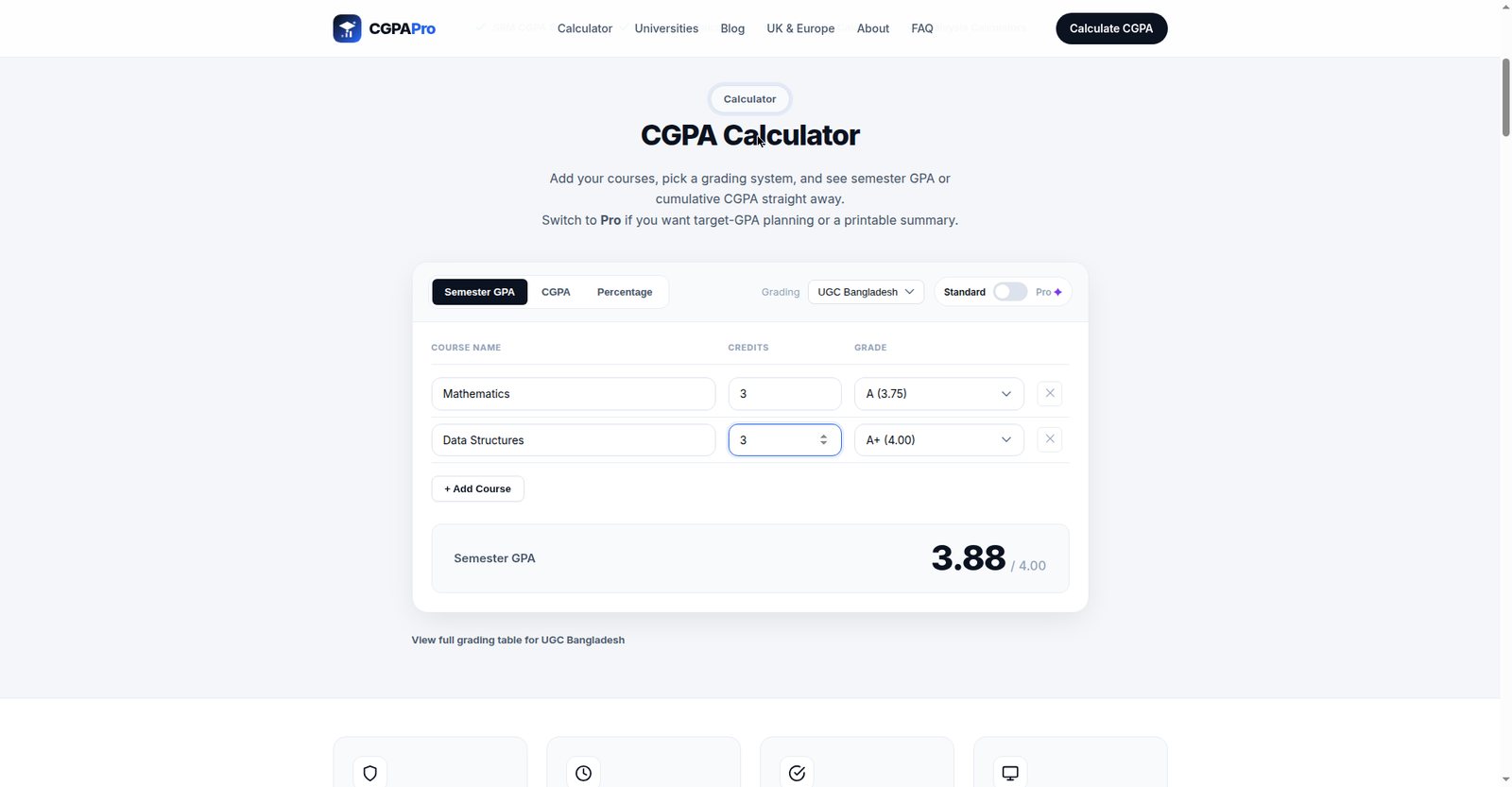
Screenshot: modelling a retake on CGPAPro — enter your completed credits and current CGPA, replace the old grade with your target grade, and the projected CGPA appears instantly. Use it to test “what if I get a B+?” before you register.
The two-minute method: note your current CGPA and completed credits from your university portal. In the calculator, remove the old grade’s quality points mentally by entering the scenario as if the course had your target grade from the start, then compare. The worked examples later in this guide show the exact hand calculation for each counting rule, so you can verify the calculator’s answer once and trust it afterwards.
Read More: How to Calculate SGPA: Formula & Examples (2026) — the credit-weighted formula behind every number in this guide, explained step by step.
The One Thing That Decides Everything: 3 Counting Rules
Every university on earth handles a retaken course in one of three ways. Find your university’s rule first — everything else in this guide hangs on it.
Rule 1: The best grade counts
Both attempts appear on your transcript, but only the higher grade point enters your CGPA. The credit hours of the course are counted once. This is the student-friendliest rule: a retake is a one-way bet. You can only gain or break even. NSU follows this rule (“the best grade obtained in this course will be counted for CGPA calculation”), and BRACU follows it for students admitted before Summer 2025.
Formula: New CGPA = (Total quality points − old grade points × credits + best grade points × credits) ÷ Total credits counted.
Rule 2: The latest grade counts
Both attempts appear on your transcript, but only the most recent grade point enters your CGPA — even if it’s worse. IUB follows this rule (“only the latest grade earned in a retaken course will be counted towards the CGPA”), and BRACU applies it to students admitted in Summer 2025 or later, per the current student-facing retake policy. This rule rewards preparation and punishes gambling: retake only when you’re confident you can beat your old grade.
Formula: New CGPA = (Total quality points − old grade points × credits + new grade points × credits) ÷ Total credits counted — where “new” is whatever you score, higher or lower.
Rule 3: Both grades count (no replacement)
Some universities — common in parts of Europe and in systems without a formal grade-forgiveness policy — average both attempts or count both as separate entries. The old grade never leaves the calculation. A retake still helps (the new grade adds fresh quality points) but the damage of the first attempt is permanent. If your university has no published retake policy at all, assume this rule until the registrar confirms otherwise — and check your current program handbook, because policies change by intake year.
| Rule | What counts in CGPA | Can a retake lower your CGPA? | Used by |
|---|---|---|---|
| Best grade counts | Higher of the two attempts | No — worst case, no change | NSU; BRACU (pre-Summer 2025 intakes) |
| Latest grade counts | Most recent attempt only | Yes — if you score lower | IUB; BRACU (Summer 2025+ intakes) |
| Both grades count | Both attempts | No, but the old grade never leaves | Systems with no replacement policy — verify with registrar |
One more fact students consistently get wrong: “replacement” is an internal CGPA rule, not a transcript eraser. At IUB, the F “will remain in the transcript even when a student retakes the same course and receives a passing grade.” At NSU, the superseded attempt stays visible with its grade points shown as 0.0. Graduate admissions evaluators and credential services such as WES may recalculate your record using both attempts by their own formula. Retake to fix your university CGPA — just don’t expect the first attempt to vanish from history.
University Retake Rules Compared: BRACU, IUB, NSU, UIU
Here are the official rules for the four universities our readers ask about most, verified against primary sources in October 2026. Policies change — if your intake year differs, confirm the row that applies to you in your student handbook before registering.
| University | Who may retake | Counting rule | Grade cap | Attempts & deadlines |
|---|---|---|---|---|
| BRAC University (BRACU) | Repeat: grade B− or below. Retake: F grade | Best grade (admitted before Summer 2025); latest grade (Summer 2025+) | B+ (3.30) maximum in a repeated/retaken course | Repeat: once per course. Retake of F: up to twice (conditions apply). Repeat/retake never appears as such on the transcript |
| Independent University, Bangladesh (IUB) | Any course for CGPA improvement; F or below-prerequisite grade must be retaken | Latest grade only | No cap | Max 2 improvement retakes per course; within 4 semesters of original registration; max 4 total attempts (2 retakes + 2 withdrawals); F retake in the immediate next semester (Spring 2026 policy) |
| North South University (NSU) | Grade B (plain) or lower | Best grade counts | No cap | Normally up to 3 retakes per course; a 4th retake needs Vice-Chancellor approval |
| United International University (UIU) | Per program rules — retake handling is built into UIU’s trimester system | New grade replaces the old grade in CGPA; credits counted once | Check your program handbook | Check UCAM / program office for per-course limits |
BRACU — the B+ cap is the whole story. BRACU’s official clarification states it plainly: students with a grade of B− or below may repeat a course once, “but shall not be awarded a grade of more than B plus (B+) in that particular course.” The same B+ ceiling applies when retaking an F. Score 95% in your repeat and your transcript still says B+. BRACU deliberately keeps the repeat fee at the regular rate and hides repeat/fail courses from the transcript — the policy is designed so a repeat fixes damage, never leapfrogs the students who earned a clean B+ the first time. Note also that BRACU changed the counting rule by intake: students admitted before Summer 2025 keep the better of the two grades; Summer 2025 and later intakes are counted on the latest grade. If you’re a BRACU student, your admission semester decides which of the two rules in the table above applies to you — this is the single most-missed detail in every BRACU retake discussion online. (Full details in our BRACU grading system guide, including the probation line at CGPA 1.5 and the 2.00 requirement by the sixth semester.)
IUB — latest grade, tight deadlines. IUB’s Academic Policy Updates (106th Academic Council, effective Spring 2026) are unusually specific: you may retake for improvement within four semesters of the original registration, a maximum of two times per course, and a course may be taken at most four times in total counting withdrawals. An F — or any grade below your department’s prerequisite minimum — must be retaken in the immediate next semester. And only the latest grade counts. That combination makes IUB retakes high-stakes: the deadline pressure is real, and a worse second attempt replaces your old grade even if it hurts you. Plan IUB retakes for a semester where you can genuinely prepare. (See our IUB grading system guide for the full grading table and prerequisite rules.)
NSU — the forgiving one, with a soft ceiling. NSU lets you retake any course graded B or lower, counts the best grade, and normally allows three retakes per course; a fourth needs the Vice-Chancellor’s approval. Because the best grade counts, an NSU retake can never reduce your CGPA — the real costs are the fee, the semester slot, and your time. The superseded attempt remains on the transcript with 0.0 grade points shown. (Our NSU grading system guide covers the full NSU grade table, and our NSU vs IUB vs BRACU comparison shows how differently the three universities treat the same transcript.)
UIU — replacement, counted once. UIU’s trimester-based system handles retakes by replacement: the new grade replaces the old one in the CGPA calculation and the course’s credits are counted once, so your completed-credit total doesn’t inflate. UIU students should confirm per-course attempt limits and any grade ceilings with the program office or UCAM, since UIU publishes its grading scale centrally but administers retake limits at program level. (See our UIU grading system guide for UIU’s A = 4.00 to D = 1.00 scale and trimester GPA rules.)
Worked Examples: What a Retake Actually Does to Your CGPA
Rules are abstract; numbers are not. All three examples use a 3-credit course and the standard formula CGPA = total quality points ÷ total credits counted, where quality points = grade points × credits.
Example 1 — Early degree, best-grade rule (NSU-style): the retake that pays
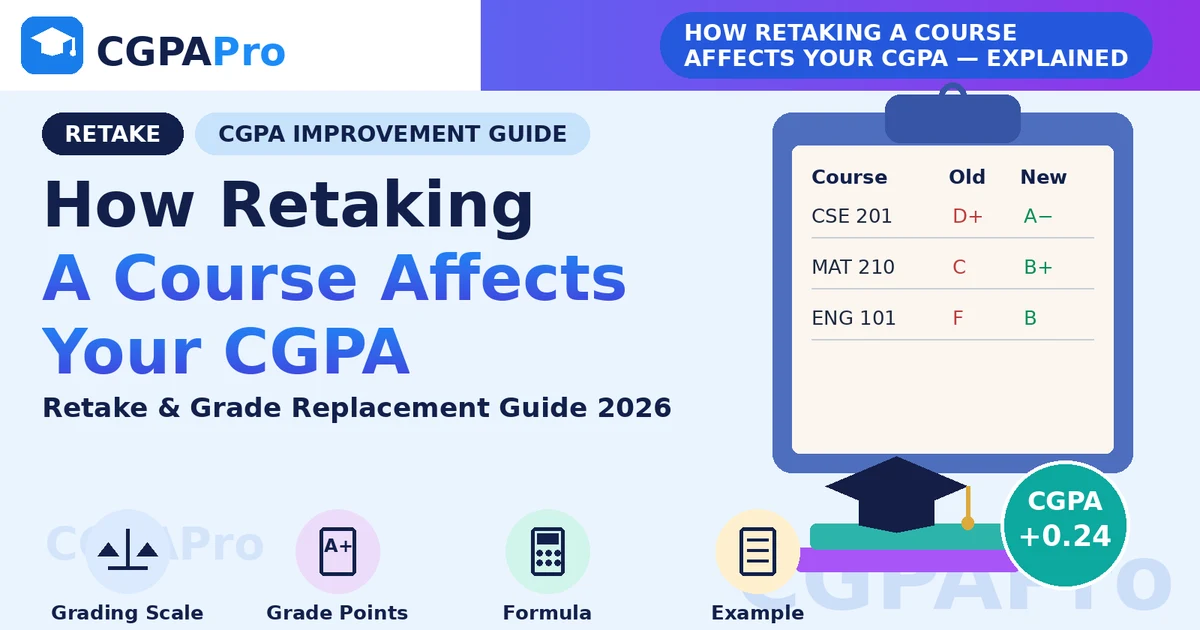
You’ve completed 30 credits with a CGPA of 2.90. Buried in there is a 3-credit course graded D+ (1.30). You retake it and earn an A− (3.70).
- Total quality points now: 2.90 × 30 = 87.00
- Remove the old attempt: 87.00 − (1.30 × 3) = 87.00 − 3.90 = 83.10
- Add the best attempt: 83.10 + (3.70 × 3) = 83.10 + 11.10 = 94.20
- Credits counted stay 30 (the course counts once)
- New CGPA = 94.20 ÷ 30 = 3.14 — a gain of +0.24
A quarter of a CGPA point from one course. Early in your degree, retaking your worst heavy course is the highest-leverage academic move available to you — nothing else you can do in one semester moves the number this much.
Example 2 — Final year, same jump: the dilution trap
Same student, same D+ and same A− retake — but now you’ve completed 90 credits at a CGPA of 2.90.
- Total quality points: 2.90 × 90 = 261.00
- Swap the grades: 261.00 − 3.90 + 11.10 = 268.20
- New CGPA = 268.20 ÷ 90 = 2.98 — a gain of just +0.08
Identical effort, identical grade jump, one-third of the payoff. The gain from any retake is (new grade points − old grade points) × course credits ÷ total credits counted. As your total credits grow, every retake is diluted. Past roughly 90–100 completed credits, a single 3-credit retake rarely justifies a semester slot unless the course is blocking graduation or a prerequisite chain — or unless the old grade is an F keeping you under a probation or graduation threshold.
Example 3 — Latest-grade rule (IUB-style): the retake that backfires
You’ve completed 60 credits with a CGPA of 3.10, including a 3-credit course graded C (2.00). In a heavy semester you retake it hoping for a B+, but land a D+ (1.30) instead.
- Total quality points: 3.10 × 60 = 186.00
- Latest grade replaces the old: 186.00 − (2.00 × 3) + (1.30 × 3) = 186.00 − 6.00 + 3.90 = 183.90
- New CGPA = 183.90 ÷ 60 = 3.07 (rounded) — you lost 0.03 and paid a full course fee for the privilege
Under a best-grade rule, the same outcome would have cost you nothing but the fee — your original C would still count. Under IUB’s latest-grade rule (and BRACU’s for Summer 2025+ intakes), the D+ is now your grade of record. The lesson is not “never retake at IUB” — it’s “never retake at a latest-grade university in a semester where you can’t protect the preparation time.” If the retake matters, give it a light semester and treat it like a course you’re taking for the first time.
When Is a Retake Worth It? A Decision Checklist
Run through these five questions before you register. You need mostly “yes” answers.
- Is the grade jump realistic at least 1.0 grade points? (e.g., D+ 1.30 → B 2.30 or better.) A one-letter improvement in a 3-credit course at 60 completed credits is worth about (1.0 × 3) ÷ 60 = +0.05. Below that, the fee usually isn’t worth it — unless a threshold is at stake.
- Are you under 60 completed credits? The earlier the retake, the more every grade point is worth. The formula above tells you exactly: gain = grade-point jump × course credits ÷ total credits.
- Is a threshold on the line? Retakes punch above their weight when they cross a line: the 2.00 continuation requirement (BRACU by the sixth semester), probation limits, scholarship CGPA floors, Dean’s List cut-offs, or a 3.0/3.5 line for jobs and MS admissions. Moving from 2.97 to 3.02 is worth far more than the raw 0.05 suggests. (If you’re near 3.5, see Is 3.5 CGPA Good? for what that line actually buys you.)
- Does your university count the best grade — or the latest? Best-grade: low risk, retake when ready. Latest-grade: only retake in a semester you control.
- Is the course a prerequisite or a repeat offender? A weak grade in a course that three later courses build on (maths sequences, programming, accounting) costs you marks every semester until you fix the foundation. Retaking it pays twice.
And the mirror-image list — skip the retake if the course is a 1-credit lab in your final year, if the realistic jump is under one letter grade, if retaking delays graduation by a semester, or if the same effort spent protecting your current courses would defend more quality points than the retake could gain. Defending an A− from slipping to a B+ in a current 3-credit course is worth exactly as much as gaining a full grade point on a retake — with zero extra fees.
The Costs Nobody Puts in the Brochure
Fees. Retakes and repeats are charged at the regular per-credit rate at BRACU and IUB — BRACU states this explicitly, and it’s deliberate: the fee exists to discourage treating repeats as a routine strategy. Budget the full course fee, not a discounted “second attempt” rate.
Scholarships. At BRACU, failing any subject in a semester makes you ineligible for tuition waiver consideration for the two subsequent semesters (you may apply again in the third), and students with retake/repeat subjects in a semester must pay for those subjects themselves. An F therefore costs three times: the grade, the retake fee, and up to a year of waiver eligibility. Check your own university’s waiver rules for the equivalent clause — most have one.
Probation and standing. Retakes interact with academic standing in both directions. A successful retake is the fastest legal way off probation — but at BRACU, a student who earns an F while also holding D/F grades in other subjects that semester gets restricted retake attempts, and the hard lines remain: minimum CGPA 1.5 to avoid probation, and 2.00 required by the end of the sixth semester (fourth for Pharmacy) to continue at all. If you’re anywhere near those lines, retaking your worst course isn’t optional strategy — it’s the priority, ahead of new electives.
Time. A retake consumes a course slot in a semester with a maximum load. At IUB, the four-semester window and the immediate-next-semester rule for F grades mean deferring a retake is not always available: miss the window and the improvement option expires, even though the bad grade doesn’t.
Common Retake Mistakes
- Retaking your worst-feeling course instead of your worst grade-points-per-credit course. A D in a 1-credit lab costs you less than a C in a 4-credit theory course. Rank your transcript by (grade points lost × credits) and retake from the top of that list.
- Assuming the old grade disappears. It stays on the transcript everywhere. CGPA replacement is an internal calculation rule; external evaluators may count both attempts.
- Retaking at a latest-grade university during your heaviest semester. Example 3 above is not hypothetical — it’s arithmetic. Protect the retake with a lighter load.
- Forgetting the cap. BRACU repeat students sometimes aim for an A that the rules convert into a B+ (3.30) anyway. Knowing the ceiling changes how much effort the retake deserves relative to your other courses.
- Retaking a B or B+ “for the A” where it’s not allowed. NSU’s door closes above a plain B; BRACU’s repeat door closes above B−. Check eligibility before planning around a retake you can’t register for.
- Ignoring the deadline. IUB’s four-semester improvement window and next-semester F rule are the most common ways students lose the retake option entirely.
How to Actually Score Higher the Second Time
A retake fails for a boring reason: students study the same way that produced the first grade. Change the inputs. Sit in a different section with a different instructor if your university allows it — teaching style mismatch is a real and fixable cause. Start from your returned midterm and final scripts: most universities let you review them, and the gap between “I studied everything” and “the exam rewards these three topic clusters” is where retake grades are won. Front-load the continuous assessment: quizzes, assignments, and attendance are the cheapest grade points in any retake because you already know the course shape. And if the first attempt collapsed for non-academic reasons — illness, family emergency, a brutal semester — say so to your advisor; universities have incomplete-grade and withdrawal machinery precisely so that one bad semester doesn’t have to be re-fought as a retake at all.
Frequently Asked Questions
Does retaking a course remove the old grade from my transcript?
No. At IUB the original F explicitly “will remain in the transcript even when a student retakes the same course.” At NSU the first attempt stays visible with 0.0 grade points shown. What changes is which grade counts in your CGPA — best grade at NSU, latest grade at IUB and for BRACU’s Summer 2025+ intakes. External evaluators (employers, WES, some foreign universities) may recalculate using both attempts, so a retake fixes your university CGPA, not your history.
Can I retake a course I got a C in?
Usually yes. NSU allows retakes for any grade of B or lower; BRACU allows repeats at B− or below (capped at B+, once per course); IUB allows up to two improvement retakes per course within four semesters. Whether it’s worth it depends on your completed credits — use the gain formula: grade-point jump × course credits ÷ total credits. A C → A jump (2 points) in a 3-credit course at 45 completed credits gains about +0.13; at 105 credits, only +0.06.
What happens if I score lower in the retake?
It depends on the counting rule. Under a best-grade rule (NSU; BRACU pre-Summer-2025), nothing bad happens to your CGPA — the original grade still counts. Under a latest-grade rule (IUB; BRACU Summer 2025+), the lower grade replaces the higher one and your CGPA drops, as Example 3 shows. Know your rule before you register.
How many times can I retake the same course?
IUB: twice for improvement (four total attempts including withdrawals), and failing the same course three times can lead to cancellation of admission. NSU: normally three retakes, with a fourth requiring Vice-Chancellor approval. BRACU: repeats once per course; retakes of an F up to twice, subject to conditions on your other grades that semester. UIU students should confirm limits with their program office. Every university also caps your total degree duration, so retakes compete with your graduation deadline.
Will a retake affect my scholarship or tuition waiver?
Very likely, yes. At BRACU, an F suspends tuition-waiver eligibility for the two following semesters, and repeat/retake subjects are billed at the regular rate with no waiver on those credits. Other universities have similar clauses. If you hold a waiver, read its conditions before assuming a retake is “free” — and factor the waiver risk into any decision to gamble on a latest-grade retake.
Is it better to retake a course or take a new elective to raise my CGPA?
Compare the realistic gains. A new 3-credit elective at an A (3.70+) adds fresh quality points but also adds 3 credits to your denominator; a retake swaps out your worst existing grade points without growing the denominator as much. Early in your degree the retake of a D/D+ usually wins. Late in your degree, or when the old grade is already a B− or better, a well-chosen new elective (or simply defending your current grades) usually wins. Run both scenarios in the CGPA calculator — the two-minute check beats a semester of regret.
The Bottom Line
A retake is not automatically a CGPA rescue. It’s a trade: one course fee and one semester slot, in exchange for replacing (or attempting to replace) your weakest grade points. The trade is excellent early in your degree, at a best-grade university, for a heavy course with a bad grade and a realistic one-point-plus jump. It’s a poor trade in your final year, for a light course, under a cap you didn’t know about, or — at a latest-grade university — in a semester where you can’t guarantee you’ll beat your first attempt.
Do the two-minute version before you decide: find your university’s counting rule in the table above, plug your numbers into the gain formula (grade-point jump × course credits ÷ total credits), and check it against your thresholds — probation lines, scholarship floors, the 3.0 and 3.5 lines that employers and admissions committees actually filter on. Then, if the retake earns its place, register for it in a semester you control, and study it like a new course with an unfair advantage: you’ve already seen the exam once.
Policies verified against BRAC University’s official retake/repeat clarification, IUB’s Academic Policy Updates (106th Academic Council, effective Spring 2026), North South University’s Academic Information and Policies, and UIU grading documentation, October 2026. University policies change by intake year — confirm the rule for your admission semester in your current program handbook before registering for a retake.