The BRACU Grading System in 30 Seconds
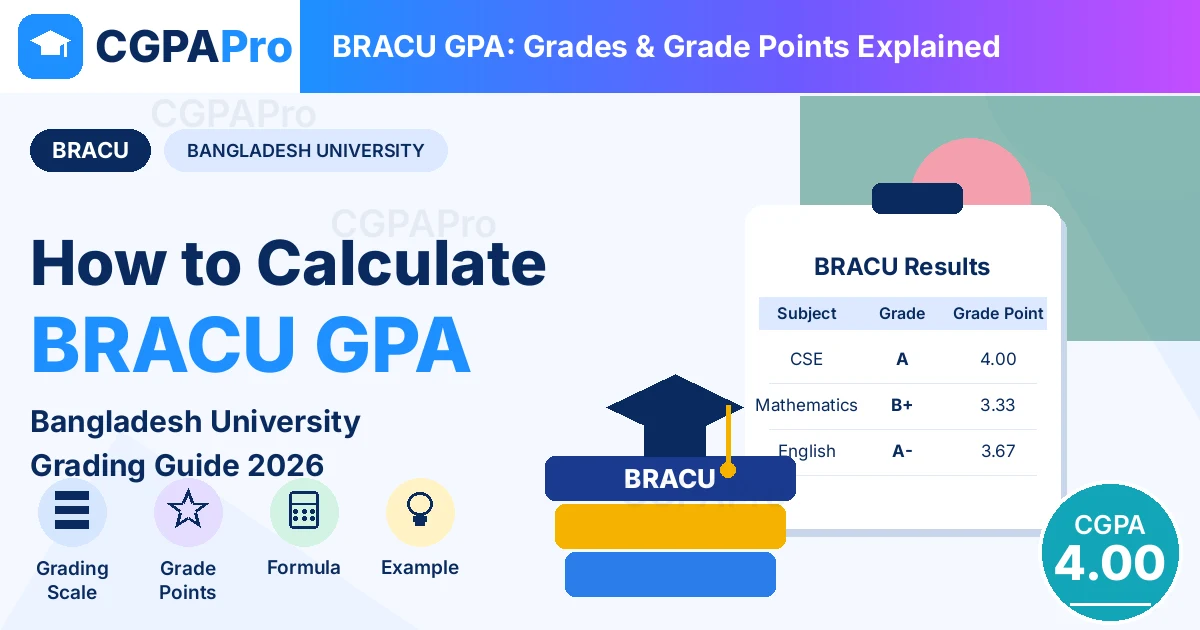
The BRACU grading system is straightforward once you see it laid out: every course you take at BRAC University gets a letter grade — from A+ down to F — and each letter is worth a fixed number of grade points on a 4.00 scale. Your semester GPA is the credit-weighted average of those points for one semester; your CGPA is the same average across every semester you’ve completed.
The essentials you need to remember about the BRACU grading system:
- A+ and A are both worth 4.00. Scoring 97 or 90 makes zero difference to your CGPA.
- The lowest passing grade is D− (50–52 marks), worth just 0.70.
- An F gives you 0.00 points but its credits still count in your CGPA denominator — so failures drag you down twice.
- Retaking an F course counts your best grade; repeating a passed course counts your latest grade. This asymmetry confuses almost everyone — keep reading.
- Since Summer 2022, probation kicks in below a 2.00 CGPA, and you must reach 2.00 to continue your degree.
This guide walks through the official BRACU grade table, the exact GPA and CGPA formulas, a fully worked semester example, the retake and repeat rules most students misunderstand, and the probation policy that decides whether you stay enrolled. Every rule here is checked against BRAC University’s official Policies and Procedures — not student rumors.
How to Calculate Your BRACU CGPA Online (Fastest Way)
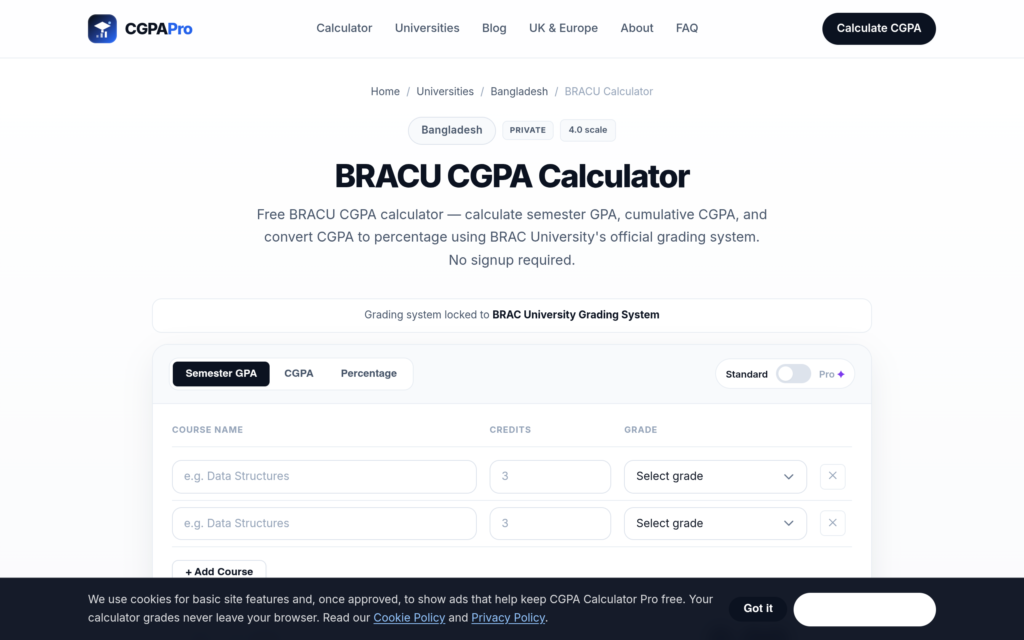
Doing this by hand for a full transcript is slow and error-prone, which is why most students use a dedicated tool. The BRAC University CGPA calculator is pre-loaded with the official BRACU grade scale, so you don’t have to look up grade points yourself:
- Enter each course — pick the letter grade from the dropdown and set the credit hours (most BRACU theory courses are 3 credits, labs are usually 1).
- Add retakes separately if needed. Remember the official rule: for a retaken F course, the calculator should use the best of your grades; for a repeated (grade-improvement) course, use the latest grade.
- Include every attempted course — even ones you failed. An F’s credits count in the denominator, so skipping them gives you a fake, inflated number.
- Leave out P, I, and W grades. These carry no grade points and are excluded from CGPA entirely.
- Hit calculate and compare the result with your official transcript to make sure everything lines up.
That covers the mechanical part. But if you want to understand why the number moves the way it does — and how to push it up strategically — the sections below are worth your time.
Official BRACU Grade Table (Fall 2020 Onwards)
BRAC University revised its grading system for the Fall 2020 semester, and the current table has stayed in place since. This is the authoritative version, straight from the university’s published policies:
| Marks Range | Letter Grade | Grade Points | Standing |
|---|---|---|---|
| 97 – 100 | A+ | 4.00 | Exceptional |
| 90 – below 97 | A | 4.00 | Excellent |
| 85 – below 90 | A− | 3.70 | |
| 80 – below 85 | B+ | 3.30 | |
| 75 – below 80 | B | 3.00 | Good |
| 70 – below 75 | B− | 2.70 | |
| 65 – below 70 | C+ | 2.30 | |
| 60 – below 65 | C | 2.00 | Fair |
| 57 – below 60 | C− | 1.70 | |
| 55 – below 57 | D+ | 1.30 | |
| 52 – below 55 | D | 1.00 | Poor |
| 50 – below 52 | D− | 0.70 | |
| Below 50 | F | 0.00 | Failure |
A few things about this table that most BRACU students don’t fully appreciate until it’s too late:
- The 50-mark line is a cliff. At 50 you pass with a D− (0.70); at 49 you fail with an F (0.00). Two marks is the difference between earning credits and earning nothing while the credits still punish your CGPA.
- The D− band is unusually thin. Only 50–52 marks. Below 50, there’s no mercy grade — it’s straight to F.
- There is no A− vs A nuance at the top that matters numerically: 85–89.99 gives you 3.70, and everything from 90 up gives the full 4.00. If you’re sitting at 93 with one exam left, grinding for 97+ earns you exactly nothing extra on your transcript.
- Marks are cumulative. Your final number combines quizzes, class tests, assignments, the midterm, and the final exam — there’s no single test that decides your grade alone.
How GPA Is Calculated at BRACU (Step by Step)
BRACU’s official GPA formula is refreshingly simple:
GPA = Sum of (Grade Points × Credit Hours) ÷ Sum of Credits Attempted
Here’s what each part means in practice:
- Find the grade point for each course from the table above (e.g., a B+ = 3.30).
- Multiply that point value by the course’s credit hours. These are your “quality points.” A 3-credit B+ gives you 3.30 × 3 = 9.90 quality points.
- Add up the quality points across all courses in the semester.
- Add up all the credit hours you attempted — including courses you failed.
- Divide. Total quality points ÷ total attempted credits = your semester GPA.
The critical word in that formula is “attempted.” A course you failed with an F contributes 0.00 × 3 = 0 quality points, but the 3 credits still go into the denominator. That’s why a single F hurts far more than most students expect — it doesn’t just add nothing, it actively dilutes everything else.
Grades that carry no numerical value — P (Pass), I (Incomplete), and W (Withdrawal) — are left out of the calculation entirely: no quality points, no credits in the denominator. The same goes for audited courses (graded AU). If you’re comparing systems across universities, the main CGPA calculator hub covers other institutions’ formulas too.
CGPA Formula: The Same Idea, Across Every Semester
Your CGPA (Cumulative Grade Point Average) uses exactly the same formula — it just runs across your entire academic history instead of one semester:
CGPA = Total Quality Points (all semesters) ÷ Total Credits Attempted (all semesters)
The fastest shortcut when you already know your current standing:
New CGPA = (Current CGPA × Completed Credits + This Semester’s Quality Points) ÷ (Completed Credits + This Semester’s Credits)
This shortcut is genuinely useful. Before every semester, plug in your target grades and see exactly what CGPA you’ll land on — it tells you whether “just pass everything” is enough or whether you need specific grades in specific courses to stay off probation.
Full Worked Example: A Real BRACU Semester
Let’s make this concrete. Meet a fictional CSE student, Tanvir, finishing his third semester. He already has a CGPA of 3.10 over 45 completed credits. This semester he took five courses:
| Course | Credits | Grade | Grade Points | Quality Points |
|---|---|---|---|---|
| CSE110 — Programming Language I | 3 | B | 3.00 | 9.00 |
| ENG101 — English Fundamentals | 3 | A− | 3.70 | 11.10 |
| MAT110 — Mathematics I | 3 | C+ | 2.30 | 6.90 |
| BNG103 — Bangla Language & Literature | 3 | A | 4.00 | 12.00 |
| CSE170 — Programming Lab | 1 | A− | 3.70 | 3.70 |
Step 1 — semester quality points: 9.00 + 11.10 + 6.90 + 12.00 + 3.70 = 42.70
Step 2 — credits attempted: 3 + 3 + 3 + 3 + 1 = 13
Step 3 — semester GPA: 42.70 ÷ 13 = 3.28
Now the CGPA, using the shortcut:
Step 4 — old quality points: 3.10 × 45 = 139.50
Step 5 — new totals: quality points = 139.50 + 42.70 = 182.20; credits = 45 + 13 = 58
Step 6 — new CGPA: 182.20 ÷ 58 = 3.14
Notice something important: Tanvir’s semester GPA (3.28) was higher than his old CGPA (3.10), so his CGPA climbed — but only to 3.14. That’s the inertia of a cumulative average: the more credits you accumulate, the harder each new semester has to work to move the needle. A strong early record protects you; a weak one takes sustained effort to fix. This is also why one bad semester in your final year barely dents a CGPA built over 100+ credits — and why one bad semester in your first year can haunt you for a long time.
GPA vs CGPA at BRACU: Why Both Numbers Matter
Students use these terms interchangeably, but at BRACU they trigger different consequences:
- GPA (Grade Point Average) covers a single semester. It’s a snapshot — how you did this term, nothing more.
- CGPA (Cumulative Grade Point Average) covers your entire degree. This is the number on your transcript, the number employers and graduate schools ask for, and the number the probation policy watches.
Here’s the practical difference: you can have a terrible semester (low GPA) and still hold a healthy CGPA if your earlier record was strong. Conversely, a great semester won’t rescue a CGPA weighed down by several bad ones. BRACU’s probation rules look at CGPA, not semester GPA — so the cumulative number is the one that determines your academic survival. For context on how CGPA translates elsewhere, see our guide on converting CGPA to percentage. (For reference, in Bangladesh’s public universities a CGPA of 3.00+ is generally considered first-class territory, per published grading norms — private universities like BRACU don’t use the class system officially, but employers often think in these bands anyway.)
7 Mistakes Students Make With the BRACU Grading System
After years of watching students miscalculate, misjudge, or simply misunderstand the system, these are the errors that cost the most:
- Thinking an F “doesn’t count.” It absolutely counts — its credits sit in your denominator at zero points. A 3-credit F in an otherwise 3.50 semester drags you down far more than a C ever would.
- Chasing 97+ when you’re already at 92. A+ and A are both 4.00 at BRACU. Those extra study hours buy you nothing on your transcript; spend them pulling a C+ up to a B− instead, where every mark actually moves your points.
- Confusing retake with repeat. Retaking an failed course uses your best grade; repeating a passed course for improvement uses your latest grade — which means a repeat can theoretically lower your CGPA contribution if you do worse. Know which rule applies before you register.
- Missing the repeat deadline. You can only repeat a course for grade improvement once, and it must be within two semesters of your first enrollment. Wait too long and the option is gone permanently.
- Treating a W as free. A Withdrawal doesn’t touch your CGPA — true — but it stays on your transcript, you paid full tuition for it, and a pattern of Ws tells its own story to anyone reading your record.
- Ignoring an I grade. An Incomplete automatically converts to an F if you don’t sit the make-up exam at the first opportunity. An “I’ll deal with it later” I is a ticking F.
Retake vs Repeat: The BRACU Grading System Rule Almost Everyone Gets Wrong
This is the single most misunderstood part of the BRACU grading system, so let’s be precise. The university’s official policy treats these as two different things with two different CGPA rules:
Retake (for failed courses)
If you receive an F in a course, you may retake it twice. In exceptional cases — for example, if you’re on probation — the Head of Department or Dean can approve a third attempt through the Registrar. One special case: non-credit courses in the 091/092 category allow only one retake, and only in your first or second semester.
The CGPA rule for retakes: the best of the grades received is counted. So if you failed MAT110 and then earned a B+ on retake, the B+ (3.30) is what feeds your CGPA — the F stops dragging you down. Note the retake doesn’t add extra credits to your denominator; the course is still one course, one set of credits.
Repeat (for grade improvement)
Separately, you may repeat a passed course once to improve your grade — but you must do it within two semesters of your original enrollment, and there’s no cap on the grade you can earn in the repeated course.
The CGPA rule for repeats is different: the latest grade earned is counted — not the best. Repeat a C and earn a B? Your CGPA uses the B. Repeat a B+ and slip to a B? Your CGPA uses the B. This is why repeating is a calculated risk, and why some student-built CGPA tools get it wrong by applying one blanket rule.
A word of caution: several unofficial student-made calculators floating around claim BRACU changed these rules based on admission year. The university’s published policy states the retake/repeat policy “is effective for all students.” If a tool’s numbers disagree with the official rule, trust the official rule — and confirm anything critical with your department or the Registrar.
Probation, Dismissal & Graduation Rules at BRACU
BRACU runs three semesters a year — Spring (January), Summer (May), and Fall (September), each 13 working weeks plus a finals week. Your CGPA is evaluated against academic-standing thresholds every term, and there are two different probation regimes depending on when you enrolled:
New probation policy (enrolled Summer 2022 onwards)
- You must maintain a minimum CGPA of 2.00. Fall below it and you’re placed on probation for the following semester.
- You then have up to 3 consecutive semesters to pull your CGPA back to 2.00 (2 semesters for Pharmacy students).
- You cannot drop a probationary semester — no sitting it out — except for serious illness or major circumstances beyond your control, approved by the Head of Department with the Registrar and verified by the university Medical Centre.
- Fail to reach 2.00 within the allowed semesters and you’ll be considered for withdrawal from the university, subject to review by the Dean/Head of Department with the Registrar. (The Dean may recommend one further defined period if there were genuine adverse circumstances or a borderline failure.)
Old probation policy (enrolled before Summer 2022)
- The threshold was a CGPA of 1.50 (both semester and cumulative).
- Failing to raise your CGPA to 1.50 within two consecutive semesters on probation meant dismissal.
- A first-semester GPA below 1.00 could get you asked to withdraw outright.
- Students could continue with a 1.50 CGPA up to the sixth semester (fourth for Pharmacy), but needed 2.00 by the end of that semester to continue in the undergraduate program.
The graduation floor: across both regimes, a CGPA of 2.00 is effectively the minimum to earn your degree — the standing rules simply don’t let you continue or graduate below it. Treat 2.00 as survival, 3.00+ as the zone where scholarships, Dean’s List recognition, and strong job or graduate-school applications live. (BRACU’s own scholarship program ties tuition waivers of 10–100% to CGPA bands starting at 3.70 — another reason every decimal point matters.)
Special grades: P, I, W
P (Pass): You can take a course pass/fail with instructor approval, provided you carry at least 12 credits of regular letter-graded courses that semester. Maximum 16 pass/fail credits in your whole degree, and no more than 4 in one semester. Departments can refuse pass/fail for courses counting toward your major — so check before you opt in.
I (Incomplete): Assigned only when you couldn’t finish course requirements for an unavoidable reason and applied for it. You’ll get a make-up exam at the first available opportunity — miss it and the I automatically becomes an F.
W (Withdrawal): Assigned when you withdraw within the official withdrawal deadline. Withdraw after the deadline and you get whatever grade your performance earned. None of P, I, or W carry grade points or enter the CGPA calculation.
8 Practical Tips to Improve Your BRACU CGPA
- Defend the 50-mark line first. If you’re hovering near failing in any course, every hour spent climbing from 45 to 52 is worth more CGPA than any other studying you can do — it converts a 0.00 into 0.70 and saves the credits.
- Retake every F as early as allowed. Since the best grade counts, a retake is pure upside: the F’s drag gets replaced by whatever you earn. Don’t let failed courses sit while you take new ones.
- Use your one repeat wisely — and on time. Target a high-credit course where you got a C or C− and you’re confident you can do better. Remember the two-semester deadline and the latest-grade-counts rule.
- Stop over-investing past 90. Once you’re safely in A territory, redirect effort to your weakest course. A B− pulled up to a B (0.30 gain × 3 credits) beats an A polished into an A+ (0.00 gain) every time.
- Consider pass/fail strategically. For a risky elective outside your major, the P option protects your CGPA — but confirm your department allows it for that course, and remember the 16-credit lifetime cap.
- Project before you register. Each advising season, run your planned courses through the BRACU CGPA calculator with realistic grade estimates. If the projection lands you near 2.00, rebalance your load before the semester starts, not after midterms.
- Never let an I grade linger. Calendar the make-up exam the day you get the I. An auto-converted F is the most avoidable CGPA disaster in the system.
- Watch your credit load on probation. You can’t drop a probationary semester, so the lever you have is course selection: a lighter, high-confidence load you can ace beats an ambitious schedule that sinks you further.
What is the passing grade at BRAC University?
The lowest passing grade at BRACU is D−, awarded for 50–52 marks and worth 0.70 grade points. Anything below 50 marks is an F (0.00) and counts as a failed course that must be retaken.
Is an A+ worth more than an A at BRACU?
No. At BRAC University both A+ (97–100) and A (90–below 97) carry 4.00 grade points. There is no CGPA advantage to scoring above 97 versus scoring 90.
How does retaking a failed course affect my CGPA at BRACU?
You may retake a failed course twice (three times by special approval). For CGPA calculation, the best of the grades you received is counted — so a successful retake replaces the F’s drag on your CGPA. The course’s credits are counted once, not twice.
What happens if my CGPA falls below 2.0 at BRACU?
For students enrolled from Summer 2022 onwards, a CGPA below 2.00 puts you on academic probation. You then have up to 3 consecutive semesters (2 for Pharmacy students) to raise it back to 2.00; failing that, you may be withdrawn from the university. You cannot drop a probationary semester except on serious medical or exceptional grounds.
Can I repeat a passed course to improve my grade at BRACU?
Yes — you may repeat a course once, within two semesters of your original enrollment, with no cap on the new grade. But unlike retakes, repeats use the latest grade for CGPA (not the best), so repeating carries some risk if you perform worse.
Does a W (Withdrawal) grade affect my CGPA?
No. W, along with P (Pass) and I (Incomplete), carries no grade points and is excluded from the CGPA calculation entirely. However, a W stays on your transcript and you’ve still paid tuition for the course. Note that an I grade automatically converts to an F if you miss the make-up exam.
What CGPA do I need to graduate from BRAC University?
You need a minimum CGPA of 2.00. BRACU’s academic standing rules require students to reach and maintain 2.00 — students who cannot lift their CGPA to 2.00 within the allowed probationary semesters are withdrawn, so 2.00 is effectively the graduation floor.
Final Word
The BRACU grading system rewards students who understand its mechanics, not just its table. Know that an F’s credits count against you, that retakes use your best grade while repeats use your latest, that 90 and 97 are worth exactly the same, and that the probation clock for current students runs on a 2.00 CGPA with a three-semester recovery window. Run your numbers through the BRACU CGPA calculator before every semester, plan around the rules instead of discovering them mid-crisis, and that CGPA will move in the direction you want.