
BUET Grading System 2026: Grades, GPA & CGPA Guide
Here’s a sentence that will sound wrong the first time you read it: you can retake a failed course at BUET, score 85%, and still get a B. Not a maybe — the university’s official rules say it plainly. Per §12 of BUET’s Rules and Regulations for the Undergraduate Programme, a student repeating a course with a previous F “will not be eligible to get a grade better than ‘B’ in such a course.” Scored 95%? Still a B. And it gets worse: you can’t repeat a course you passed with a B or better at all, you get exactly one improvement attempt per course, and you have a lifetime budget of just 4 courses (for engineering programs).
This guide is the complete, official-rulebook-backed explanation of the BUET grading system for 2026 — built from BUET’s own Undergraduate Rules and the Postgraduate Ordinance, not from generic calculator blogs. Inside: the exact undergraduate grade table, the real marks distribution (10% participation + 20% quizzes/homework + 70% Term Final — one 3-hour exam decides 70% of your grade), how Term GPA and CGPA are actually computed, the F-exclusion rule with a worked side-by-side example, the full repeat/improvement machinery, Honours at 3.75+, the Dean’s List, the 2.20 survival line (probation → suspension), the postgraduate scale that alumni keep confusing with the current one, and an honest answer on CGPA-to-percentage conversion (BUET publishes no official formula).
The Short Answer
- BUET UG uses the standard UGC Bangladesh 10-grade scale: A+ at 80% and above (4.00) down to D at 40–45% (2.00). Anything below 40% is an F. Grade points move in 0.25 steps — an A is exactly 3.75, a B− exactly 2.75.
- Pass mark is 40% (D grade) — and attendance of at least 60% of classes in every course is mandatory.
- BUET says “Term”, not “semester”: Term GPA, Term Final, 18-week terms. One 3-hour Term Final exam carries 70% of your course marks.
- F grades are excluded from GPA calculation entirely (official §12) — but stay permanently on your transcript. An F-repeat is capped at B (3.00) no matter what you score.
- Improvement repeats are allowed only below B, only once per course, with the new grade also capped at B — lifetime budget of 4 courses (engineering) / 5 (architecture).
- The “harsh BUET scale” is the postgraduate scale, not yours: UG students are graded on the same UGC table as DU, RUET, and CUET.
- Graduation needs 157 credits with CGPA ≥ 2.20, inside a 7-year limit. Fall below 2.20 and you’re on probation; two sub-2.20 years can mean suspension.
- Honours at 3.75+; Dean’s List at 3.75+ across two regular terms — but any F that year disqualifies you.
- BUET publishes no official CGPA → percentage formula. (CGPA ÷ 4) × 100 is an unofficial shortcut, not a BUET rule.
Calculate Your BUET CGPA the Fast Way
The fastest way to see where you stand is to run your term through a calculator that knows BUET’s scale. CGPAPro’s BUET CGPA calculator has the official BUET grading scale built in — pick your grades, enter your credit hours, and your GPA appears instantly. (The main CGPA calculator also carries a BUET scale in its dropdown if you prefer the full multi-university tool.)
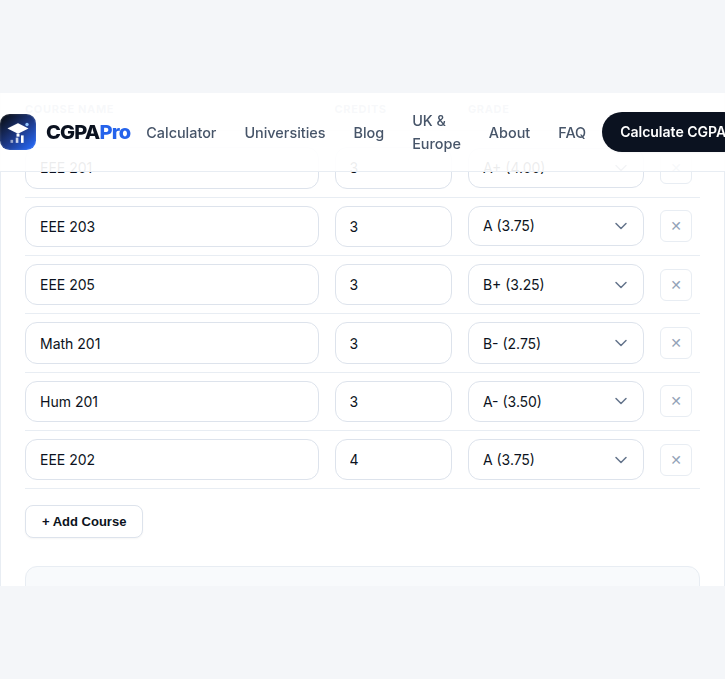
Screenshot: the CGPAPro calculator with the BUET scale selected and a worked term example. Add your own courses to see your real Term GPA in seconds.
Two cautions before you trust any calculator — including ours — for your official number. First, most calculators count an F as zero grade points over its full credit hours: at BUET that is wrong — §12 excludes F grades from the GPA calculation entirely. Second, no generic calculator caps your retake at B. Read those sections below, then verify your number by hand once so you know exactly what your grade sheet will say.
Read More: How to Calculate SGPA: Formula & Examples (2026) — the credit-weighted formula explained step by step with four worked scenarios.
The Official BUET Grade Table (2026)
This is the undergraduate letter-grade table from BUET’s Rules and Regulations for the Undergraduate Programme Under Course System (§11), as published on BUET’s official EEE department site. Every undergraduate grade sheet you will ever receive at BUET is built on this table:
| Numerical Grade | Letter Grade | Grade Points |
|---|---|---|
| 80% or above | A+ | 4.00 |
| 75% to less than 80% | A | 3.75 |
| 70% to less than 75% | A− | 3.50 |
| 65% to less than 70% | B+ | 3.25 |
| 60% to less than 65% | B | 3.00 |
| 55% to less than 60% | B− | 2.75 |
| 50% to less than 55% | C+ | 2.50 |
| 45% to less than 50% | C | 2.25 |
| 40% to less than 45% | D | 2.00 |
| Less than 40% | F | 0.00 |
| — | X (continuation — project/thesis/design courses) | — |
Three details most websites get wrong about this table:
1. This is the standard UGC Bangladesh scale — the same one DU, RUET, and CUET use. The grade points move in 0.25 steps: 4.00, 3.75, 3.50, 3.25, 3.00, 2.75, 2.50, 2.25, 2.00. Don’t confuse it with Pakistan’s 3.67/2.67-style steps (COMSATS, NUST) or the rounded 4.0/3.7/3.3 scales some generic calculators use. At BUET, an A is exactly 3.75 and a B− is exactly 2.75.
2. The bands are written “75% to less than 80%” — and that wording matters at the edges. Exactly 80.0% is an A+, not an A. Exactly 75.0% is an A, not an A−. Most websites write “75–79”, which is fine for whole numbers but wrong for fractional marks. With grade bands just 5 percentage points wide, a quarter of a percent can be worth 0.5 grade points.
3. The pass mark is 40% (D). Below 40% is an F. And separately, you must attend at least 60% of classes in every course — less than 60% is both a rule violation and (per the official attendance bands) zero participation marks.
The “harsh BUET scale” myth — read this if an alumnus told you an A is only 3.5. The harsh 6-grade scale (A = 3.5, pass = 50%, no A−/B−/C+/D) is BUET’s postgraduate scale, verified in BUET’s official Postgraduate Ordinance (§5): 90%+ A+ 4.0, 80–90 A 3.5, 70–80 B+ 3.0, 60–70 B 2.5, 50–60 C 2.0, below 50 F. As an undergraduate, you are graded on the standard 10-grade table above — the same as the private universities people compare you to. BUET’s undergraduate reputation for toughness comes from the 70% Term Final, the 5%-wide grade bands, and the B-capped repeats — not from a harsher table. (There’s a full PG grading sidebar later in this guide.)
Where Your Marks Actually Come From: 10 / 20 / 70
This is the part of BUET that surprises every new student — and the most-quoted student complaint on the internet. A BUET alumnus put it this way on Quora: “I never understood the marks distribution at BUET. For 3 credit, 300 mark exam. Grade changed at 5% marks, that means losing each 15 marks would downgrade your grade by one level. And a small question generally carried 18/17 marks. So if I missed just a small question, I would be losing one grade.”
The official distribution (§11.1) is:
| Component | Weight |
|---|---|
| Class participation / attendance | 10% |
| Homework assignments and quizzes | 20% |
| Term Final examination (one 3-hour paper, internal + external examiners) | 70% |
| Total | 100% |
The quiz rule most students never read: the number of quizzes in a course must be at least n+1, where n is the number of credits — and only the best n quizzes count. So a 3-credit course has at least 4 quizzes, and your worst one is discarded. Your teacher must announce the continuous-assessment scheme on the first day of classes, so you know exactly what’s coming.
The attendance bands: participation marks are awarded on official attendance bands — 90%+, 85–90%, 80–85%, 75–80%, 70–75%, 65–70%, 60–65%, below 60% (zero). The widely reported mapping is 10/9/8/7/6/5/4/0 marks out of the 10% participation component, but confirm the exact mapping against your department’s rules booklet. What is official: you must attend at least 60% of classes in every course, and absence from the Term Final exam means an automatic F. Short illness absences (up to 3 weeks) can get makeup quizzes and assignments with a medical certificate.
Now do the math that the Quora alumnus was doing. Grade bands are 5 percentage points wide. With 70% riding on one 3-hour exam, a small question worth ~6% of the total can move you a full letter grade. That’s the real reason BUET feels brutal: it’s not the grade table, it’s the concentration of 70% of your fate into a single morning.
How Term GPA and CGPA Are Calculated
BUET’s official definition (§14): Term GPA is the weighted average of the grade points obtained in all the courses passed/completed in that term. The formula is the standard credit-weighted one:
Term GPA = Σ (credit hours × grade points) ÷ Σ (credit hours of passed/completed courses)
CGPA is the same computation extended over your entire degree: total quality points earned across all terms ÷ total credit hours passed. One note: BUET’s official terminology is Term GPA / Term Final / terms — the undergraduate program runs on 18-week terms (14 weeks of classes, 2 weeks recess, 2 weeks of Term Final exams), two per year plus an optional Short Term.
Worked example: a realistic 2nd-year EEE term (19 credit hours)
| Course | Credits | Marks | Grade | Grade Point | Quality Points |
|---|---|---|---|---|---|
| EEE 201 (Electronics I) | 3 | 83 | A+ | 4.00 | 12.000 |
| EEE 203 (Signals & Systems) | 3 | 76 | A | 3.75 | 11.250 |
| EEE 205 (EM Fields) | 3 | 68 | B+ | 3.25 | 9.750 |
| Math 201 (ODE & PDE) | 3 | 58 | B− | 2.75 | 8.250 |
| Hum 201 (Economics) | 3 | 72 | A− | 3.50 | 10.500 |
| EEE 202 (Electronics Sessional) | 4* | 79 | A | 3.75 | 15.000 |
| Total | 19 | 66.750 |
*Sessional (lab/design) credit hours equal half the weekly class hours (§4.2b) — lab hours count differently from lecture hours.
Term GPA = 66.750 ÷ 19 = 3.51.
And CGPA across terms is just the same idea one level up. Say your first term was 3.40 over 19 credit hours and the term above was 3.51 over 19: CGPA = (3.40 × 19 + 3.51 × 19) ÷ 38 = 3.46. Every term’s credit-weighted GPA folds into the total.
Your F Doesn’t Drag Your GPA Down — But It Stays Forever
Per §12: “‘F’ grades will not be counted for GPA calculation but will stay permanently on the Grade Sheet and Transcript.”
What that means in practice: the failed course earns no credit and is simply left out of the denominator when your GPA is computed. Take the worked term above, but imagine the student failed Math 201 (3 credits) instead of earning a B−:
- Quality points over passed courses only: 66.750 − 8.250 = 58.500
- Credit hours of passed courses: 19 − 3 = 16
- Real BUET Term GPA: 58.500 ÷ 16 = 3.66
Now run the same numbers through a generic online calculator, which quietly counts the F as 0 grade points × 3 credit hours in the denominator: 58.500 ÷ 19 = 3.08. That’s the number most BUET students panic over — and it is wrong by more than half a point. Your official GPA is 3.66; the calculator says 3.08.
Two permanent costs remain. First, the F stays on your grade sheet and transcript forever — it never gets erased, even after you repeat the course. Second, the repeat comes with the B-cap (next section). And one more trap: an F in a Core course must be repeated; an F in an Optional course can be repeated or replaced with a substitute course if one is available.
Honest caveat: §17 of the rules contains loosely worded examples (“term hours taken”, “attempting 100 credit hours”) that could be read as including failed courses. The explicit §12 rule — F grades will not be counted — governs. If your department ever hands you a number that doesn’t match this, ask them to show the §12 calculation.
The Repeat Trap: Score 85%, Still Get a B
This is the section of BUET’s rulebook that most students discover too late. Read it slowly.
Repeating after an F: you will not be eligible for a grade better than B (3.00) in the repeated course — even if you score 85%, 90%, 95%. The cap is hard.
Improvement repeats (you passed, but want better):
- Allowed only if your grade is below B. Got a B or higher? It’s locked forever — no repeat for improvement is permitted.
- Only once per course, and you must forgo the earlier grade.
- The new grade is also capped at B.
- Lifetime budget: maximum 4 courses for engineering programs (5 for B.Arch). Choose carefully.
- Self-study/special courses cannot be used for grade improvement.
The B-cap, with numbers
Go back to the worked term (3.51 GPA). The student decides to repeat Math 201 (originally B−, 2.75) for improvement and scores 85% in the repeat — a performance that would earn an A+. Instead, the cap gives a B (3.00):
- Old Math 201 contribution: 3 × 2.75 = 8.250 quality points
- New Math 201 contribution: 3 × 3.00 = 9.000 quality points
- Term quality points become 66.750 − 8.250 + 9.000 = 67.500; GPA = 67.500 ÷ 19 = 3.55
The repeat moved the GPA from 3.51 to 3.55 — a gain of 0.04, at the cost of one of the student’s 4 lifetime improvement slots. Meanwhile, a student planning “I’ll retake all my C+ courses and pull A+” is living in a fantasy the rulebook doesn’t allow: each of those retakes tops out at B, each gets one shot, and the budget covers only four courses across the entire degree. This is why the first attempt at BUET is the only attempt that counts for excellence.
Related: the RUET grading guide covers a sister system with the same F-exclusion rule but different repeat machinery — useful if you’re comparing options.
Honours, Dean’s List, and the “First Class” That Doesn’t Exist
Honours: you graduate with Honours if your overall GPA is 3.75 or better (§13). That’s the official line — no application, no ceremony trick, just the number.
Dean’s List: students with a cumulative GPA of 3.75 or above across the two regular terms of an academic year may be published in the Dean’s List of their faculty. The killer clause (§13.1): students who received an F in any course during either of the two regular terms will not be considered for the Dean’s List that year. One failed course — even with a 3.9 in everything else — kills it.
The “First Class” that isn’t there: many Bangladeshi job circulars and students talk about “First Class” CGPAs, and other universities (RUET, for instance) define degree-class bands in their ordinances. BUET’s undergraduate rules define no First/ Second Class bands at all — only Honours (3.75+). The common hiring convention treats 3.50+ as first-class-equivalent, but that is an employer convention, not a BUET rule. Don’t quote a BUET-official First Class threshold in an interview — there isn’t one.
The 2.20 Survival Line: Good Standing, Probation, Suspension
Normal progress requires a CGPA of at least 2.20. You’re in “good standing” if your term GPA is 2.20 or above. Lose it, and the machinery starts:
- Not in good standing if any one of: term GPA below 2.20, CGPA below 2.20, or earned credits below 15 × the number of terms attended.
- Probation: term or CGPA below 2.20 puts you on academic probation — a formal warning. Minimum one term, usually an academic year, extended until CGPA returns to 2.20. The Dean can restrict your course load and extracurricular activities during probation. Students with CGPA below 2.20 are capped at 4 courses in the next term.
- Suspension: failing to hold a GPA of 2.20 during two consecutive academic years can get you suspended. You can petition the Dean only after at least one full term of suspension, and reinstatement is possible after the first one — a second suspension is final and absolute.
- Time limit: the degree must be completed within 7 years (engineering/URP) or 8 years (architecture).
- Graduation floor: at least 157 credit hours for engineering (190 for architecture) including the specified core courses, with a minimum GPA of 2.20.
- Attendance: at least 60% of classes in every course, no exceptions.
Two silver linings. Category 1/2/3 registration: Category 1 students (passed everything, no backlog) register the full load; Category 2 (earned ≥15 credits but carrying backlog) are advised at least one course less plus prescribed backlog courses; Category 3 (earned under 15 credits) are advised at least two courses less, minimum 15 credits registered — the system slows you down before you drown. And after meeting all degree requirements, you may take up to 15 additional credits (18 for architecture) with your adviser’s consent purely to raise your GPA.
Short Term: an optional ~8-week term (7 weeks of classes + 1 week of exams), maximum 2 courses, charged per credit hour — the catch-up window for backlog core courses. Special self-study courses (maximum 2, allowed only in your last term) are for flexibility, not for grade improvement.
CGPA to Percentage: The Formula BUET Never Published
Every BUET graduate applying for a job or higher studies hits this question: “3.42 CGPA — kitne percent hua?” Here’s the honest answer: BUET publishes no official CGPA-to-equivalent-marks formula. (Contrast RUET, whose ordinance gives a piecewise formula — see our RUET guide.) The shortcut everyone uses, (CGPA ÷ 4.00) × 100, is unofficial. A 3.42 becomes “85.5%” by this math — treat that as a convention, not a rule, and when an employer asks, say so: ask their HR or the Controller of Examinations whether they accept the shortcut. We cover conversion methods in depth in How to Convert CGPA to Percentage in 2026.
Postgraduate Grading: A Different Beast (Read This if You’re M.Sc.-Bound)
BUET’s postgraduate grading is a separate 6-grade scale (official PG Ordinance, §5):
| Numerical Grade | Letter Grade | Grade Points |
|---|---|---|
| 90% or above | A+ (A Plus) | 4.0 |
| 80% to below 90% | A | 3.5 |
| 70% to below 80% | B+ (B Plus) | 3.0 |
| 60% to below 70% | B | 2.5 |
| 50% to below 60% | C | 2.0 |
| Below 50% | F | 0.0 |
This is where the “harsh BUET grading” reputation comes from: A is only 3.5, there’s no A−/B−/C+/D granularity, and the pass line is 50%. But it also has a unique mercy rule no other Bangladeshi system we’ve seen offers: up to two C grades can be ignored for GPA calculation on written request (with supervisor recommendation), if you meet the total credit-hour requirements with a GPA of 2.75 or better in the remaining subjects. Repeats for improvement count the better grade. And as in UG, F grades are excluded from the GPA but every grade — including F — stays on the transcript.
Common Mistakes BUET Students Make
- Counting F as zero in the denominator. BUET excludes F grades from GPA entirely. Verify your GPA with §12’s rule, not a generic calculator.
- Planning to “repeat and fix” grades. Repeats cap at B, improvement is one-shot and only below B, and the lifetime budget is 4 courses. Your first attempt is your real grade.
- Skipping class because “attendance is only 10%.” Below 60% attendance is a rule violation — and buys you zero participation marks plus the loss of the quiz/homework rhythm that 30% of your grade depends on.
- Confusing UG and PG scales. If an alumnus says an A is 3.5 at BUET, they’re remembering the postgraduate scale. Yours is the standard UGC 10-grade table.
- Assuming there’s a “First Class” line. BUET’s UG rules define Honours (3.75+), not First Class. Don’t cite an official First Class number that doesn’t exist.
- Inventing a CGPA-to-percentage formula for your CV. There is no BUET-official one. Use the (CGPA ÷ 4) × 100 convention openly as a convention, or ask the employer.
Tips: How to Actually Get a Good GPA at BUET
- Respect the 30% before the exam. Participation (10%) plus quizzes and homework (20%) is nearly a full letter grade of low-hanging fruit — and the best-n-quizzes rule forgives one bad day.
- Learn the 5%-band math. Every grade band is 5 percentage points. On a 70%-weighted Term Final, each ~3.5% of the exam paper is half a grade band. Small questions decide everything.
- Guard against the F at all costs — not because it enters the GPA (it doesn’t), but because it permanently scars the transcript, kills that year’s Dean’s List, and the repeat is B-capped.
- Protect your Dean’s List eligibility: 3.75+ across two regular terms with zero Fs. One slip in any course ends it for the year.
- Spend your 4 improvement slots like money. A repeat at 85% buys you at most a B. Never waste a slot on a marginal B− → B upgrade; save it for genuine disasters.
- Watch the 2.20 floor early. Probation comes at term GPA below 2.20, and the load cap (4 courses) makes climbing back harder. Two sub-2.20 years can end in suspension.
- Use the extra-credit rule. Once degree requirements are met, up to 15 extra credits can be taken with adviser consent purely to lift the GPA — a legitimate endgame move.
Frequently Asked Questions
What is a good CGPA at BUET?
3.5 and above is excellent — it’s Honours-adjacent (Honours is 3.75+), and most employers and foreign universities treat 3.50+ as first-class-equivalent. 3.0–3.49 is solidly competitive for most Bangladeshi engineering jobs. Below 3.0, your options narrow for top-tier firms and funded MS abroad, but plenty of careers run on a 2.8 with strong skills. The realistic advice from alumni: don’t panic below 3.0, do panic below 2.20 — that’s the suspension line.
I got a C+ — can I repeat the course and pull an A+?
No. Improvement repeats are allowed only once per course, only for grades below B, the new grade is capped at B (3.00), and you have a lifetime budget of just 4 courses in engineering (5 in architecture). B and above can’t be repeated at all. Plan like the first attempt is final — because for excellence, it is.
I failed a course (F). How badly did my CGPA drop?
Less than you think, and more than you think. Your GPA math drops nothing for the F itself — §12 excludes F grades from the calculation entirely, so a generic calculator showing a huge drop is wrong. But the F stays permanently on your transcript, it kills that year’s Dean’s List eligibility, and the mandatory repeat is capped at B. The math is kind; the record is not.
Is BUET grading harsher than private universities?
The table isn’t harsher — BUET undergraduates use the same UGC 10-grade scale as DU, RUET, and CUET. The harshness is structural: 70% of each course rides on one 3-hour Term Final, grade bands are only 5 percentage points wide, and repeats are capped at B. The “A = 3.5” scale people quote is BUET’s postgraduate scale.
How do I convert my BUET CGPA to a percentage for job applications?
BUET publishes no official formula, so there is no official answer. The common shortcut is (CGPA ÷ 4.00) × 100 — a 3.42 becomes “85.5%”. Present it as a convention, not a rule, and check with the employer or the Controller of Examinations if the application is strict about it.
What are the pass marks and attendance rules?
The pass mark is 40% (a D grade). You must also attend at least 60% of classes in every course. Absence from the Term Final exam means an automatic F, regardless of your coursework marks.
Is postgraduate grading at BUET the same?
No. PG uses a 6-grade scale (A+ 4.0 at 90%+, A 3.5, B+ 3.0, B 2.5, C 2.0, F below 50%) — harsher bands, but with a unique mercy rule: up to two C grades can be ignored for GPA on written request if your remaining GPA is 2.75 or better.
Conclusion
BUET’s grading system rewards one thing above all: getting it right the first time. The grade table itself is the standard UGC scale — nothing exotic — but everything around it is unforgiving by design. Seventy percent of every course hangs on a single 3-hour exam, grade bands are a razor-thin 5 points, failed and repeated courses top out at a B, improvement slots are budgeted like treasure, and a single F permanently marks the transcript and ends that year’s Dean’s List run.
None of that is unfair — it’s written down, publicly, in the university’s own rules. The students who struggle are the ones who never read them. Now you have: the official table, the 10/20/70 distribution, the F-exclusion rule with proof, the B-cap machinery, the 2.20 survival line, and the postgraduate scale that explains the alumni stories. Run your numbers through the BUET CGPA calculator, verify the F math by hand once, and spend your four improvement repeats like the last coins in your pocket.