COMSATS Grading System 2026: Grades, GPA & CGPA Guide
If you’re a COMSATS student, you’ve probably been told two completely different stories about how grading works. One senior swears that anything below 60% is a fail. Another insists passing is 50%. A popular calculator website says an A- is worth 3.67, while your friend’s transcript seems to suggest 3.66. Here’s the truth: all of them are half-right, because COMSATS changed its grading policy in Fall 2021 — and most of the internet never caught up.
This guide fixes that. It explains the official COMSATS grading system for 2026: the exact grade table straight from CUI’s own handbooks (including the precise 3.66 / 2.66 / 1.66 / 1.30 grade points that nearly every third-party calculator rounds off), how SGPA and CGPA are actually computed, what the Fall 2021 policy change means for you, the probation and dismissal rules that can end a degree, and the retake and medal rules nobody reads until it’s too late.
The Short Answer
- COMSATS uses an 11-grade absolute scale (no curving): A at 85% and above (4.00) down to D at 50–53% (1.00). Anything below 50% is an F.
- The official grade points are 3.66 / 2.66 / 1.66 / 1.30 for A− / B− / C− / D+ — not the rounded 3.67 / 2.67 / 1.67 you see on most calculator websites.
- Passing marks are 50% (D grade) for everyone admitted in or after Fall 2021. If you were admitted before Fall 2021, your pass line is still 60% (C grade) under the old policy.
- There is no A+. A at 4.00 is the ceiling. Several calculator sites list an A+ — it’s wrong.
- Marks are rounded to the nearest whole number before grading. Tenths of 5 or more round up: 84.6% becomes 85, which is an A.
- SGPA = Σ (grade points × credit hours) ÷ total credit hours for one semester. CGPA = the same calculation across every semester.
- 2.00 is the danger line for BS students. A CGPA below 2.00 puts you on probation; a second successive probation means dismissal. For MS/PhD students the floor is 2.50.
Calculate Your COMSATS CGPA the Fast Way
The fastest way to know where you stand is to run your courses through a calculator that already knows COMSATS’ scale. CGPAPro’s CGPA calculator has a built-in COMSATS scale — pick it from the dropdown, choose each course’s grade, enter the credit hours, and your GPA appears instantly:
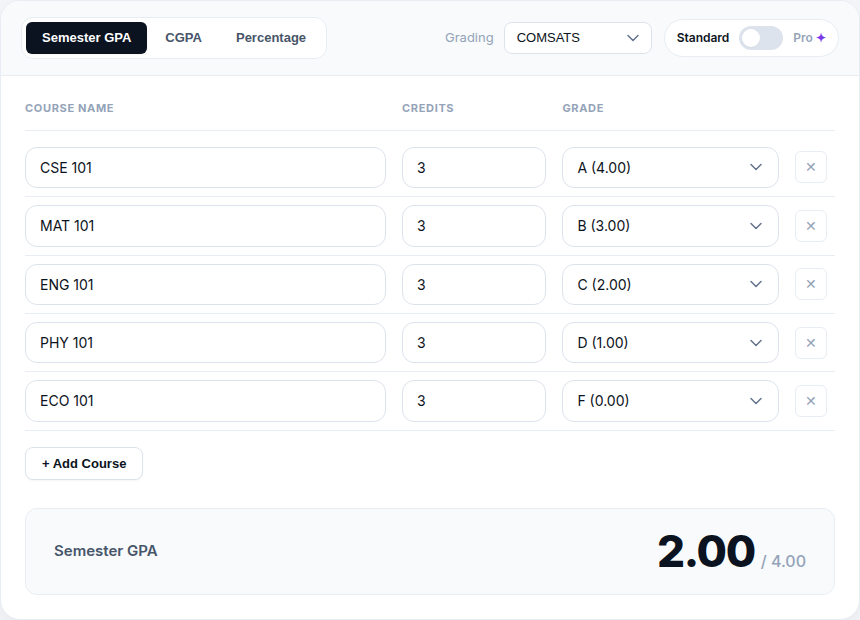
Screenshot: the CGPAPro calculator with the COMSATS scale selected and a worked five-course semester — exactly 2.00, the good-standing line. Add your own courses the same way.
One honest note: like most calculators, CGPAPro uses the rounded grade points (3.70 for A−, 2.70 for B−) for quick calculation, while COMSATS’ official handbook uses the exact values (3.66 / 2.66 / 1.66 / 1.30). The difference only matters at the margins, and the rest of this guide shows you the official math so you can double-check anything by hand.
Read More: How to Calculate SGPA: Formula & Examples (2026) — the credit-weighted formula explained step by step with four worked scenarios.
The Official COMSATS Grade Table (2026)
This is the table from CUI’s own Graduate Handbook 2023 (§2.10, “Grading”), which applies the grading policy adopted by the Academic Council in 2021. If any third-party site shows you something different, this table wins:
| Percentage | Letter Grade | Grade Points | Assessment |
|---|---|---|---|
| 85 & above | A | 4.00 | Excellent |
| 80 – 84 | A− | 3.66 | Very Good |
| 75 – 79 | B+ | 3.33 | Above Average |
| 71 – 74 | B | 3.00 | Good |
| 68 – 70 | B− | 2.66 | Fair |
| 64 – 67 | C+ | 2.33 | Satisfactory |
| 61 – 63 | C | 2.00 | Adequate |
| 58 – 60 | C− | 1.66 | Marginal |
| 54 – 57 | D+ | 1.30 | Pass |
| 50 – 53 | D | 1.00 | Pass |
| Below 50 | F | 0.00 | Fail |
Three things jump out. First, there is no A+ — a plain A is the highest grade you’ll ever earn, and it’s worth the same 4.00 that an A+ gets elsewhere. Second, the grade points are exact to two decimals in an unusual way: 3.66, 2.66, 1.66 and 1.30. Almost every third-party calculator rounds these to 3.67, 2.67, 1.67 (and 1.33), which introduces small errors in hand calculations. Third, the bands are narrow in the middle: B+ is just 75–79, B is 71–74 — a single bad quiz really can move your letter grade.
Also note the band edges carefully: B starts at 71, not 70. C is 61–63, not 60–63. One popular calculator lists C+ as 61–64 and C as 58–60, which is simply wrong and can mislead you by a full grade near the boundaries.
Why Half the Internet Says 60% Is Passing
This is the single biggest source of confusion about COMSATS grading, so let’s settle it with the handbook’s own words:
“The minimum pass marks in a course shall be 60% or a C grade for students admitted before Fall 2021… The minimum pass marks for students admitted in or after Fall 2021 shall be 50% or a D grade.”
In Fall 2021, COMSATS overhauled its grading policy (per the Grading Criteria Notification adopted by the Academic Council that year). Before the change, you needed 60% — a C — to pass a course. After the change, the pass line dropped to 50% — a D. The D+, C− and revised C+ bands were introduced at the same time.
So when a senior, an old forum post, or a five-year-old article tells you “COMSATS mein 60 se neeche fail hai,” they’re remembering the pre-2021 policy. For anyone who joined in Fall 2021 or later — which is every current BS student by now — 50% is the pass line. Your transcript follows the policy that was in force when you were admitted.
The Rounding Rule Nobody Mentions
Here’s a detail from §2.10 of the Graduate Handbook that no calculator site mentions: your marks are rounded to the nearest whole number before they’re matched to a grade band. If the tenths digit is 5 or more, you round up; below 5, you round down. The handbook’s own examples: 70.5 or 70.6 → 71 (a B), while 70.4 → 70 (a B−).
This answers the most anxiety-inducing question every semester: “79.6% pe konsa grade?” 79.6 rounds to 80 — an A− (3.66). But 79.4 rounds to 79 — a B+ (3.33). That’s a 0.33 grade-point swing on a 0.2-mark difference, which is why borderline students should always check their exact aggregate instead of assuming.
A couple more examples: 84.6% rounds to 85 → A (4.00). 57.5% rounds to 58 → C− (1.66) instead of D+ (1.30). And 49.5%? That rounds to 50 — a D (1.00), not an F. Rounding is your friend at the bottom of a band and your enemy at the top.
Absolute Grading: No Curving at COMSATS
COMSATS grades on a fixed, absolute scale — the bands above apply to everyone, every semester, with no adjustment. If the whole class scores 90+, the whole class gets A. If the exam was brutal and the class average is 62, there is no curve to save anyone; the marks stand as they are.
This is a genuine differentiator from peer universities. NUST and FAST (NUCES) both use relative grading, where your grade depends on how the class performed — an 82% could be an A in a hard section or a B+ in an easy one. At COMSATS, an 82% is an A−, period, and you can predict your exact GPA before results come out. The flip side: nobody’s grade gets lifted by a hard paper.
Read More: NUST Grading System 2026: HEC Grades, GPA Calculation & Everything Students Ask — see how NUST’s relative grading compares to COMSATS’ fixed bands.
How SGPA and CGPA Are Calculated at COMSATS
COMSATS uses the standard credit-weighted formula. Each course contributes grade points × credit hours (its “quality points”), and you divide by total credit hours:
SGPA = Σ (Grade Points × Credit Hours) ÷ Σ Credit Hours — for one semester
CGPA = Σ (Semester quality points) ÷ Σ Credit Hours — across all semesters
The result is typically reported to two decimal places. A few practical points: courses registered as non-credit (NC) are excluded from the GPA/CGPA calculation entirely — pass or fail, they don’t move the number (only passed NC courses appear on the transcript, listed separately). W (withdrawn) grades carry no grade points and don’t affect GPA either.
Worked Example: Calculating SGPA Step by Step
Let’s take a realistic first-semester student — five courses, 15 credit hours — and use the official grade points:
| Course | Marks | Grade | GP | CH | Quality Points |
|---|---|---|---|---|---|
| Programming Fundamentals | 85 | A | 4.00 | 3 | 12.00 |
| Calculus | 77 | B+ | 3.33 | 4 | 13.32 |
| English Composition | 69 | B− | 2.66 | 3 | 7.98 |
| Physics | 65 | C+ | 2.33 | 3 | 6.99 |
| Pakistan Studies | 51 | D | 1.00 | 2 | 2.00 |
| Total | 15 | 42.29 |
SGPA = 42.29 ÷ 15 = 2.82
Notice how the official 2.66 and 2.33 (not the rounded 2.67 / 2.33 that calculators use) shift the decimals: with rounded values this student would show 2.83 instead of 2.82. Small per semester, but it compounds over eight semesters — which is exactly why the official table matters for hand verification.
Also notice the D in Pakistan Studies: 51 marks earns a D (1.00), not an F — the post-2021 pass line at work. Under the old policy that same 51 would have been a fail.
Worked Example: CGPA Across Semesters
CGPA weights each semester by its credit hours. Say our student takes 18 credit hours each semester and earns SGPAs of 3.20, 3.40, 3.50 and 3.30:
Quality points: (3.20 × 18) + (3.40 × 18) + (3.50 × 18) + (3.30 × 18) = 57.60 + 61.20 + 63.00 + 59.40 = 241.20
CGPA = 241.20 ÷ 72 = 3.35
A later semester with more credit hours pulls the CGPA harder than a lighter one — improving a heavy 21-credit semester moves your CGPA more than a 12-credit one does. And converting to percentage by the HEC convention: 3.35 ÷ 4.00 × 100 = 83.75% (more on the honesty of that conversion below).
Passing, Probation and Dismissal: the BS Rules
This section comes from COMSATS Lahore’s official Student Handbook, and it’s the part students should read before they need it. Every BS student’s transcript carries a two-letter academic status each semester:
- GS — Good Standing. You start here, and you keep it as long as your CGPA is 2.00 / 4.00 or above.
- PB — Probation. The moment your CGPA drops below 2.00 at the end of a semester, probation is stamped on your transcript. It’s a warning, not the end — you get a chance to climb back.
- DI — Dismissal. A second successive probation triggers automatic dismissal from the university.
The math is unforgiving: with a 2.82 SGPA like our worked example, one bad semester (say a 1.50) drags a two-semester CGPA to 2.16 — technically safe, but one more slip and you’re on probation. This is why students hover anxiously around the 2.00 line: it’s not just a number, it’s the difference between staying enrolled and leaving.
Practical guardrails that go with these statuses: a full-time BS student registers 12–21 credit hours per semester (two ~18-week semesters a year: Spring and Fall). You can add or drop courses within 5 teaching days of the semester start, and withdraw before the second sessional test with a W on the transcript and no academic penalty. Dropping within the first 4 weeks carries no penalty at all. If life intervenes, you can freeze up to 4 semesters total (never more than 2 in a row) — but frozen semesters count toward your maximum 12-semester degree duration.
MS and PhD Grading: the 2.50 Floor
Graduate students play by stricter rules (from the Graduate Handbook 2023, §§2.1, 2.4, 2.8, 2.10). The headline number is 2.50, not 2.00:
- Good academic standing (GAS) requires a CGPA of 2.50 / 4.0 at the end of every semester (Fall-2023 admits onward, per the BASAR standard).
- Fall below 2.50 in any semester → PRB (probation).
- Fail to climb back to 2.50 by the end of the next semester → DIS (dismissal), with admission cancelled without notice.
The failed-course repeat rules are the part that surprises graduate students most. If you fail a course, you get two chances to reappear by repeating the same course whenever it’s offered — and you cannot substitute a different course to dodge it. Fail the same course twice and you’re dismissed, full stop.
Then there’s the “Two-‘C’ Grade Policy” for MS/PhD students admitted in or before Spring 2023: you are allowed a maximum of one course with a C or lower (excluding F) in your entire degree. Accumulate more than one such course in your first semester → dismissal. Accumulate more than two in later semesters → DIS. You get one improvement chance, under PRB status, in the same course. An elective with no improvement opportunity is terminal for your degree.
Two more graduate landmines: in courses with both theory and lab components, you must pass theory and lab separately — failing either fails the whole course. And 80% attendance is required to sit the terminal exam; the HoD can condone up to 10% on your teacher’s recommendation, but short attendance means you’re not allowed in the exam hall and an F is awarded.
For reference on the way out: an MS degree needs a 2.50 CGPA plus a final thesis copy, a Certificate of Originality and a plagiarism report. A PhD needs 18 credit hours of coursework, a comprehensive exam (passed within the first two years, 60% per paper, max two attempts), at least one research article in an HEC-recognized journal, a thesis and an oral defense. MS admission itself requires a minimum CGPA of 2.5 with no D grade anywhere in your academic career and 50% on the NTS GAT; PhD admission needs 3.0, no D grade, and 60% on the GAT (Subject).
Failed a Course? Retake Rules Explained
The biggest student fear after an F is simple: “kya hoga?” Here’s the policy picture:
- Graduate students: repeat the same course when offered (two chances); no substitution; F twice in the same course → dismissal.
- Undergraduate students: the Lahore handbook’s GS/PB/DI statuses apply, and you must clear failed courses to progress — check your current program handbook for the exact repeat-and-improvement wording, since the most detailed official repeat rules published are the graduate ones.
- Theory + lab rule applies wherever both exist: failing either component fails the whole course, so a strong lab score can’t rescue a failed theory paper.
- Rechecking (retotalling) is available on payment of a fee — but reevaluation is not allowed, and lab, practical and viva papers can’t be rechecked at all.
- Makeup exams: mid-term makeup only in special circumstances (apply within 1 week); a terminal-exam makeup requires 60%+ pre-terminal marks and an application within 2 working days.
The honest bottom line: COMSATS gives you room to recover from a bad semester, but very little room to recover from repeated failures in the same course. Plan retakes early, not in your final year.
How Your Marks Are Split (Undergrad vs Graduate)
Knowing the split tells you where to fight. For graduate courses: 25% mid-term + 25% quizzes and assignments + 50% terminal exam (labs follow the same split). For undergraduates (Lahore handbook): 10% Sessional I + 15% Sessional II + 25% quizzes and assignments + 50% terminal.
The takeaway is stark: half of your grade is decided before you ever sit the final. A student with 45/50 in sessionals and quizzes walks into the terminal needing only 35/100 to reach an 80 (A−). A student with 20/50 in sessionals needs 60/100 in the final for the same grade — the same paper, twice the pressure. Consistent weekly work beats heroic last-minute studying at COMSATS, mathematically.
CGPA to Percentage: the Honest Conversion
Across Pakistan, the HEC convention is:
Percentage = (CGPA ÷ 4.0) × 100
So a 3.35 CGPA → 83.75%, a 3.50 → 87.50%. Almost every calculator uses this. But here’s the honesty part: COMSATS has no single official transcript-equivalence table mapping CGPA to percentage. The HEC formula is a widely accepted convention, not a university-stamped conversion.
Why does this matter? Because of WES and foreign universities. If you’re applying for an MS abroad, credential evaluators like WES apply their own conversion to your grades — and some treat Pakistani grades differently from the HEC formula. Always check the specific evaluator’s policy (and your target university’s requirements) instead of assuming (CGPA/4)×100 is what will land on your application.
Read More: How to Convert CGPA to Percentage in 2026 — formulas, country-wise tables and the WES pitfalls to watch for.
COMSATS vs NUST vs FAST: Absolute vs Relative Grading
Students choosing between Pakistan’s top tech universities often ask which grading is “easier.” The honest answer is that they work so differently the comparison needs a table:
| COMSATS | NUST | FAST (NUCES) | |
|---|---|---|---|
| Grading style | Absolute (fixed bands) | Relative (curved vs class) | Relative (curved vs class) |
| A band | 85%+ | Varies by section | 90%+ |
| Pass line | 50% (D) | 50% (D) | 50% (D) |
| Grade points | 3.66 / 2.66 / 1.66 / 1.30 | 3.67 / 2.67 / 1.67 | 3.67 / 2.67 / 1.67 |
| A+ | None | None | None |
| Predictability | You can compute your GPA from raw marks | Depends on class performance | Depends on class performance |
Practically: at COMSATS an 82% is always an A−. At NUST that same 82% could be an A in a section where the average was 60, or a B in a section where everyone scored 90. Relative grading rewards you for outperforming peers and punishes you for being average in a strong batch; absolute grading is neutral — your grade is yours alone. Neither is “easier”; they’re different games, and COMSATS’ game is the more transparent one.
LUMS’ grading system is another useful comparison if you’re weighing business-school options alongside the tech universities.
Gold Medals, Dean’s List and What Counts as “Good”
What CGPA should you aim for? Let’s separate what’s official from what’s commonly quoted:
- Patron’s Gold Medal: CGPA 4.00. A perfect record.
- Institute Gold / Silver / Bronze: 3.75 and above.
- Campus Gold / Silver / Bronze: 3.50 and above.
These come from the Registrar’s Academic Medals notification — and the eligibility conditions are brutal: you qualify only if you never failed or repeated any course and completed the degree within the minimum prescribed time (no breaks, no freezes, no absences). Eligibility is just the ticket — medals are decided on merit among the eligible, ties at two decimals share the medal, and they’re awarded only at convocation.
Dean’s List: students commonly quote 3.50 as the Dean’s List cutoff, and many departments honor it in practice — but be aware that no current official CUI document we could find publishes this threshold. Treat 3.50 as the strong norm, not a guaranteed rule.
And the “is my CGPA good?” question: below is a practical read for Pakistani universities. A 3.50+ keeps you eligible for campus medals, most scholarships and MS-abroad shortlists; 3.00–3.49 is solid and safe for local jobs; 2.50–2.99 is fine but closes some graduate-school doors; below 2.00 (BS) puts your enrollment at risk. Our full career breakdown is in Is 3.5 CGPA Good?
Common Mistakes COMSATS Students Make
- Calculating with rounded grade points. Most websites use 3.67/2.67/1.67. Your transcript uses 3.66/2.66/1.66/1.30. Over eight semesters the drift is real.
- Believing the old 60% pass line. If you joined in Fall 2021 or later, 50% passes. Panicking over a 55 because “seniors said 60 is fail” is wasted anxiety.
- Assuming there’s an A+. There isn’t. Planning your semester around “I’ll just grab an A+ in the easy course” doesn’t work at COMSATS.
- Ignoring the rounding rule. A 79.4 and a 79.6 look nearly identical on a marksheet but differ by 0.33 grade points. Always check your exact aggregate.
- Treating the terminal exam as 100% of the grade. It’s 50%. Half your grade is sessionals, quizzes and assignments — skipping a quiz series can quietly cost you a full letter grade.
- Missing the attendance line. Below 80% attendance and you don’t sit the terminal exam — an F, not a zero on one paper. An F.
- Thinking W or NC courses “protect” your GPA by hiding. They don’t affect GPA, true — but a transcript full of Ws tells its own story to graduate schools and employers.
- Letting one course fail twice (graduate students). Two Fs in the same course is dismissal. Repeat early, take the improvement chance, don’t drift.
7 Tips to Protect Your COMSATS CGPA
- Target the band edges, not the middle. The jump from 79 to 80 is worth 0.33 grade points — more than the jump from 80 to 84. Before finals, compute exactly which grade boundary you’re closest to and aim your revision there.
- Win the first 50%. Sessionals, quizzes and assignments are the cheapest marks in the course. Walking into the terminal with 42/50 banked turns every final into a formality.
- Guard your attendance like your GPA depends on it — it does. One skipped lecture too many and you’re not failing a paper, you’re failing the course.
- Never let a D+ sit when you can improve it. A 1.30 drags every average it touches. If your handbook allows improvement attempts, use them on your weakest pass grades first.
- Balance heavy and light semesters. A 21-credit semester moves your CGPA almost twice as fast as a 12-credit one. Put your hardest courses in the semesters where you have the lightest total load.
- For graduate students: count your C-or-below courses. The Two-‘C’ policy means your margin for mediocre courses is essentially one. Plan course selection around it.
- Verify with the official table. Run the numbers yourself with the handbook grade points (3.66/2.66/1.66/1.30) once a semester — it takes ten minutes and catches every discrepancy between what a calculator told you and what your transcript will say.
Frequently Asked Questions
What is the passing percentage at COMSATS in 2026?
50% — a D grade — for all students admitted in or after Fall 2021. Students admitted before Fall 2021 remain under the old policy where the pass line was 60% (C grade). If you joined recently, ignore anyone quoting 60%.
How is CGPA calculated at COMSATS?
Multiply each course’s official grade points (e.g. A = 4.00, A− = 3.66, B+ = 3.33) by its credit hours, add those quality points up, and divide by total credit hours. Do this per semester for SGPA; across all semesters for CGPA. Results are reported to two decimals.
Is there an A+ grade at COMSATS?
No. The official scale tops out at A (85%+, 4.00). Calculator websites that list an A+ are wrong.
What happens if my CGPA drops below 2.0 at COMSATS?
For BS students, a CGPA below 2.00 at semester end puts you on probation (PB) on your transcript. A second successive probation means dismissal. Graduate students face a higher floor: below 2.50 means probation (PRB), and failing to recover by the next semester means dismissal (DIS).
Can I retake a failed course at COMSATS?
Yes — graduate students get two chances to reappear by repeating the same course (no substitution allowed). But failing the same course twice means dismissal. Theory and lab components of a course must each be passed separately.
How do I convert my COMSATS CGPA to percentage?
Use the HEC convention: Percentage = (CGPA ÷ 4.0) × 100. A 3.35 CGPA ≈ 83.75%. Note this is a convention, not an official COMSATS equivalence table — foreign credential evaluators like WES may apply their own conversion.
What CGPA do I need for a gold medal at COMSATS?
4.00 for the Patron’s Gold, 3.75+ for Institute medals, 3.50+ for Campus medals — and you must have never failed or repeated any course and finished within the minimum degree duration. Eligibility alone doesn’t win the medal; it’s decided on merit among eligible students.
Conclusion
COMSATS’ grading system looks intimidating on a forum thread, but it’s one of the most transparent in Pakistan once you have the real rules: fixed absolute bands, exact handbook grade points (3.66 / 2.66 / 1.66 / 1.30, not the rounded versions), marks rounded before banding, a 50% pass line since Fall 2021, and a clear 2.00 / 2.50 probation ladder. The students who get hurt are the ones working from outdated advice — the 60% pass line, the phantom A+, the wrong band edges.
Bookmark this guide, verify your numbers against the official table once a semester, and use the CGPAPro calculator (COMSATS scale) for quick checks between results. Your GPA is entirely computable from your raw marks — at COMSATS, there are no surprises unless you let them happen.