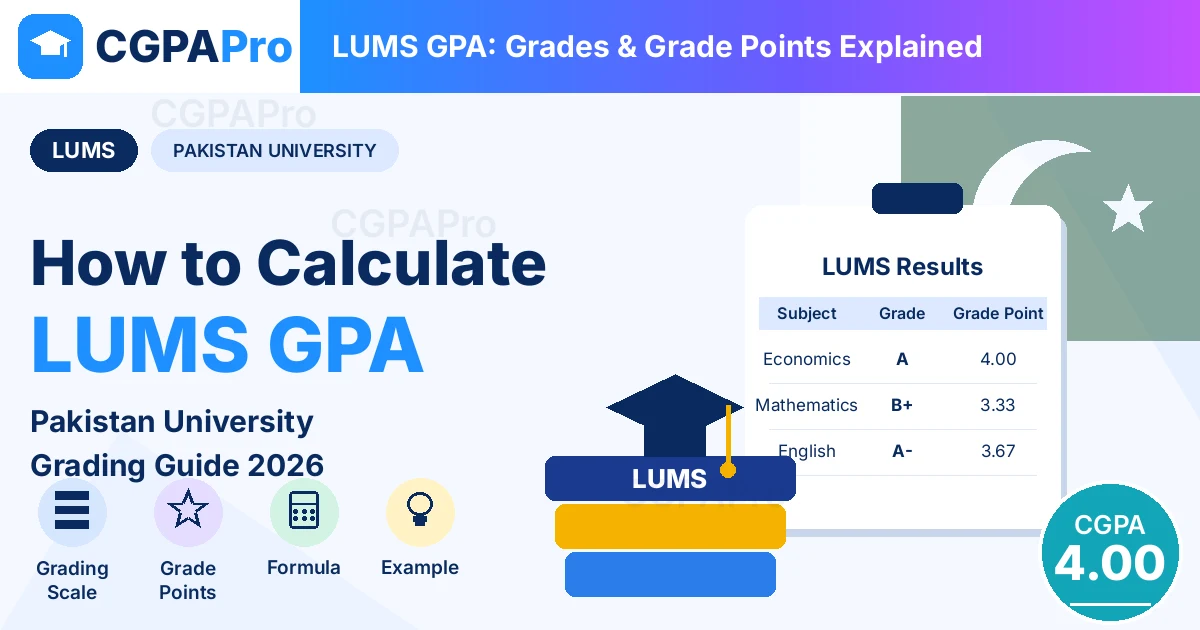
The LUMS grading system runs on a 4.0 GPA scale where your letter grades convert to fixed grade points: A+ and A both equal 4.0, A− is 3.7, B+ is 3.3, B is 3.0, B− is 2.7, C+ is 2.3, C is 2.0, C− is 1.7, D is 1.0, and F is 0.0. Your semester GPA is the credit-weighted average of those points, and your CGPA is the same calculation stretched across every semester you have completed. That is the whole system in one paragraph — but the details are where LUMS students get tripped up, because the percentage bands you see floating around online are not actually fixed by the university, the Dean’s list cutoff is lower than most people think, and falling below a 2.0 CGPA starts a very specific warning-probation-separation ladder that is written into the student handbook.
This guide walks through all of it with real numbers: the official grade table, how semester GPA and CGPA are calculated exactly the way LUMS computes them, a full worked example, the probation and Dean’s Honour List rules verified from the LUMS Undergraduate Student Handbook, the mistakes that quietly cost students grade points every semester, and answers to the questions LUMS students actually ask each other. If you just want the number, use the calculator below — if you want to understand the system, keep reading.
Calculate Your LUMS GPA in Seconds
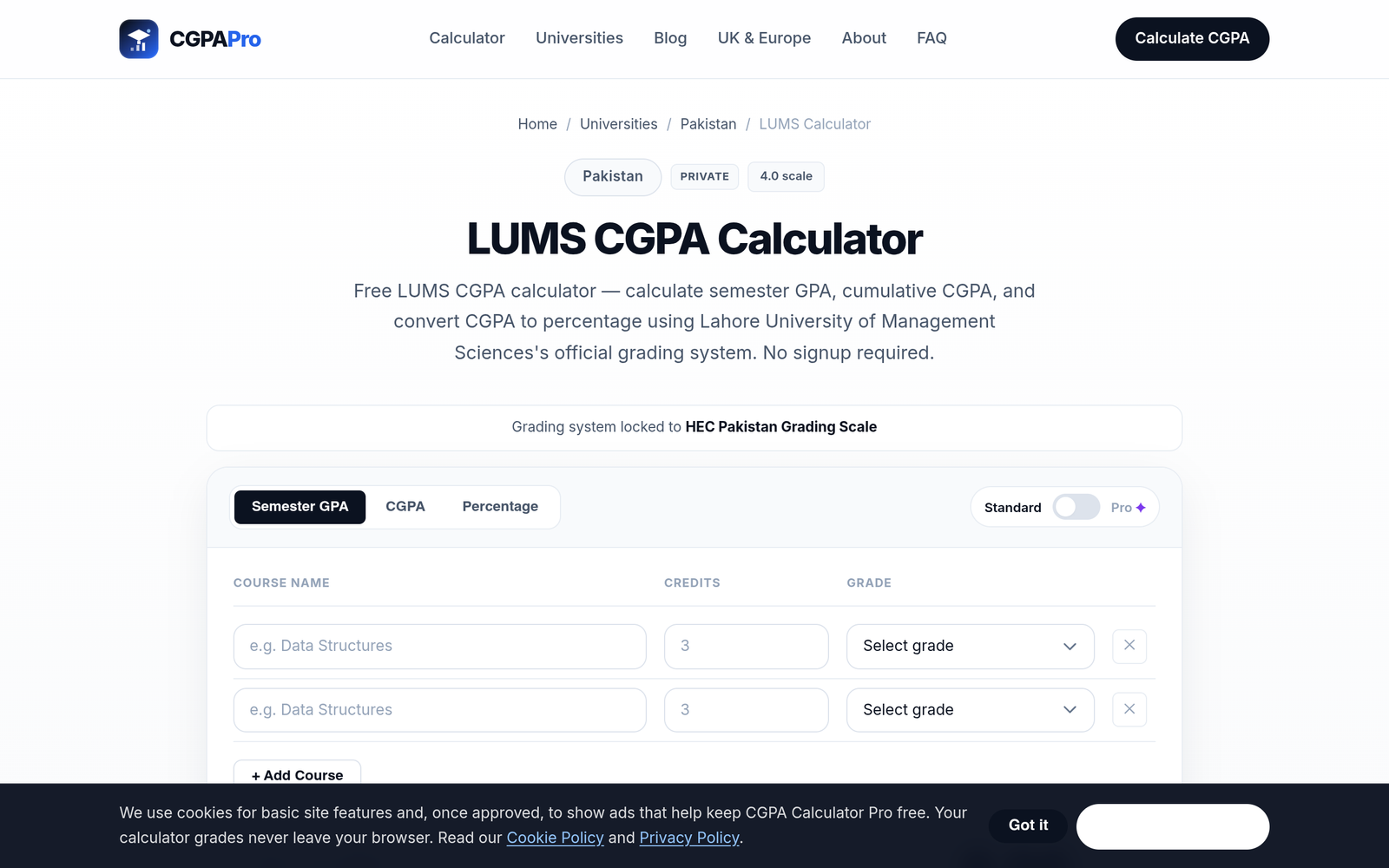
Before the tables and formulas, here is the fastest path: the free LUMS GPA calculator is pre-loaded with the LUMS grading system, so you don’t have to look up grade points yourself.
- Open the LUMS GPA calculator.
- Add each course: enter the course name, its credit hours, and the letter grade you received (or expect).
- The calculator converts every grade to LUMS grade points automatically — A is 4.0, B+ is 3.3, and so on.
- To get your semester GPA, enter only this semester’s courses. To get your CGPA, add your previous cumulative credit hours and grade points as well.
- Play with “what-if” grades before finals: change a B+ to an A− and watch exactly how many hundredths of a point it moves your GPA.
That last step is the one most students skip, and it is the most useful. At LUMS, where a semester GPA of 3.60 puts you on the Dean’s Honour List and a CGPA under 2.00 puts you on probation, knowing precisely how much each remaining exam is worth changes how you study for it.
The Official LUMS Grade Table (2026)
Here is the letter-to-grade-point mapping used at LUMS, verified against the LUMS Undergraduate Student Handbook and the HEC Pakistan grading framework. One thing to notice immediately: LUMS fixes the letter-to-point mapping, not the percentage bands. Each instructor sets the percentage cutoffs for their own course (absolute scale) or grades on a curve (relative scale) — the course outline issued in the first week tells you which. That is why two LUMS students can earn the same letter with different percentages, and why percentage-conversion tables from random websites are unreliable.
| Letter Grade | Grade Points | Meaning |
|---|---|---|
| A+ | 4.0 | Exceptional |
| A | 4.0 | Excellent |
| A− | 3.7 | Very good |
| B+ | 3.3 | Good |
| B | 3.0 | Above average |
| B− | 2.7 | Average |
| C+ | 2.3 | Satisfactory |
| C | 2.0 | Adequate |
| C− | 1.7 | Below average |
| D | 1.0 | Passing (minimum) |
| F | 0.0 | Failing |
Two grades deserve special attention. A+ is worth 4.0 — exactly the same as A. Chasing an A+ instead of settling for an A buys you zero CGPA, though it does matter for end-of-year top-position tie-breakers (more on that below). D is a passing grade at 1.0, unlike some universities where anything below C is a fail — but a D still drags your average down hard, as the worked example will show.
How to Calculate Your LUMS GPA (Step by Step)
LUMS computes GPA the standard credit-weighted way, per the Undergraduate Student Handbook’s stated method:
Semester GPA = Total grade points earned ÷ Total credit hours attempted
- Convert each letter grade to grade points using the table above.
- Multiply each course’s grade points by its credit hours. (A 4-credit A− = 3.7 × 4 = 14.8 points.)
- Add up all the grade points → total grade points.
- Add up all the credit hours → total credit hours attempted. (Failed courses count here at 0.0 points; withdrawn courses do not count at all.)
- Divide total grade points by total credit hours. That is your semester GPA.
Worked Example: A Real LUMS Semester
Take a typical 17-credit LUMS semester:
| Course | Credits | Grade | Points | Grade Points |
|---|---|---|---|---|
| Quantitative Methods | 4 | A− | 3.7 | 14.8 |
| Academic Writing | 3 | B+ | 3.3 | 9.9 |
| Microeconomics | 4 | B | 3.0 | 12.0 |
| Intro to Computing | 3 | A | 4.0 | 12.0 |
| Pakistan Studies | 3 | C+ | 2.3 | 6.9 |
| Total | 17 | — | — | 55.6 |
Semester GPA = 55.6 ÷ 17 = 3.27
Notice how the 4-credit A− (14.8 points) contributes more than the 3-credit A (12.0 points) — credit hours multiply everything. And notice the C+ in Pakistan Studies: a single 3-credit C+ costs roughly 0.2 GPA points in a 17-credit semester. That is the arithmetic behind “protect your high-credit courses first.”
How to Calculate CGPA at LUMS
CGPA uses the same formula stretched across your whole degree:
CGPA = Total grade points (all semesters) ÷ Total credit hours attempted (all semesters)
Worked example across four semesters:
| Semester | GPA | Credits | Grade Points |
|---|---|---|---|
| Semester 1 | 3.31 | 18 | 59.58 |
| Semester 2 | 3.55 | 17 | 60.35 |
| Semester 3 | 3.42 | 18 | 61.56 |
| Semester 4 | 3.70 | 16 | 59.20 |
| Total | — | 69 | 240.69 |
CGPA = 240.69 ÷ 69 = 3.49
This student is one strong semester away from the 3.60 Dean’s Honour List zone and comfortably clear of any academic trouble. Now look at the darker version of this math, because it matters: suppose instead this student finished those four semesters with a CGPA of 3.30 (227.7 grade points over 69 credits) and wanted to reach 3.50 by the end of semester five (16 more credits, 85 total). They would need 297.5 total grade points — meaning 69.8 points from 16 credits, an average of 4.36 per credit. That is mathematically impossible, since the maximum is 4.0. CGPA is a weighted average with a long memory: the more credits you have banked, the harder each additional semester has to work to move the needle. A bad semester early is cheap to fix; the same bad semester in your junior year is nearly permanent. This is why the “I’ll fix it next semester” plan quietly fails — run the numbers honestly before you believe it.
GPA vs CGPA: What’s the Difference?
| Semester GPA | CGPA | |
|---|---|---|
| Covers | One semester only | Your entire degree so far |
| Used for | Dean’s Honour List eligibility, probation warnings | Graduation, jobs, MS/PhD applications |
| Resets? | Yes — fresh start every semester | No — every semester leaves a permanent mark |
| Volatility | Swings easily (one F can halve it) | Moves slowly (dozens of credits anchor it) |
Both matter, but for different audiences. Recruiters and graduate schools look at your CGPA — it is the headline number on your transcript. LUMS’s own academic machinery mostly watches your semester GPA and CGPA together: a bad semester GPA triggers a warning letter even if your CGPA is fine, and the Dean’s Honour List is awarded on semester GPA alone. Treat them as two dashboards: semester GPA tells you how you are driving right now, CGPA tells you where the car actually is.
7 Common Mistakes LUMS Students Make With Grades
- Trusting a random percentage table from Google. As covered above, LUMS fixes the letter-to-point mapping, not the percentage bands. An “A = 85–89%” table from a calculator site is not your course’s table. Check the course outline.
- Treating all courses as equal. A 4-credit A− (14.8 points) outweighs a 3-credit A (12.0 points). Students routinely pour revision hours into a beloved 3-credit elective while a 4-credit core course quietly decides their GPA.
- Ignoring the W option until it’s too late. A strategic withdrawal from a course you are failing removes its credits from the GPA denominator entirely. An F keeps the credits in the denominator at 0.0 points. Know your semester’s withdrawal deadline — it is one of the highest-leverage dates in your calendar.
- Forgetting that a retaken F doesn’t erase the original. Both attempts’ credit hours factor into attempted hours per the handbook’s method. Retaking helps because the new grade adds points, but the old F’s drag doesn’t vanish.
- Chasing A+ for the GPA. A+ and A are both 4.0. The extra effort to turn an A into an A+ buys you zero CGPA — spend it turning a B+ into an A− instead, which is worth 0.4 points per credit.
- Assuming summer courses count for Dean’s list. They don’t — the Dean’s Honour List considers Fall and Spring semesters only.
- Doing CGPA math with simple averages. Averaging 3.31 + 3.55 + 3.42 + 3.70 gives 3.50, but the true credit-weighted CGPA in our example was 3.49. Small difference here; with uneven credit loads across semesters, the gap gets much bigger. Always weight by credits.
Probation, Warnings & Separation at LUMS: The Real Rules
This is the section no calculator site covers, and it is the one that actually determines whether you stay at LUMS. The rules below come from the LUMS Undergraduate Student Handbook’s academic standing regulations — the same framework the Higher Education Commission (HEC) of Pakistan expects HEC-recognised universities to enforce — not from forum folklore.
Warning letters (before probation)
LUMS issues academic warning letters in two situations: if your semester GPA falls below 2.00 in any regular semester, regardless of your CGPA, or if your CGPA sits below 2.50 but above 2.00. A warning is not probation — it is the university telling you to fix things now. First-year students who get a warning are advised to reduce their load and may not take more than 14 credit hours the following semester.
Academic probation
You are placed on academic probation if your CGPA falls below 2.00 at the end of any regular semester (Fall or Spring — summer doesn’t trigger standing decisions). You return to good standing as soon as your CGPA reaches 2.00 or above. Note that you can land on probation without ever receiving a warning letter first.
Separation from the programme
If your CGPA stays below 2.00 for two consecutive regular semesters, you are separated from your programme. For first-year students the timeline is tighter: fall below 2.00 in your first Fall semester and you spend Spring on probation; if your CGPA is still below 2.00 after Spring, you are separated with immediate effect. In later years, probation can extend over a maximum of two regular semesters, tracked through your Probation Semester GPA (PSGPA) — your cumulative performance since probation began. If your PSGPA is 2.50 or above at the end of the first probation semester while your overall CGPA is still under 2.00, probation is extended for one more semester; if the CGPA is still below 2.00 after that, separation follows.
The practical message: the 2.00 line at LUMS is not a suggestion. One bad semester puts you on probation; two in a row ends your degree. If you are anywhere near it, run your numbers through the LUMS GPA calculator before finals week — probation math done in November is a study plan; done in January, it’s damage control.
Dean’s Honour List at LUMS
The Dean’s Honour List is LUMS’s per-semester academic recognition, and the verified criteria are more specific — and more achievable — than the “3.7+” figure floating around the internet:
- Semester GPA of 3.60 or above in a regular semester (Fall or Spring; summer excluded).
- At least 16 credit hours successfully completed in that semester (waived only for your final semester before graduation).
- The remark “Placed on Dean’s Honour List” is printed on your transcript. There is no ceremony — it is a transcript honour, which is exactly what employers and graduate schools see.
At the end of each academic year, LUMS also recognises top position holders (Sophomore, Junior, Senior) under a separate university policy. Ties are broken with unusual precision: CGPA compared to six decimal places, then the count of A+ grades in 3–4 credit-hour courses, then A grades, then total credits completed. This is the one place where A+ grades genuinely matter — they are the first tie-breaker for the top position in your batch.
Graduation Requirements
To graduate from a LUMS undergraduate programme you must complete all required credit hours with a CGPA of at least 2.00 — the same threshold that governs probation, which is no coincidence. Only successfully completed credits count toward the degree: F grades and withdrawals earn nothing, though F grades still drag your GPA as explained above. Check your specific programme handbook for any additional requirements (senior project, internships, or school-specific rules), since these vary across LUMS’s schools.
8 Practical Tips to Improve Your CGPA at LUMS
- Rank your courses by GPA leverage, not by affection. Multiply each course’s credit hours by the point-gap between your likely grade and the next grade up. A 4-credit course where you can move from B to B+ (0.3 × 4 = 1.2 points) beats a 3-credit course where you might move from A− to A (0.3 × 3 = 0.9 points).
- Learn each course’s grading scheme in week one. Absolute or curved? What are the cutoffs? Under a curve, find the median and aim to sit clearly above it rather than chasing an arbitrary percentage.
- Protect the 3.60 line if you’re near it. The difference between a 3.58 and a 3.62 semester is a transcript honour. When you’re close, allocate revision time to the course sitting nearest a grade boundary.
- Use withdrawals strategically, not emotionally. Withdrawing from a doomed course removes it from your GPA entirely; riding it to an F keeps the credits in the denominator at zero points. Mark the withdrawal deadline at the start of every semester.
- Front-load effort in high-credit core courses. First-year students especially: the 4-credit quantitative and writing courses decide your GPA far more than electives do.
- Do the recovery math honestly. As the worked example showed, a 3.30 CGPA over 69 credits cannot reach 3.50 in one 16-credit semester — it’s arithmetically impossible. Knowing this early lets you set a two-semester plan instead of burning out chasing a fantasy.
- Convert your CGPA to percentage correctly for job forms. Many Pakistani job and FPSC forms ask for percentage — don’t guess; use the proper conversion method for your transcript. Our CGPA to percentage conversion guide walks through the accepted formulas step by step.
- Track every semester in a calculator, not in your head. Keep a running sheet of grade points per semester so you always know your exact CGPA trajectory — the CGPA Calculator Pro homepage has free tools for every major Pakistani university, including LUMS.
Read More: How to Convert CGPA to Percentage (2026) — the formulas employers and application forms expect, with worked examples for the 4.0 scale.
Frequently Asked Questions
What is the LUMS grading system?
LUMS uses a 4.0 GPA scale with plus/minus letter grades. A+ and A are both 4.0, A− is 3.7, B+ is 3.3, B is 3.0, B− is 2.7, C+ is 2.3, C is 2.0, C− is 1.7, D is 1.0 (passing), and F is 0.0. Semester GPA and CGPA are credit-weighted averages of these grade points, calculated per the method in the LUMS Undergraduate Student Handbook.
Does LUMS use relative grading (a curve)?
It depends on the course. LUMS instructors may grade on an absolute scale with fixed cutoffs or on a relative curve where your letter depends on your rank in the class. The course outline, issued in the first week, states which method applies — always check it, because the same percentage can earn different letters in different courses.
What percentage is an A at LUMS?
There is no single official answer. LUMS publishes the letter-to-grade-point mapping but not fixed university-wide percentage bands; each instructor sets the cutoffs for their course. Percentage tables you find online are approximations, not official LUMS policy.
What is the Dean’s Honour List cutoff at LUMS?
A semester GPA of 3.60 or above with at least 16 credit hours completed in a regular Fall or Spring semester. Summer semesters don’t count, and the remark “Placed on Dean’s Honour List” appears on your transcript.
What happens if my CGPA drops below 2.0 at LUMS?
You are placed on academic probation at the end of that regular semester. If your CGPA is still below 2.00 after a second consecutive regular semester, you are separated from the programme. You return to good standing as soon as your CGPA reaches 2.00 again. Warning letters are issued earlier — for any semester GPA below 2.00, or a CGPA between 2.00 and 2.49.
Do W grades affect my LUMS GPA?
No. Withdrawn courses are excluded from the credit hours attempted, so they don’t enter the GPA calculation at all. Failed (F) courses are different: their credit hours stay in the denominator at 0.0 grade points, pulling your GPA down.
Is an A+ better than an A at LUMS?
For your CGPA, no — both are worth 4.0 grade points. An A+ matters for end-of-year top-position awards, where A+ counts are the first tie-breaker, and it signals exceptional performance on your transcript.
Final Word
The LUMS grading system rewards students who understand its mechanics: the fixed letter-to-point table, the per-course percentage bands, the way credit hours multiply every grade’s impact, and the hard 2.00 and 3.60 lines that govern probation and honours. Most students learn these rules by accident — usually after a semester that didn’t go as planned. You now know them in advance. Run your numbers each semester with the LUMS GPA calculator, keep an eye on your credit-weighted trajectory, and the system stops being a source of anxiety and starts being a tool you can actually plan around.