
The NUST grading system confronts every NUST student in their first semester: the coursework is relentless, and the grading system has more letters than the alphabet seems to allow. A+? A? A−? B+? B? B−? With grade points dropping in 0.33 steps and HEC rules layered on top, computing your own CGPA by hand is an exercise in frustration.
This guide untangles it all: NUST’s official grade scale, the HEC framework behind it, step-by-step GPA math with a worked example, the repeat-course rules, and the mistakes that quietly cost NUST students grade points every semester.
Quick answer: The NUST grading system runs on a 4.00 scale where A = 4.0 and F = 0.0 (some NUST schools also award A+). Your semester GPA is total grade points ÷ total credit hours, and your CGPA extends this across all semesters. Failed courses must be repeated, and only the new grade counts toward CGPA. A minimum 2.00 CGPA is required to graduate under HEC policy.
Click Here: Free NUST CGPA Calculator — GPA, CGPA & Grade Planning
How to Use the NUST CGPA Calculator
Skip the manual arithmetic — the calculator comes pre-loaded with NUST’s official grading scale:
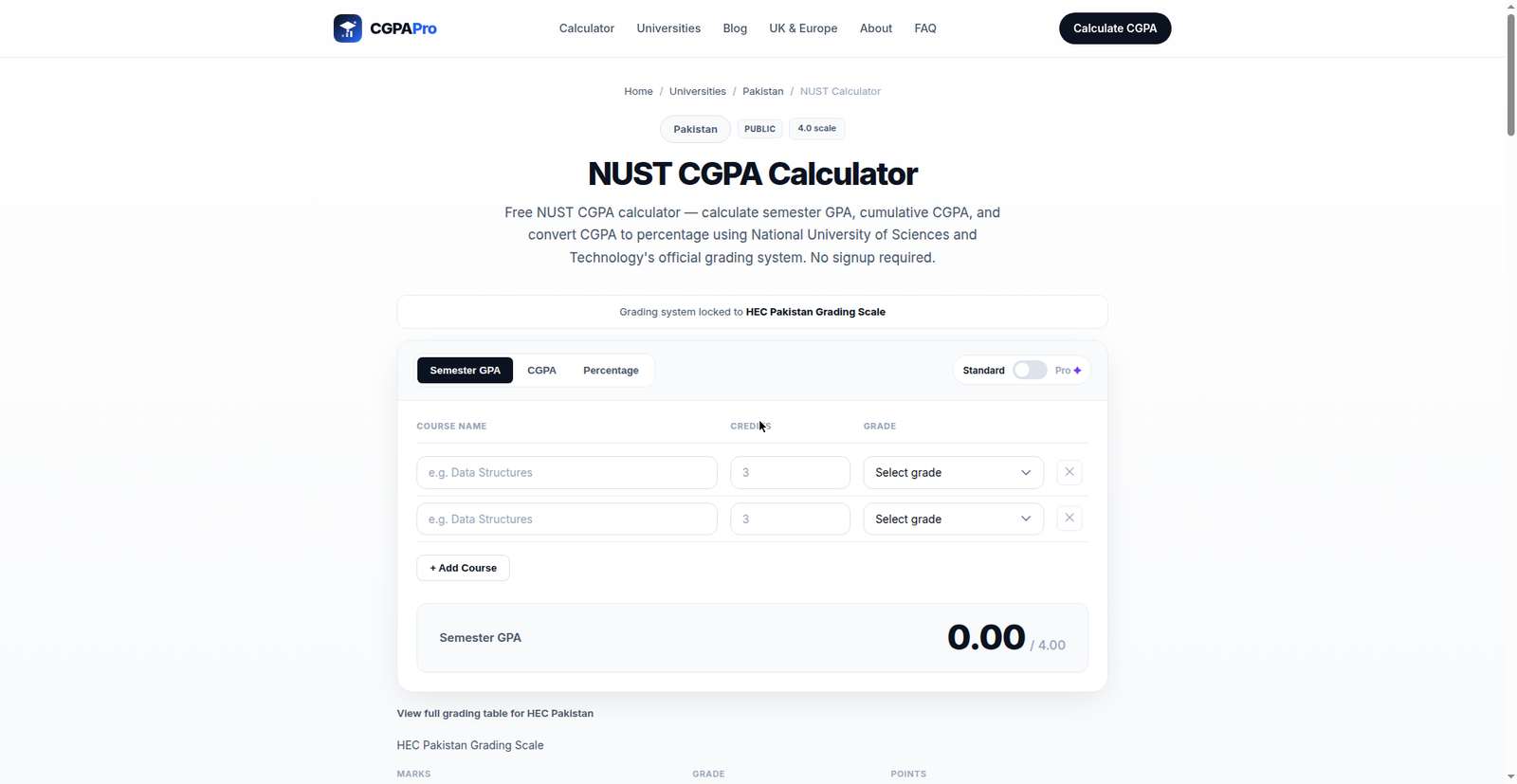
- Add your courses — one row per subject from your NUST result.
- Enter credit hours (most theory courses are 3 credits, labs 1).
- Select the letter grade — the correct NUST grade point maps automatically.
- Calculate for your instant semester GPA.
- Stack semesters in CGPA mode for your cumulative figure.
Quick Tip: NUST’s grade bands are narrow in the middle (B to C range) — check the official table below before estimating, because a 2–3 mark swing can move you a full letter grade.
What Is the NUST Grading System?
NUST follows the Higher Education Commission (HEC) of Pakistan’s grading framework: a letter-grade system on a 4.00 scale where each letter maps to a fixed grade point. Your course marks convert to a letter grade, the letter converts to grade points, and grade points weighted by credit hours produce your GPA.
Two NUST-specific notes. First, grade bands can vary slightly between NUST schools and programs — the letter-to-grade-point mapping below is the HEC/NUST standard, but your school’s student handbook is the final authority on exact marks cutoffs. Second, NUST transcripts commonly use the full HEC ladder including A+ and the minus grades, so make sure you’re reading the right row.
The Official NUST / HEC Grade Scale
| Letter Grade | Grade Point | Standing |
|---|---|---|
| A+ | 4.00 | Outstanding |
| A | 4.00 | Outstanding |
| A− | 3.67 | Excellent |
| B+ | 3.33 | Very good |
| B | 3.00 | Good |
| B− | 2.67 | Above average |
| C+ | 2.33 | Average |
| C | 2.00 | Satisfactory |
| C− | 1.67 | Below average |
| D+ | 1.33 | Weak pass |
| D | 1.00 | Minimum pass |
| F | 0.00 | Fail |
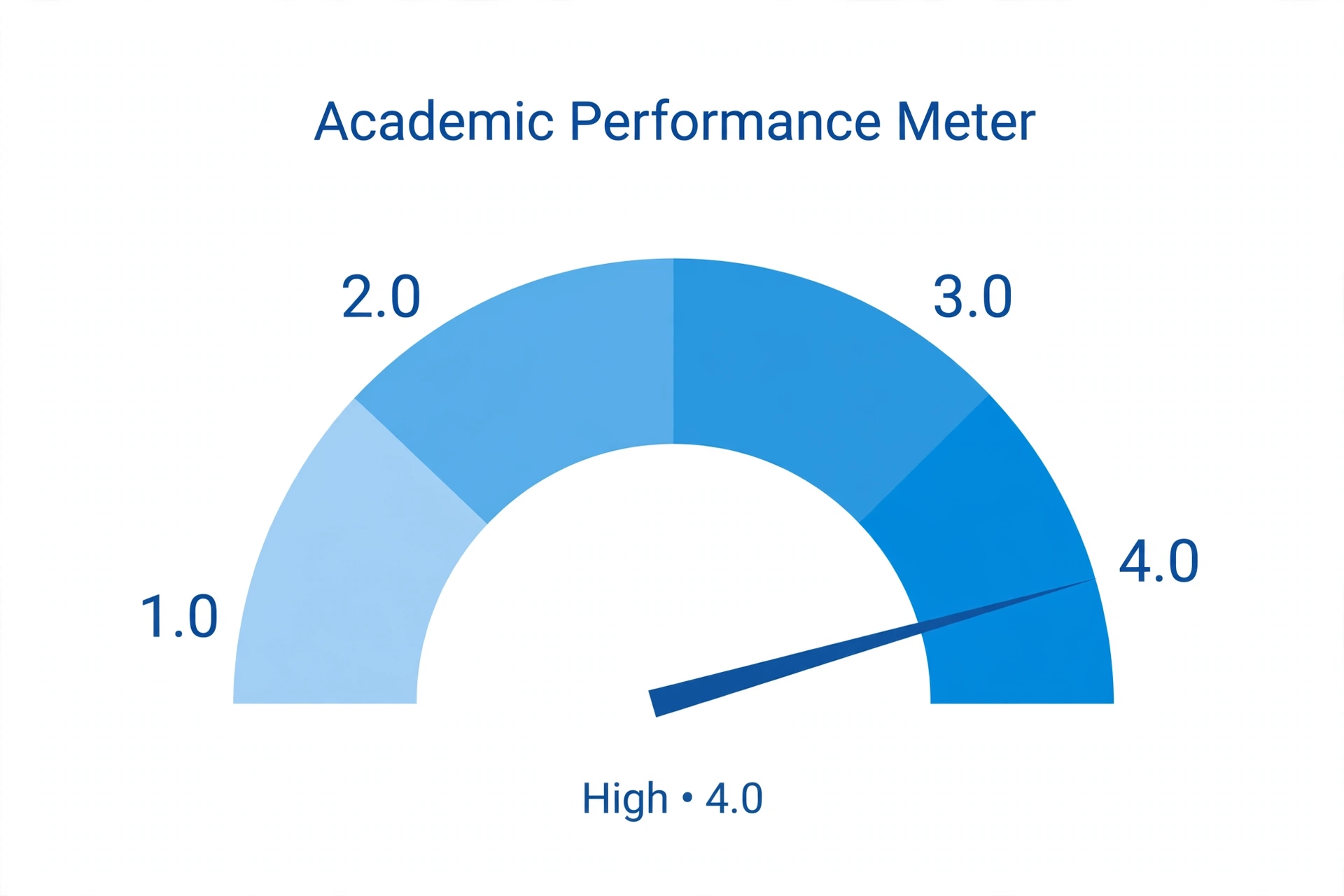
Notice the 0.33/0.34 stepping: A− (3.67) → B+ (3.33) → B (3.00). Every letter-grade step is worth roughly a third of a grade point per credit — which means crossing a single boundary on a 3-credit course swings your numerator by about 1.0 grade point.
What Information Do You Need to Calculate NUST GPA?
Your letter grades
The grade for each course exactly as awarded — A, B+, C−, and so on. Work from your official result, not from remembered marks.
Credit hours per course
The weight multiplier. Most NUST theory courses are 3 credit hours; labs are typically 1. Confirm from your registration record — one wrong credit value corrupts the whole calculation.
Which grades enter the formula
Only letter grades A+ through F count. W (withdrawal), I (incomplete), and similar non-grade entries appear on the transcript but are excluded from both grade points and attempted credits.
How to Calculate NUST GPA Step by Step
| Step | What to Do | Example |
|---|---|---|
| 1. List your courses | Each course with its credit hours | CS101 — 3 credits |
| 2. Convert grades to points | Use the official HEC/NUST table | A− → 3.67 |
| 3. Multiply | Grade point × credit hours per course | 3.67 × 3 = 11.01 |
| 4. Sum everything | Total grade points and total credits separately | 39.99 points / 12 credits |
| 5. Divide | Total grade points ÷ total credits | 39.99 ÷ 12 = 3.33 GPA |
Full worked example
A realistic NUST semester, worked end to end:
- CS101 (3 credits): A− (3.67) → 3 × 3.67 = 11.01
- EE102 (3 credits): B+ (3.33) → 3 × 3.33 = 9.99
- MTH103 (3 credits): B (3.00) → 3 × 3.00 = 9.00
- HUM104 (3 credits): A (4.00) → 3 × 4.00 = 12.00
Total grade points = 11.01 + 9.99 + 9.00 + 12.00 = 42.00
Total credits attempted = 12
Semester GPA = 42.00 ÷ 12 = 3.50
The NUST GPA Formula
Semester GPA = Total Grade Points Earned ÷ Total Credit Hours Attempted
CGPA = Total Grade Points (all semesters) ÷ Total Credit Hours Attempted (all semesters)
Identical mechanics — CGPA simply widens the window to your complete NUST record. Under HEC policy, your final degree CGPA is computed to two decimal places, and that number determines your degree division.
Difference Between GPA and CGPA at NUST
| GPA | CGPA |
|---|---|
| Measures one semester only | Measures your entire NUST degree |
| Can swing sharply term to term | Moves slowly — anchored by history |
| Shows recent form | Determines your degree division |
| Example: Semester GPA = 3.50 | Example: Overall CGPA = 3.29 |
NUST Repeat-Course Policy: Fixing Failed and Weak Grades
- Failed (F) courses must be repeated — you cannot graduate with an unresolved F on your record.
- When you repeat a course, only the new grade counts toward your CGPA; the old attempt’s grade-point contribution is removed from the calculation.
- You must re-register and pay tuition again for the repeated course.
- An F keeps contributing 0.0 against attempted credits until repeated — it actively drags your CGPA every semester it sits unresolved.
- Some NUST schools also allow repeating passed courses to improve grades (typically C or below) — check your school’s undergraduate handbook.
Strategy: because the grade-point steps are uniform (0.33 per letter), every boundary you cross on a retake is worth ~1.0 numerator points on a 3-credit course. Model it first in the NUST calculator — prioritize 3-credit courses sitting just below the next letter grade.
HEC Degree Divisions: What Your Final CGPA Means
| CGPA Range | Division | Standing |
|---|---|---|
| 3.50 – 4.00 | First Division | Distinction tier — top grad school & scholarship bracket |
| 2.50 – 3.49 | Second Division | Solid — meets most employer cutoffs |
| 2.00 – 2.49 | Third Division | Pass — graduation minimum only |
These HEC divisions appear on your degree and are the first filter on many Pakistani job applications and foreign university admissions. Crossing from 3.49 to 3.50 isn’t just a number — it’s a division change.
How to Interpret Your NUST GPA
What a higher GPA actually shows
NUST’s uniform 0.33 stepping means a high GPA reflects consistency across the whole ladder — there are no cheap jumps. A 3.6 at NUST means you lived in the A−/B+ band or better across nearly every course, which is why it carries weight with employers.
How each grade moves the needle
Credit hours dominate. A 3-credit course contributes 3× the grade points of a 1-credit lab, so a B+ in a core subject outweighs an A in a lab. Rank your finals prep by credit hours × boundary distance.
Why one F hurts disproportionately
An F adds zero points while its credits stay in the denominator — a 3-credit F forces your other courses to average near-perfect just to hold a 3.0. Repeating failed courses immediately is the single highest-ROI academic move available.
What your GPA doesn’t tell you
Trajectory matters more than a snapshot. A student climbing 2.4 → 2.9 → 3.4 demonstrates something a flat 3.1 never will — resilience and growth. Make your later semesters tell that story.
Common Mistakes When Calculating NUST GPA
Mixing up A+ and A grade points
Both carry 4.00 in the HEC scale. Students sometimes assign A+ a phantom 4.33 — it doesn’t exist in this system.
Using 3.7 instead of 3.67
NUST/HEC uses 3.67 for A− (not the 3.70 some Bangladeshi universities use). Small difference per course, but it compounds across a transcript.
Averaging marks instead of grade points
Marks must convert to letters first, then to grade points, then weight by credits. Averaging raw marks produces a meaningless number.
Forgetting credit weights
A straight average of grade points is only correct if every course carries identical credits — which is rarely true with labs in the mix.
Counting W and I grades
Withdrawals and Incompletes are excluded from both sides of the division. Including them deflates your result.
Rounding mid-calculation
Carry full precision through every multiplication; round only the final GPA to two decimals per HEC convention.
Tips for Improving Your NUST CGPA
- Repeat failed courses immediately. An unresolved F taxes every semester’s CGPA until it’s gone.
- Target boundary courses. Courses 1–2 marks below the next letter grade are your highest-ROI study hours.
- Weight effort by credit hours. A 3-credit B→B+ upgrade beats perfecting every 1-credit lab.
- Check your school’s handbook. Marks cutoffs can vary slightly between NUST schools — confirm before estimating.
- Model scenarios pre-finals. Enter target grades in the calculator and convert anxiety into a target list.
Frequently Asked Questions
How is CGPA calculated at NUST?
Total grade points earned across all semesters divided by total credit hours attempted, using the HEC letter-to-grade-point scale. Only grades A+ through F enter the calculation.
What is the HEC grading formula in Pakistan?
The HEC uses a 4.00 scale: A+/A = 4.00, A− = 3.67, B+ = 3.33, B = 3.00, B− = 2.67, C+ = 2.33, C = 2.00, C− = 1.67, D+ = 1.33, D = 1.00, F = 0.00. GPA = total grade points ÷ total credit hours.
Can I repeat a course at NUST to improve my CGPA?
Failed courses must be repeated, and only the new grade counts toward CGPA. Many NUST schools also allow repeating passed courses (typically C or below) — confirm in your school’s handbook.
What is a good CGPA at NUST?
3.50+ (First Division) is the benchmark for scholarships, top employers, and foreign graduate admissions. 3.00+ is solid; 2.00 is the graduation minimum.
Does NUST use A+ grade?
Many NUST schools award A+ on transcripts, and it carries 4.00 grade points — the same as A — in the HEC scale.
What happens if my CGPA drops below 2.00 at NUST?
You face academic probation under HEC policy and must raise it to remain enrolled; 2.00 is the minimum for graduation.
Do W grades affect my NUST CGPA?
No. Withdrawals are excluded from both grade points and attempted credits.
How do I convert my NUST CGPA to percentage?
HEC’s commonly used equivalence is (CGPA ÷ 4) × 100. So a 3.50 CGPA ≈ 87.5%. See our full CGPA-to-percentage guide for country-wise formulas.
Conclusion
The NUST grading system is transparent and mechanical: the HEC scale is fixed, the formula is simple, and the repeat policy gives you a genuine second chance at failed or weak courses. The students who finish with the strongest CGPAs aren’t the ones who never struggled — they’re the ones who repeated strategically, weighted their effort by credit hours, and treated every semester as a plannable equation. Start with the free NUST CGPA calculator, know exactly where you stand, and plan your next semester like an engineer.