The NSU grading system is the engine behind your entire academic life at North South University: scholarships, internships, graduate school applications, even some job screenings — everything asks for one number, your CGPA. And yet, most NSU students can’t actually explain how their CGPA is computed. They know the number on their transcript, but not the machinery behind it.
That matters more than you’d think. NSU’s grading system has quirks — a generous retake policy, no official marks-to-grade table, and class boundaries that decide your degree classification — that can cost you (or save you) real grade points if you don’t understand them. This guide covers everything: the official grade scale, step-by-step GPA math with a worked example, the retake rules most students discover too late, and the mistakes that silently drag CGPAs down.
Quick answer: The NSU grading system runs on a 4.00 scale where A = 4.0 and F = 0.0. Your semester GPA is your total grade points divided by total credits attempted; your CGPA extends the same formula across all semesters. You can retake any course graded B or lower, and only the better grade counts toward your CGPA. You need a minimum 2.00 CGPA to graduate.
Click Here: Free NSU CGPA Calculator — GPA, CGPA & Grade Planning
How to Use the NSU CGPA Calculator
Before we get into the theory, here’s the fastest way to get your number. Our NSU calculator comes pre-loaded with the university’s exact grading scale, so you never have to look up grade points manually:
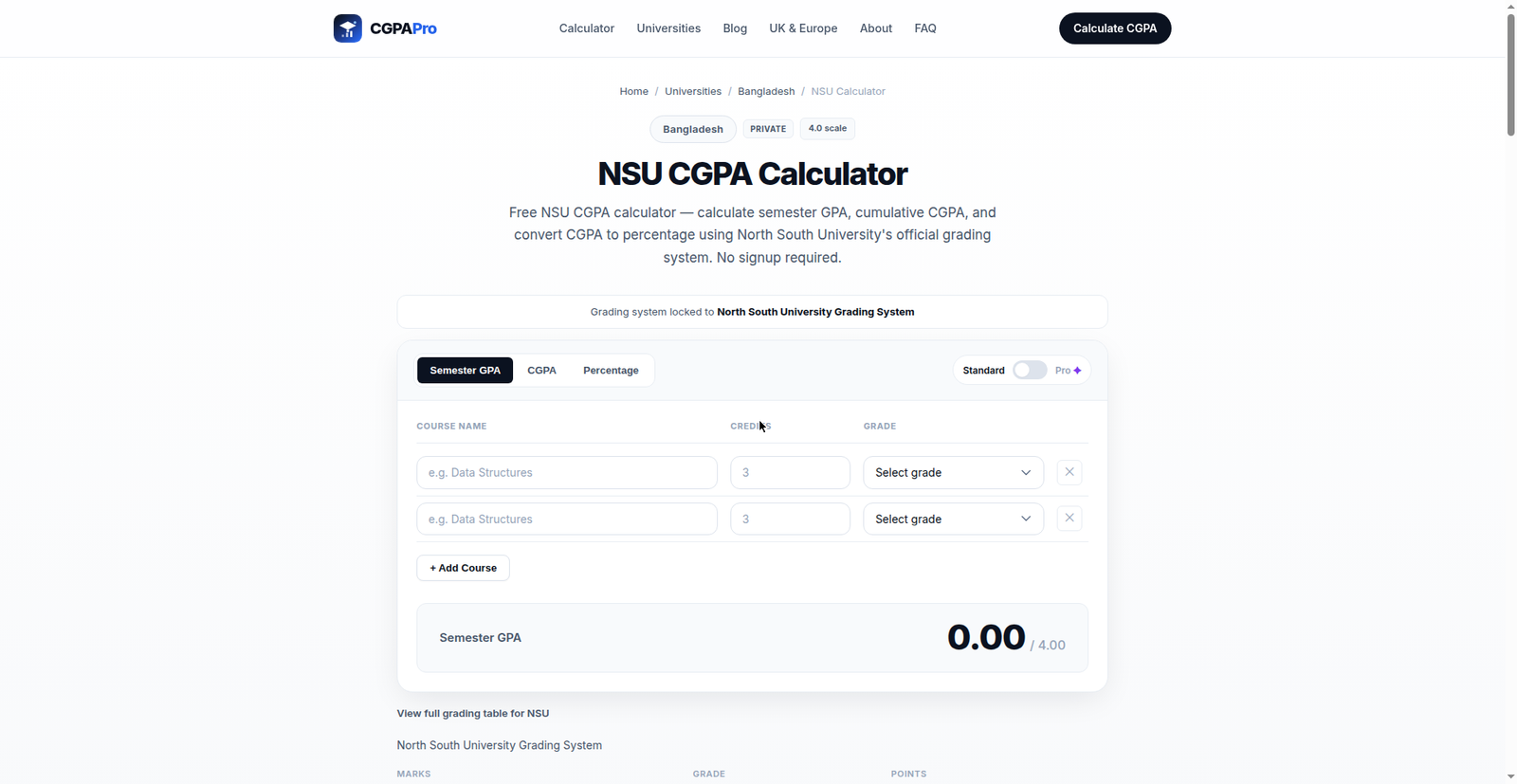
- Select your courses. Add one row per course you took this semester.
- Enter credit hours. Most NSU courses are 3 credits; labs are usually 1.
- Pick your letter grade for each course from the dropdown — the correct NSU grade point fills in automatically.
- Hit Calculate. Your semester GPA appears instantly, along with total credits and quality points.
- Add previous semesters in the CGPA section to get your cumulative figure.
Quick Tip: Use the calculator before finals week, not after. Plug in the grades you’re aiming for and see exactly what each course needs to be — it turns vague anxiety into a concrete target list.
What Is the NSU Grading System?
NSU follows a North American-style letter grading system on a 4.00 scale. At the end of every course, your total marks are converted to a letter grade (A through F), each letter maps to a fixed grade point, and those grade points — weighted by credit hours — produce your GPA.
Two things make NSU’s system distinctive. First, there is no A+ — the scale tops out at a plain A (4.00). Second, and more importantly, NSU does not officially publish a fixed marks-to-grade conversion table. The letter-to-grade-point mapping is official and immutable; but how many marks earn you an A versus an A− is set by your instructor and can vary between sections of the same course. Keep that in mind whenever a third-party website presents NSU “marks ranges” as gospel — they’re approximations, not policy.
The Official NSU Grade Scale
This is the fixed, official part — letter grades and their grade points:
| Letter Grade | Grade Point | Standing |
|---|---|---|
| A | 4.00 | Outstanding |
| A− | 3.70 | Excellent |
| B+ | 3.30 | Very good |
| B | 3.00 | Good |
| B− | 2.70 | Above average |
| C+ | 2.30 | Average |
| C | 2.00 | Satisfactory |
| C− | 1.70 | Below average |
| D+ | 1.30 | Weak pass |
| D | 1.00 | Minimum pass |
| F | 0.00 | Fail |
What Information Do You Need to Calculate Your NSU GPA?
Before touching a calculator, gather these three things. Getting them right is what separates an accurate GPA from a misleading one.
Your letter grades
The grade for each course, exactly as it appears on your grade report — A, B+, C, and so on. NSU’s calculator and official records work from letters, not raw marks, so convert first if you’re estimating.
Credit hours per course
Every NSU course carries a credit weight (usually 3 for theory courses, 1 for labs). This is the multiplier that makes a 3-credit B worth more than a 1-credit A. Using wrong credit values is the single most common DIY calculation error.
Which grades count
Only letter grades A through F enter the GPA. Withdrawals (W), Incompletes (I), Pass (P), and transfer credits (TR) appear on your transcript but contribute zero to the GPA math — they’re excluded from both the numerator and the denominator.
How to Calculate NSU GPA Step by Step
| Step | What to Do | Example |
|---|---|---|
| 1. List your courses | Write down every graded course and its credit hours | CSE115 — 3 credits |
| 2. Convert grades to points | Use the official table above | A− → 3.70 |
| 3. Multiply | Grade point × credit hours per course | 3.70 × 3 = 11.10 |
| 4. Add everything up | Total all the products, and total all the credits | 42.00 points / 12 credits |
| 5. Divide | Total grade points ÷ total credits | 42.00 ÷ 12 = 3.50 GPA |
Full worked example
Here’s a realistic NSU semester, worked end to end:
- CSE115 (3 credits): A− (3.70) → 3 × 3.70 = 11.10
- ENG102 (3 credits): B+ (3.30) → 3 × 3.30 = 9.90
- MAT116 (3 credits): B (3.00) → 3 × 3.00 = 9.00
- BUS112 (3 credits): A (4.00) → 3 × 4.00 = 12.00
Total grade points = 11.10 + 9.90 + 9.00 + 12.00 = 42.00
Total credits attempted = 12
Semester GPA = 42.00 ÷ 12 = 3.50
The NSU GPA Formula
Semester GPA = Total Grade Points Earned ÷ Total Credits Attempted
CGPA = Total Grade Points (all semesters) ÷ Total Credits Attempted (all semesters)
The formula is identical — CGPA just widens the window to your entire academic history at NSU. That’s why early semesters matter so much: a rough first year isn’t one bad semester, it’s a weight that every future semester has to lift.
Difference Between GPA and CGPA at NSU
| GPA | CGPA |
|---|---|
| Measures one semester only | Measures your entire NSU career |
| Can swing sharply term to term | Moves slowly — it’s an average of averages |
| Shows recent form | Shows overall standing |
| Example: Semester GPA = 3.50 | Example: Overall CGPA = 3.32 |
NSU Retake Policy: The Rule That Can Save Your CGPA
This is the most financially and academically important policy at NSU, and the one students understand least:
- You may retake any course in which you earned a B or lower.
- Only the better grade counts toward your CGPA. The old grade stays visible on your transcript, but its grade-point contribution becomes 0.0 in the CGPA calculation.
- An F keeps counting as 0.0 against your attempted credits until you retake the course — it actively drags your CGPA down every semester it sits there.
- You must re-register and pay tuition again for the retaken course.
Strategic takeaway: retakes are most valuable on high-credit courses with low grades. Turning a C (2.0) into a B+ (3.3) in a 3-credit course adds nearly 4 grade points to your numerator — often the fastest CGPA recovery available. But run the math first with the NSU calculator: retaking a 1-credit lab from B to A barely moves the needle, while the same effort in a 3-credit core course transforms your transcript.
Class Equivalence: What Your CGPA Means in Bangladesh
| CGPA Range | Class | What it unlocks |
|---|---|---|
| 3.80 – 4.00 | First Class (Summa Cum Laude range) | Top grad school & scholarship tier |
| 3.50 – 3.79 | First Class (Cum Laude range) | Strong for competitive jobs |
| 3.00 – 3.49 | First Class | The benchmark most employers expect |
| 2.50 – 2.99 | Second Class | Workable with an upward trend |
| 2.00 – 2.49 | Third Class | Meets graduation minimum only |
How to Interpret Your NSU GPA
What a higher GPA actually shows
A rising GPA usually means consistency across subjects, not brilliance in one. Because every course is weighted by credits, a 3.6 built from steady B+/A− grades is more robust than a 3.6 built from two A’s and two C’s — the second profile is one bad exam away from collapsing.
How each grade moves the needle
Since GPA is a weighted average, high-credit courses dominate. A single 3-credit A (12.0 points) outweighs a 1-credit lab grade almost entirely. When you’re triaging study time before finals, rank your courses by credit hours × grade uncertainty, not by which exam comes first.
Why one low grade hurts more than you think
An F doesn’t just add zero — it adds zero while still counting its credits in the denominator. A 3-credit F forces your other 9 credits that semester to average 4.0 just to reach a 3.0 semester GPA. That’s the mathematics of why retaking failed courses promptly is the highest-ROI move in your academic career.
What your GPA doesn’t tell you
GPA doesn’t capture course difficulty, improving trends, or skills. A 3.2 with a steep upward trajectory often impresses graduate admissions more than a flat 3.4. If your early semesters were rough, your transcript’s direction is your best argument — make sure your later semesters tell that story.
Common Mistakes When Calculating NSU GPA
Using unofficial marks tables as fact
The most NSU-specific error: treating a random blog’s “marks range” table as official policy. NSU instructors set their own cutoffs. An 88 might be an A− in one section and a B+ in another. Always work from your actual letter grades.
Forgetting that retaken courses still show the old grade
Students sometimes panic seeing the old grade on their transcript and assume the retake “didn’t count.” It did — for CGPA purposes only the better grade’s points are used. The transcript display and the CGPA math are two different things.
Counting W and I grades
Withdrawals and Incompletes carry no grade points and must be excluded from both sides of the division. Including them deflates your result.
Using the wrong credit hours
Double-check every course’s credits from your official registration, not from memory. A 4-credit course entered as 3 credits corrupts the entire calculation.
Rounding too early
Carry full precision through every multiplication and add at the end. Round only the final GPA — NSU reports to two decimals.
Tips for Improving Your NSU CGPA
- Attack high-credit low grades first. Sort your transcript by (credits × grade deficit) and retake from the top of that list.
- Front-load effort into 3-credit cores. A B+ to A− jump in a 3-credit course is worth 1.2 grade points — more than perfecting every 1-credit lab combined.
- Use the retake window strategically. You can only retake B-or-lower courses; don’t waste retakes polishing a B+ when a C+ is sitting there.
- Track every semester in the calculator. Students who model “what-if” scenarios before finals consistently outperform those who just hope.
- Protect your denominator. If you’re going to fail a course, withdrawing (W) before the deadline is mathematically far kinder than taking the F — a W doesn’t touch your GPA at all.
Frequently Asked Questions
How is CGPA calculated at NSU?
Total grade points earned across all semesters divided by total credits attempted. Only grades A through F count; W, I, P, and transfer credits are excluded from both sides of the calculation.
Does retaking a course replace the old grade at NSU?
For CGPA purposes, yes — only the better grade’s grade points are used. The original grade remains visible on your transcript but contributes 0.0 to the CGPA math. Retakes are allowed for courses graded B or lower.
What is a good CGPA at NSU?
3.00+ (First Class) is the standard benchmark for jobs and grad school. 3.50+ earns Cum Laude honors; 3.80+ is Summa Cum Laude territory.
How many marks do I need for an A at NSU?
There is no official fixed conversion — each instructor sets their own cutoffs. Any website publishing exact NSU marks ranges is giving approximations, not policy.
Does an F stay on my transcript after I retake the course?
The F remains visible, but once retaken, only the new grade counts toward your CGPA. Until you retake it, the F counts as 0.0 against your attempted credits.
What happens if my CGPA drops below 2.00 at NSU?
You are placed on academic probation and must raise it above 2.00 to remain in good standing — 2.00 is also the minimum CGPA required to graduate.
Do W grades affect my NSU CGPA?
No. Withdrawals carry no grade points and are completely excluded from the GPA calculation.
Is 3.5 CGPA good at NSU?
Yes — it’s comfortably in the First Class band and qualifies for Cum Laude honors, making you competitive for scholarships and graduate admissions.
Conclusion
The NSU grading system rewards students who understand its mechanics: the fixed letter-to-point scale, the weighted-credit math, and above all the retake policy that lets you erase your worst grades from the CGPA calculation (if not from the transcript). The students with the strongest CGPAs aren’t always the ones who never stumbled — they’re the ones who knew exactly which stumbles were worth fixing, ran the numbers, and retook strategically.
Start by calculating where you actually stand with the free NSU CGPA calculator — then use the retake and credit-weight strategies above to plan your next semester like an engineer, not a gambler.