
Monash Grading System 2026: WAM, GPA & CGPA Guide
If you study at Monash University — Clayton, Caulfield, Peninsula, or the Malaysia campus in Sunway — your academic life is measured by a number. The problem is that Monash runs three different numbers: a WAM out of 100, a GPA on a 4.0 scale, and (Malaysia campus only) a CGPA on a different 4.0 scale with different values. Students mix them up constantly, and the consequences are real: put the wrong one on a resume, and a Malaysian employer sees 2.22 where your official CGPA letter would have said 2.92.
Here’s the short version. Monash’s marks bands are HD 80–100, D 70–79, C 60–69, P 50–59, N 0–49. Your WAM averages your actual marks out of 100 — first-year units count half (0.5 weighting), everything else counts full. Your GPA converts each grade to a 4.0-scale value (HD 4.0, D 3.0, C 2.0, P 1.0, N 0.3) and averages by credit points — it appears on your transcript. If you’re at Monash Malaysia, you get a CGPA instead on a different scale (D 3.67, C 2.85, P 2.15, N 1.15), it does not appear on your transcript, and you must request a CGPA letter — and you need 2.00 to graduate. There is no official Monash 7.0 scale, no matter what some calculator sites claim: the 7.0 conversion belongs to GEMSAS and converts your percentages, not your Monash GPA. Monash uses Australian honours classes (H1 80+, H2A 70–80, H2B 60–70), not “Second Class Upper”.
This guide lays all three scales side by side (something Monash’s own pages never do — they’re split across three different URLs), walks through the official formulas with fully worked numbers, demolishes the fabricated “official 7.0 matrix” spreading on competitor sites, explains the Malaysia CGPA-letter system nobody else documents, and answers the questions students actually ask on ATAR Notes and Lowyat. Every number below is verified against Monash’s official results, WAM, and GPA pages.
The Short Answer: Monash Grades at a Glance
- Marks bands: HD 80–100 | D 70–79 | C 60–69 | P 50–59 | N (fail) 0–49 | NH (hurdle fail, recorded at mark 45) | WN (withdrawn fail).
- WAM = average of your actual marks out of 100, including fails and repeats. Level 1 units weighted 0.5, all other levels 1.0 — by the unit code’s level, not when you took it. On your transcript, to 3 decimals.
- GPA (4.0 scale) = Σ(grade value × credit points) ÷ Σ(credit points), to 3 decimals. HD 4.0, D 3.0, C 2.0, P 1.0, near pass 0.7, fail N 0.3 (not 0.0), WN 0.0. On your transcript. From Semester 1 2008 commencers.
- Malaysia CGPA = the same formula with different values: HD 4.0, D 3.67, C 2.85, P 2.15, near pass 1.7, N 1.15, WN 0.0. Used instead of GPA in Malaysia. Not on the transcript — request a CGPA letter. Minimum 2.00 to graduate.
- 7.0 scale: Monash issues no official 7.0 conversion. GEMSAS converts your percentages via its own bands (80+ = 7.0 … 50–54 = 4.0), weighting your last three full-time-equivalent years (1, 2, 3) ÷ 6.
- Honours classes: H1 80+, H2A 70–<80, H2B 60–<70, P 50–<60 (2021+ starters). Engineering uses HWA: for 2021+ commencers, HWA is the WAM of engineering units only.
- The fails that fool everyone: a failed unit still drags every scale — its mark enters the WAM, it earns 0.3 GPA points, 1.15 CGPA points. Withdraw before census date and there’s no record at all.
Calculate It Yourself: The CGPAPro Monash Calculator
Before the theory, the practical shortcut. CGPAPro’s Monash University Malaysia calculator computes GPA/CGPA from your units, credit points, and grades — enter each unit exactly as it appears on your Monash portal, and it does the weighted math for you.
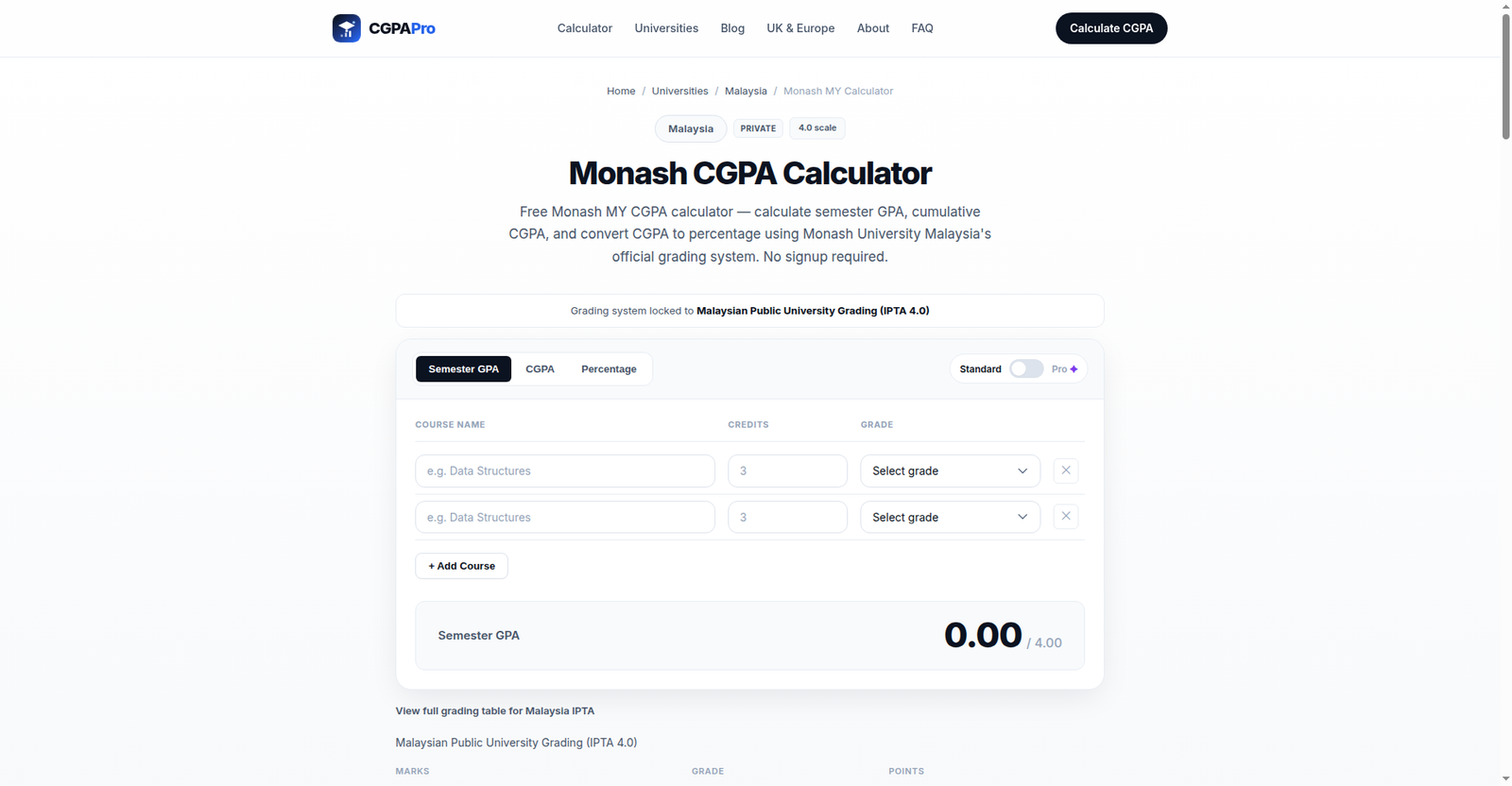
Screenshot: the worked example from this guide modelled on the CGPAPro Monash calculator — the same six units, grades, and marks used in the WAM/GPA/CGPA calculations below, so you can verify the math by hand. Australian-campus students: the mark-to-grade bands in this guide apply to every Monash campus, including Malaysia. One honest heads-up: the calculator page is currently being updated to Monash’s official HD/D/C/P/N scale (HD 4.0, D 3.0 on the GPA scale / D 3.67 on the Malaysia CGPA scale, N below 50) — all the values used throughout this guide, verified against Monash’s results pages. The calculation method is identical; the letter labels on the calculator are being switched to match.
The general CGPA calculator is handy for “what-if” planning — plug in your current GPA and completed credit points, add next semester’s expected grades, and see your projected result before results are even released.
Read More: How to Calculate SGPA: Formula & Examples (2026) — the credit-weighted formula behind every number in this guide, explained step by step.
The Official Grade Tables: All Three Scales Side by Side
Monash publishes the marks legend, the WAM rules, and the GPA/CGPA scales on three separate pages, which is exactly why students end up confused. Here they are, merged into one table so you can see at a glance how the same mark becomes three different numbers:
| Marks | Grade | GPA value (Australia, 4.0) | CGPA value (Malaysia) |
|---|---|---|---|
| 80 – 100 | HD (High Distinction) | 4.0 | 4.0 |
| 70 – 79 | D (Distinction) | 3.0 | 3.67 |
| 60 – 69 | C (Credit) | 2.0 | 2.85 |
| 50 – 59 | P (Pass) | 1.0 | 2.15 |
| — | Near pass | 0.7 | 1.7 |
| 0 – 49 | N (Fail) | 0.3 | 1.15 |
| 45 (recorded) | NH (Hurdle fail) | 0.3 | 1.15 |
| — | WN (Withdrawn fail) | 0.0 | 0.0 |
Two things about this table surprise almost everyone:
1. A fail is worth 0.3 GPA points, not 0.0. Several calculator sites state flatly that failed units give “0.0 GPA points.” That is wrong. Monash’s official GPA page assigns N = 0.3 (and the Malaysia CGPA page assigns N = 1.15). A fail hurts — but it doesn’t zero out the way competitors claim.
2. Malaysia students: your Distinction is worth 3.67, not 3.0. The Malaysia CGPA scale is systematically more generous than the Australian GPA scale at every grade below HD — a D is worth 0.67 more, a C 0.85 more, a P 1.15 more. That is why your CGPA letter will always read higher than the GPA on your transcript, and why you must never quote the transcript GPA to a Malaysian employer (more on that below).
WAM: The Number Monash Actually Uses Most
The Weighted Average Mark (WAM) is the average of your actual marks — the 0–100 numbers, not the grades. Monash’s official WAM page defines it precisely:
WAM = [Σ (Level 1 marks × credit points × 0.5) + Σ (all other marks × credit points × 1.0)] ÷ [Σ (Level 1 credit points × 0.5) + Σ (all other credit points × 1.0)]
Three rules students get wrong:
First-year units count half. Level 1 units carry a 0.5 weighting; every other level carries 1.0. A 90 in a first-year unit moves your WAM half as much as a 90 in a third-year unit. This is deliberate — Monash discounts the year when everyone is still finding their feet.
“Level” means the unit code’s level, not when you took it. A Level 1 unit (e.g. a 1000-series unit) still gets the 0.5 weighting even if you take it in your third year as an elective. Conversely, taking a Level 2 unit in your first year doesn’t halve its weight. The designation comes from the code, not the calendar — this directly answers the ATAR Notes question about how much each year level “contributes.”
Fails and repeats are included. Failed units contribute their actual mark to the WAM, and repeated units count each attempt — there is no “latest attempt replaces” rule at Monash (unlike some Malaysian universities where repeating wipes the old attempt). A failed-then-repeated unit hits your WAM twice. The grades that are excluded from the WAM are: SFR, NSR, NE, NAS, WDN, WI, PGO, NGO, DEF, NS and WH — administrative and non-graded outcomes, not academic results.
The WAM is calculated to 3 decimal places, appears on your transcript, and applies from Semester 1 2008 commencers (research Masters and PhD excluded — they don’t get a WAM at all).
WAM worked example (with level weighting)
A second-year student with six standard 6-credit-point units (check your unit handbook — most Monash undergraduate units are 6cp, but some aren’t):
| Unit | Level | Credit points | Mark | Grade | Weight | Mark × CP × weight |
|---|---|---|---|---|---|---|
| Intro to Programming | 1 | 6 | 82 | HD | 0.5 | 82 × 6 × 0.5 = 246 |
| Academic Writing | 1 | 6 | 76 | D | 0.5 | 76 × 6 × 0.5 = 228 |
| Data Structures | 2 | 6 | 68 | C | 1.0 | 68 × 6 = 408 |
| Statistics | 2 | 6 | 71 | D | 1.0 | 71 × 6 = 426 |
| Database Systems | 3 | 6 | 55 | P | 1.0 | 55 × 6 = 330 |
| Operating Systems | 3 | 6 | 48 | N | 1.0 | 48 × 6 = 288 |
| Total | 1,926 |
Denominator: (6 × 0.5) + (6 × 0.5) + 6 + 6 + 6 + 6 = 3 + 3 + 24 = 30.
WAM = 1,926 ÷ 30 = 64.200.
Notice what happened: the two first-year units (82 and 76) contributed only 474 of the 1,926 numerator points — about a quarter of the total — despite being a third of the units. And the failed Operating Systems unit dragged in its 48 anyway. If you want to move your WAM, the leverage is always in your current-level units, not in first-year leftovers.
GPA (4.0 Scale): What’s on Your Transcript
Monash’s official GPA is on a 4.0 scale only. The formula, straight from the GPA page:
GPA = Σ (grade value × unit credit points) ÷ Σ (unit credit points), calculated to 3 decimal places.
Grade values: HD 4.0, D 3.0, C 2.0, P 1.0, near pass 0.7, fail N 0.3, hurdle fail 0.3, withdrawn fail WN 0.0. Fails and repeated units are included. Excluded from the GPA: SFR, NE, NAS, WI, PGO, NPGO and WNGO. The GPA appears on your academic transcript, and the scheme covers Semester 1 2008 commencers onwards.
GPA worked example (same six units)
Take the identical six units from the WAM example and convert the grades:
| Mark | Grade | Grade value | Credit points | Value × CP |
|---|---|---|---|---|
| 82 | HD | 4.0 | 6 | 24.0 |
| 76 | D | 3.0 | 6 | 18.0 |
| 68 | C | 2.0 | 6 | 12.0 |
| 71 | D | 3.0 | 6 | 18.0 |
| 55 | P | 1.0 | 6 | 6.0 |
| 48 | N | 0.3 | 6 | 1.8 |
| Total | 36 | 79.8 |
GPA = 79.8 ÷ 36 = 2.217.
The same transcript gives a WAM of 64.200 and a GPA of 2.217 — they measure different things (raw marks vs grade values), so don’t expect them to “agree.”
Malaysia CGPA: A Different Scale Entirely
At Monash University Malaysia, the GPA above is replaced by a CGPA computed with different grade values:
CGPA = Σ (grade value × unit credit points) ÷ Σ (unit credit points), to 3 decimal places — with HD 4.0, D 3.67, C 2.85, P 2.15, near pass 1.7, fail N 1.15, hurdle fail 1.15, WN 0.0.
Three facts Malaysian students need tattooed on their brains:
1. The CGPA is NOT on your transcript. Your transcript shows the 4.0-scale GPA. The CGPA lives on a separate CGPA letter that you must request — from Student Services if you’re at the Malaysia campus, or Monash Connect if you’re in Australia. Allow processing time and check the current fee before you need it for a job or scholarship deadline.
2. Minimum CGPA 2.00 to graduate. Fall below it and you don’t graduate, regardless of whether every unit shows a pass. The CGPA scheme covers 1 January 2008 commencers onwards.
3. It’s always higher than the transcript GPA. Every grade below HD is worth more on the CGPA scale. This is the number Malaysian employers expect — it’s the closest thing Monash Malaysia has to the “local” CGPA other universities print.
Malaysia CGPA worked example (same six units)
| Mark | Grade | CGPA value | Credit points | Value × CP |
|---|---|---|---|---|
| 82 | HD | 4.00 | 6 | 24.00 |
| 76 | D | 3.67 | 6 | 22.02 |
| 68 | C | 2.85 | 6 | 17.10 |
| 71 | D | 3.67 | 6 | 22.02 |
| 55 | P | 2.15 | 6 | 12.90 |
| 48 | N | 1.15 | 6 | 6.90 |
| Total | 36 | 104.94 |
CGPA = 104.94 ÷ 36 = 2.915.
One transcript, three numbers
| Metric | Result (same six units) | What it measures |
|---|---|---|
| WAM | 64.200 | Actual marks out of 100; Level 1 halved |
| GPA (4.0) | 2.217 | Grade values on the Australian scale; on transcript |
| Malaysia CGPA | 2.915 | Grade values on the Malaysia scale; CGPA letter only |
The same six units produce 64.200, 2.217, and 2.915. Now you see why “my CGPA is higher than my GPA” is not a bug — it’s the scale design. And why the most expensive mistake a Malaysia student can make is handing an employer the 2.217 transcript GPA instead of the 2.915 CGPA letter.
The 7.0 Truth: Monash Does NOT Have One
Time for the myth-buster, because this one is actively costing students. A competitor site publishes what it calls the “Official 2026 Monash 7.0 Grading Matrix” — HD 85–100 = 7.0, 75–84 = 6.0, and so on — and claims Monash “provides an official GPA calculation on the 7.0 scale.” Both claims are false. Monash’s official GPA is 4.0. Monash issues no official 7.0 conversion at all.
The 7.0 scale students are actually asking about belongs to GEMSAS (the graduate-medicine admissions system — see the official GEMSAS GPA calculation guide), and it works completely differently from what the fake matrix shows:
- GEMSAS converts your percentages, not your Monash GPA — using your actual marks wherever your transcript shows them.
- The real bands: 80–100 = 7 | 75–79 = 6.5 | 70–74 = 6 | 65–69 = 5.5 | 60–64 = 5 | 55–59 = 4.5 | 50–54 = 4 | below 50 = 0 (GEMSAS guide v3.8, March 2024). Note the half-points at 75–79, 65–69 and 55–59 — the fake matrix erases them.
- It covers your last three full-time-equivalent years, with the final year weighted most: ((Final−2 × 1) + (Final−1 × 2) + (Final × 3)) ÷ 6 for most schools.
- Fails and repeats are included — there is no hiding a bad year.
- For Monash graduate medicine specifically: minimum weighted GPA 5.0/7.0 OR WAM 65 for interview consideration (GEMSAS 2024 guide — check the current guide for this year’s exact threshold).
GEMSAS 7.0 worked example
A student’s marks in five units: 84, 72, 66, 58, 51. Convert each percentage through the GEMSAS bands: 84 → 7, 72 → 6, 66 → 5.5, 58 → 4.5, 51 → 4.
Annual GPA = (7 + 6 + 5.5 + 5.5 + 4) ÷ 5 = 27 ÷ 5 = 5.400.
Now weight three years — say Final−2 = 5.0, Final−1 = 5.5, Final = 5.4:
Weighted GPA = (5.0 × 1 + 5.5 × 2 + 5.4 × 3) ÷ 6 = (5 + 11 + 16.2) ÷ 6 = 32.2 ÷ 6 = 5.367.
That clears the 5.0 Monash medicine bar — but notice the final year (weight 3) dominates the result. A weak final year sinks a GEMSAS application far faster than a weak first year, which is the opposite of how Monash’s own WAM treats the years.
Read More: UiTM Grading System 2026: Grades, GPA & CGPA Guide — Malaysia’s biggest public university uses a 13-grade scale — a useful contrast if you’re comparing offers.
Honours Classes and Engineering HWA
Monash awards honours using the Australian classification, not the Malaysian one:
- H1 First Class Honours: WAM 80+
- H2A Second Class Honours Division A: WAM 70 to <80
- H2B Second Class Honours Division B: WAM 60 to <70
- P Pass: WAM 50 to <60 (2021+ starters; pre-2021 starters got H3 Third Class at this band)
There is no “Second Class Upper” / “Second Class Lower” in Monash’s official vocabulary. If a Malaysian employer or scholarship form asks for it, don’t invent a mapping — Monash publishes none. Present your CGPA letter and let the number speak; the official results legend is your citation if anyone asks what H2A means.
Engineering students get a separate metric: the Honours Weighted Average (HWA). For 2021+ commencers, the HWA is simply the WAM of your engineering units only — units from a double-degree partner faculty are excluded. (You can even graduate with the “Bachelor of Engineering (Honours)” title on a plain Pass.) For pre-2021 commencers, the old rules still apply: units weighted 1/2/3/4 by the first digit of the unit code, and a repeated unit’s mark is reduced by 10% before weighting. Forum posts quoting the 1/2/3/4 rule without the 2021 cutoff are outdated — check your commencing year.
Failed, Withdrawn and Hurdle Units: Exact Impact Per Scale
| Outcome | WAM | GPA (4.0) | Malaysia CGPA |
|---|---|---|---|
| N (fail, mark 0–49) | The actual mark counts | 0.3 × credit points | 1.15 × credit points |
| NH (hurdle fail) | Recorded mark 45 counts | 0.3 × credit points | 1.15 × credit points |
| WN (withdrawn fail) | No mark to include | 0.0 × credit points | 0.0 × credit points |
| Repeat of a failed unit | Both attempts’ marks count | Both attempts count | Both attempts count |
| Excluded grades (SFR, WI, WDN, PGO, …) | Excluded | Excluded | Excluded |
Three practical consequences:
A hurdle fail is a double punishment. NH means you failed a compulsory hurdle (often the exam) while possibly passing overall — Monash records it at mark 45, so your WAM takes a 45 and your GPA takes 0.3. Check every unit’s hurdle requirements in week one, not week twelve.
Repeating doesn’t erase anything at Monash. Both attempts stay in all three calculations — the WAM gets both marks, the GPA/CGPA gets both grade values. A repeat is still worth doing (a new pass replaces a fail’s 0.3 with real points), but it dilutes rather than replaces. This differs sharply from universities where the latest grade overwrites — here’s how retake rules differ across Malaysian universities.
Withdraw before census date if you’re going to sink. A clean withdrawal leaves no record on any scale. A WN, by contrast, sits in your GPA/CGPA at 0.0. Know your semester’s census date — it’s the cheapest insurance in the table.
Which Number Goes Where: Resume, Postgrad, Scholarships
- Malaysian job applications: quote the Malaysia CGPA from your CGPA letter, never the transcript GPA. A 2.92 CGPA reads like a normal local-university pointer; a 2.22 transcript GPA gets your application filtered out by a 2.50 or 3.00 cutoff. Attach or offer the CGPA letter.
- Australian graduate programs and employers: they usually ask for WAM — it’s the number Australian recruiters and universities are calibrated to. Your transcript already shows it to 3 decimals.
- Australian postgraduate / honours applications: WAM first, transcript GPA second — faculties publish WAM cutoffs (e.g. H2A = 70+ for many honours programs).
- Graduate medicine: forget your Monash GPA entirely — compute the GEMSAS 7.0 weighted GPA from your percentages (last 3 FTE, weights 1/2/3), and remember Monash’s interview bar is 5.0/7.0 or WAM 65.
- US / overseas applications: Monash publishes no official conversion to the US 4.0 scale — its position is to check with the receiving institution. For formal credential recognition, a WES evaluation is the standard route (and note: WES evaluates your transcript, which carries the 4.0 GPA — the Malaysia CGPA letter is a separate document, so include it in what you submit and confirm with the receiving body which figure they want).
Common Mistakes Monash Students Make
1. Quoting the transcript GPA to a Malaysian employer. The 4.0-scale GPA (P = 1.0!) looks catastrophically low next to local-university CGPAs. The CGPA letter exists precisely for this — request it, quote it, attach it.
2. Believing the fake “official 7.0 matrix.” Monash has no 7.0 scale. The bands 85–100 = 7 / 75–84 = 6 circulating on calculator sites are fabricated. GEMSAS bands start at 80+ = 7 and include half-points.
3. Assuming failed units give 0.0 GPA points. Officially N = 0.3 (CGPA 1.15). It’s still damaging, but the “0.0” claim overstates it — and more importantly, the failed mark still sits in your WAM.
4. Ignoring the 0.5 first-year weighting. Students obsess over first-year marks that move the WAM at half strength, then coast in second year when every mark counts full. Front-load your effort into current-level units.
5. Forgetting hurdle requirements. An NH records a 45 in your WAM and 0.3 in your GPA even if your overall mark would have passed. Read the unit guide’s hurdle clause in week one.
6. Expecting repeats to overwrite. At Monash, both attempts count everywhere. Repeating a passed unit to “improve” it dilutes your marks with a second data point — only repeat genuine fails (or check your faculty’s specific advice first).
7. Using “Second Class Upper” on forms. Monash doesn’t award it. Write H2A (70–<80) or quote the CGPA — don’t invent a Malaysian class band Monash never gave you.
Tips That Actually Move the Numbers
- Defend the 79/80 and 69/70 lines first. One mark from 79 to 80 moves a GPA grade value from 3.0 to 4.0 and a CGPA value from 3.67 to 4.00 — on a 6-credit unit that’s 6.0 GPA points or 1.98 CGPA points. Nothing else has that return on effort.
- Weight your study hours by level and credits. A Level 2+ unit’s mark counts double a Level 1 unit’s mark in the WAM. Allocate effort accordingly.
- Model every “what-if” on the calculator — the Monash calculator for the semester, the general CGPA calculator for cumulative projections. Students who simulate their semester before it starts pick better unit combinations.
- Request the CGPA letter before you need it — not the week a job application closes. Student Services (Malaysia) / Monash Connect (Australia); allow processing time.
- Know your census date. Withdrawing cleanly beats a WN (0.0 in GPA/CGPA) every time.
- Medicine hopefuls: your final year is weighted 3× in GEMSAS — protect it above all else, and note the bar is 5.0/7.0 or WAM 65.
FAQ: What Monash Students Actually Ask
Can I convert my WAM to a GPA?
Not with a formula — they’re computed from different inputs (marks vs grade values), so no official conversion exists. As a rough sense of scale, a WAM in the low 60s typically corresponds to a GPA in the low 2s (our worked example: WAM 64.200 → GPA 2.217), and WAM 80+ maps to the HD band at 4.0. But anyone asking for an exact number — an employer, a university — should be given the actual WAM or GPA, not a conversion. (The ATAR Notes threads asking “WAM to GPA?” all land here: there is no official answer.)
Does 80+ automatically mean 7.0 on GEMSAS?
Yes — 80–100 converts to 7.0 per unit under the GEMSAS bands. But that’s per unit from your percentage marks, and the final GEMSAS GPA weights your last three years (1, 2, 3) ÷ 6 with fails included. An 80 average in first year does not give you a 7.0 GEMSAS GPA by itself.
How much do Level 1, 2 and 3 units contribute to my WAM?
Level 1 units are weighted 0.5, all other levels 1.0 — and the level comes from the unit code, not when you took it. A 1000-series unit taken in third year still counts half; a 2000-series unit taken in first year counts full. So “first year” contributes less only because first years mostly take Level 1 units.
What WAM is considered good at Monash?
Anchored to official bars: 80+ is H1 territory — first-class honours, the top few percent. 70–79 is a Distinction average (H2A) — clears most honours and competitive grad-program bars. 65+ meets Monash graduate medicine’s interview-consideration minimum. 60–69 is a solid Credit average. Below 50 in enough units and you’re failing — the only official floor is the 2.00 CGPA graduation requirement at the Malaysia campus.
WES evaluation — do I send my GPA or my CGPA?
WES evaluates your transcript, which carries the 4.0-scale GPA — this is the Lowyat confusion (“WES shows GPA not CGPA”): the Malaysia CGPA exists only on the separate CGPA letter. Include the CGPA letter in your documents and confirm with the receiving institution which figure they want — Monash’s position is that there is no official US-scale conversion, so the receiving body decides.
My employer asks for “Second Class Upper.” What do I give them?
Monash doesn’t use that classification — it awards H1/H2A/H2B honours classes. Don’t invent a mapping; none is official. Give the employer your CGPA letter (Malaysia) or your WAM/transcript (Australia), and if a form forces a class band, cite the official results legend showing H2A = 70–<80. Most Malaysian employers screening at “3.00+” are really asking for a pointer — the CGPA letter’s number is what they need.
Why is my Malaysia CGPA higher than my transcript GPA?
Because they’re different scales: every grade below HD is worth more in the CGPA (D 3.67 vs 3.0, C 2.85 vs 2.0, P 2.15 vs 1.0, N 1.15 vs 0.3). Same units, same effort, systematically higher number. Quote the CGPA letter wherever a CGPA is asked for.
Conclusion
Monash’s grading system punishes students who treat it as one number when it’s three: the WAM averages your marks with first year halved, the GPA converts grades to a 4.0 scale for your transcript, and the Malaysia CGPA runs a more generous scale that lives on a letter you have to request. The students who get hurt are the ones who quote the transcript GPA to a Malaysian employer, trust a fabricated “official 7.0 matrix,” or assume a repeat erases a fail. None of those are how Monash works.
Start by running your current units through the Monash University Malaysia calculator and checking the result against the official tables in this guide — the worked example above (WAM 64.200, GPA 2.217, CGPA 2.915 from the same six units) is there so you can verify the math by hand. And if you’re weighing Monash against local options, the UiTM grading guide shows what a 13-grade public-university scale looks like next to Monash’s three-metric system.
Sources: Monash University — WAM calculation, GPA and CGPA calculation, results legend (marks, grades, honours classes); Monash Engineering — HWA rules (2021+ commencers); GEMSAS “How to calculate your GPA” guide v3.8 (2024-03-25). Student questions sourced from ATAR Notes and Lowyat forums. Where Monash publishes no official position (US-scale conversion, CGPA-to-Malaysian-class mapping), this guide says so — check your faculty handbook for the final word.