Jahangirnagar University Grading System 2026: Grades, GPA & CGPA Guide
Here’s the rule that surprises almost every Jahangirnagar University student the first time they hear it: if you pass a course and your semester GPA is 2.5 or higher, JU will not let you retake it to improve your grade. Not for a fee, not with a faculty petition — the ordinance flat-out says no. Improvement repeats at JU don’t exist for polishing a B− into a B. They exist for students who failed a course, or whose entire semester fell apart. Got a C+ but a 2.8 semester GPA? JU won’t let you retake it.
Here’s the short version. Your grades come from an official 11-grade table — the standard UGC Bangladesh scale, identical to BUET, RUET and DU: A+ (80% and above) = 4.00 down to F (below 40%) = 0.00, with grade points running in 0.25 steps. There is no C− grade at JU, despite what Scholaro’s Jahangirnagar page shows. Your GPA is credit-weighted and computed only over courses you passed — F grades are excluded from the GPA entirely, which means every generic online calculator that drops an F in as 0×credits is wrong for JU. Your marks split 10% attendance / 20% tutorials / 70% semester-end exam, and falling below 60% attendance bars you from sitting the final at all. You may repeat a failed course only if your semester GPA is at least 2.5; three or more Fs in one semester means repeating the entire semester. And if you don’t withdraw a struggling course within two working weeks of the semester starting, your grade is recorded as F.
This guide walks through the full official grade table (all 11 rows, verified against JU’s published ordinance — the same table confirmed across four JU documents), the 10/20/70 marks split with the exact attendance bands nobody explains, the GPA and CGPA formulas with real worked examples, the repeat/improvement/withdrawal rules students are literally protesting about on campus in 2026, the band-edge traps (79 vs 80 is a bigger deal than you think), and the myths floating around online — including the C− grade that doesn’t exist. Everything below is grounded in JU’s own documents, not calculator-blog folklore.
Quick Answer: JU Grades at a Glance
- Grade scale: 11 grades, A+ to F plus I (Incomplete), on the 4.00 UGC Bangladesh scale. A+ = 4.00, A = 3.75, A− = 3.50 — the steps are 0.25, not the Pakistani-style 0.33. No C− exists.
- GPA = Σ (grade point × credits) ÷ Σ credits, computed only over courses passed. F grades are excluded from the GPA (§10.1) — but a failed course must be repeated and earns no credits.
- CGPA = the same credit-weighted calculation across all semesters — it is not a simple average of your semester GPAs.
- Marks split: 10% attendance + 20% class assessment/tutorials + 70% semester-end exam. Each theory course carries 100 marks.
- Attendance gate: below 60% attendance you cannot sit the final exam — and you get 0 attendance marks.
- Improvement gate: passed the course + semester GPA ≥ 2.5 → no improvement repeat allowed. Improvement exists for Fs and sub-2.5 semesters, not for grade polishing.
- F rules: max 2 Fs per semester (each must be repeated if semester GPA ≥ 2.5); 3+ Fs → repeat the whole semester.
- MS degree floor: minimum CGPA 2.50 to graduate. No JU-official undergraduate floor was found in the documents read — check your department handbook.
Calculate It Yourself: The CGPAPro JU Calculator
Before the theory, here’s the practical shortcut. CGPAPro’s Jahangirnagar University CGPA calculator is built on the official 11-grade UGC scale used in this guide — enter each course, its credit hours, and your grade, and it computes your semester GPA and projected CGPA instantly. Use it alongside the worked examples below to check your own numbers.
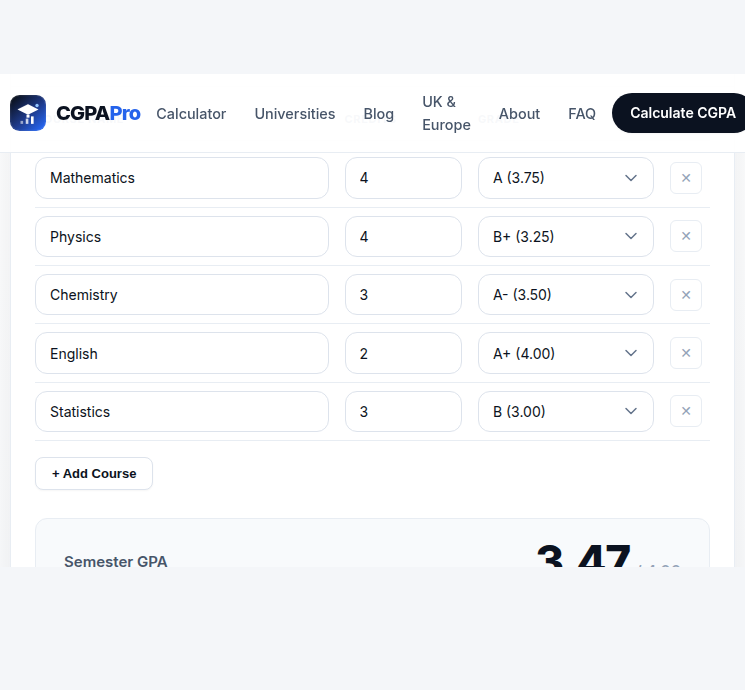
Screenshot: a real 5-course semester modelled on the CGPAPro JU calculator — credit hours and grades in, semester GPA out. The worked example below uses exactly these numbers so you can verify the math by hand.
Worked example: a real 5-course semester
Meet Tanvir, a first-semester student. His results:
| Course | Credits | Grade | Grade Point | Points (GP × credits) |
|---|---|---|---|---|
| Mathematics | 4 | A | 3.75 | 15.00 |
| Physics | 4 | B+ | 3.25 | 13.00 |
| Chemistry | 3 | A− | 3.50 | 10.50 |
| English | 2 | A+ | 4.00 | 8.00 |
| Statistics | 3 | B | 3.00 | 9.00 |
- Total grade points: 15.00 + 13.00 + 10.50 + 8.00 + 9.00 = 55.50
- Total credits: 4 + 4 + 3 + 2 + 3 = 16
- Semester GPA = 55.50 ÷ 16 = 3.47 (this is also his CGPA, since it’s his first semester)
Notice the credit-weight effect: the 4-credit Mathematics A contributes 15.00 points — nearly double the 2-credit English A+. If Tanvir had pushed Physics from B+ (3.25) to A− (3.50) — one grade step in a 4-credit course — he’d gain (3.50 − 3.25) × 4 = 1.00 point, lifting his GPA from 3.47 to 3.53. Fixing your weakest heavy course is always the highest-leverage move.
The Official JU Grade Table (All 11 Grades)
This is the full table from JU’s grading regulations — the same table appears in the official JU ordinance (juniv.edu) and in three further JU documents (the EMIR program syllabus, the IIT PGDIT syllabus, and the Academic Writing course doc). It is the university-wide UGC Bangladesh uniform scale. Compare it against any calculator tool you’re using — if the grade points run in 0.33 steps (3.67, 2.67), that’s the wrong country’s scale for JU.
| Numerical Marks | Letter Grade | Grade Point | Status |
|---|---|---|---|
| 80% and above | A+ | 4.00 | Pass |
| 75% to less than 80% | A | 3.75 | Pass |
| 70% to less than 75% | A− | 3.50 | Pass |
| 65% to less than 70% | B+ | 3.25 | Pass |
| 60% to less than 65% | B | 3.00 | Pass |
| 55% to less than 60% | B− | 2.75 | Pass |
| 50% to less than 55% | C+ | 2.50 | Pass |
| 45% to less than 50% | C | 2.25 | Pass |
| 40% to less than 45% | D | 2.00 | Pass — minimum passing grade |
| Less than 40% | F | 0.00 | Fail — must repeat, excluded from GPA |
| — | I (Incomplete) | 0.00 | Carries no marks band; conversion rules were not found in the documents read — check your department |
Four things about this table trip students up every semester:
1. The band edges use “to less than” wording — and it matters. Exactly 80% is A+, exactly 75% is A, exactly 70% is A−. Competitor pages that write “75–79” are approximately right for integer marks but imprecise at exact boundaries. If your transcript shows exactly 75.0, that’s an A (3.75), not an A−.
2. There is no C− at JU. Scholaro’s Jahangirnagar University page invents a “C− 40–44” row with a blank grade point — sitting right next to “D 40–44 = 2.00”, which is what 40–44 actually is. The official table has exactly 11 grades: A+, A, A−, B+, B, B−, C+, C, D, F, and I (the count includes the Incomplete). If your calculator tool shows a C− for JU, its table is wrong.
3. D (40%) is the pass line. D earns 2.00 grade points, counts as earned credits, and goes into your GPA. Below 40% is F: zero earned credits, excluded from the GPA, and you must repeat the course. One mark — 39 vs 40 — is the difference between “passed, move on” and “repeat the entire course next semester.”
4. The steps are 0.25, not 0.33. A = 3.75, B+ = 3.25, C+ = 2.50. JU uses the uniform UGC Bangladesh scale — the same numbers as BRACU and RUET. Any tool applying 3.67/2.67 steps to JU grades is silently miscalculating every borderline grade.
Read More: RUET Grading System 2026: Grades, GPA & CGPA Guide — JU and RUET share the same UGC Bangladesh 11-grade table, but RUET’s repeat and attendance rules differ in important ways.
How Your Marks Are Actually Split: 10 / 20 / 70
Before your semester-end exam, 30 of your 100 marks are already on the table. JU’s ordinance fixes the distribution for every theory course:
- Class attendance: 10%
- Class assessment / tutorials: 20% — theory courses require at least three tutorials
- Semester-end examination: 70% — a 3-credit theory course gets a 3-hour final with question choice (e.g., answer 5 out of 8)
The semester itself runs 21 weeks: 15 weeks of classes, 2 weeks of preparatory leave, and 4 weeks of semester-end examinations, with at least 4 weeks between semesters.
The attendance marks use exact bands that most students have never seen written down. These are the percentages of the 10 attendance marks, verified from the ordinance:
| Class Attendance | Share of Attendance Marks | Marks out of 10 |
|---|---|---|
| 90% and above | 100% | 10 |
| 85% to less than 90% | 90% | 9 |
| 80% to less than 85% | 80% | 8 |
| 75% to less than 80% | 70% | 7 |
| 70% to less than 75% | 60% | 6 |
| 65% to less than 70% | 50% | 5 |
| 60% to less than 65% | 40% | 4 |
| Less than 60% | 0% | 0 — barred from the final exam |
Two consequences fall straight out of this table. First, attendance alone can swing 6 of your 100 marks — the difference between 90%+ (10 marks) and 62% (4 marks) is more than a full grade band, which is more than 0.25 grade points per credit on every course. Second, the 60% line is a hard gate: below it you don’t just lose the attendance marks, you’re barred from sitting the semester-end final entirely. A student at 87% attendance keeps 9 of 10 marks; a student at 62% keeps 4 — and a student at 58% gets zero and no exam.
GPA and CGPA: The Formulas (and Why F Vanishes)
The formula is credit-weighted — a 4-credit course counts double a 2-credit one:
Semester GPA = (sum of grade point × credits for every course passed this semester) ÷ (total credits of courses passed this semester)
CGPA = (sum of grade point × credits for all courses passed across all semesters) ÷ (total credits of all courses passed across all semesters)
JU’s ordinance is explicit about the numerator of both formulas: the CGPA is the weighted average of the grade points obtained in all the courses passed. Failed courses don’t sit in the denominator at 0 — they are excluded from the GPA altogether. They still must be repeated (see the next section), but the arithmetic ignores them until you pass the repeat.
Worked example: the ordinance’s own CGPA calculation
JU’s ordinance gives an official CGPA worked example (its separate GPA example is garbled by an OCR/text-extraction error — the letter-to-point mappings don’t match the official table — so we use §9’s table throughout and the clean CGPA example here):
- 1st Year 1st Semester: GPA 4.00, 20 credits → 80.00 points
- 1st Year 2nd Semester: GPA 3.00, 16 credits → 48.00 points
- Total: 80.00 + 48.00 = 128.00 points over 36 credits
- CGPA = 128.00 ÷ 36 = 3.56
The common student mistake is averaging the two GPAs: (4.00 + 3.00) ÷ 2 = 3.50. Close, but wrong — and the error grows whenever semesters have different credit loads. Always weight by credits.
Worked example: the F-exclusion side-by-side
This is where generic calculators fail JU students. Take a semester with four courses:
| Course | Credits | Grade | Grade Point | Points |
|---|---|---|---|---|
| Math | 4 | A | 3.75 | 15.00 |
| Physics | 3 | B | 3.00 | 9.00 |
| Chemistry | 3 | C+ | 2.50 | 7.50 |
| English | 3 | F | 0.00 | excluded |
JU’s official method (§10.1): the F course is excluded from the GPA. Total points = 15.00 + 9.00 + 7.50 = 31.50; total credits = 4 + 3 + 3 = 10. GPA = 31.50 ÷ 10 = 3.15.
The generic-calculator method: the F is entered as 0 × 3 and dragged into the denominator. GPA = 31.50 ÷ 13 = 2.42.
Same transcript: 3.15 vs 2.42. The generic calculator understates this student’s GPA by more than seven-tenths of a point — enough to flip every “am I eligible?” question a student might ask. (The failed course still has to be repeated — it earns no credits — and with a 3.15 semester GPA the repeat is mandatory, not optional. See the next section.)
Read More: How Retaking a Course Affects Your CGPA (2026 Guide) — the full decision framework for when a retake is worth it, with worked examples for the F-exclusion, best-grade, and latest-grade counting rules used across Bangladeshi universities.
Repeat, Improvement and Withdrawal Rules: The Reversed Gate
This is the section that makes JU different from almost every university its students compare it to. All of it comes from §10 of the JU ordinance (verified in the Environmental Sciences ordinance — repeat mechanics vary by department and institute, so check your department handbook; the IIT PGDIT program, for example, has its own more lenient improvement rule, noted below).
Rule 1 — D or higher earns credits; F earns nothing. Only courses graded D or above count as credits earned. F grades “shall not be counted for Grade Point Average (GPA)” — the exclusion demonstrated above.
Rule 2 — Fail a course and you must repeat it, but only if the semester wasn’t a disaster. A student who gets an F in any course must repeat that course, provided they earned at least a 2.5 GPA in that semester. Maximum two F grades per semester are allowed; if you get more than 2 Fs in the same semester, you must repeat the entire semester.
Rule 3 — the reversed gate: improvement is forbidden when things went fine. If you obtain a grade higher than F in a course and your semester GPA is at least 2.5, you shall not be allowed to repeat that course for grade improvement. This is the reverse of the usual student intuition — and of how most other universities work, where improvement is a routine paid option. At JU, a passed course with a solid semester is final. Improvement repeats exist for Fs and for semesters below the 2.5 line, not for polishing a C+ into a B when your semester GPA is 2.8.
Rule 4 — withdraw within two working weeks or wear the F. A student must withdraw a course within two working weeks of the semester’s commencement; otherwise the grade in that course is recorded as F. Miss that window on a course you’re clearly going to fail, and the F is on the transcript.
Put together, the decision logic for a JU student looks like this:
| Your situation | What the rules say |
|---|---|
| Passed the course, semester GPA ≥ 2.5 | No improvement repeat allowed. The grade stands. |
| Passed the course, semester GPA below 2.5 | Improvement repeat is possible — the gate opens only when the semester itself was weak. |
| 1–2 Fs, semester GPA ≥ 2.5 | Mandatory repeat of the failed course(s). |
| 3+ Fs in one semester | Repeat the entire semester. |
| Course going badly in week 1–2 | Withdraw now — after two working weeks it becomes an F. |
One honest caveat: the IIT PGDIT syllabus (§11) runs a more lenient rule — a student getting less than B in the final exam (or missing it for serious illness or accident) gets a chance to improve/repeat the final exam. That’s a different institute with different mechanics. Quote the rules above as the ordinance baseline, and confirm your own department’s handbook before making enrollment decisions.
The Improvement Fight on Campus: JUCSU’s 2026 Demands
The rules above aren’t abstract — they’re a live argument on campus right now. On 2026-09-13, the JUCSU (Jahangirnagar University Central Students’ Union) staged a sit-in demanding implementation of its 13-point academic reform agenda. Two demands hit the rules in this guide directly: “simplifying improvement examinations” and “allowing re-evaluation of examination scripts”. The Academic Council had accepted the demands on 2026-07-29 (tbsgraduates.net).
That context is exactly why the improvement gate deserves to be the first thing a JU grading guide explains. Students are demanding simpler improvement exams precisely because the current system — the reversed gate in §10.3 — blocks retakes in the situations where students most want them. Until any reform changes the ordinance, the rules above are the ones that govern your transcript.
The Marks-Band Traps: Where One Mark Costs Real Points
Because every band is 5 marks wide and each step is 0.25 grade points, the edges of the bands are the most expensive marks in the whole system. Three scenarios JU students face every results season:
The 79/80 cliff. 79 marks = A (3.75). 80 marks = A+ (4.00). In a 4-credit course, that’s 15.00 vs 16.00 grade points — a 1.00-point swing from a single mark. On a 16-credit semester like Tanvir’s, that one mark is worth about 0.06 GPA. If your coursework total has you sitting at 77–79 with the final exam still ahead, that exam is worth fighting for.
The 74/75 line. 74 marks = A− (3.50). 75 marks = A (3.75). Same 1.00-point swing in a 4-credit course. Students who treat 74 and 75 as “basically the same” are leaving real GPA on the table.
The 39/40 line. 39 marks = F (0.00) — a fail you must repeat, excluded from the GPA. 40 marks = D (2.00) — a pass that earns credits and counts. One mark is the difference between “passed, move on” and “repeat the entire course next semester.” If you’re projected at 37–39 before the final, every available mark of coursework — attendance, tutorials — is worth more than any other studying you could do.
Common Mistakes JU Students Make
- Trusting Scholaro’s table. The top search result invents a C− grade (40–44) with a blank grade point that JU’s official table doesn’t have. If a tool shows C− for JU, it’s not built on the ordinance.
- Using generic calculators that include F in the denominator. F is excluded from JU’s GPA (§10.1). The side-by-side above shows 3.15 vs 2.42 for the same transcript — always use the JU-specific calculator or the exclusion math.
- Applying the 3.67/2.67 scale. JU runs in 0.25 steps (A = 3.75, B+ = 3.25). Tools built for Pakistani or Malaysian scales miscalculate every borderline grade.
- Assuming improvement is always available. Pass the course with a ≥ 2.5 semester GPA and the door is closed. The reversed gate is the single most misunderstood rule at JU.
- Sleeping on the withdrawal window. Two working weeks from semester start — miss it and a struggling course becomes an F on the transcript, not a clean drop.
- Treating “75–79” as the band. The official boundary is “75% to less than 80%.” Exactly 75 is an A; rounding down in your head costs you the grade you’re actually earning.
- Ignoring the attendance bands. The 60% bar-to-sit-the-final rule is the famous one, but the quiet damage is 62% vs 90% attendance: 4 vs 10 marks out of 100, with zero studying involved.
- Forgetting the 3-F rule. Two Fs mean repeating those courses; the third F in the same semester means the whole semester goes again. Know your F count before results season.
Tips to Protect Your GPA at JU
- Lock the 30 pre-final marks first. Attendance (10) and tutorials (20) are decided before the semester-end exam — they’re the cheapest marks in the system. Push attendance to 90%+ to bank the full 10.
- Rank study time by (grade gap × credits). Every hour goes to the course where one grade step buys the most points: biggest credit load × closest to the next band edge.
- Fight hardest at 39/40, 74/75 and 79/80. Those three edges are worth 0.25–2.00 grade points per credit for a single mark.
- Withdraw early if a course is collapsing. Two working weeks is the entire decision window. A strategic withdrawal in week 2 beats an F on the transcript.
- Track your F count. Two Fs is a repair job; three Fs is a lost semester. If you’re carrying two shaky courses, the third is the highest-stakes course of your degree.
- Model repeats with the exclusion math. A repeated F swaps back into your GPA only when you pass it — run the scenario in the JU calculator before results day so you know exactly what’s at stake.
Frequently Asked Questions
Can I give an improvement exam at JU?
It depends on your semester, not your course grade — and the answer usually surprises students. If you passed the course and your semester GPA is 2.5 or higher, the ordinance does not allow an improvement repeat. Improvement is available when you failed (mandatory repeat, if semester GPA ≥ 2.5) or when your semester GPA fell below 2.5. That’s why JUCSU’s September 2026 sit-in demanded “simplified improvement examinations” — the gate blocks retakes exactly when students most want them. Note that mechanics vary by department (IIT PGDIT has a more lenient, exam-level rule) — confirm your department handbook.
I got 2 Fs in one semester — do I repeat the courses or the whole semester?
You repeat just the two failed courses (this is mandatory if your semester GPA is at least 2.5). The whole-semester repeat only kicks in at more than 2 Fs in the same semester. The Fs don’t drag your GPA down while unresolved — they’re excluded from it — but they earn no credits, so the repeats are required before you can move on.
Are my failed (F) courses included in my CGPA?
No. JU’s ordinance states that F grades “shall not be counted for Grade Point Average (GPA).” The course sits outside the calculation entirely until you repeat and pass it. But beware: generic online calculators that put F in as 0 × credits get this wrong and will show you a lower GPA than your transcript does — the worked side-by-side above shows 3.15 vs 2.42 for the same results.
I missed the withdrawal deadline — what happens?
If you don’t withdraw within two working weeks of the semester’s commencement, your grade in that course is recorded as F. There’s no late-drop mechanism in the ordinance — the deadline is absolute, and an F on the transcript then falls under the repeat rules above.
Does JU have a C− grade? Scholaro shows C− for 40–44 marks.
No. JU’s official table has exactly 11 grades and no C− — marks from 40% to less than 45% are a D (2.00). Scholaro’s Jahangirnagar page lists a “C− 40–44” row with a blank grade point, duplicated against its own “D 40–44 = 2.00” row. It’s one of the clearest examples of why you shouldn’t trust third-party grade tables over the university’s own ordinance.
My attendance dropped below 60% / I missed the final exam — what now?
Below 60% attendance, you’re barred from sitting the semester-end final and you get 0 attendance marks. The ordinance doesn’t spell out a missed-exam makeup path in the sections read here — what happens next (a repeat, an Incomplete, or an F) depends on your department’s handling, so talk to your course teacher immediately and confirm your department handbook’s procedure. And remember the withdrawal rule: if you know in week 1–2 that attendance or a clash will sink a course, withdrawing beats an F.
Is a 2.50 CGPA enough at JU?
2.50 is the number that keeps coming up in verified JU documents — but with an important qualifier. It’s the minimum CGPA to graduate from the MS program (§15), and JU’s 2026 EMBA admission circulars require a minimum 2.50/4.00 at bachelor’s level. However, no JU-official undergraduate degree-minimum CGPA was found in the documents read for this guide, and neither were any honours, Dean’s List, or First/Second/Third Class bands. Don’t treat 2.50 as the UG floor without checking your department handbook.
The Bottom Line
JU’s grading system punishes students who assume the generic rules apply: the improvement gate is reversed (good semester = no retake), F vanishes from the GPA while forcing a repeat, three Fs erase your whole semester, a missed two-week withdrawal becomes an F, and the top search result invents a C− grade that doesn’t exist. The students who do well at JU understand the exact 11-grade table with its “to less than” boundaries, the 10/20/70 split with its granular attendance bands, the F-exclusion math that generic calculators get wrong, and the repeat rules students are demanding reform of in 2026.
Run your own numbers before results season, not after: plug your courses into the Jahangirnagar University CGPA calculator, check which band edge you’re closest to in your final exams, and know your F count. And if you’re comparing scales across Bangladeshi universities, the CGPA-to-percentage conversion guide covers how these 4.00-scale numbers translate for job and scholarship applications.
Grade table, 10/20/70 marks distribution, attendance bands, GPA/CGPA rules and repeat/improvement/withdrawal regulations verified against Jahangirnagar University’s published ordinance (Dept. of Environmental Sciences Master’s program, via juniv.edu) and corroborating JU syllabi (EMIR, IIT PGDIT, Academic Writing), read October 2026. The ordinance’s own GPA worked example is garbled by an OCR/text-extraction error and was not reproduced here. Repeat and improvement mechanics vary by department/institute, GPA/CGPA rounding is not stated in the ordinance, and no JU-official undergraduate degree minimum, honours/Dean’s List bands, Incomplete conversion rules, or CGPA-to-percentage formula appeared in the documents read — confirm your department handbook before making enrollment decisions.