If you are a Dhaka University student, you have probably stared at your result sheet and wondered why 75 marks gave you an A but not an A+, whether that C+ can ever be improved, or why your friend at NSU got a much lower grade point for the exact same 80 marks. This guide answers all of that from Dhaka University’s own published rules — not from a generic “how to calculate CGPA” blog, and definitely not from one of the many Delhi University articles that keep stealing this keyword.
A quick clarification before we start, because search results mix three different things up. “DU” here means the University of Dhaka, Bangladesh — the country’s oldest public university, running on the UGC Bangladesh uniform grading system. It does not mean Delhi University in India (which uses a 10-point CBCS system with O, A+, A grades and the famous “CGPA × 9.5” percentage formula — none of that applies to Dhaka), and it does not mean DU’s affiliated 7 colleges (which share the UGC scale but have their own improvement-exam notices). Every number below is verified against pages on du.ac.bd and Dhaka University’s official syllabus documents.
Use the DU CGPA calculator first
The fastest way to get your number: open the free DU CGPA calculator, pick the Standard tab (it is already locked to the UGC Bangladesh scale that DU uses), and type in each course’s credits and the letter grade from your result sheet. The calculator shows semester GPA instantly, and the CGPA tab combines all your semesters credit-weighted — the same way DU’s own formula does.
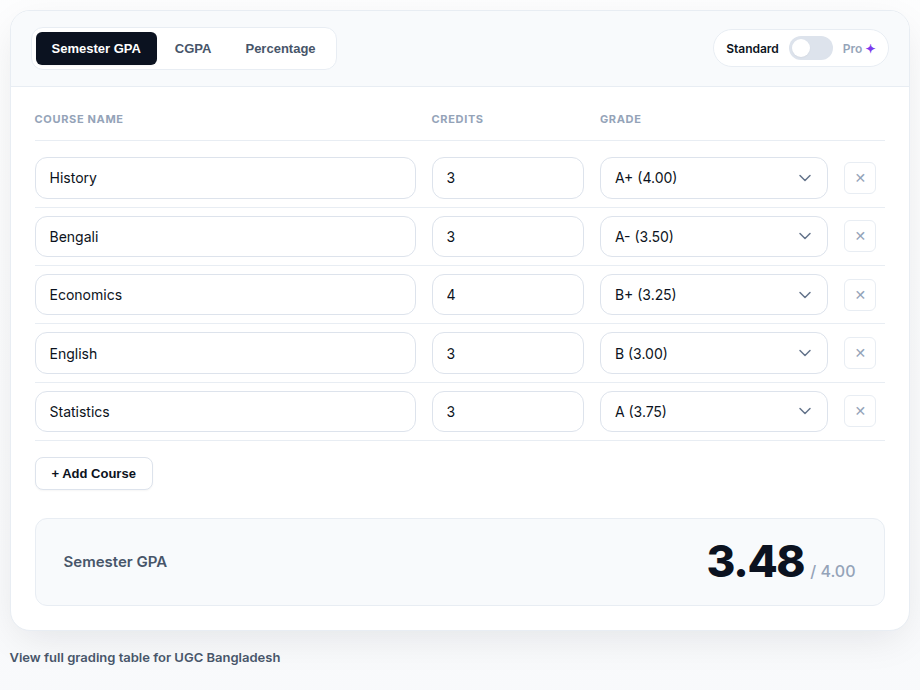
The screenshot above shows a real 5-course semester filled in: History (3 credits, A+ = 4.00), Bengali (3 credits, A− = 3.50), Economics (4 credits, B+ = 3.25), English (3 credits, B = 3.00), Statistics (3 credits, A = 3.75). Total quality points: 12.00 + 10.50 + 13.00 + 9.00 + 11.25 = 55.75. Divide by 16 credits and you get 3.484375, which DU’s rounding rule reports as 3.48. We will work through a longer example by hand below so you can check the calculator’s math yourself.
Dhaka University grading system: the official table
DU follows the UGC uniform grading system mandated for all public universities in Bangladesh since a 2006 UGC circular. The exact table below is taken from three DU sources that all agree: the official undergraduate syllabus on DU’s own domain, the Department of Chemistry’s published “Grades and Grade Points” page, and DU’s Faculty of Business Studies program pages.
| Numerical marks | Letter grade | Grade point |
|---|---|---|
| 80 and above | A+ | 4.00 |
| 75–79 | A | 3.75 |
| 70–74 | A− | 3.50 |
| 65–69 | B+ | 3.25 |
| 60–64 | B | 3.00 |
| 55–59 | B− | 2.75 |
| 50–54 | C+ | 2.50 |
| 45–49 | C | 2.25 |
| 40–44 | D | 2.00 |
| Below 40 | F | 0.00 |
Two more letters can appear on your grade sheet: I (Incomplete) for a student who did not sit an examination, and W (Withdrawn) for a student who attended no classes and took no exam. Both carry 0.00 grade points.
Three quirks in the DU syllabus document are worth knowing because no calculator tells you about them:
- Teachers award marks, not letters. All marks are entered in numerical form during evaluation; letter grades appear only on the final tabulation sheet. You might actually see your raw marks on departmental notices even though letters are the official record.
- Fractional marks are rounded up to the whole number. A total of 74.3 in a course becomes 75 — which is the difference between A− (3.50) and A (3.75). Marks are recorded to two decimals, and the fractional total is raised to the higher whole number.
- GPA and CGPA are reported to two decimals, with round-half-up. If the third decimal is 5 or above, the second decimal moves up — 3.458 becomes 3.46. This is not banker’s rounding; it is the plain “5 or more rounds up” rule.
- Your transcript does NOT show numerical marks. The official transcript prints letter grades, grade points, GPA and CGPA — but not the raw marks. So that 79.6 you lost sleep over shows up as a simple “A”.
How GPA and CGPA are actually calculated at DU
Per the DU undergraduate syllabus, the formulas are credit-weighted — a 4-credit course counts twice as much as a 2-credit one:
Semester GPA = Σ (course credits × grade point earned) ÷ total credits taken
CGPA (over more than one semester) = Σ (semester GPA × semester credits) ÷ total credits of the semesters concerned
Notice the second formula: your CGPA is a credit-weighted combination of semester GPAs, not a simple average. If semester 1 was 15 credits at 3.20 and semester 2 was 16 credits at 3.80, the CGPA is (15×3.20 + 16×3.80) ÷ 31 = 3.51 — not (3.20+3.80) ÷ 2 = 3.50. Small difference, real money on a transcript.
Worked example: semester GPA step by step
Let us run a full semester by hand, the way the tabulation sheet would. Meet Rafid, a first-year student with 5 courses:
| Course | Credits | Marks | Letter | Grade point | Quality points |
|---|---|---|---|---|---|
| CSE-101 | 3 | 84 | A+ | 4.00 | 3 × 4.00 = 12.00 |
| CSE-102 | 3 | 77 | A | 3.75 | 3 × 3.75 = 11.25 |
| MAT-101 | 3 | 66 | B+ | 3.25 | 3 × 3.25 = 9.75 |
| PHY-101 | 2 | 61 | B | 3.00 | 2 × 3.00 = 6.00 |
| ENG-101 | 1 | 52 | C+ | 2.50 | 1 × 2.50 = 2.50 |
| Total | 12 | 41.50 |
GPA = 41.50 ÷ 12 = 3.45833… The third decimal is 8, which is 5 or above, so the second decimal rounds up: Rafid’s semester GPA is 3.46.
Now watch what happens across three semesters:
| Semester | Credits | GPA | Weighted points |
|---|---|---|---|
| Semester 1 | 15 | 3.20 | 48.00 |
| Semester 2 | 16 | 3.46 | 55.36 |
| Semester 3 | 14 | 3.71 | 51.94 |
| Total | 45 | 155.30 |
CGPA = 155.30 ÷ 45 = 3.45111… → 3.45. Here is the trap: the simple average of the three GPAs is (3.20 + 3.46 + 3.71) ÷ 3 = 3.46, but the correct credit-weighted CGPA is 3.45. Always weight by credits.
Read more: Jahangirnagar University uses the same UGC scale — the JU guide has another full worked example if you want more practice.
GPA vs CGPA: which one matters and when
Your GPA describes a single semester. Your CGPA is the running total across everything you have completed, and it is the number that appears on your degree, your transcript, and — crucially — every job application, BCS form, and foreign-university application you will ever fill in.
The number that decides whether you move to the next year is also a CGPA, not a semester GPA. DU’s Faculty of Business Studies publishes the promotion bar explicitly, calculated excluding viva-voce grades:
- 1st year → 2nd year: minimum CGPA 2.00
- 2nd year → 3rd year: minimum CGPA 2.25
- 3rd year → 4th year: minimum CGPA 2.50
Fall below the bar and you are not promoted; readmission is possible (once, in most regulations), and any course you clear after readmission carries an “R” prefix on your transcript — RA, RB+, and so on.
Improvement and retake rules: the part nobody explains
This is the section DU students ask about most — and the one generic CGPA articles never cover. Everything below comes from published DU program regulations.
If you get an F or an I, retaking is not optional
An F (0.00 grade points) stays in your denominator — its credits drag your GPA down — until the course is cleared. DU’s program rules state it plainly: a student earning F or I shall improve the grade by retaking the course on payment of fees in a subsequent available semester. And you cannot graduate with an F or I anywhere on your record. No degree is awarded with an uncleared F or I, even if your CGPA is otherwise fine.
You can also improve a bad pass grade — with a ceiling
Depending on the program, a student earning B or less (some notices say C+ or lower, some departmental rules say C or lower — the exact eligibility bar varies, so check your department’s notice) may retake the course to improve the grade. The rules that are consistent across programs:
- The improved grade is capped at B+ (3.25). You can pull a C up to a B+, but not to an A, no matter how well you do on the retake.
- Only the term-final examination is repeated in the affiliated-college notices — not the whole course’s incourse marks.
- One shot. Retakes are typically allowed once per course; the earlier grade is automatically cancelled when you apply.
- Your transcript is marked. Retaken courses carry an “R” annotation, so the improvement is visible.
- If you fail to improve, the old grade stands. You cannot do worse than your original result — the previous grade stays valid.
A worked improvement scenario: say you have a CGPA of 3.10 after 60 credits (186.00 quality points). One 3-credit course sits at C (2.25), contributing 6.75 points. You repeat the term-final and score at B+ level — capped at 3.25, contributing 9.75. New total: 186.00 − 6.75 + 9.75 = 189.00, and 189.00 ÷ 60 = 3.15. One improvement exam, five hundredths of a CGPA point. Whether that is worth it depends entirely on how close you are to a threshold like 3.00 or 3.50.
Read more: How retaking a course affects your CGPA — the math of before-and-after scenarios, worked out in detail.
Attendance, degree minimum, and the 6-year clock
Before exams even happen, attendance can stop you. DU’s published tiers: 75% or above means you are regular and can sit the exam; 60–74% makes you “non-collegiate” (you can still sit, on payment of a Tk 5,000 fine); below 60% and you cannot sit at all — readmission is the only route.
For the degree itself, departmental and professional-program regulations consistently require a minimum CGPA of 2.50 with no F or I on the record, and the full program must be completed within 6 academic years. (These figures come from published DU departmental and program regulations; DU does not appear to publish a single university-wide honours minimum on its central pages, so confirm against your department’s ordinance.)
The three magic numbers: 3.00, 3.50, and 3.75
Students talk about “a good CGPA” as if it were one number. At DU it is really three different bars, and mixing them up is the most common confusion in every student forum thread:
- 3.00 — the first-class line. Bangladeshi public universities follow the British-style class convention: CGPA 3.00–4.00 is first class, 2.25–2.99 second class, 2.00–2.24 third class. This is the threshold that matters for BCS eligibility and most government job circulars. (A note on sourcing: this class mapping is the widely used national convention — see the standard public-university table — DU itself does not publish a class table on its website, but every public-university grading reference in Bangladesh uses it.)
- 3.50 — the lecturer-recruitment bar. DU’s own faculty recruitment advertisements require “first class or a minimum CGPA of 3.50” — a 2026 DU Fisheries department ad listed it explicitly. If you ever dream of teaching at DU, 3.50 is your real target, not 3.00.
- 3.75 — the Dean’s Award line. DU awards the Dean’s Award to students finishing their 4-year program with CGPA 3.75 or above — a maximum of 5 candidates per department. And here is the catch that no calculator will warn you about: any F grade, any retake or improvement, any readmission, or attendance below 80% disqualifies you, no matter how high your final CGPA is. One improvement exam in first year permanently closes this door.
Converting DU CGPA to percentage (and the Delhi trap)
Foreign universities and some employers ask for a percentage instead of a CGPA. A DU B.Sc. Engineering ordinance recommends this piecewise formula:
- For CGPA between 3.75 and 4.00: Percentage = 79 + 84 × (CGPA − 3.75)
- For CGPA between 2.25 and 3.75: Percentage = 44 + 20 × (CGPA − 2)
Check it: CGPA 3.45 → 44 + 20 × 1.45 = 73%. CGPA 3.90 → 79 + 84 × 0.15 = 91.6%. Both formulas meet at 79% for CGPA 3.75, so the scale is continuous. Present this as the engineering-ordinance formula when a form asks for “official conversion” — and add a footnote that it comes from that ordinance, not a central DU rule.
Now the warning. If you search “CGPA to percentage formula,” half the internet will tell you Percentage = CGPA × 9.5. That is Delhi University’s rule, from its 10-point CBCS system. It has nothing to do with Dhaka University, and using it will inflate your percentage by a huge margin — 3.45 × 9.5 would claim 32.8%, which is nonsense here, and 4.00 × 9.5 claims 38%. The correct DU-side answer for 4.00 is 100%. If an evaluator asks where your number comes from, cite the formula and its source; do not mix the two countries’ systems.
Why your 80 marks are worth less than your friend’s at NSU
One more comparison that confuses every DU student who has friends in private universities. The “4.00 scale” is not the same everywhere in Bangladesh:
- At DU, 80 marks = A+ (4.00)
- At NSU, 80 marks = roughly B (3.00) — NSU needs 93+ for an A
Same marks, a full grade point of difference. This is why a DU 3.60 and an NSU 3.60 describe very different transcripts, and why foreign universities and scholarship committees that understand Bangladesh weight public-university CGPAs accordingly. Your CGPA only ever means something inside the grading system that produced it.
Read more: NSU vs IUB vs BRACU grading compared — how private-university boundaries differ from DU’s UGC scale.
Common mistakes DU students make
- Averaging semester GPAs instead of weighting by credits. As shown above, (3.20 + 3.46 + 3.71) ÷ 3 = 3.46 is wrong; the credit-weighted 3.45 is right. The DU calculator’s CGPA tab does this correctly.
- Assuming the ×9.5 percentage formula. Delhi’s rule, not Dhaka’s. Use the DU engineering-ordinance formula above.
- Thinking an improvement exam can take you from C to A. The B+ (3.25) cap means improvements are for crossing thresholds (2.00, 3.00), not for chasing 4.00.
- Ignoring the 80% attendance rule for the Dean’s Award. You can have a 3.9 and still be ineligible because of attendance — and the disqualification is silent until award season.
- Forgetting that F credits sit in the denominator. An F is 0.00 grade points but its credits still count, so one F hurts more than most students expect — clear it in the next available semester.
- Expecting raw marks on the transcript. DU transcripts show letters, grade points, GPA and CGPA only. Your 79.6 becomes a clean “A”.
Tips for keeping your DU CGPA healthy
- Protect your boundaries. On the UGC scale, 74 vs 75 is the difference between 3.50 and 3.75 — one mark worth a quarter of a grade point. Know your boundaries and fight for borderline marks through re-evaluation channels where your department allows it.
- Weight your effort by credits. A 4-credit course moves your GPA twice as much as a 2-credit one. Allocate study time proportionally, not equally.
- Use improvement exams surgically. With the B+ cap, the best use of an improvement is lifting a C/C+ (2.25–2.50) to B+ (3.25) right before a threshold — say, pushing a 2.96 CGPA over the 3.00 first-class line.
- Never skip the attendance gate. Below 60% you cannot even sit the exam; below 75% you pay a fine; below 80% you lose Dean’s Award eligibility. Attendance is the cheapest grade insurance you have.
- Plan your target backwards. Current CGPA 3.20 after 45 credits, want 3.30 after a 15-credit semester? You need (3.30 × 60 − 3.20 × 45) ÷ 15 = 3.60 next semester. If the required GPA is above 4.00, the target is mathematically impossible — adjust it now, not in the exam hall.
Frequently asked questions
What is a good CGPA at Dhaka University?
It depends on the bar you are aiming at: 3.00 is first class (the BCS/government-job threshold), 3.50 is the minimum DU asks of its own lecturer applicants, and 3.75 earns the Dean’s Award. For most careers, crossing 3.00 is the essential milestone; for academia, aim for 3.50+.
Can I improve a B or C+ at DU?
Yes, depending on your program — some allow improvement for B or less, others for C+ or lower. But the improved grade is capped at B+ (3.25), usually only the term-final is repeated, retakes are typically allowed once per course, and the transcript is marked with “R”. If you do not improve, your original grade stays valid.
Does an F still count after I retake the course?
No — applying for a retake automatically cancels the earlier grade, and the retaken course shows an R annotation on your transcript. But until you clear it, the F’s credits sit in your GPA denominator at 0.00 grade points, so retake in the next available semester.
How do I convert my DU CGPA to a percentage?
Use the formula from DU’s B.Sc. Engineering ordinance: for CGPA 2.25–3.75, Percentage = 44 + 20 × (CGPA − 2); for 3.75–4.00, Percentage = 79 + 84 × (CGPA − 3.75). Do NOT use the Indian “× 9.5” formula — that belongs to Delhi University.
Why does DU give A+ at 80 when my friend’s university needs 93?
Because grade boundaries are set by each university’s system, not by a national marks table. DU uses the UGC uniform scale (80+ = A+ = 4.00); NSU and IUB set their A bands much higher. A CGPA only has meaning inside the system that awarded it.
What is the minimum CGPA to graduate from DU?
Published DU departmental and professional-program regulations require a minimum CGPA of 2.50 with no F or I grades on the record, within 6 academic years. Year-to-year promotion bars are 2.00 (to 2nd year), 2.25 (to 3rd year), and 2.50 (to 4th year). Confirm the exact figures against your department’s ordinance, as thresholds vary slightly.
Does DU show marks on the transcript?
No. DU transcripts print letter grades, grade points, GPA and CGPA — numerical marks are not included, even though teachers evaluate in numerical form and departments may post raw marks on notice boards.
Conclusion
Dhaka University’s grading system is the UGC uniform scale: 80 marks and above earns the full 4.00, GPAs are credit-weighted, fractional marks round up, and transcripts speak in letters. The parts that actually move your future are the ones calculators never show — the B+ improvement cap, the one-shot retake with its R annotation, the 2.00/2.25/2.50 promotion bars, and the three thresholds of 3.00 (first class), 3.50 (lecturer bar) and 3.75 (Dean’s Award).
Run your numbers through the DU CGPA calculator to see where you stand, plan your next semester backwards from your target, and if you are close to a threshold, convert your CGPA to a percentage the DU way — not Delhi’s — when forms ask for one.