If you are applying to a Pakistani university in 2026, one number decides your fate more than any other: your aggregate. Not your FSc percentage alone, not your entry-test score alone — the weighted combination your target university actually uses. And here is the problem: the formula is different at every university, the numbers floating around on calculator sites are often wrong or years out of date, and nobody puts all of them on one page with the closing merits you need to beat.
This guide fixes that. Every formula below was checked against official sources for the 2026 admission cycle, with a source link under each claim. Where a number could not be verified, I say so plainly instead of bluffing — because an aggregate built on a wrong formula is worse than no aggregate at all.
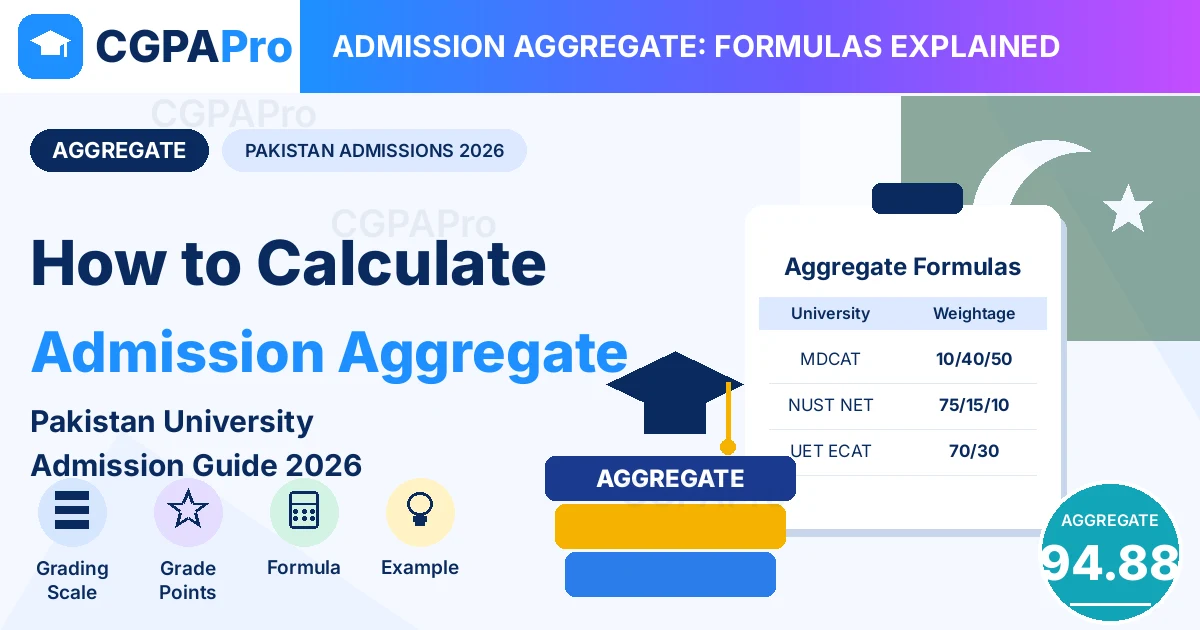
The Short Answer: Every 2026 Aggregate Formula on One Page
Here is the master table. Find your university, note the weights, and the worked examples further down show exactly how to crunch your own numbers.
| University / Test | Aggregate formula (2026) | Test details |
|---|---|---|
| MDCAT (MBBS/BDS, PMDC) | 10% Matric + 40% FSc + 50% MDCAT | 180 MCQs, no negative marking |
| NUST (NET) | 75% NET + 15% HSSC + 10% Matric | 200 MCQs, 3 hours, best of 3–4 attempts |
| UET Lahore (ECAT) | 70% FSc + 30% ECAT — no Matric | 100 MCQs, +4/−1, 400 marks |
| FAST-NU | Reported: 50% Inter (Part-I) + 50% NU test — not published in FAST’s 2026 handbook; verify | NU admission test, min 50% to pass |
| COMSATS | 10% Matric + 40% Inter + 50% NTS NAT | NAT-IE / NAT-ICS, two intakes a year |
| GIKI | 85% admission test + 15% SSC | Computer-based: Math + Physics + English |
| PIEAS | Reported: 60% test + 25% FSc + 15% Matric — secondary sources; verify in the 2026 leaflet | 100 MCQs, +3/−1, calculators allowed |
| PU Lahore | 10% Matric + 40% Inter + 50% PU Entry Test | PU’s own entry test |
| LUMS | No percentage aggregate — holistic review | LCAT / SSAT / SAT + application + interview |
The formula is always the same shape:
Aggregate = (w1 × Matric %) + (w2 × FSc %) + (w3 × Test %)
Convert each component to a percentage first (obtained ÷ total × 100), multiply by its weight, add them up. That is the entire “calculator”. The worked examples below do it step by step with real numbers so you can copy the method.
2026 numbers the top Google results get wrong. Before you trust any aggregate calculator site, know this: MDCAT 2026 is 180 MCQs, not 200 (several ranking pages still divide by 200, which understates your score by about 11%). UET Lahore’s 2026 formula is 70% FSc + 30% ECAT with no Matric — the “25% Matric + 45% FSc Part-I + 30% ECAT” split was a COVID-era 2020 policy, and one popular calculator site’s “Matric 17% + FSc Part-I 50% + ECAT 33%” appears to be fabricated while claiming to be official. NUST is 10 + 15 + 75 = 100 — a site ranking for “NUST aggregate” lists weights that add to 110%. Always check the weights add to 100.
The Two-Minute Aggregate Check
Do the weighted math by hand once — it takes two minutes and you will understand your number instead of blindly trusting a tool. Then use CGPAPro’s calculator as the companion for everything around the formula: verify your percentage conversions, rerun the formula with “what if my FSc were 2 points higher?” scenarios, and once you are admitted, plan your semesters with the NUST calculator, FAST-NU calculator, and COMSATS Islamabad calculator — each using the correct local grade scale.
The CGPAPro calculator with a worked example — enter your courses, credits, and grades to see your CGPA instantly. Use it alongside the aggregate formulas above to plan both your admission number and your first semester.
The method, once, slowly:
- Convert every component to a percentage: obtained ÷ total × 100.
- Multiply each percentage by its weight (as a decimal): 50% weight = × 0.50.
- Add the three products. That sum is your aggregate.
Example — an MDCAT applicant: Matric 1050/1100 = 95.45%, FSc 980/1100 = 89.09%, MDCAT 165/180 = 91.67%.
- Matric: 95.45 × 0.10 = 9.545
- FSc: 89.09 × 0.40 = 35.636
- MDCAT: 91.67 × 0.50 = 45.833
- Aggregate = 9.545 + 35.636 + 45.833 = 91.02%
(UHS publishes merit to four decimal places, so keep the decimals.) Now the same treatment, university by university.
MDCAT Aggregate 2026: 10% Matric + 40% FSc + 50% MDCAT
The MDCAT formula is set by the PMDC and applies to public-sector MBBS/BDS admissions (provinces may tweak the private-sector split, so check your province’s 2026 policy). The 2026 test: 180 MCQs, 1 mark each, no negative marking, 3 hours, held on 20 September 2026. Subject split: Biology 81, Chemistry 45, Physics 36, English 9, Logical Reasoning 9.
Eligibility floor: 55% in MDCAT (99/180) for MBBS, 50% (90/180) for BDS. Below that, you are not eligible for that year’s merit — no matter how good your FSc is.
The highest-leverage fact in this entire guide: 1 MDCAT mark = 50 ÷ 180 = 0.278 aggregate points. Ten extra MDCAT marks are worth 2.78 aggregate points — roughly what 76 extra FSc marks (out of 1100) would give you (76 × 40/1100 = 2.76). In the final two months before MDCAT, an hour spent on test prep buys roughly 7–8× the aggregate of an hour spent polishing FSc board exams you have already taken. Plan accordingly.
Worked example (MDCAT)
Matric 1020/1100 = 92.73%, FSc 960/1100 = 87.27%, MDCAT 158/180 = 87.78%.
- Matric: 92.73 × 0.10 = 9.273
- FSc: 87.27 × 0.40 = 34.909
- MDCAT: 87.78 × 0.50 = 43.889
- Aggregate = 88.07%
What you needed for public MBBS last year (UHS 2025-26, official final lists)
- King Edward Medical University (KEMU): 94.8838%
- Allama Iqbal Medical College (AIMC): 94.4636%
- Services Institute of Medical Sciences (SIMS): 94.2379%
- Nishtar Medical University: 94.1667%
- Ameer-ud-Din Medical College: 94.0253%
- Rawalpindi Medical College: 93.9525%
- Lowest public-sector MBBS closing: roughly 93.6%
- Private-sector MBBS: around 78.8%
Notice how tight the band is at the top: the difference between KEMU and RMC is under one aggregate point — about 3–4 MDCAT marks. That is why the “1 mark = 0.28 points” math matters so much.
UET Lahore (ECAT) Aggregate 2026: 70% FSc + 30% ECAT
UET’s formula is the simplest on this page — and the most misreported. Aggregate = 70% FSc + 30% ECAT. Matric does not count at all (per UET’s official 2026 merit rules; UET’s own aggregate document). If a calculator asks for your Matric marks for UET, close the tab.
ECAT 2026: 100 MCQs, +4 for a correct answer, −1 for a wrong one, 400 marks total. Subjects: Physics 30, Mathematics 30, English 10, and Chemistry or Computer Science 30. Eligibility: minimum 60% in FSc and a minimum 50% aggregate to appear on merit. Registration closed 9 June 2026; tests ran 16–21 June 2026; results were announced 7 August 2026.
Two UET-specific quirks most guides skip: sports and Hafiz-e-Quran marks count inside the 70% FSc component, and 10 marks are deducted if an exam was passed “by parts” (supply/improvement split across sessions).
The negative marking changes the strategy: 1 ECAT mark = 30 ÷ 400 = 0.075 aggregate points, but a wrong answer costs you 0.075 and hands your competitor relative ground. Never guess blindly on ECAT — eliminate first, then decide.
Worked example (ECAT)
FSc 950/1100 = 86.36%, ECAT 300/400 = 75%.
- FSc: 86.36 × 0.70 = 60.455
- ECAT: 75 × 0.30 = 22.5
- Aggregate = 82.95%
UET closing merits
2025 closings, main campus (official UET PDF): Software Engineering 86.24%, Computer Science 80.23%, Artificial Intelligence 77.40%, Cyber Security 72.90%, Data Science 71.79%. Fall 2026 Merit List 1 (morning): CS 87.46732, Cyber Security 86.53509, Data Science 85.15655, Electrical Engineering 85.13726. CS keeps climbing — treat last year’s closing as a floor, not a target.
NUST (NET) Aggregate 2026: 75% NET + 15% HSSC + 10% Matric
NUST weights the test heaviest of any major university: 75% NET + 15% HSSC + 10% Matric. Your board marks are nearly a formality here — the NET decides almost everything. Note the HSSC nuance: applicants without a Part-II result are evaluated on HSSC Part-I marks; where the full result exists, it is used. Minimum 60% in Matric and HSSC separately to be eligible, and you may apply on an FSc Part-I basis.
NET 2026: 200 MCQs, 3 hours. The series system is NUST’s gift to planners: NET-1 in Dec/Jan, NET-2 in Mar/Apr, NET-3 in Jun/Jul (a fourth series ran in 2026, deadline 8 June 2026) — your best attempt counts. There is no reason to take it only once. O/A-level students in their final year get 25% weight to O-level equivalence marks (IBCC certificate required), and there is an ACT/SAT alternative pathway for foreign-qualification candidates.
One mark of NET = 75 ÷ 200 = 0.375 aggregate points — the single most valuable test mark in Pakistani admissions. And the strategic fact no competitor page mentions: NET-1 happens in Dec/Jan of your FSc Part-I year. Students who start preparing in the summer after Matric get three or four attempts; students who discover the NET in May get one.
Honest caveat: whether the NET carries negative marking is disputed across sources — confirm the marking scheme in your admit card / the current NUST prospectus before you plan a guessing strategy.
Worked example (NET)
Matric 1000/1100 = 90.91%, HSSC 920/1100 = 83.64%, NET 140/200 = 70%.
- Matric: 90.91 × 0.10 = 9.091
- HSSC: 83.64 × 0.15 = 12.545
- NET: 70 × 0.75 = 52.5
- Aggregate = 74.14%
NUST closing merits
2024 closing aggregates, main campus: Software Engineering 74%, Computer Science 73%, AI 72%, Electrical Engineering 72%, Mechanical Engineering 71%; BBA 65%, BS Economics 67%. NUST has since shifted to publishing merit positions rather than percentages — 2025 closing positions: CS 747, SE 482, EE 1069, ME 450. If your position number is at or below the closing position, you are in.
NUST Grading System 2026: HEC Grades, GPA & CGPA Guide — what happens to your marks after you get in.
How to Calculate SGPA: Formula & Examples (2026) — the semester math you will use from day one.
FAST-NU Aggregate 2026: Reported 50% Inter + 50% NU Test
FAST is the one university on this page where I have to be honest with you: FAST’s own 2026 Academic Rules Handbook publishes no percentage breakdown. The widely reported formula is 50% Inter (Part-I) + 50% NU admission test, with no Matric — and it matches how FAST merit lists behave — but treat it as reported, not official, and verify against the current prospectus before you rely on it.
What is official for 2026: minimum 60% in SSC and 60% in HSSC for engineering programs, and you must score at least 50% on the NU admission test to pass it. The 2026 cycle: applications closed 26 June 2026, tests in July, merit lists around 23–24 July 2026, classes after 15 August 2026.
FAST publishes no public closing-merit numbers, which is why you will not find them in any honest guide. Worked example under the reported formula — Inter Part-I 450/550 = 81.82%, NU test 70/100 = 70%: 81.82 × 0.50 + 70 × 0.50 = 75.91%.
COMSATS Aggregate 2026: 10% Matric + 40% Inter + 50% NTS NAT
COMSATS runs no entry test of its own — it uses the NTS NAT (NAT-IE for engineering, NAT-ICS for computing): 10% Matric + 40% Inter + 50% NAT. Two structural advantages students miss: COMSATS has two intakes a year (Spring and Fall), so a missed Fall is not a lost year, and the NAT is offered in multiple sessions, so you can retake it like the NET.
Worked example: Matric 980/1100 = 89.09%, Inter 900/1100 = 81.82%, NAT 80/100 = 80% → 8.909 + 32.727 + 40 = 81.64%.
Islamabad campus closings: Spring 2026 — CS 84.23%, SE 82.47%; 2023 — CS 87.10%, SE 85.42%, AI 85.33%. Note the Spring/Fall swing: Spring intakes often close a few points lower, which makes the Spring attempt a genuine second chance, not a consolation round.
COMSATS Grading System 2026: Grades, GPA & CGPA Guide — COMSATS’ HEC grading scale, GPA rules, and probation policy once you are in.
GIKI Aggregate 2026: 85% Test + 15% SSC
GIKI is the most test-dominant university in Pakistan: 85% admission test + 15% SSC/Matric (or O-level equivalent), verified in GIKI’s official Undergraduate Admissions Policy. Your FSc marks do not enter the formula at all — the test is nearly everything.
The test is computer-based: Mathematics + Physics + English. Overseas applicants can substitute SAT-II (Math + Physics). Worked example: SSC 990/1100 = 90%, test 75/100 = 75% → 13.5 + 63.75 = 77.25%. One test mark = 85 ÷ 100 = 0.85 aggregate points — the highest per-mark value on this page.
PIEAS Aggregate 2026: Reported 60% Test + 25% FSc + 15% Matric
PIEAS’s reported formula is 60% written test + 25% FSc + 15% Matric — but this comes from secondary sources, so verify it in the PIEAS 2026 admission leaflet before you plan around it. The test: 100 MCQs, +3 for correct / −1 for wrong, 3 hours, calculators allowed — the only major test in Pakistan that lets you bring a calculator. Reserved seats exist for overseas Pakistanis with SAT-II 2000+ / ACT 25+. Worked example under the reported formula: Matric 1000/1100 = 90.91%, FSc 950/1100 = 86.36%, test 65/100 = 65% → 13.636 + 21.591 + 39 = 74.23%.
LUMS: No Aggregate — Holistic Review
LUMS does not compute a percentage aggregate at all. Admission is holistic: your academic record, an admission test (LCAT, SSAT, or SAT accepted), your application and documents, and an interview if shortlisted (LUMS undergraduate flyer). There is no formula to game — which also means there is no “closing merit” to chase. Strong board marks help, but the test and application carry real weight.
Bonus: Punjab University (PU Lahore) — 10/40/50
PU Lahore’s 2026 formula mirrors MDCAT’s shape: 10% Matric + 40% Inter + 50% PU Entry Test. BS CS 2025 closings: main campus 87.18%, Gujranwala 81.77%, Jhelum 71.88% — the campus you choose changes the target by 15 points. Worked example: Matric 1000/1100 = 90.91%, Inter 920/1100 = 83.64%, PU test 75% → 9.091 + 33.455 + 37.5 = 80.05% — short of the main-campus CS closing, comfortable for Gujranwala.
IBCC Equivalence: How O/A-Level Grades Become Pakistani Marks
If you did O/A levels, every formula above still applies — but first your grades must be converted to Pakistani marks by the IBCC. This is the step every calculator site waves at and none of them actually shows. Here is the official conversion (IBCC conversion page).
Official grade values per subject: A* = above 90 (session-based from 2021 onward — it is not a fixed 90), A = 85, B = 75, C = 65, D = 55, E = 45. F/G grades are not accepted.
- O-level → SSC: 8 subjects (English, Mathematics, Urdu, Islamiyat, Pakistan Studies + 3 electives) out of 800, scaled to /900. IBCC’s own example: all-A* = 750/800 → 844/900.
- A-level → HSSC: 8 O-level + 3 A-level subjects out of 1100. IBCC’s example: all-A* = 1030/1100.
- Foreign nationals: 5 O-level + 3 A-level subjects out of 800, then scaled ×1100.
- Extra subjects: IBCC drops your lowest grades and counts the best — so a weak 9th O-level subject does not drag you down.
- Equivalence is computed session by session — apply early so a paperwork delay does not cost you a merit list.
Worked example: an O-level student with 5 A*, 2 A, 1 B. Marks = 5×90 + 2×85 + 75 = 450 + 170 + 75 = 695/800 → scaled: 695 ÷ 800 × 900 = 781.88 → 782/900 as the SSC equivalent. (Using the fixed A* = 90 baseline; your actual session’s A* value may differ slightly — the certificate rules.) That 782/900 = 86.89% is the “Matric %” you plug into every formula above.
Where One Mark Buys You the Most: The ROI Table
Not all marks are equal. This table shows what a single extra mark is worth in aggregate points at each university — spend your final month where the return is highest:
| Test | 1 extra test mark = | 1 extra FSc mark (of 1100) = |
|---|---|---|
| MDCAT | 0.278 pts | 0.036 pts |
| NUST NET | 0.375 pts | 0.014 pts |
| UET ECAT | 0.075 pts | 0.064 pts |
| COMSATS NAT | 0.50 pts | 0.036 pts |
| GIKI test | 0.85 pts | 0 (FSc not counted) |
| PU Entry Test | 0.50 pts | 0.036 pts |
| PIEAS test | 0.60 pts | 0.023 pts |
Read it plainly: for NUST, one NET mark is worth 27 FSc marks. For MDCAT, one test mark is worth about 8 FSc marks. Only at UET — where the test is 30% and FSc is 70% — are board marks and test marks close in value. If your FSc exams are done, the test is where your aggregate is won or lost.
Closing Merits Master Table (Latest Available)
| University / Program | Last closing | Source year |
|---|---|---|
| KEMU (MBBS, public) | 94.8838% | UHS 2025-26 |
| AIMC (MBBS, public) | 94.4636% | UHS 2025-26 |
| Lowest public MBBS | ~93.6% | UHS 2025-26 |
| Private MBBS | ~78.8% | UHS 2025-26 |
| UET CS (morning, Merit List 1) | 87.46732 | Fall 2026 |
| UET SE (afternoon) | 86.24% | 2025 (official PDF) |
| UET CS (afternoon) | 80.23% | 2025 (official PDF) |
| NUST SE | 74% | 2024 |
| NUST CS | 73% | 2024 |
| NUST CS (merit position) | 747 | 2025 |
| COMSATS Isb CS (Spring) | 84.23% | Spring 2026 |
| COMSATS Isb SE (Spring) | 82.47% | Spring 2026 |
| PU Lahore BS CS (main) | 87.18% | 2025 |
| PU Lahore BS CS (Gujranwala) | 81.77% | 2025 |
Treat every closing as a floor, not a target — popular programs creep upward most years. Aim 2–3 points above the last closing for your program.
When to Start: The Month-by-Month Timeline
- December–January (FSc Part-I year): NUST NET-1. Yes, this early — your best attempt counts, and an early score tells you exactly how much work remains.
- March–April: NET-2. MDCAT syllabus prep begins in earnest.
- May–June: MDCAT registration. ECAT registration (deadline early June). NET additional series (deadline early June). GIKI applications (mid-June).
- Mid–late June: ECAT tests. FAST applications close (late June).
- July: FAST admission tests. NET-3. FAST merit lists (late July). COMSATS Fall applications.
- Early August: ECAT results. UET merit lists follow.
- After mid-August: FAST classes begin.
- September: MDCAT (20 Sep in 2026).
- October–November: UHS merit lists for public medical colleges.
The students who start at NET-1 get four data points before final decisions. The students who start in May get one shot at everything. The timeline is the strategy.
Common Aggregate Mistakes
- Using the wrong total for MDCAT — dividing by 200 instead of 180. Your percentage, and therefore half your aggregate, comes out ~11% too low, and you panic-apply to the wrong universities.
- Counting Matric for UET — it is 70/30 with no Matric. Every year students under-apply because a wrong calculator told them their weak Matric disqualifies them.
- Forgetting weights must sum to 100 — the fastest sanity check there is. If a site’s formula adds to 110%, nothing on that page can be trusted.
- Mixing Part-I and full FSc marks — know which one your university uses for your category (NUST: Part-I if no Part-II result yet).
- Applying A-level grades directly — convert through IBCC first; raw grade letters are not percentages.
- Chasing last year’s closing exactly — closings move. The UET CS morning list jumped from 80.23% (2025 afternoon) to 87.47% (Fall 2026 List 1). Build a margin.
- Ignoring the second intake — COMSATS Spring, NUST’s multiple NET series, and private medical merit lists are all second chances most students never plan for.
Tips That Actually Move Your Aggregate
- Attack the highest-weight component first. The ROI table is your study plan: NET > MDCAT > NAT > ECAT in per-mark value.
- Respect negative marking where it exists. ECAT (−1 on a +4 scale) and PIEAS (+3/−1) punish blind guessing; MDCAT has none — attempt everything.
- Take every attempt you are offered. NET’s best-of-series, NAT’s multiple sessions, COMSATS’ two intakes — each is a free option. Use them.
- Get your IBCC equivalence early. Session-by-session processing plus document verification is the most common avoidable delay in Pakistani admissions.
- Reverse-calculate your target. Want 88% aggregate for UET CS with 86% FSc? You need ECAT = (88 − 0.70×86) ÷ 0.30 = 92.7%. Now you know the exact score to chase — no vague “do your best”.
- Apply to a ladder, not a lottery ticket. One dream program, two matches (at/above last closing), one safety (Spring intake or a second campus). The closing table above is your ladder.
FAQ: What Students Actually Ask
Is MDCAT 180 or 200 MCQs in 2026?
180 MCQs, 1 mark each, no negative marking, 3 hours. Pages saying 200 are recycling older years. Dividing your score by 200 understates your percentage — and half your aggregate — by about 11%.
Does UET ECAT count Matric marks?
No. The 2026 formula is 70% FSc + 30% ECAT. Matric does not enter the calculation. (The 25/45/30 split some sites show was a 2020 COVID-era policy.)
Can A-level students apply for MDCAT, NUST, and UET?
Yes — through IBCC equivalence, which converts your grades to Pakistani marks (see the IBCC section above). NUST additionally gives final-year O/A-level applicants 25% weight to their O-level equivalence marks, and offers an ACT/SAT pathway for foreign-qualification candidates.
What aggregate do I need for NUST Computer Science?
The 2024 closing was 73% aggregate (SE closed at 74%). NUST now publishes merit positions instead — 2025 CS closed at position 747. Aim above 75% to be comfortable.
Is the FAST 50/50 formula official?
Not confirmed. 50% Inter (Part-I) + 50% NU test is widely reported and matches observed merit behavior, but FAST’s own 2026 handbook publishes no percentages. Verify against the current prospectus before relying on it.
What happens if I score below 99/180 in MDCAT?
You fall below the 55% MBBS eligibility floor (50% / 90 marks for BDS) and cannot appear on that year’s public merit lists. Your options: private colleges (lower cutoffs, ~78.8% aggregate), improving and reappearing next year, or pivoting to non-medical programs whose tests (NET, NAT, ECAT) you can still take.
When should I start preparing?
The December before your final year — NUST NET-1 runs in Dec/Jan of your FSc Part-I year, and your best attempt counts. Starting then gives you up to four NET attempts plus a full MDCAT runway. Starting in May gives you one shot at everything.
The Bottom Line
Your aggregate is three multiplications and an addition — but only if the weights are right. For 2026: MDCAT 10/40/50, NUST 75/15/10, UET 70/30 with no Matric, COMSATS 10/40/50 on the NAT, GIKI 85/15 on its test, PU 10/40/50, and reported-but-unverified splits at FAST (50/50) and PIEAS (60/25/15). Convert A-levels through IBCC first, aim 2–3 points above last year’s closing, and start at NET-1 instead of May. Do that, and the merit list becomes arithmetic instead of anxiety.