AKMU or AKMMC — make sure you mean the right one
The name “Anwer Khan Modern” belongs to two different institutions in Dhaka. This guide is about Anwer Khan Modern University (AKMU) — the private university at House 6, Garib-E-Newaz Avenue, Sector-11, Uttara, Dhaka-1230, established in 2018 and offers BBA, MBA, CSE, EEE, CE, ME, FDAM, BSTE and MPH programs. If you are looking for Anwer Khan Modern Medical College (AKMMC) — the private medical college in Dhanmondi, established 2008 and affiliated with the University of Dhaka for MBBS — this is not your guide, and the grading tables here do not apply to it. Confusing the two is the most common mistake students make when searching for AKMU grades.
Check Your AKMU GPA With the Calculator
Reading a grade table is one thing; trusting your own arithmetic under exam-season stress is another. The fastest way to verify your semester GPA is to punch your courses into a calculator that already uses the UGC Bangladesh scale AKMU’s grading follows.
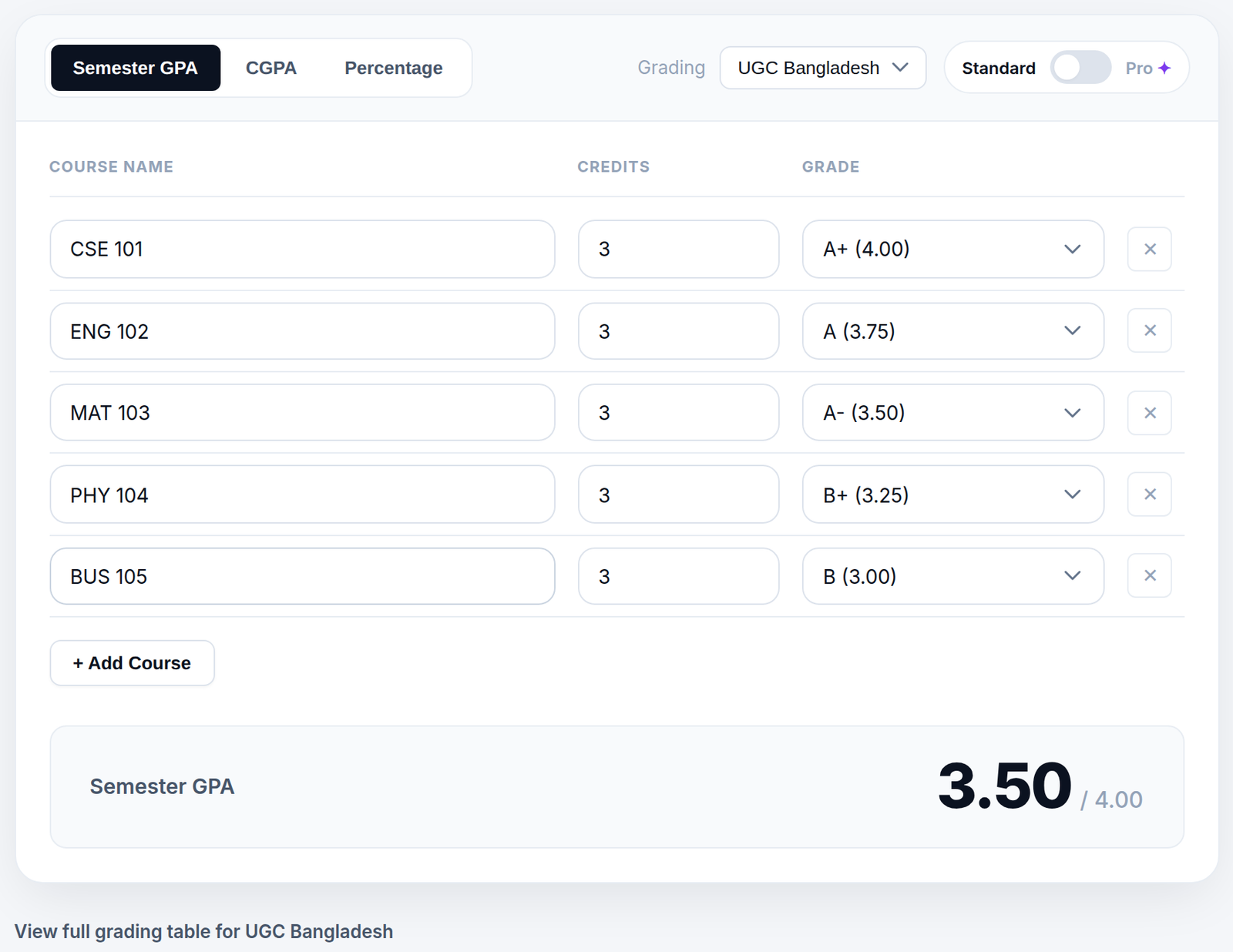
Here is the exact workflow, matching the screenshot above:
- Open the CGPAPro GPA calculator and make sure the grade scale is set to UGC Bangladesh (A+ = 4.00, A = 3.75, and so on — the scale used below).
- Click + Add Course once per course. Type the course code and its credit hours — AKMU theory courses are typically 3 credits, labs and sessionals often 1–2 credits, so read each row of your registration card carefully.
- Pick the letter grade you earned (or expect) in each row from the dropdown.
- Read Semester GPA. In the screenshot it is 3.50 — that is Worked Example 1 below, reproduced exactly so you can check every number.
The calculator ignores blank rows, so add exactly as many rows as you have graded courses. If a course shows I (Incomplete) or W (Withdrawn), leave it out of the calculation.
The AKMU Grade Table
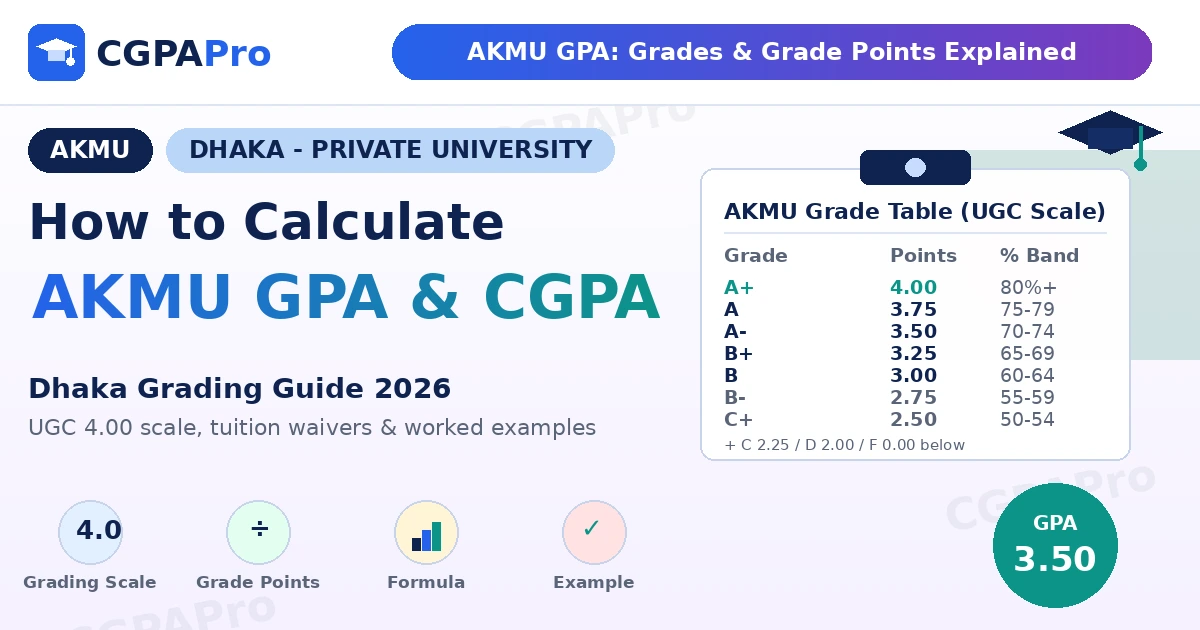
One honest note before the table: AKMU does not publish its grading policy on its website. Its “Academic Regulations” page currently carries no content, and no official grade table is posted at akmu.edu.bd. What AKMU does follow, like every UGC-recognized private university in Bangladesh, is the UGC Bangladesh uniform 4.00 grading scale — the same table built into the calculator above. Present it as such: this is the standard scale your marks are converted on, and if your department ever publishes a local variant, that document wins.
| Letter Grade | Grade Point | Marks | Standing |
|---|---|---|---|
| A+ | 4.00 | 80% and above | Excellent |
| A | 3.75 | 75% to less than 80% | Better |
| A− | 3.50 | 70% to less than 75% | Good |
| B+ | 3.25 | 65% to less than 70% | Above average |
| B | 3.00 | 60% to less than 65% | Average |
| B− | 2.75 | 55% to less than 60% | Below average |
| C+ | 2.50 | 50% to less than 55% | Satisfactory |
| C | 2.25 | 45% to less than 50% | Not satisfactory |
| D | 2.00 | 40% to less than 45% | Pass |
| F | 0.00 | Less than 40% | Fail |
Two details that matter more than the table itself:
- Band edges are brutal. 74.9% is a B+ (3.25); 75.0% is an A (3.75). That half a mark is worth 0.50 grade points per credit — in a 3-credit course, 1.50 quality points, roughly the difference between a good semester and a great one. If you are hovering near a boundary before finals, that is exactly where one extra evening of revision pays off.
- D is the lowest passing grade. F earns zero grade points and no credit — it still counts in the credit denominator of your GPA, so it drags the average down twice over.
How to Calculate Your Semester GPA, Step by Step
Forget the simple average of your grades — that is the single most common error, and it quietly misleads students every semester. GPA is credit-weighted: a 4-credit engineering core course moves your average more than a 2-credit lab.
- List every graded course with its credit hours and your letter grade.
- Convert each letter grade to its grade point using the table above.
- Multiply each course’s grade point by its credit hours. These products are your quality points.
- Add up all quality points (the numerator).
- Add up all credit hours (the denominator).
- Divide total quality points by total credit hours. Round to two decimals — that is your semester GPA.
The GPA Formula
GPA = Σ (Grade Point × Credit Hours) ÷ Σ (Credit Hours)
In words: multiply each course’s grade point by its credits, add all those products, then divide by the total credits. The same formula gives CGPA when you extend it across all semesters — just keep adding quality points and credits semester after semester.
Worked Example 1 — Semester GPA of Exactly 3.50
This is the exact semester shown in the calculator screenshot above, so you can verify every number twice. Five 3-credit courses:
| Course | Credits | Grade | Grade Point | Quality Points |
|---|---|---|---|---|
| CSE 101 | 3 | A+ | 4.00 | 3 × 4.00 = 12.00 |
| ENG 102 | 3 | A | 3.75 | 3 × 3.75 = 11.25 |
| MAT 103 | 3 | A− | 3.50 | 3 × 3.50 = 10.50 |
| PHY 104 | 3 | B+ | 3.25 | 3 × 3.25 = 9.75 |
| BUS 105 | 3 | B | 3.00 | 3 × 3.00 = 9.00 |
Total quality points = 12.00 + 11.25 + 10.50 + 9.75 + 9.00 = 52.50. Total credits = 15. Semester GPA = 52.50 ÷ 15 = 3.50. Enter the same five rows into the calculator and you will see Semester GPA 3.50 — the screenshot is proof.
Worked Example 2 — Mixed Credits and the Band Edge
Real semesters are not five identical courses. Here is a messier, more realistic one — note how the 4-credit course dominates, and watch the band-edge lesson at the end:
| Course | Credits | Grade | Grade Point | Quality Points |
|---|---|---|---|---|
| EEE 201 | 4 | A− | 3.50 | 4 × 3.50 = 14.00 |
| CSE 202 | 3 | B+ | 3.25 | 3 × 3.25 = 9.75 |
| MAT 203 | 3 | B | 3.00 | 3 × 3.00 = 9.00 |
| ENG 204 | 2 | A | 3.75 | 2 × 3.75 = 7.50 |
| PHY 205 (lab) | 3 | C+ | 2.50 | 3 × 2.50 = 7.50 |
Total quality points = 14.00 + 9.75 + 9.00 + 7.50 + 7.50 = 47.75. Total credits = 15. Semester GPA = 47.75 ÷ 15 = 3.18.
Two lessons hide in this example. First, credits are leverage: the A in 2-credit ENG 204 contributes only 7.50 quality points, while the A− in 4-credit EEE 201 contributes 14.00 — double, despite the lower grade. Your heavy core courses deserve a disproportionate share of your study time. Second, the band edge: imagine the PHY 205 lab mark was 69.9% (B+, 3.25) instead of a C+. Quality points would jump to 3 × 3.25 = 9.75, the total to 50.00, and the GPA to 3.33. One band boundary, 0.15 GPA — worth a polite recheck request if your mark sits on the line.
Worked Example 3 — CGPA Across Two Semesters
CGPA is not the average of your semester GPAs. It is the same credit-weighted formula stretched across every semester. Suppose:
- Semester 1: 15 credits, GPA 3.50 → 15 × 3.50 = 52.50 quality points
- Semester 2: 16 credits, GPA 3.25 → 16 × 3.25 = 52.00 quality points
Total quality points = 52.50 + 52.00 = 104.50. Total credits = 31. CGPA = 104.50 ÷ 31 = 3.37.
The trap: (3.50 + 3.25) ÷ 2 = 3.375, which rounds to 3.38 here — off by only a hundredth, but with uneven credit loads and more semesters the error compounds. Always weight by credits.
Read More
Studying at another Uttara-area university? See our Uttara University Grading System 2026: GPA & CGPA Guide — same UGC 4.00 scale, different campus.
GPA vs CGPA — What Each One Means for You
GPA is one semester: a snapshot. It tells you whether this term’s study habits worked and it is the number your department looks at for semester standing. CGPA is the running cumulative figure across your whole degree: the number printed on your transcript, the number employers and scholarship committees ask for, and the number that decides your class of degree. CGPA has inertia — early semesters weigh heavily because there are fewer total credits to dilute them. A 2.80 in your first semester takes several strong semesters to pull back above 3.50, while one weak semester late in the degree barely moves the needle. Start strong.
Converting Your AKMU CGPA to a Percentage
Job applications and some foreign-university forms ask for a percentage. There is no official UGC conversion formula, so always ask the requesting institution which method they want. The convention used across Bangladesh for the 4.00 UGC scale is:
Percentage ≈ CGPA × 25
So a 3.50 CGPA ≈ 87.5%, and 3.20 ≈ 80%. Treat it as an approximation, never as an official equivalence — and never present it on a transcript.
Common Mistakes AKMU Students Make
- Averaging letter grades directly. (A + B) ÷ 2 is not 3.50 in any meaningful sense. Weight by credits, always.
- Ignoring credit hours. A B in a 4-credit core course and an A in a 1-credit sessional do not cancel out — the B drags harder.
- Counting an F’s credits as zero. An F earns zero grade points but its credits still sit in the denominator. It is not a neutral non-event; it actively pulls the average down.
- Mixing up the two Anwer Khans. Searching “Anwer Khan Modern grades” and reading AKMMC’s MBBS grading (a University of Dhaka scheme) instead of the university’s 4.00 scale. If the page says “professional MBBS examination,” you are on the wrong institution.
- Forgetting the waiver math. AKMU ties real money to GPA: 50% tuition waiver for GPA 5.00 in both SSC and HSC, 30% for 5.00 in one of them, 10% for 3.00 in both — and diploma engineers need CGPA 3.70+ for the evening-program scholarship. A semester that slips from 3.75 to 3.40 can cost more than pride.
What AKMU Does Not Publish — Read This Before You Assume
This is the honest part, and it matters more than it looks. From public sources we could not verify any of the following, so this guide deliberately does not state them: retake/improvement examination rules and whether a retake replaces the old grade; the minimum CGPA required to graduate; probation and dismissal thresholds; Dean’s List or honors criteria; and exact per-program credit structures. Other sites invent these numbers freely. Do not trust any page — including this one — that quotes AKMU-specific retake or probation rules without citing an AKMU document. Your program office and your student handbook are the only authorities here.
Tips for Raising Your AKMU CGPA
- Attack your heaviest courses first. Every hour on a 4-credit core course buys twice the GPA movement of an hour on a 2-credit course. Build your revision schedule around credit weights, not just difficulty.
- Defend the band edges. Know which courses sit near 75, 70, 65 or 60 — a few marks there are worth 0.25–0.50 grade points per credit. Prioritize borderline courses in the final weeks.
- Never let a course slide to F. One F in a 3-credit course needs roughly two A grades in other 3-credit courses just to undo the damage.
- Run the numbers before the semester ends. Plug your expected grades into the calculator mid-semester; seeing that you need a B+ in one specific course to hold 3.50 turns a vague goal into a study plan.
- Protect scholarship eligibility early. If you are on any GPA-linked waiver or aiming for the CGPA 3.70+ diploma-engineer scholarship, track your running CGPA every semester — recovery gets exponentially harder the longer you wait.
Read More
Curious how the UGC scale differs from Pakistan’s HEC scale? Read HEC vs UGC Grading Scale: Pakistan & Bangladesh 2026 for a side-by-side comparison.
Frequently Asked Questions
What grading system does Anwer Khan Modern University use?
AKMU follows the UGC Bangladesh uniform 4.00 grading scale: A+ (4.00, 80%+) down to D (2.00, 40–44%), with F (0.00) below 40%. AKMU does not publish its own grade table on its website, so confirm exact band cutoffs with your program office — but the UGC table above is the standard scale.
What is the passing grade at AKMU?
D (40–44%, 2.00 grade points) is the lowest passing grade on the UGC scale. F (below 40%) is a fail: zero grade points and no credit earned, though its credits still count in your GPA denominator.
Is a 3.50 CGPA good at AKMU?
Yes. In Bangladesh, 3.50+ on the 4.00 scale is generally First Class / excellent standing — it keeps you competitive for jobs, higher studies abroad, and GPA-linked scholarships. 3.00–3.49 is very good; below 3.00 you should be actively planning recovery.
Are Anwer Khan Modern University and Anwer Khan Modern Medical College the same?
No. AKMU is a private university (est. 2018) at Uttara, Dhaka, offering BBA, MBA, CSE, EEE, CE, ME, FDAM, BSTE and MPH. AKMMC is a private medical college (est. 2008) in Dhanmondi, affiliated with the University of Dhaka for MBBS. Different institutions, different grading schemes.
How do I convert my AKMU CGPA to a percentage?
There is no official conversion formula. The common Bangladeshi convention is CGPA × 25 (so 3.50 ≈ 87.5%). Always check what the requesting employer or university wants before submitting a converted figure.
Does retaking a failed course replace my old grade at AKMU?
AKMU does not publish its retake policy publicly, so we do not state a rule here. Ask your program office whether a retake replaces the F in your CGPA calculation or whether both attempts count.
Where is Anwer Khan Modern University located?
The main campus is at House 6, Garib-E-Newaz Avenue, Sector-11, Uttara, Dhaka-1230. There is also a Dhanmondi admission booth at Rupayan Khan Plaza, House 18 (New), 7th Floor, Dhanmondi, Dhaka-1205.
Conclusion
The AKMU grading system is straightforward once you see it as one formula: convert each mark to a grade point on the 4.00 UGC scale, weight by credits, divide. The students who struggle are rarely the ones who cannot do the math — they are the ones who average grades naively, ignore credit weights, mix AKMU up with the medical college, or assume retake rules nobody has published. Run your own numbers with the calculator, defend your band edges, and remember what this guide cannot tell you: for retakes, probation and graduation thresholds, your program office is the only source that counts.
Sources
- Anwer Khan Modern University — official website (programs, campuses, contact details; admission requirements page for SSC/HSC GPA thresholds)
- Anwer Khan Modern Medical College — Wikipedia (est. 2008, Dhanmondi, University of Dhaka affiliation; used for AKMU/AKMMC disambiguation)
- CGPAPro GPA calculator (UGC Bangladesh scale values used for the grade table and screenshot: A+ 4.00 through F 0.00)