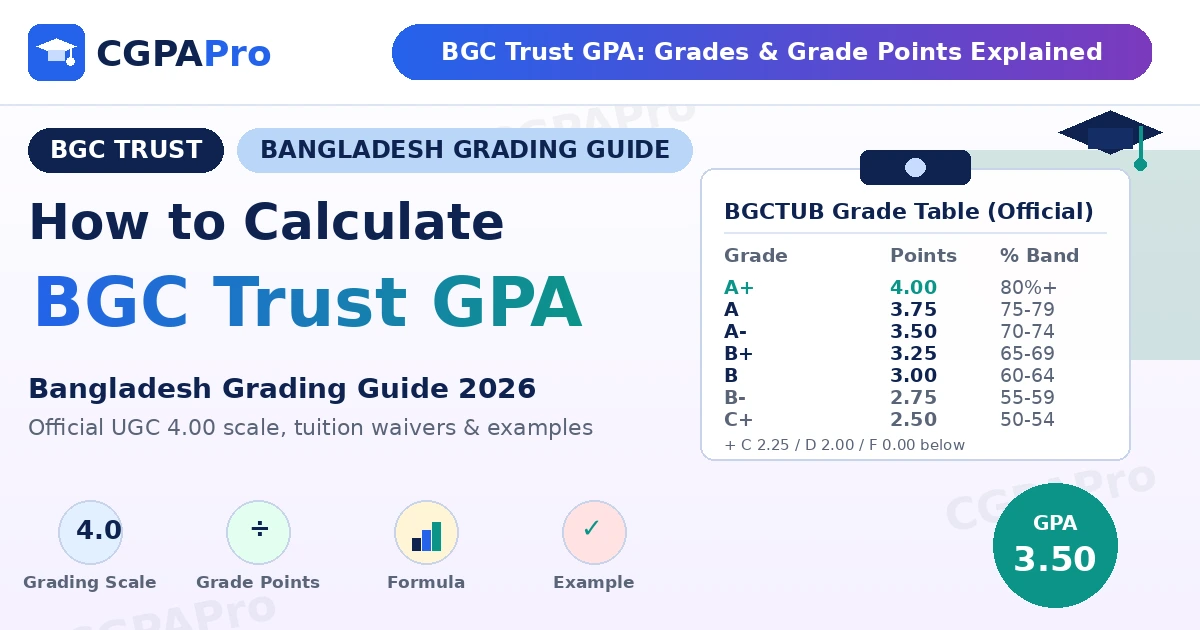
Quick answer: BGC Trust University’s grading system at a glance
BGC Trust University Bangladesh (BGCTUB) uses the UGC Bangladesh uniform 4.00 grading scale. Every course’s marks convert to a letter grade and a grade point — A+ (4.00) needs 80% or above, A (3.75) needs 75–79%, all the way down to D (2.00) for 40–44% and F (0.00) below 40%. Your semester GPA is the credit-weighted average of grade points; your CGPA is the same calculation across every semester you’ve completed. That’s the whole system in three sentences — the rest of this guide shows you exactly how to work it, with real numbers.
Check Your BGC Trust GPA With the Calculator
Before we get into tables and formulas, here’s the fastest route: CGPAPro’s free GPA calculator already has the UGC Bangladesh 4.00 scale built in, so it uses the exact grade points BGC Trust University follows. No sign-up, no download — just this:
- Open the CGPA calculator and select the UGC Bangladesh grading scale (A+ 4.00 … D 2.00).
- Add one row per course: enter the credit hours and pick the letter grade from the dropdown.
- Your GPA appears instantly. For CGPA, repeat for each completed semester — or enter semester totals directly.
A note on credit fields: some browsers show a placeholder “3” in the credit box even when nothing is typed — always type your actual credit number in every field, or the result will read 0.00.
What BGC Trust University Is
BGC Trust University Bangladesh (BGCTUB) is a private university at BGC Bidyanagar, Chandanaish, Chattogram — about 34 km from Chittagong port city. Founded in 2001 by the philanthropist Engr. Afsar Uddin Ahmad through the Begum Gul Chemonara Trust, it is the country’s only rural-based private university, sitting on a 100-acre campus that also hosts a medical college, a 1,000-bed hospital, a nursing institute, a dental college and a physiotherapy college. Around 3,000 students study across seven departments: Business Administration, Computer Science & Engineering, Pharmacy, English, Law, Journalism & Media Studies, and Public Health.
The academic year runs on two semesters: Spring (January–June) and Summer (July–December). If you see older pages claiming three 4-month semesters, that information is outdated.
The Official BGC Trust Grading Table
BGCTUB follows the Uniform Grading System of the University Grants Commission of Bangladesh. The university publishes the table below: your total marks in each course convert to a letter grade (LG) and grade point (GP), and GPA/CGPA are computed from the grade points.
| Letter Grade | Grade Point | Marks | Standing |
|---|---|---|---|
| A+ | 4.00 | 80% and above | Excellent |
| A | 3.75 | 75% to less than 80% | Better |
| A− | 3.50 | 70% to less than 75% | Good |
| B+ | 3.25 | 65% to less than 70% | Above average |
| B | 3.00 | 60% to less than 65% | Average |
| B− | 2.75 | 55% to less than 60% | Below average |
| C+ | 2.50 | 50% to less than 55% | Satisfactory |
| C | 2.25 | 45% to less than 50% | Not satisfactory |
| D | 2.00 | 40% to less than 45% | Pass |
| F | 0.00 | Less than 40% | Fail |
| I | — | — | Incomplete |
| W | — | — | Official Withdrawn |
Two things students misunderstand about this table:
- The boundary matters enormously. One mark changes everything at the edges: 79% is an A worth 3.75, but 80% is an A+ worth 4.00 — a full 0.25 grade points from a single percent. The same cliff sits between every pair of grades (69 vs 70, 59 vs 60…). If you’re ever near a boundary at the end of a semester, one extra mark of revision genuinely moves your GPA.
- There is no C− at BGCTUB. Some pages on the internet paste a foreign C− (1.67) row into Bangladeshi tables. BGCTUB’s published table goes straight from C (2.25) to D (2.00), and D is the lowest passing grade. If your department’s handbook says something different, the handbook wins — but this is the university’s official published scale.
The non-letter codes I (Incomplete) and W (Official Withdrawn) carry no grade points and don’t enter the GPA calculation — they’re status markers, not results.
How GPA and CGPA Are Calculated at BGCTUB
Both figures are credit-weighted averages. Credits are the weight: a 3-credit course pulls three times harder on your GPA than a 1-credit lab.
The formula
GPA (one semester) = (sum of grade point × credits for every course) ÷ (total credits that semester)
CGPA (whole degree so far) = (sum of grade point × credits for every course across all semesters) ÷ (total credits so far)
Equivalently, CGPA = (sum of each semester’s GPA × that semester’s credits) ÷ (total credits). Averaging two semester GPAs directly only works if both semesters had identical credit totals — otherwise you must weight by credits, as worked example 2 shows.
Step by step
- Convert each course’s marks to its grade point using the table above.
- Multiply each grade point by that course’s credit hours — these are your “quality points.”
- Add all quality points together.
- Add all credit hours together.
- Divide quality points by credits. Round to two decimals.
Worked Example 1: A Semester GPA at BGC Trust
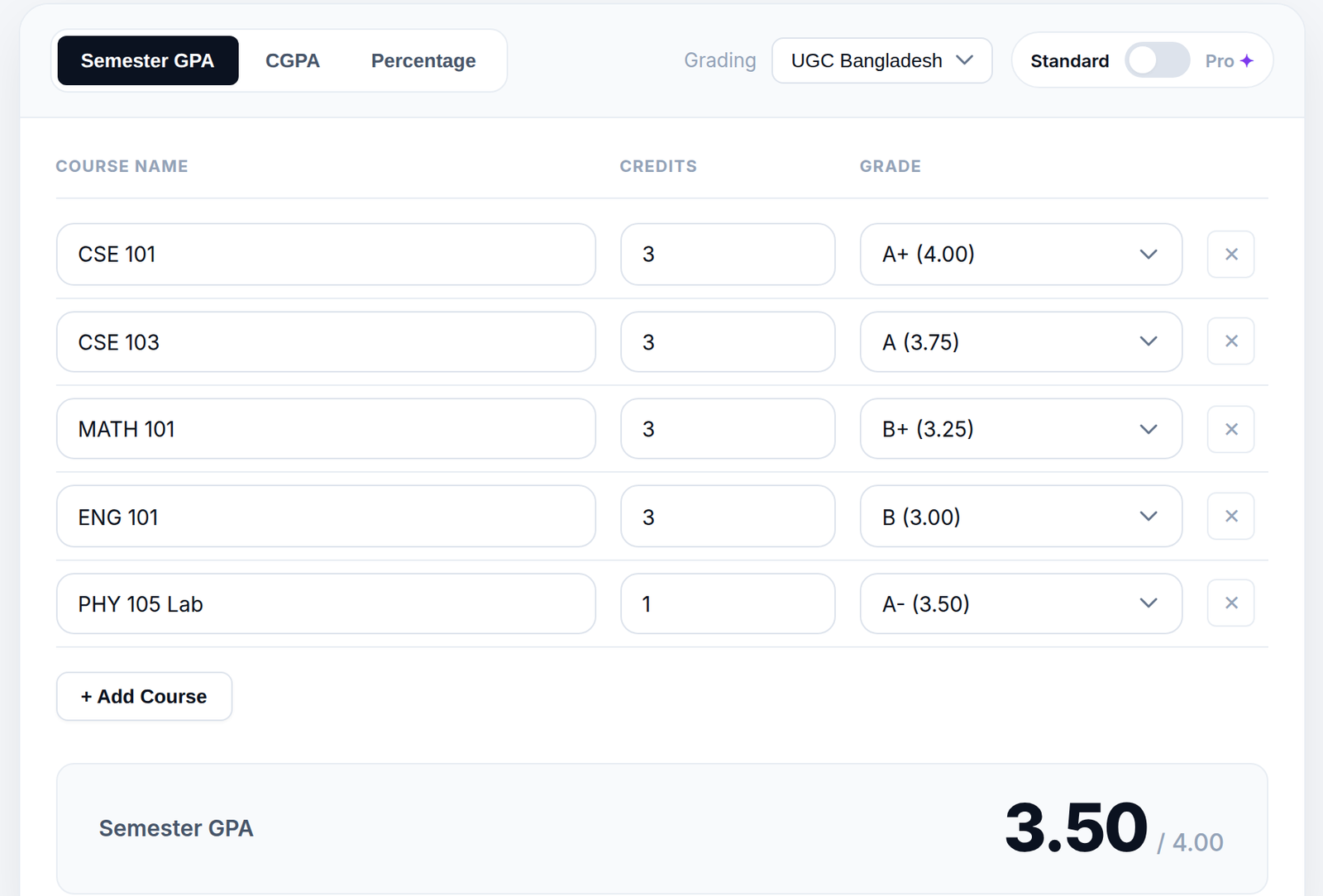
Say a CSE student finishes a Spring semester with five courses:
| Course | Credits | Grade | Grade Point | Quality Points |
|---|---|---|---|---|
| CSE 101 | 3 | A+ | 4.00 | 3 × 4.00 = 12.00 |
| CSE 103 | 3 | A | 3.75 | 3 × 3.75 = 11.25 |
| MATH 101 | 3 | B+ | 3.25 | 3 × 3.25 = 9.75 |
| ENG 101 | 3 | B | 3.00 | 3 × 3.00 = 9.00 |
| PHY 105 (lab) | 1 | A− | 3.50 | 1 × 3.50 = 3.50 |
Total quality points = 12.00 + 11.25 + 9.75 + 9.00 + 3.50 = 45.50
Total credits = 3 + 3 + 3 + 3 + 1 = 13
GPA = 45.50 ÷ 13 = 3.50
Notice the A+ in the 3-credit CSE 101 contributes 12 quality points — four times what the 1-credit lab contributes even at A−. High-credit courses are where your GPA is won or lost.
Worked Example 2: CGPA Across Three Semesters
Now follow the same student across three semesters. Each semester has a different credit load, so a simple average of the GPAs would be wrong:
| Semester | GPA | Credits | GPA × Credits |
|---|---|---|---|
| Spring (Sem 1) | 3.50 | 15 | 3.50 × 15 = 52.50 |
| Summer (Sem 2) | 3.30 | 18 | 3.30 × 18 = 59.40 |
| Spring (Sem 3) | 3.75 | 16 | 3.75 × 16 = 60.00 |
Total = 52.50 + 59.40 + 60.00 = 171.90
Total credits = 15 + 18 + 16 = 49
CGPA = 171.90 ÷ 49 = 3.51
The trap: (3.50 + 3.30 + 3.75) ÷ 3 = 3.52. Off by only a hundredth here, but with uneven loads and more semesters the error grows — always weight by credits.
Read More
Studying elsewhere in Chattogram? See our USTC Grading System 2026: GPA & CGPA Guide — Chittagong for the same UGC-scale walkthrough at another Chittagong private university.
GPA vs CGPA — What Each One Means for You
GPA is your performance in one semester: a snapshot. It decides semester standing and shows whether your study habits are improving or slipping term to term. CGPA is the running cumulative figure across your whole degree: the number that appears on your transcript, that employers ask for, and that scholarship committees check. CGPA has inertia — early semesters weigh heavily, because there are fewer total credits to dilute them. A 2.8 in your first semester takes several strong semesters to drag back above 3.5, while one weak semester late in the degree barely moves the needle. Start strong.
Converting Your BGCTUB CGPA to a Percentage
Job applications and some foreign-university forms ask for a percentage. There is no official UGC conversion formula, so always ask the requesting institution which method they want. The convention used across Bangladesh for the 4.00 UGC scale is:
Percentage ≈ CGPA × 25
So a CGPA of 3.51 ≈ 87.75%, and 3.50 ≈ 87.5%. This is an approximation for forms, not a transcript figure — your transcript carries letter grades and grade points only.
What Your GPA Unlocks at BGC Trust
Your GPA isn’t just a number on a result sheet — at BGCTUB it has direct financial value:
- Tuition waivers: the university grants a 10% tuition-fee waiver based on your previous GPA score. Keep it up and the discount compounds semester after semester.
- Special waivers: female students, tribal students and freedom-fighter wards receive a 30% tuition-fee reduction.
- Named scholarships: the Chairman’s Scholarship and Vice-Chancellor’s Scholarship go to top performers.
Entry also runs on GPA: admission requires a minimum GPA of 3.00 in both SSC and HSC (or the O/A-level equivalents). A 3.50+ CGPA is broadly considered the mark of a strong academic record in Bangladesh — the zone where government jobs, bank recruitment and higher-study applications open up.
Rules we could not verify — check your handbook
Some policies matter but are not published in BGCTUB’s public materials, so we will not guess at them: retake/improvement rules (can you repeat a C or D to raise your CGPA?), the minimum CGPA required to graduate, academic probation thresholds, and any Dean’s List / merit-list criteria. These live in your program handbook or with the Controller of Examinations — confirm them there before planning your semester.
Common Mistakes BGCTUB Students Make
- Using the wrong scale. The generic 4.0 scale (B+ = 3.33, B− = 2.67) is wrong for BGCTUB. On the UGC scale B+ = 3.25 and B− = 2.75. Using generic values inflates or deflates your estimate by whole grade points across a transcript.
- Averaging GPAs instead of weighting by credits. (3.50 + 3.30 + 3.75) ÷ 3 ≠ your CGPA when semesters carry different credit loads.
- Ignoring the 1-credit labs. They’re small, but an F (0.00) in even a 1-credit course drags quality points down for zero credit relief — F earns no credits at all.
- Confusing C with D. Both are passes, but C (“not satisfactory”, 2.25) is meaningfully better than D (“pass”, 2.00). Two D’s cost you 0.50 grade points vs two C’s — across a degree, that gap compounds.
- Forgetting F earns no credit. Credits for failed courses don’t count toward graduation and the 0.00 still enters the GPA divisor through quality points — you retake the course and carry the damage.
- Not checking marks near boundaries. 79% vs 80% is a 0.25 grade-point swing. If you’re at 78–79%, asking for a recheck or pushing one more answer in the final can genuinely change your GPA.
Tips to Raise Your CGPA at BGC Trust
- Front-load effort into high-credit courses. A 3-credit core course moves your GPA three times more than a 1-credit lab. Rank courses by (credits × risk) and study in that order.
- Target the boundaries. Know each course’s standing mid-semester; a course sitting at 73–74% is one solid final-exam performance away from A− (3.50) instead of B+ (3.25).
- Protect the early semesters. CGPA inertia means first-year results anchor your whole degree. A strong start is worth more than a strong finish of equal size.
- Clear I (Incomplete) grades fast. They earn nothing and can block prerequisites — finish the missing work before they convert.
- Use the calculator for “what-if” planning. Plug your current grades into the CGPAPro calculator, then test what a B+ vs an A in your remaining 3-credit course does to the semester GPA. Concrete targets beat vague ambition.
- Guard the waiver. If your tuition waiver depends on your GPA, treat the waiver as a study budget: every 0.1 GPA you drop is real money.
Read More
Compare with another Rajshahi-region guide: Varendra University Grading System 2026: GPA & CGPA Guide — same UGC 4.00 scale, different campus.
Frequently Asked Questions
What grading system does BGC Trust University use?
BGCTUB uses the UGC Bangladesh uniform 4.00 grading scale: A+ (4.00, 80%+) down to D (2.00, 40–44%), with F (0.00) below 40%. I (Incomplete) and W (Withdrawn) carry no grade points.
What is the passing grade at BGC Trust University?
D (40–44%, 2.00 grade points) is the lowest passing grade. F (below 40%) is a fail and earns no credit. Note that C (45–49%) is officially marked “not satisfactory” — it passes, but it signals a problem.
How do I calculate my CGPA at BGC Trust?
Multiply each course’s grade point by its credits, add all of those up across every semester, and divide by your total credits. Or use the CGPAPro calculator on the UGC Bangladesh scale and let it do the weighting.
Is 3.5 CGPA good at BGC Trust University?
Yes — 3.50 at BGCTUB means averaging between A− and A across your degree, which is a strong record. It’s comfortably in the zone employers and scholarship committees look for, and it keeps tuition waivers within reach.
Can I retake a course to improve my CGPA at BGCTUB?
The university’s public materials don’t publish retake/improvement rules, so we can’t confirm the policy here. Check your department’s program handbook or ask the Controller of Examinations — don’t assume a repeat replaces the old grade.
How many semesters does BGC Trust University have per year?
Two: Spring (January–June) and Summer (July–December). Older pages mentioning three 4-month semesters are outdated.
How do I convert my BGCTUB CGPA to a percentage?
The common Bangladeshi convention is CGPA × 25 (so 3.50 ≈ 87.5%). There’s no official UGC formula, so confirm with whoever is asking for the percentage.
Conclusion
BGC Trust University’s grading system is straightforward once you see it clearly: one national UGC scale, marks-to-grade boundaries where single percentages swing quarter-points, and credit-weighted math all the way down. Learn the table, weight by credits, watch the boundaries, and protect your early semesters — your CGPA, and the waivers tied to it, will follow. Run your own numbers through the CGPAPro GPA calculator on the UGC Bangladesh scale, and check the two worked examples above if anything looks off.
Sources
- BGC Trust University Bangladesh — Wikipedia (grading table, citing the university’s “Uniform Recommended Grading System” page; semesters; faculties)
- BGC Trust University Bangladesh — official website
- University Grants Commission of Bangladesh — 50th Annual Report 2023 (student statistics)