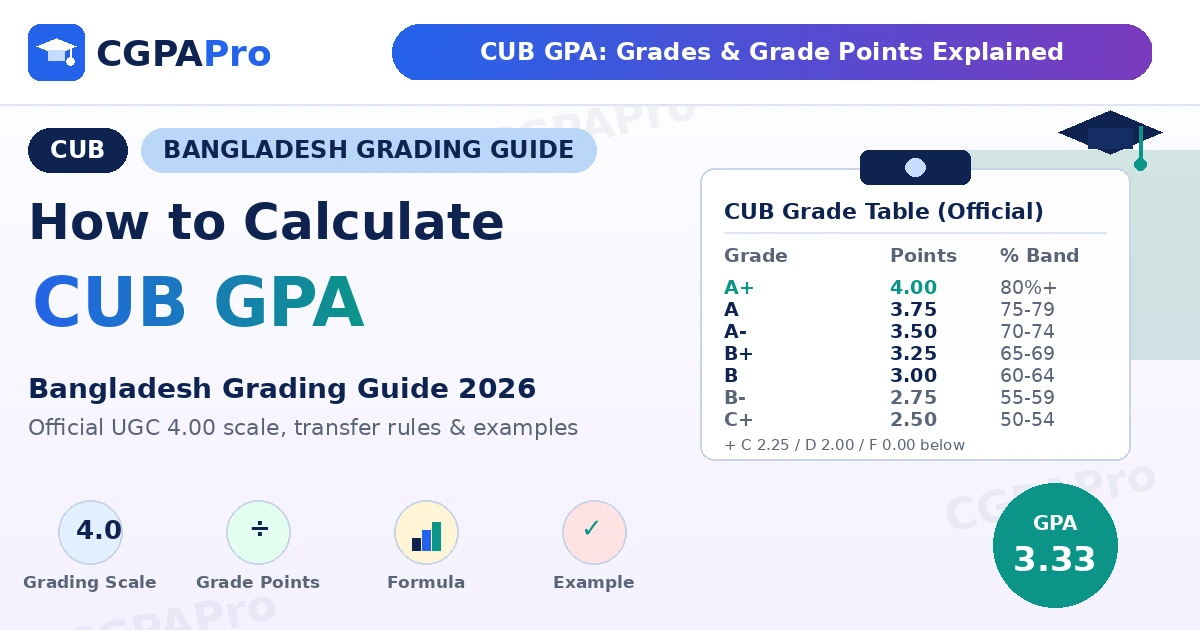
Quick answer: Canadian University of Bangladesh’s grading system at a glance
First, one important clarification: this guide is about the Canadian University of Bangladesh (CUB) — the private university in Dhaka — not universities in Canada. Most of the internet’s “Canadian university grading system” articles describe Canada’s 4.0/4.33 scales with their provincial quirks. CUB is a different story entirely: it uses the UGC Bangladesh uniform 4.00 grading scale. A+ (4.00) needs 80% or above, A (3.75) needs 75–79%, down through D (2.00) for 40–44%, with F (0.00) below 40%. Your term GPA is the credit-weighted average of grade points; your CGPA is the same calculation across every term you’ve completed. And here’s the rule students love most: if you retake a course at CUB, only the better grade counts toward your CGPA. The rest of this guide works it all out with real numbers.
Check Your CUB GPA With the Calculator
Before the tables and formulas, the fastest route: CGPAPro’s free GPA calculator already has the UGC Bangladesh 4.00 scale built in, so it uses the exact grade points CUB follows. No sign-up, no download:
- Open the CGPA calculator and select the UGC Bangladesh grading scale (A+ 4.00 … D 2.00).
- Add one row per course: enter the credit hours and pick the letter grade from the dropdown.
- Your GPA appears instantly. For CGPA, repeat for each completed term — or enter term totals directly.
A note on credit fields: some browsers show a placeholder “3” in the credit box even when nothing is typed — always type your actual credit number in every field, or the result will read 0.00.
What Canadian University of Bangladesh Is
Canadian University of Bangladesh (CUB) is a private university in Dhaka, established in 2016 and accredited by the Government of Bangladesh with its curricula and programs approved by the University Grants Commission. Classes run in English, and the university operates two campuses: the City Campus at 201/1 Pragati Sharani (Bir Uttam Rafiqul Islam Avenue), Dhaka-1212, and a permanent campus at Plot 60, Road 107 & 404, Sector 9, Purbachal New Town. Undergraduate programs include CSE, EEE, BBA, English, and Media Communication & Journalism; postgraduate offerings include the MBA, EMBA, and Maritime Transportation & Logistics.
CUB runs on a three-term calendar, which surprises students coming from two-semester schools:
- 1st Term (Spring): late January to April
- 2nd Term (Summer): late May to August
- 3rd Term (Fall): late September to December
Three terms a year means your CGPA accumulates faster — a weak term can be repaired sooner, but a strong one also dilutes faster. More on what that means for your numbers below.
The Official CUB Grading Table
CUB publishes its grading policy on the university’s official site, and it follows the Uniform Grading System of the University Grants Commission of Bangladesh. Your total marks in each course convert to a letter grade and grade point like this:
| Marks | Letter Grade | Grade Point | Standing |
|---|---|---|---|
| 80% and above | A+ | 4.00 | Outstanding |
| 75% to less than 80% | A | 3.75 | Excellent |
| 70% to less than 75% | A− | 3.50 | Very Good |
| 65% to less than 70% | B+ | 3.25 | Good |
| 60% to less than 65% | B | 3.00 | Satisfactory |
| 55% to less than 60% | B− | 2.75 | Above Average |
| 50% to less than 55% | C+ | 2.50 | Average |
| 45% to less than 50% | C | 2.25 | Below Average |
| 40% to less than 45% | D | 2.00 | Pass |
| Less than 40% | F | 0.00 | Fail |
Two things about this table that trip students up:
- The boundaries are cliffs. 79% is an A worth 3.75; 80% is an A+ worth 4.00. A single percentage point can swing a quarter of a grade point — the same cliff sits between every pair of grades. If you’re near a boundary when results come out, one recheck or one pushed answer in the final can genuinely move your GPA.
- There is no C−. Some tables floating online paste a foreign C− (1.67) row into Bangladeshi scales. CUB’s official published table goes straight from C (2.25) to D (2.00), and D is the lowest passing grade.
The Codes That Don’t Count: X, I, R, W, WV, RP
Not everything on your CUB transcript carries grade points. These six codes sit at 0.00 and their credits do not count toward CGPA calculation — they’re status markers, not results:
| Code | Meaning | Effect on CGPA |
|---|---|---|
| X | Continuation of Research/Thesis | None — excluded |
| I | Incomplete | None — excluded |
| R | Retake | None — excluded |
| W | Withdrawal | None — excluded |
| WV | Waiver | None — excluded |
| RP | Replaced | None — excluded |
Seeing an R or RP on your transcript is not a penalty — it’s the system’s own bookkeeping for retakes and replaced grades, covered in detail below.
Watch Out: Stale CUB Scales Floating Online
A word of caution before you trust any scale you find in a PDF. Older CUB course syllabi — still hosted on third-party document sites — show a legacy grading scale that contradicts the official one: A worth 4.0, B+ worth 3.3, C worth 2.2, D worth just 1.5. That table belongs to a pre-UGC-uniform era. The university’s current official grading-policy page uses the uniform UGC 4.00 scale (A 3.75, B+ 3.25, D 2.00). If a number you see online doesn’t match the table above, the official policy page wins. This guide uses only the official table.
How GPA and CGPA Are Calculated at CUB
Both figures are credit-weighted averages. Credits are the weight: a 3-credit course pulls three times harder on your GPA than a 1-credit lab. The university’s own policy states it plainly: CGPA equals total grade points divided by total credit counted.
The formula
Term GPA = (sum of grade point × credits for every course) ÷ (total credits that term)
CGPA (whole degree so far) = (sum of grade point × credits for every course across all terms) ÷ (total credits so far)
Equivalently, CGPA = (sum of each term’s GPA × that term’s credits) ÷ (total credits). Averaging term GPAs directly only works if every term had identical credit totals — otherwise you must weight by credits, as worked example 2 shows.
Step by step
- Convert each course’s marks to its grade point using the official table above.
- Multiply each grade point by that course’s credit hours — these are your “quality points.”
- Add all quality points together.
- Add all credit hours together.
- Divide quality points by credits. Round to two decimals.
Worked Example 1: A Term GPA at CUB
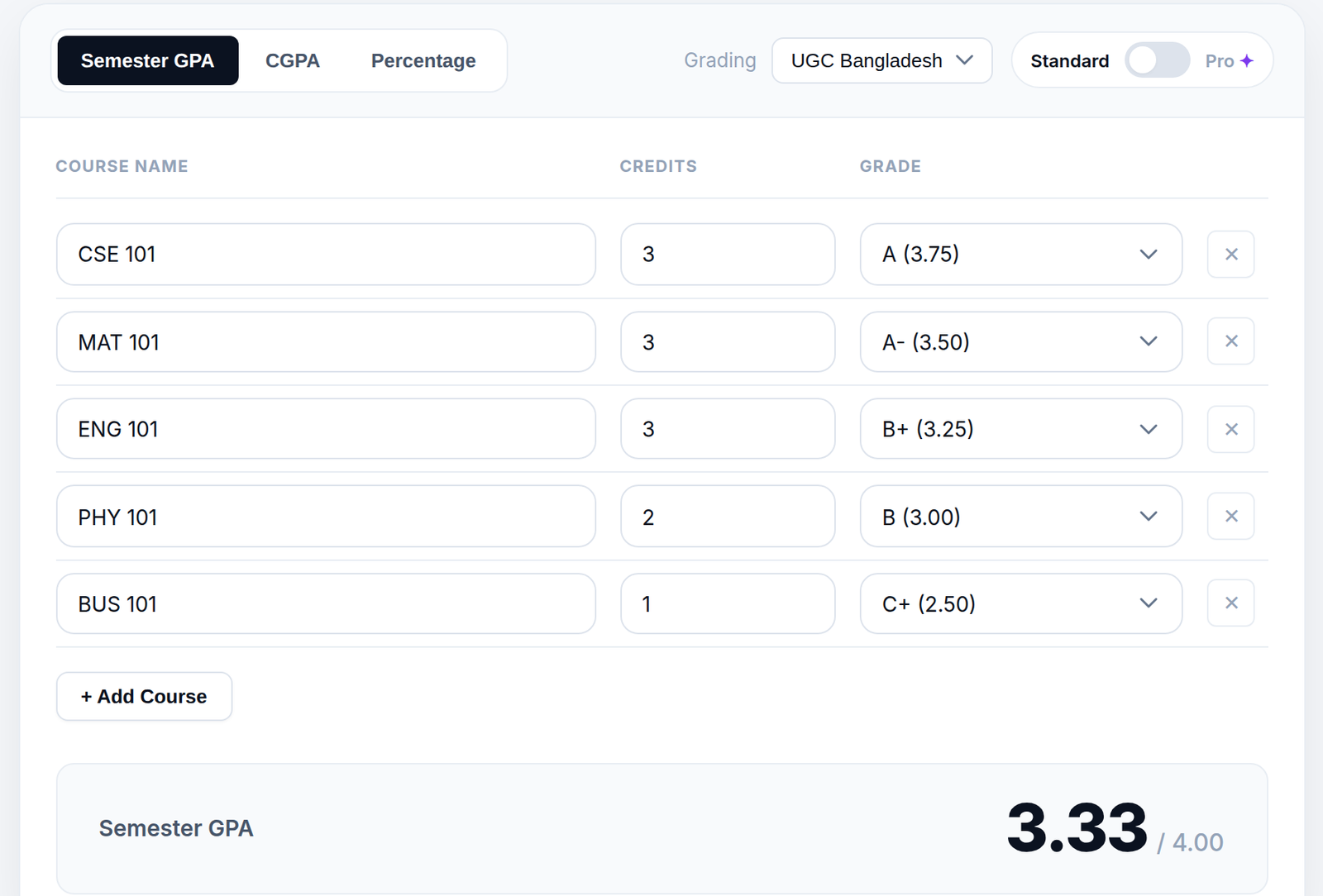
Say a CSE student finishes a Spring term with five courses:
| Course | Credits | Grade | Grade Point | Quality Points |
|---|---|---|---|---|
| CSE 101 | 3 | A | 3.75 | 3 × 3.75 = 11.25 |
| MAT 101 | 3 | A− | 3.50 | 3 × 3.50 = 10.50 |
| ENG 101 | 3 | B+ | 3.25 | 3 × 3.50 = 9.75 |
| PHY 101 | 2 | B | 3.00 | 2 × 3.00 = 6.00 |
| BUS 101 | 1 | C+ | 2.50 | 1 × 2.50 = 2.50 |
Total quality points = 11.25 + 10.50 + 9.75 + 6.00 + 2.50 = 40.00
Total credits = 3 + 3 + 3 + 2 + 1 = 12
Term GPA = 40.00 ÷ 12 = 3.33
Notice how the 3-credit courses dominate: the A in CSE 101 contributes 11.25 quality points while the 1-credit BUS 101 contributes just 2.50 — your GPA is won and lost in the heavy-credit core courses.
Worked Example 2: CGPA After a Weak Start
Now the CGPA calculation — the scenario that worries most students. Imagine this student had a rough earlier spell: a CGPA of 3.10 across 60 completed credits, and now the 3.33 term above. Here’s the math:
Previous quality points = 3.10 × 60 = 186.00
This term’s quality points = 40.00
Total = 186.00 + 40.00 = 226.00
Total credits = 60 + 12 = 72
New CGPA = 226.00 ÷ 72 = 3.14
One solid term lifted the CGPA from 3.10 to 3.14 — and here’s where CUB’s three-term calendar helps: you get three of these repair opportunities per year instead of two, so recovery math runs faster than at two-semester universities. The trap to avoid: averaging the two figures directly — (3.10 + 3.33) ÷ 2 = 3.22 — is wrong, because the two blocks carry very different credit weights. Always weight by credits.
Read More
Confused by similarly-named universities? Our Queen’s University Grading System 2026: GPA & CGPA Guide walks through the same UGC 4.00 scale at another Bangladesh private university with a foreign-sounding name.
GPA vs CGPA — What Each One Means for You
GPA is your performance in one term: a snapshot. With three terms a year at CUB, that snapshot refreshes fast — a bad term hurts for four months, not six. CGPA is the running cumulative figure across your whole degree: the number on your transcript, the number employers ask for, the number scholarship committees check. CGPA has inertia — early terms weigh heavily because there are fewer total credits to dilute them. A weak first year takes several strong terms to drag back above 3.5, while one weak term late in the degree barely moves the needle. Start strong.
Retakes at CUB: The Better Grade Replaces the Old One
This is CUB’s most student-friendly rule, and it’s printed right in the official grading policy: when you retake a course, only the better grade counts in the CGPA calculation. The earlier attempt’s grade point shows on your transcript as 0.0, and the replaced attempt carries the RP (Replaced) marker.
Here’s what that means in practice. Say you earned a C (2.25) in a 3-credit course, then retook it and earned a B (3.00). Your CGPA uses the 9.00 quality points from the B — the 6.75 from the C is gone from the calculation entirely. Contrast that with universities that average the two attempts, where the old grade keeps dragging you down. At CUB, a retake is a genuine fresh start.
Two caveats: you’ll still pay to retake (it’s a full re-registration), and the old attempt remains visible on your transcript — it just can’t hurt your CGPA. Check with your course advisor about how many times a course may be retaken, since that limit isn’t published in the public policy.
Transfer Students: Your Old CGPA Does Not Carry Over
If you’re transferring into CUB from another university, understand the math before you arrive — it catches students off guard every year:
- Your CGPA starts fresh. CUB calculates CGPA “based on the credits completed in CUB only.” Your previous university’s CGPA does not blend into your CUB CGPA.
- Maximum 50%. CUB accepts at most half of your program’s total credits as transfer or waiver credits, and only from UGC-approved universities (or Education Board institutions). Foreign credentials need Ministry of Education equivalency plus Foreign Ministry approval.
- The C+ floor. Only courses with a C+ (2.50) or above transfer. That C or D you scraped through at your old university will not travel with you — you’ll retake those courses at CUB.
- Transferred credits count for graduation, not for CGPA. They reduce how many credits you must complete, but they add zero quality points and zero weight to your CGPA divisor.
A quick illustration: transfer 60 credits into a 120-credit program with a 2.50 old CGPA. You still need 60 CUB credits, and your CUB CGPA starts at 0.00 earned — a clean slate. Treat it as an advantage: with only 60 graded credits ahead of you, every A+ pulls harder on your final CGPA.
Honors at Graduation: The Cum Laude Ladder
CUB publishes degree honors cutoffs, which is worth knowing early because they turn every quarter-point into something tangible:
| Award | CGPA Range |
|---|---|
| Summa Cum Laude | 3.80 – 4.00 |
| Magna Cum Laude | 3.65 – 3.79 |
| Cum Laude | 3.50 – 3.64 |
These are awarded on fulfilling the university’s criteria, and there’s also the Chancellor’s Gold Medal for top recipients. The practical takeaway: the 0.25-point cliffs in the grading table are the difference between “good degree” and a named honor. A B+ (3.25) vs an A− (3.50) in one 3-credit course is 0.75 quality points — multiply that across a degree and it’s the whole Magna-to-Cum-Laude gap.
Converting Your CUB CGPA to a Percentage
Job applications and foreign-university forms sometimes ask for a percentage. There is no official UGC conversion formula, so always ask the requesting institution which method it wants. The convention used across Bangladesh for the 4.00 UGC scale is:
Percentage ≈ CGPA × 25
So a CGPA of 3.33 ≈ 83.25%, and 3.14 ≈ 78.5%. This is an approximation for forms — your transcript carries letter grades and grade points only. If you’re applying to actual universities in Canada, expect them to evaluate your transcript with their own equivalency charts (or ask for a WES report) rather than accept a conversion you computed yourself — our WES CGPA conversion guide for the US and Canada covers that process.
What Your GPA Unlocks at CUB
Your GPA has direct financial value before you even enroll. CUB’s published fee structure ties tuition waivers to SSC/HSC results:
- GPA 10 (Golden) — 100% tuition waiver
- GPA 10 (non-Golden) — 40% waiver
- GPA 9.50 – 9.99 — 25% waiver
- GPA 9.00 – 9.49 — 20% waiver
- GPA 8.00 – 8.99 — 15% waiver
- GPA 7.50 – 7.99 — 10% waiver
Admission itself requires a minimum GPA of 2.5 in both SSC and HSC (or an aggregate of 6.00 with at least one at 2.00), plus a written admission test. For engineering programs, Math, Physics and Chemistry in HSC are required — without them, you’ll take a non-credit remedial mathematics course on top of your regular load. And on the degree side, the BSc CSE syllabus sets graduation at 152 credits with a 2.5 CGPA — confirm your own program’s requirement in its current handbook, since credit totals vary by department.
Rules we could not verify — check your handbook
A few policies matter but aren’t published in CUB’s public materials, so we won’t guess at them: the academic probation threshold, the university-wide minimum graduation CGPA (only the BSc CSE figure is documented), how many times a course may be retaken and the retake fee mechanics, Dean’s List criteria beyond the Latin honors, and per-term credit limits. These live in your program handbook or with the Controller of Examinations — confirm them there before planning your term.
Common Mistakes CUB Students Make
- Using a Canadian university’s scale. Search engines mix CUB up with universities in Canada (4.0/4.33 scales, A− = 3.7). CUB uses the UGC Bangladesh scale (A− = 3.50, B+ = 3.25). Using a Canadian table silently inflates or deflates every estimate.
- Trusting old PDFs. Legacy CUB syllabi online show a contradictory old scale (A = 4.0, B+ = 3.3, D = 1.5). The official grading-policy page is authoritative — ignore anything older.
- Using the generic 4.0 scale. The generic scale (B+ = 3.33, B− = 2.67) is wrong for CUB. On the UGC scale B+ = 3.25 and B− = 2.75.
- Averaging term GPAs instead of weighting by credits. (3.10 + 3.33) ÷ 2 ≠ your CGPA when the two blocks carry different credit totals.
- Thinking transfer credits count in CGPA. They count toward graduation credits only — your CUB CGPA is computed on CUB credits alone.
- Forgetting F earns no credit. Failed courses add 0.00 quality points and no credits; you retake the course and the damage stays until you do.
- Ignoring the C+ transfer floor. Transfer students: anything below C+ (2.50) at your old university will not transfer — plan for retakes.
- Not checking marks near boundaries. 79% vs 80% is a 0.25 grade-point swing, and at CUB that quarter-point can be the difference between Cum Laude and nothing.
Tips to Raise Your CGPA at CUB
- Front-load effort into high-credit courses. A 3-credit core course moves your term GPA three times more than a 1-credit lab. Rank courses by (credits × risk) and study in that order.
- Target the boundaries. Know each course’s standing mid-term; a course sitting at 73–74% is one solid final away from A− (3.50) instead of B+ (3.25).
- Use retakes strategically. CUB’s better-grade-replaces rule makes a retake a real CGPA repair tool — a C retaken as a B in a 3-credit course nets you +2.25 quality points with zero lingering damage. Reserve retakes for heavy-credit courses where the math pays off.
- Exploit the three-term calendar. You get three repair windows per year. A weak Spring doesn’t have to wait until next year — Summer is four months away.
- Chase the honors ladder deliberately. Summa (3.80), Magna (3.65), Cum Laude (3.50) are published cutoffs — if you’re at 3.48, one A− where you projected a B+ is the whole difference.
- Use the calculator for “what-if” planning. Plug your current grades into the CGPAPro calculator, then test what a B+ vs an A in your remaining 3-credit course does to the term GPA. Concrete targets beat vague ambition.
Read More
Studying at another Dhaka private university? See our Manarat International University Grading System 2026: GPA & CGPA Guide — same UGC 4.00 scale, different campus, similar retake questions answered.
Frequently Asked Questions
What grading system does Canadian University of Bangladesh use?
CUB uses the UGC Bangladesh uniform 4.00 grading scale: A+ (4.00, 80%+) down to D (2.00, 40–44%), with F (0.00) below 40%. The codes X, I, R, W, WV and RP carry 0.00 and don’t count toward CGPA.
Is this the same as the Canadian (Canada) university grading system?
No. This guide covers Canadian University of Bangladesh in Dhaka. Universities in Canada mostly use 4.0 or 4.33 scales (A− = 3.7, B+ = 3.3) with provincial variations — a completely different table. Don’t mix them up.
What is the passing grade at CUB?
D (40–44%, 2.00 grade points) is the lowest passing grade. F (below 40%) is a fail. Note that C (45–49%) is officially marked “Below Average” — it passes, but it signals a problem.
How do I calculate my CGPA at CUB?
Multiply each course’s grade point by its credits, add all of those up across every term, and divide by your total credits — using only courses completed at CUB. Or use the CGPAPro calculator on the UGC Bangladesh scale and let it do the weighting.
Can I retake a course to improve my CGPA at CUB?
Yes — and it’s unusually generous. Only the better grade counts toward your CGPA; the earlier attempt shows on your transcript as 0.0 (marked RP, Replaced). You’ll still pay to re-register, so target heavy-credit courses where the repair math pays off.
Do my transferred credits count toward my CUB CGPA?
No. CUB computes CGPA on credits completed at CUB only. Transfer and waiver credits (max 50% of the program, C+ or above only) count toward your total credit requirement for graduation but add nothing to your CGPA.
What CGPA do I need for honors at CUB?
Summa Cum Laude 3.80–4.00, Magna Cum Laude 3.65–3.79, Cum Laude 3.50–3.64. For BSc CSE, the department syllabus sets graduation at 152 credits with a 2.5 CGPA — confirm your program’s requirement in its current handbook.
How do I convert my CUB CGPA to a percentage?
The common Bangladeshi convention is CGPA × 25 (so 3.33 ≈ 83.25%). There’s no official UGC formula, so confirm with whoever is asking for the percentage.
Conclusion
CUB’s grading system rewards students who read the fine print: one national UGC scale with quarter-point cliffs at every boundary, a true grade-replacement retake rule that most universities don’t offer, a transfer policy that wipes your old CGPA clean, three terms a year to repair damage fast, and published honors cutoffs worth chasing. Learn the official table — not an old PDF, not a Canadian university’s table — weight by credits, and treat your heavy courses like the high-stakes bets they are. Run your own numbers through the CGPAPro GPA calculator on the UGC Bangladesh scale, and check the two worked examples above if anything looks off.
Sources
- Canadian University of Bangladesh — Grading Policy (official grading table, non-graded codes, CGPA definition, retake rule, honors awards; fetched live 2026-10-23)
- Canadian University of Bangladesh — Admission Policy (credit transfer rules, 50% cap, C+ floor, admission requirements)
- Canadian University of Bangladesh — Fees Structure Fall 2026 (GPA-based tuition waivers, campus addresses)