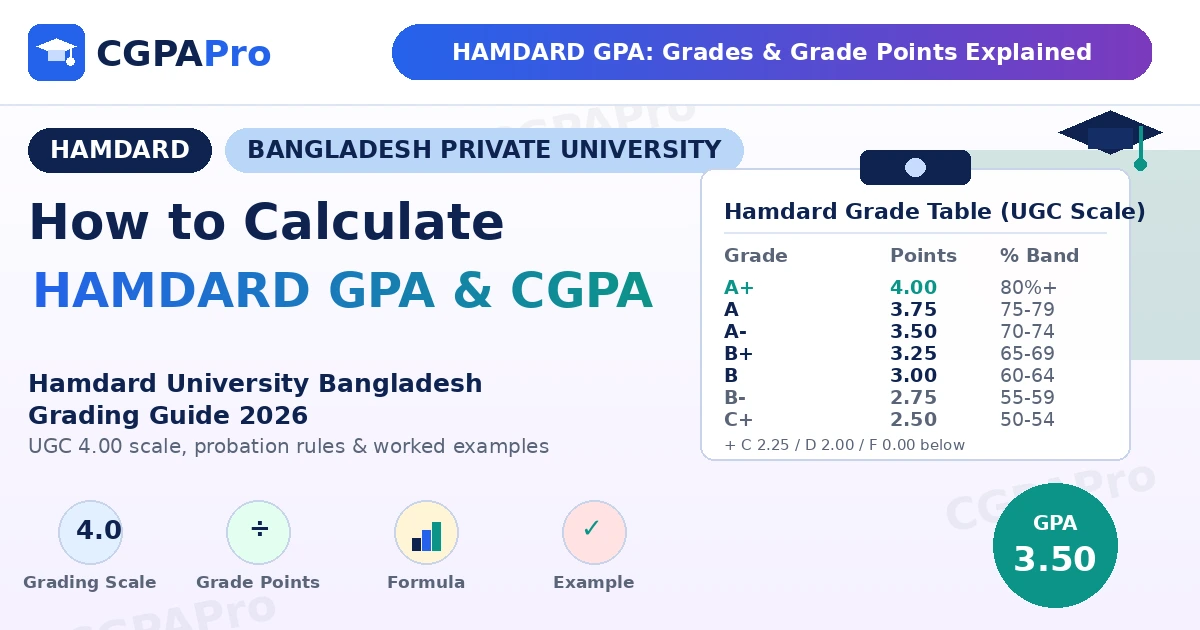
Quick answer: Hamdard University Bangladesh grades on a 4.00 scale. Your marks in each course convert to a letter grade and a grade point — A+ is 4.00 for 80% and above, A is 3.75, A− is 3.50, down through D at 2.00 for 40% to less than 45%, and F is 0.00 below 40%. Your semester GPA is the credit-weighted average of those grade points, and your CGPA is the credit-weighted average across every semester you have completed. Keep both your semester GPA and your cumulative GPA at 2.00 or above, because falling below 2.00 on either one puts you on probation the following semester.
Which “Hamdard” do you mean? Read this first
The name Hamdard belongs to more than one institution, and mixing them up is the fastest way to use the wrong grading rules. This guide is about Hamdard University Bangladesh (HUB) — the private university established in 2012 at Hamdard City of Science, Education & Culture, Gazaria, Munshiganj, founded by Hamdard Foundation Bangladesh, offering BBA, BSc in CSE, BSc in EEE, BSc (Honours) in Mathematics, BA (Honours) in English, BSS (Honours) in Economics, BUMS, BAMS, MBA, MA, MSc and MPH programmes. It is not Hamdard University in Karachi, Pakistan (Madinat-al-Hikmah), not Jamia Hamdard in Delhi, India, and not Hamdard Laboratories (Waqf) Bangladesh — the Unani medicine company whose products you see in pharmacies. Those three share a common history through the Hamdard movement, but their academic rules are different. If your campus is in Gazaria, Munshiganj, you are in the right place. If it is in Karachi or Delhi, stop here and look for that university’s own handbook instead.
Check Your Hamdard GPA With the Calculator
A grade table tells you what each course is worth. It does not do your arithmetic for you, and arithmetic under result-day stress is exactly where mistakes creep in. The fastest check is a calculator that already uses the same scale Hamdard itself publishes.
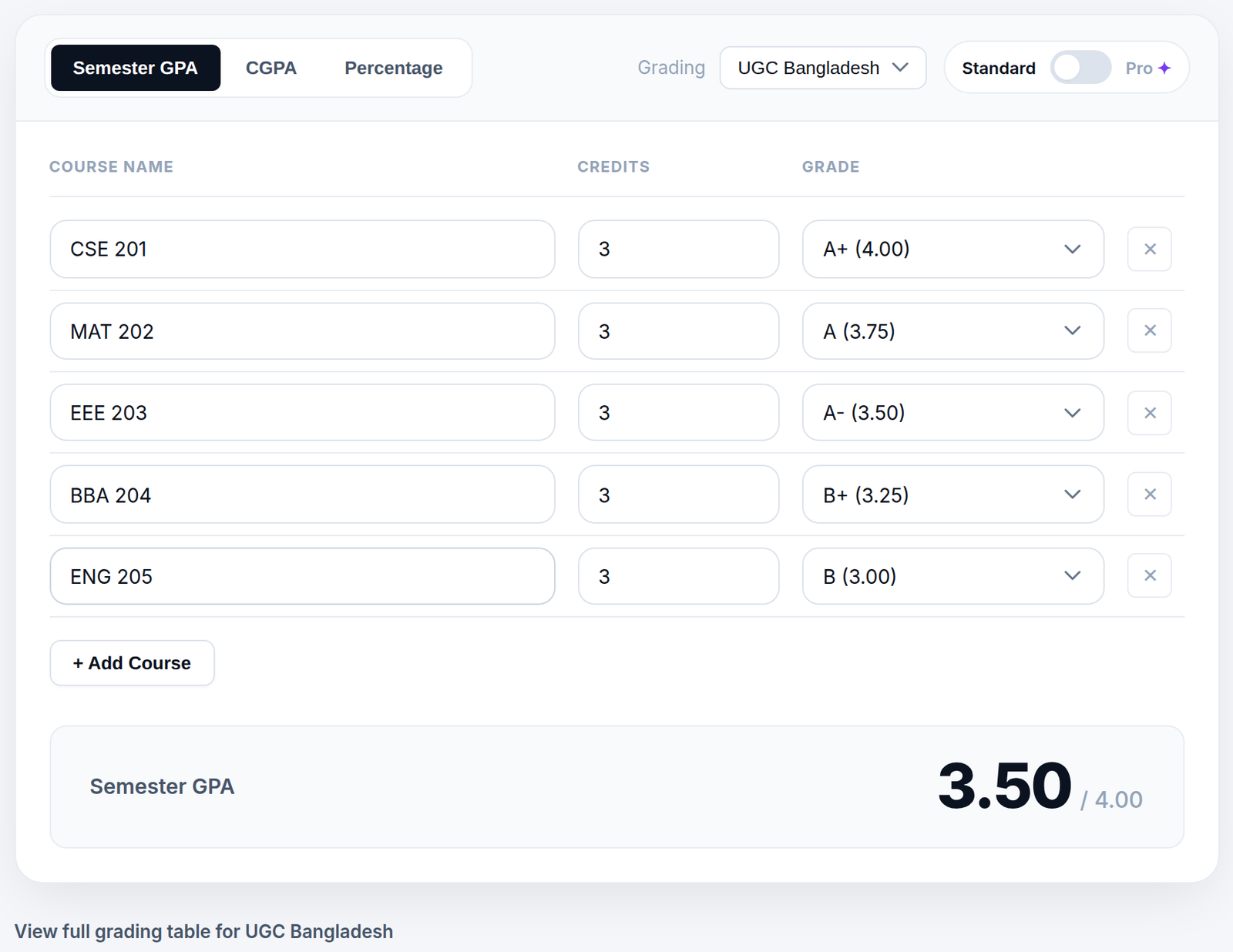
Screenshot: the CGPAPro homepage calculator with the UGC Bangladesh scale, showing Worked Example 1 below. There is no dedicated Hamdard calculator page on cgpacalculatorpro.com yet, so this guide uses the homepage calculator with the same UGC Bangladesh grade scale Hamdard follows — the numbers are identical, only the page is generic.
Here is the exact workflow, matching the screenshot above:
- Open the CGPAPro GPA calculator and make sure the grade scale is set to UGC Bangladesh (A+ = 4.00, A = 3.75, and so on — the scale in the table below).
- Click + Add Course once per course. Type the course code and its credit hours — Hamdard theory courses are typically 3 credits, and labs and sessionals carry their own credit values, so read each row of your registration card rather than assuming every course is worth the same.
- Pick the letter grade you earned (or expect) in each row from the dropdown.
- Read Semester GPA. In the screenshot it is 3.50 — that is Worked Example 1 below, reproduced exactly so you can check every number.
The calculator ignores blank rows, so add exactly as many rows as you have graded courses. If a course shows I (Incomplete) or W (Withdrawal), leave it out of the calculation — neither carries a grade point, and including one as zero would wrongly drag your average down.
What Hamdard Is — and Why Its Table Is Easy to Trust
Hamdard University Bangladesh is a private university with faculties in Science, Engineering and Technology (Mathematics, Computer Science and Engineering, Electrical and Electronic Engineering), Business Administration, Arts and Social Science (English, Economics, Islamic Studies), Unani and Ayurvedic Medicine (BUMS and BAMS — these are degree programmes inside HUB, not separate universities), and Health Sciences (Public Health). That breadth matters for grading because a BUMS student and a CSE student sit under the same university grading system even though their course structures look nothing alike.
Here is the good news, and it is worth stating plainly because it is not true of every private university in Bangladesh: Hamdard publishes its grading system on its own website, and the table it publishes is exactly the University Grants Commission (UGC) Bangladesh uniform 4.00 scale. There is no hidden local variant to hunt for. The university’s Academic Principles page and its programme prospectuses agree on every band, and the EEE programme page says explicitly that HUB follows the Uniform Grading System as directed by the UGC. When this guide quotes a grade band, it is quoting Hamdard’s own published table, not a generic Bangladesh table borrowed from somewhere else. Where Hamdard’s own pages disagree with each other — and they do, on the grade-improvement window, as you will see below — this guide says so rather than quietly picking one version.
The Official Hamdard Grade Table
One table, used across the university:
| Letter Grade | Grade Point | Marks | Standing |
|---|---|---|---|
| A+ | 4.00 | 80% to 100% | Outstanding |
| A | 3.75 | 75% to less than 80% | Excellent |
| A− | 3.50 | 70% to less than 75% | Very Good |
| B+ | 3.25 | 65% to less than 70% | Good |
| B | 3.00 | 60% to less than 65% | Satisfactory |
| B− | 2.75 | 55% to less than 60% | Above Average |
| C+ | 2.50 | 50% to less than 55% | Average |
| C | 2.25 | 45% to less than 50% | Below Average |
| D | 2.00 | 40% to less than 45% | Pass |
| F | 0.00 | Less than 40% | Fail |
Three grades carry no grade point at all:
- P — Pass. Credit without a numerical grade; it does not move your GPA either way.
- I — Incomplete. Assigned when a student misses the final examination. It is a temporary state, not a result: the student may sit that examination within the time set by the Controller of Examinations, on payment of the applicable fee. Miss that window and the I automatically becomes an F. Treat an I as urgent, not as a pause button.
- W — Withdrawal. Assigned when a student withdraws from a course within the withdrawal deadline. Withdraw after the deadline and you earn the grade based on your performance before withdrawal instead — medical grounds and other university conditions can be exceptions, but do not assume one applies to you.
Two details in the table deserve more attention than the rest. First, band edges are unforgiving. A score of 74.9% is a B+ worth 3.25; a score of 75.0% is an A worth 3.75. That tenth of a percent is worth 0.50 grade points per credit — in a 3-credit course, 1.50 quality points. If you are hovering near a boundary before finals, that is exactly where one more evening of revision pays for itself many times over. Second, D is the lowest passing grade. An F earns zero grade points and no credit, yet the course’s credits still sit in your GPA denominator if you count attempted credits — so an F drags the average down twice over, once by adding nothing to the numerator and once by inflating the denominator. That is why a single F hurts far more than a single C.
Where Your 100 Marks Come From
Most grading guides jump straight from marks to letters and never explain how the 100 marks themselves are built. Hamdard’s prospectus does, and it matters because it tells you where marks are actually available to earn before the final exam.
For a theory course, the 100 marks break down as: class attendance 10%, class tests 10%, assignment and presentation 10%, mid-term examination 30%, and final examination 40%. In other words, 30% of your grade is decided before the mid-term even happens, and 70% is decided before you walk into the final. A student who treats attendance and assignments as optional has already capped their grade before finals week.
For a laboratory course, the split is: class attendance 10%, lab report assessment 20%, project or presentation 30%, and final examination 40%. Lab work is not a side activity at Hamdard — it is 50% of the course mark before the final. If your lab reports are late or sloppy, no final-exam performance can fully rescue that course.
Practical consequence: when you estimate a grade before results come out, do not guess a single percentage. Add up the components you already know — attendance, tests, assignments, mid-term — and work out what final-exam score you actually need to cross the next band. That is a far more honest forecast than “I think I did well.”
How to Calculate Your Semester GPA, Step by Step
Forget the simple average of your grades. That is the single most common error students make, and it quietly misleads them every semester. GPA is credit-weighted: a 4-credit core course moves your average more than a 1-credit or 2-credit course, because it counts more.
- List every graded course with its credit hours and your letter grade. Leave out P, I and W courses — they carry no grade point.
- Convert each letter grade to its grade point using the table above.
- Multiply each course’s grade point by its credit hours. These products are your quality points.
- Add up all quality points (the numerator).
- Add up all credit hours (the denominator).
- Divide total quality points by total credit hours. Round to two decimals — that is your semester GPA.
The GPA Formula
GPA = Σ (Grade Point × Credit Hours) ÷ Σ (Credit Hours)
In words: multiply each course’s grade point by its credits, add all those products, then divide by the total credits. The same formula gives CGPA when you extend it across all semesters — just keep adding quality points and credits semester after semester, and divide the grand totals. That last sentence is important, because Hamdard’s own Academic Principles page also carries a shorthand line that says CGPA is the sum of 8 semester GPAs divided by 8. That shorthand only gives the same answer as the credit-weighted method when every semester carries exactly the same number of credits. Most students’ semesters do not. The worked CGPA example below shows the difference with real numbers, so you can see which method to trust.
Worked Example 1 — Semester GPA of Exactly 3.50
This is the exact semester shown in the calculator screenshot above, so you can verify every number twice. Five 3-credit courses:
| Course | Credits | Grade | Grade Point | Quality Points |
|---|---|---|---|---|
| CSE 201 | 3 | A+ | 4.00 | 3 × 4.00 = 12.00 |
| MAT 202 | 3 | A | 3.75 | 3 × 3.75 = 11.25 |
| EEE 203 | 3 | A− | 3.50 | 3 × 3.50 = 10.50 |
| BBA 204 | 3 | B+ | 3.25 | 3 × 3.25 = 9.75 |
| ENG 205 | 3 | B | 3.00 | 3 × 3.00 = 9.00 |
Total quality points = 12.00 + 11.25 + 10.50 + 9.75 + 9.00 = 52.50. Total credits = 15. Semester GPA = 52.50 ÷ 15 = 3.50. Enter the same five rows into the calculator and you will see Semester GPA 3.50 — the screenshot is the proof, not a claim.
Worked Example 2 — Mixed Credits, Where Weighting Shows
Real semesters are not five identical courses. Here is a messier, more realistic one — watch how the 4-credit course dominates, and how a strong grade in a 2-credit course cannot rescue a weak grade in a 4-credit one:
| Course | Credits | Grade | Grade Point | Quality Points |
|---|---|---|---|---|
| CSE 310 | 4 | B+ | 3.25 | 4 × 3.25 = 13.00 |
| EEE 311 | 3 | A | 3.75 | 3 × 3.75 = 11.25 |
| MAT 312 | 3 | C+ | 2.50 | 3 × 2.50 = 7.50 |
| BBA 313 | 2 | A+ | 4.00 | 2 × 4.00 = 8.00 |
| ENG 314 | 3 | B | 3.00 | 3 × 3.00 = 9.00 |
Total quality points = 13.00 + 11.25 + 7.50 + 8.00 + 9.00 = 48.75. Total credits = 15. Semester GPA = 48.75 ÷ 15 = 3.25. Now compare with the wrong method: the simple average of the five grade points (3.25 + 3.75 + 2.50 + 4.00 + 3.00) ÷ 5 = 3.30. The simple average overstates this semester by 0.05 because it gives the 2-credit A+ the same weight as the 4-credit B+. Half a tenth may sound small; over eight semesters, repeated errors like that are the difference between believing you are safe and discovering you are not.
Worked Example 3 — CGPA, and the “Divide by 8” Trap
Take two semesters with different credit loads. Semester 1: 12 credits, GPA 3.80 — that is 12 × 3.80 = 45.60 quality points. Semester 2: 18 credits, GPA 3.20 — that is 18 × 3.20 = 57.60 quality points. Credit-weighted CGPA = (45.60 + 57.60) ÷ (12 + 18) = 103.20 ÷ 30 = 3.44.
The simple average of the two semester GPAs gives (3.80 + 3.20) ÷ 2 = 3.50. That is 0.06 higher than the true CGPA, because it pretends the 12-credit semester mattered as much as the 18-credit one. Hamdard’s “sum of 8 semester GPAs divided by 8” shorthand makes exactly this mistake whenever semesters carry different credits. If all your semesters happen to carry the same credits, both methods agree and the shorthand is harmless. If they do not — and for most students, with labs, electives and retakes, they do not — use the credit-weighted method: total quality points across all semesters divided by total credits across all semesters. Your transcript’s CGPA is the credit-weighted one, so calculate the number your university actually reports.
For a quick sense of scale, and for guidance on how to read a CGPA once you have it, see whether a 3.5 CGPA is good for jobs, scholarships and study abroad
GPA vs CGPA — and the 5.00 Scale You Left Behind
Semester GPA (sometimes called SGPA) covers one semester. CGPA covers every graded semester you have completed so far. Employers, scholarship committees and foreign universities almost always ask for CGPA, not your best semester — so a strong final semester does not erase earlier ones, and a weak first semester does not define you forever either, because every new semester’s credits dilute the old ones.
One confusion deserves its own paragraph because it affects almost every Bangladeshi student in their first university year: your SSC and HSC GPA was out of 5.00; your university CGPA is out of 4.00. An HSC A+ was 5.00; a university A+ is 4.00. An HSC A was 4.00; a university A is 3.75. Do not carry the school scale into university calculations, and do not panic when a “4.00” that once meant an A in school now means an A+ at university. If you are converting a CGPA back to a percentage for a form, the percentage-conversion guide walks through the usual formula — but check what the receiving institution actually asks for, because there is no single official CGPA-to-percentage rule in Bangladesh.
Probation, Improvement, Retakes — the Rules That Decide Your Next Semester
Grades are only half the story. The other half is what the university does with them, and Hamdard publishes this too.
Probation. Students are expected to maintain a minimum GPA of 2.00 — both semester GPA and cumulative GPA. Fall below 2.00 on either, and you are put on probation during the following semester. Probation is a warning with a deadline, not an expulsion: the practical response is to take a manageable credit load the next semester, protect the courses you are strongest in, and clear any F grades rather than loading up on new hard courses to “catch up” all at once.
Improving a grade. Here Hamdard’s own pages do not use identical words, and honesty requires saying so. The Academic Principles page says course grades B− and below can be improved in the next two consecutive semesters by paying the applicable exam fees. A programme page says grade C and below may be improved by students, in the next available opportunity, on payment of the applicable course fee. Those two wordings differ on both the grade range (B− and below, or C and below) and the window (two semesters, or the next opportunity). Check your current department handbook before planning an improvement — do not assume the wider or the narrower version applies to you, and do not pay a fee until the department confirms which courses are eligible in your case.
Failing a course. For an F grade, the student has to take the class in full, with all requirements and examinations — there is no exam-only shortcut for a failed course. The Academic Principles page also describes an advantage for students with a maximum of two F grades and a minimum CGPA of 1.80; the page states this tersely and this guide does not embellish it, so if that situation applies to you, confirm the exact terms with the Controller of Examinations before relying on it.
Graduation thresholds — do not mix up programmes. The CSE programme requires 153 credits with a minimum CGPA of 2.00, normally over 8 semesters and four years. The EEE programme page lists 154.5 theory and laboratory credits, plus a 6-credit dissertation with at least a C+ grade (2.50), passing all courses individually, and a minimum CGPA of 2.5. Those are programme-page figures for different programmes. The EEE 2.5 is not a university-wide graduation rule, and the CSE 2.00 is not the EEE rule. Check the programme page for your own degree — BBA, English, Economics, BUMS, BAMS, Public Health and the rest each carry their own credit totals — before telling anyone what CGPA you “need to graduate”.
Dean’s List. No Dean’s List or honours cut-off rule for HUB was found in this research, so this guide invents none. In Bangladesh generally, a CGPA of 3.50 and above is widely treated as First Class territory, but that is a general marker, not a Hamdard rule — if your department announces a list, its own notice is the authority.
Common Mistakes Hamdard Students Make
- Averaging letter grades instead of weighting by credits. Covered above — it is wrong whenever credits differ, and credits almost always differ.
- Using the “divide by 8” CGPA shorthand on unequal semesters. It overstates your CGPA when your weaker semesters carried more credits, which is exactly when you most need an honest number.
- Counting I and W as zero. They carry no grade point. Counting them as F-grade zeros invents a failure that does not exist — but ignoring an I until it converts to a real F is the opposite error.
- Carrying the HSC 5.00 scale into university. A university A is 3.75, not 4.00; a university A+ is 4.00, not 5.00.
- Assuming the EEE graduation CGPA applies to every programme. It does not; check your own programme page.
- Using Hamdard Pakistan’s or Jamia Hamdard’s rules. Different universities, different handbooks — the name is shared, the rules are not.
- Treating attendance, tests and assignments as free marks. They are 30% of a theory course and 50% of a lab course before the final exam.
- Rounding mid-calculation. Keep full quality points until the final division, then round to two decimals. Rounding each course’s contribution early is how 3.49 becomes 3.50 on paper and stays 3.49 on the transcript.
Tips That Actually Move a Hamdard CGPA
First, protect the 30% you control before finals: attendance, class tests, assignments and presentations in theory courses, and lab reports and projects in lab courses. Those marks are earned in ordinary weeks, not in exam-week heroics, and they are the cheapest grade points you will ever earn.
Second, aim at band edges, not at vague improvement. If your running total puts you at 73% in a course, you need a specific final-exam score to reach 75% and the A band — work it out from the marks split above and study to that number. If you are at 68%, the B+ to A− edge at 70% is your target. Vague goals produce vague results; band targets produce plans.
Third, sequence retakes and improvements deliberately. An F must be retaken in full, so it costs a full semester slot — pair it with courses you are confident in, not with your hardest new core courses. And before paying any improvement fee, get the department’s current improvement window in writing, given the two wordings on the university site.
Fourth, check your CGPA the credit-weighted way every semester, not just in your final year. A 0.06 error repeated across semesters is a scholarship or job-shortlist error. Enter your real courses into the calculator each semester and keep the screenshot — it is the fastest way to catch a transcript error while it can still be corrected.
For a Bangladesh-wide comparison of how other private universities grade, the AIUB grading guide shows the same UGC framework with a different university’s programme details — useful if you are comparing transfer options or explaining your transcript to someone unfamiliar with the UGC scale.
Frequently Asked Questions
What is the grading system of Hamdard University Bangladesh?
Hamdard University Bangladesh uses the UGC Bangladesh uniform 4.00 scale: A+ 4.00 (80–100%), A 3.75 (75–<80%), A− 3.50 (70–<75%), B+ 3.25 (65–<70%), B 3.00 (60–<65%), B− 2.75 (55–<60%), C+ 2.50 (50–<55%), C 2.25 (45–<50%), D 2.00 (40–<45%), and F 0.00 (below 40%). P, I and W carry no grade point.
How do I calculate my Hamdard GPA?
Multiply each course’s grade point by its credit hours, add all the products, and divide by total credit hours. For example, five 3-credit courses graded A+, A, A−, B+ and B give (12.00 + 11.25 + 10.50 + 9.75 + 9.00) ÷ 15 = 3.50. The calculator screenshot near the top of this guide reproduces that exact semester.
How is CGPA calculated at Hamdard — average of semester GPAs, or credit-weighted?
Use the credit-weighted method: total quality points across all semesters divided by total credits across all semesters. Hamdard’s Academic Principles page also states a shorthand — sum of 8 semester GPAs divided by 8 — but that only matches the credit-weighted answer when every semester carries the same credits. When credits differ, the credit-weighted figure is the one to trust.
What CGPA do I need to graduate from Hamdard?
It depends on your programme. CSE requires 153 credits with a minimum CGPA of 2.00. The EEE programme page lists 154.5 credits plus a 6-credit dissertation at C+ or above and a minimum CGPA of 2.5. Do not apply one programme’s figure to another — check your own programme page or department handbook.
What happens if my GPA falls below 2.00?
You are put on probation during the following semester, because Hamdard expects a minimum GPA of 2.00 on both semester and cumulative measures. Use the probation semester to clear failed courses and protect strong ones, rather than overloading with new difficult courses.
Can I improve a low grade at Hamdard?
Yes, on payment of the applicable fee — but the exact range and window differ between Hamdard’s own pages (B− and below within the next two consecutive semesters, versus C and below at the next available opportunity). Confirm the current rule with your department before paying or planning around an improvement.
Is Hamdard University Bangladesh the same as Hamdard University Pakistan?
No. Hamdard University Bangladesh is a private university in Gazaria, Munshiganj, founded by Hamdard Foundation Bangladesh. Hamdard University Pakistan is a separate university in Karachi. They share historical roots in the Hamdard movement, but they are different institutions with different academic rules — as is Jamia Hamdard in India, and Hamdard Laboratories (Waqf) Bangladesh, which is a medicine company, not a university.
Conclusion
Hamdard University Bangladesh is unusually straightforward to explain, and that is a compliment: it publishes its grading table, the table is the national UGC scale, and its probation, incomplete, withdrawal and retake rules are written down where students can find them. The traps are not hidden rules but honest complications — the “divide by 8” CGPA shorthand that misleads on unequal semesters, two wordings for grade improvement, programme-specific graduation figures that must not be swapped between degrees, and a shared name that points to three other institutions. Calculate the credit-weighted way, protect the marks you earn before finals, check your own programme page for graduation and improvement rules, and verify each semester in the calculator. Do that, and the number on your transcript will never surprise you.
Sources: Hamdard University Bangladesh Academic Principles (grading table, GPA formula, probation and improvement rules); HUB EEE programme page (UGC Uniform Grading System statement and EEE graduation requirements); HUB CSE programme page (153 credits, minimum CGPA 2.00). Where HUB pages differ — notably the grade-improvement window — this guide flags the difference and advises checking the current department handbook, rather than presenting one wording as settled fact.