Knowing how to convert percentage to CGPA correctly matters the moment a scholarship form, job application, or foreign university asks for grade points instead of marks. Get the conversion wrong and you either undersell a strong result — or overstate it and get flagged for misrepresentation.
“I scored 82% in my board exams — what is that in CGPA? And is it 3.28, 3.7, or 8.6?”
That confusion is the whole story. There is no single universal formula: Pakistan’s HEC, Bangladesh’s UGC, India’s CBSE, and your own university each play by different rules, and the same percentage can legally become three different CGPAs depending on whose rulebook you use. This guide gives you the exact country-wise formulas, the priority order to use them in, fully worked examples with real numbers, and the mistakes that get applications rejected.
Quick answer: The rough rule of thumb on a 4.00 scale (Pakistan, Bangladesh) is CGPA ≈ (Percentage ÷ 100) × 4 — so 80% ≈ 3.20. But treat it as an estimate, not an official figure: Pakistan’s HEC publishes its own piecewise formula (80% → 3.25), and Bangladesh’s UGC uses grade bands (80% → A+ = 4.00). In India, the CBSE-verified formula is CGPA = Percentage ÷ 9.5 — so 80% = 8.42. Always check whether your university prescribes its own formula first; an official formula always beats a generic one.
Try it now: Free Percentage to CGPA Calculator — enter your percentage, get your CGPA instantly
How to Convert Percentage to CGPA Using the Calculator
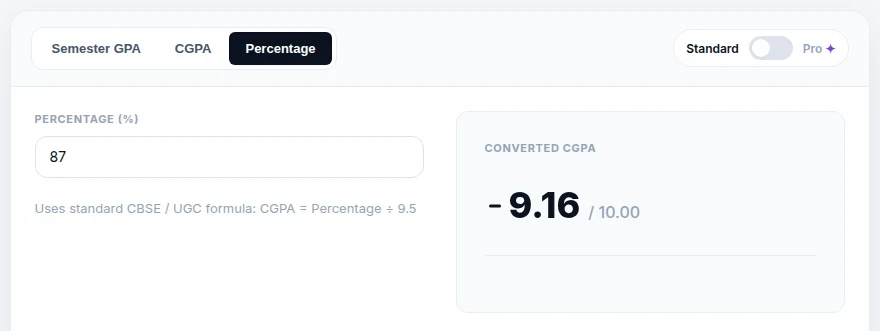
The fastest way to convert is our homepage calculator’s Percentage mode. It applies the CBSE ÷ 9.5 formula (labeled on-site as the standard CBSE/UGC formula) and shows your result on the 10-point scale:
- Open the calculator and select the Percentage tab.
- Enter your percentage — for example, 87.
- Read your CGPA — the tool instantly shows the converted value on the 10.00 scale.
- Pick your country’s formula (below) if your university uses a 4.00 scale or its own multiplier, and re-calculate with the right rule.
Quick tip: The calculator’s ÷ 9.5 conversion is the Indian standard. If you are in Pakistan or Bangladesh, keep reading — your conversion runs on the 4.00 scale, and the math is different.
Why Percentage-to-CGPA Conversion Is Tricky
Three facts make this conversion harder than it looks:
1. CGPA scales differ by country. Pakistan and Bangladesh run on a 4.00 scale. India runs on a 10-point scale (with several universities using their own variants). A conversion formula built for one scale is meaningless on the other — dividing your Pakistani percentage by 9.5 is the single most common mistake students make, and it comes straight from copying Indian answers on forums.
2. Grade bands beat straight lines. Universities do not actually compute CGPA from percentages with a formula. They map your percentage into a letter grade (say, 80–84% = A−), assign that grade a fixed grade point (3.67 or 3.70), and average those points. A formula like (Percentage ÷ 100) × 4 is an approximation of that banded process — close, but not identical. Two students with 79% and 81% can end up with grade points further apart than the 2% gap suggests, because they fell on opposite sides of a grade boundary.
3. Official formulas override generic ones. Your university’s published conversion table, the HEC equivalence for Pakistan, or the receiving employer’s stated formula always wins. The golden rule, in order:
institution-specific formula > country convention > generic formula. Always work down that priority list, and never present a generic conversion as an official one.
Country-wise Percentage to CGPA Formulas
Pakistan — HEC 4.00 scale
Pakistan’s Higher Education Commission publishes an official piecewise conversion formula (HEC “Conversion Formula” 30-11-2018) — and it is not the “divide by 25” shortcut you see on forums. Here is the real table:
| Percentage range | Official HEC formula | Example |
|---|---|---|
| 90–100 | 3.63 + (P − 90) × 0.037 | 95% → 3.82 |
| 80–89 | 3.25 + (P − 80) × 0.037 | 87% → 3.51 |
| 70–79 | 2.88 + (P − 70) × 0.036 | 75% → 3.06 |
| 60–69 | 2.50 + (P − 60) × 0.037 | 65% → 2.69 |
| 50–59 | 1.80 + (P − 50) × 0.069 | 55% → 2.15 |
| 40–49 | 1.00 + (P − 40) × 0.079 | 45% → 1.40 |
Compare: the popular shortcut (Percentage ÷ 25) says 80% = 3.20, but the official HEC figure is 3.25. The shortcut is a rough linear approximation — fine for a back-of-the-envelope guess, but never quote it as HEC’s rule. Source: HEC Conversion Formula 30-11-2018 (official PDF, university-hosted copy).
One more distinction: this conversion table is for equivalence on forms. Your transcript’s semester grades follow HEC’s separate banded grading (85–100% = A = 4.00, 80–84% = A− = 3.70, 75–79% = B+ = 3.30). So an 87% on your transcript is an A worth 4.00 grade points, while the HEC equivalence formula says 3.51. Different tools, different jobs — never “correct” your transcript with the conversion formula. To see how banded grading plays out course by course, try the NUST CGPA calculator.
Bangladesh — UGC 4.00 scale
Bangladesh’s UGC does not publish a continuous conversion formula at all. Its Uniform Grading System is a percentage-band → letter-grade → grade-point table (confirmed in official university documents citing the UGC system):
| Marks | Grade | Grade point |
|---|---|---|
| 80–100 | A+ | 4.00 |
| 75–79 | A | 3.75 |
| 70–74 | A− | 3.50 |
| 65–69 | B+ | 3.25 |
| 60–64 | B | 3.00 |
| 55–59 | B− | 2.75 |
| 50–54 | C+ | 2.50 |
| 45–49 | C | 2.25 |
| 40–44 | D | 2.00 |
| Below 40 | F | 0.00 |
So 75% → A → 3.75, 80% → A+ → 4.00, 72% → A− → 3.50. The internet-standard “CGPA = (Percentage ÷ 100) × 4” is not a UGC formula — it is a rough estimate that would wrongly give 72% → 2.88 instead of the official 3.50. Use the bands; treat the linear formula as an approximation only. You can cross-check banded results with the North South University CGPA calculator.
India — 10-point scale
India is where most conversion confusion lives, because there are several official formulas. Here is each one with its actual source:
- CBSE (verified primary source): CGPA = Percentage ÷ 9.5. So 85% → 8.95, 75% → 7.89. Source: CBSE Circular No. 24 (CBSE/ACAD/2010), 28 May 2010 — official circular (PDF), which states “overall indicative percentage of marks = 9.5 × CGPA”. Note this circular covers CBSE school boards; many universities adopted the same equivalence.
- AICTE engineering (official table): the AICTE Handbook’s “Percentage Equivalence of Grade Points” table (6.25 → 55%, 7.75 → 70%, 8.25 → 75%) is exactly equivalent to CGPA = (Percentage ÷ 10) + 0.75. So 75% → 8.25, 80% → 8.75.
- ×10 universities: CGPA = Percentage ÷ 10 — institution-specific (Anna University and several others follow this). 85% → 8.50.
- Mumbai University (reported): Percentage = 7.1 × CGPA + 11, so reversed: CGPA = (Percentage − 11) ÷ 7.1. 75% → 9.01. (Per Mumbai University’s CBCS ordinance, as reported by education portals — confirm against your college’s notice.)
Two qualifications most articles skip: UGC India issues no single national conversion formula — it defers conversion authority to each university’s Academic Council, so “the UGC formula” is a myth. And the 9.5 multiplier is official for CBSE, not for all of India.
Same 75%, four different answers: 7.89 (CBSE), 7.50 (×10), 8.25 (AICTE-style), 9.01 (Mumbai). This is why “which multiplier is correct?” is the most-asked conversion question in India — and the only correct answer is yours: the formula your university prints on its own marksheet or website. For university-specific scales, use the matching tool, e.g. the KTU Kerala CGPA calculator.
Which divisor applies to you? A 30-second decision tree: (1) Does your marksheet or university website print a conversion formula? → use it, done. (2) CBSE board student? → ÷ 9.5. (3) Engineering college following AICTE norms? → (÷ 10) + 0.75. (4) Your university’s seniors/formula page say ×10? → ÷ 10. (5) None of the above? → ask your registrar for the official equivalence before you fill the form.
Malaysia — no official conversion
Malaysia is the honest exception: no Malaysian authority publishes an official percentage↔CGPA conversion. Malaysian universities classify degrees by CGPA bands directly — typically First Class at 3.67 and above, Second Class Upper from 3.00–3.66, and so on. If a form demands a conversion, the only defensible approach is a rough proportional estimate (Percentage ÷ 100) × 4.00, clearly labeled as an estimate — or better, report your CGPA as-is with its scale: “3.45 on a 4.00 scale.”
Side by Side: One Percentage, Four CGPAs
Nothing settles the “which formula?” debate faster than watching one number split into four. Take 82%:
| Rule | Formula | 82% → CGPA |
|---|---|---|
| CBSE (India) | 82 ÷ 9.5 | 8.63 |
| ×10 university (India) | 82 ÷ 10 | 8.20 |
| Mumbai-style (India) | (82 − 11) ÷ 7.1 | 10.00 (capped — the raw math gives exactly 10.0) |
| HEC official (Pakistan) | 3.25 + (82 − 80) × 0.037 | 3.32 |
| UGC bands (Bangladesh) | 82% → A+ | 4.00 |
Same marks, five legitimate answers across the region — which is exactly why arguing about the number without naming the formula is pointless. When a form asks for your converted CGPA, the formula name is half the answer.
Step-by-Step: Convert Your Percentage to CGPA
- Start from the right percentage. Use your aggregate — total marks obtained across all subjects ÷ total maximum marks × 100. If your board drops the lowest subject or counts “best of five,” follow that rule; the percentage you convert must be the percentage your board would print.
- Identify your scale. 4.00 (Pakistan/Bangladesh) or 10-point (India)? This single choice decides the formula.
- Check for an official formula first. Look at your university’s website, marksheet reverse side, or student handbook for a printed conversion rule. If one exists, stop here and use it.
- Apply the country convention. Pakistan/Bangladesh: (Percentage ÷ 100) × 4. India CBSE/UGC: Percentage ÷ 9.5. University-specific India: your university’s multiplier.
- Round to two decimals — the standard presentation (3.48, 8.95).
- Label the conversion. On any form, write the formula you used or add “converted via [formula]” in the remarks. An unlabeled converted figure invites suspicion; a labeled one shows diligence.
- Never alter your transcript. Conversions live on application forms only. Your official record keeps whatever scale your university awarded.
The Formula Box
Pakistan — HEC official (4.00 scale):
Piecewise: ≥90 → 3.63+(P−90)×0.037; ≥80 → 3.25+(P−80)×0.037; ≥70 → 2.88+(P−70)×0.036; ≥60 → 2.50+(P−60)×0.037; ≥50 → 1.80+(P−50)×0.069; ≥40 → 1.00+(P−40)×0.079. (The ÷25 shortcut is an unofficial estimate.)
Bangladesh — UGC official bands (4.00 scale):
80–100 → 4.00; 75–79 → 3.75; 70–74 → 3.50; 65–69 → 3.25; 60–64 → 3.00; 55–59 → 2.75; 50–54 → 2.50; 45–49 → 2.25; 40–44 → 2.00; below 40 → 0.00.
India — CBSE, verified (10-point):
CGPA = Percentage ÷ 9.5
India — AICTE engineering equivalence (10-point):
CGPA = (Percentage ÷ 10) + 0.75
India — ×10 universities / Mumbai (institution-specific):
CGPA = Percentage ÷ 10; Mumbai: CGPA = (Percentage − 11) ÷ 7.1 (reported per university ordinance — confirm with your college)
Malaysia:
No official formula — report CGPA with its scale, or use a clearly labeled proportional estimate.
Rounding and Capping Traps
Three edge cases catch students every year:
1. The 100% paradox. 100 ÷ 9.5 = 10.53 — but the scale tops out at 10.00. Converted CGPAs are capped at the scale maximum, so 95% and 100% both convert to 10.00 under CBSE math (95 ÷ 9.5 = 10.00 exactly). If your converted figure exceeds the scale, cap it and note the cap.
2. Rounding conventions. 85 ÷ 9.5 = 8.9474… — is that 8.95 or 8.9? Most boards and forms use two decimals (8.95), but some university portals truncate to one (8.9). Match the form’s format; when in doubt, two decimals is the safer default.
3. The same-bracket effect. Under banded grading, 91% and 99% can sit in the same top bracket — identical grade points despite an 8-point gap. A linear formula pretends every percentage point counts equally; real grading has cliffs and plateaus. This is another reason a formula can never reconstruct your true CGPA.
Worked Examples (Real Numbers)
Example 1 — Pakistan (HEC official formula). Ayesha scored 82% in her BBA annual exams. A government job form asks for CGPA on the 4.00 scale. The 80–89 band gives: 3.25 + (82 − 80) × 0.037 = 3.25 + 0.074 = 3.32. She writes “3.32 (HEC equivalence formula)”. Had she used the ÷25 shortcut, she would have written 3.28 — close, but not the official figure. Note: on her actual transcript, 82% is an A− worth 3.70 under HEC’s banded grading — the 3.32 is strictly the form’s conversion, not her transcript grade.
Example 2 — India (CBSE ÷ 9.5). Rohan has 87% in Class 12 and a scholarship asks for CGPA. CGPA = 87 ÷ 9.5 = 9.16 — exactly what our calculator shows in the screenshot above. Under a ×10 university rule the same 87% would be 8.70, a gap of nearly half a grade point. This is why the formula source matters more than the arithmetic.
Example 3 — Bangladesh (UGC bands). Tanvir’s HSC result is 75%. Under the UGC band table, 75–79% → A → 3.75. The popular ÷25 shortcut would say 3.00 — a full 0.75 lower, and not the official figure. This single example is why the shortcut is dangerous: it systematically understates Bangladeshi results in the 70–90% range.
Example 4 — India (AICTE-style). Priya’s aggregate is 72% and her engineering college follows the AICTE equivalence. CGPA = (72 ÷ 10) + 0.75 = 7.95. Had she blindly used CBSE’s ÷ 9.5, she would have written 7.58 — underselling herself by nearly 0.4.
Example 5 — Malaysia (estimate, labeled). Daniel’s CGPA is 3.45 and an overseas form wants a percentage. There is no official conversion, so he reports “3.45 / 4.00 (Second Class Upper)” — no formula, no invented number. If the form forces a percentage field, a labeled estimate of (3.45 ÷ 4) × 100 = 86.25% with a note “estimated; no official conversion published” is the honest maximum.
Why the Same Percentage Gives a Different CGPA
This is the question that breaks every “universal formula” article, so here is the full answer:
Different scales. 80% on a 4.00 scale (÷25 → 3.20) and 80% on a 10-point scale (÷9.5 → 8.42) are different number systems. Comparing them directly is like comparing Celsius and Fahrenheit readings.
Different official multipliers. In India alone, 75% converts to 7.89 (CBSE), 7.50 (×10 universities), 8.25 (AICTE-style), or 9.01 (Mumbai). None is “wrong” — each is official somewhere and wrong everywhere else.
Bands vs. lines. A linear formula treats every percentage point equally. Real grading does not: crossing from 79% to 80% can jump you a full letter grade (and 0.3+ grade points), while moving from 81% to 84% changes nothing. Formulas smooth over these cliffs.
Rounding and averaging order. Real CGPA averages grade points per course, then rounds. A formula converts the final percentage in one step. Reversing a formula cannot recover the per-course rounding that produced the real CGPA — which is why “percentage ÷ 9.5” gives an approximation of a CGPA, never the CGPA itself.
The practical takeaway: when two students argue “but I got a higher CGPA with the same percentage,” both can be right. Ask which formula each used before arguing about the number.
Common Mistakes (Avoid These)
1. Using India’s 9.5 formula in Pakistan or Bangladesh — or the ÷25 shortcut as “official.” Dividing a Pakistani 80% by 9.5 gives 8.42 — a number that means nothing on the 4.00 scale. And the beloved “CGPA = Percentage ÷ 25” is not HEC’s or UGC’s rule: HEC’s official figure for 80% is 3.25 (not 3.20), and UGC Bangladesh gives 80% an A+ = 4.00. Match the formula to the scale and to the official table.
2. Assuming conversion is invertible. If your CGPA is 8.6, then 8.6 × 9.5 = 81.7%, and 81.7 ÷ 9.5 = 8.6 again — that round-trip works. But if your percentage is 81.7%, your real CGPA was computed from grade bands and rounding, and 81.7 ÷ 9.5 = 8.6 is only an estimate of it. The formula inverts; reality does not.
3. Mixing up scales mid-form. Writing “3.2” when you meant 8.42 (or vice versa) is the fastest way to get a form rejected. Always include the scale: “8.42 / 10.00”.
4. The big trap: converting your official transcript. Your transcript, degree, and marksheet are never converted — not by you, not by anyone. Conversions exist only for downstream forms (jobs, scholarships, applications) that request a different format. If a form’s required format contradicts your transcript, attach the transcript and add a labeled conversion note; never white-out or “correct” the official document.
5. Self-converting for foreign universities. US, UK, and Canadian admissions — and credential evaluators like WES — apply their own country-specific mappings (for instance, WES may map an Indian 75% to 3.7, not the 3.0 your ÷25 shortcut gives). Most explicitly ask you not to convert: report “8.2 on a 10-point scale” and let their evaluators do the mapping. A self-converted figure can actually slow your application down.
6. Copying a formula from another country’s students. Forum answers rarely state their country. An Indian student’s ×9.5, a Pakistani student’s ÷25, and a Bangladeshi student’s band table all look equally confident in a comment thread. Verify the formula’s origin before using it.
Frequently Asked Questions
Is 75% equal to 3.0 CGPA?
Only under the rough ÷25 shortcut — and that shortcut is not official anywhere. The real answers: Pakistan’s HEC piecewise formula gives 75% → 3.06; Bangladesh’s UGC bands give 75% → A → 3.75; India gives 7.89 (CBSE ÷9.5), 7.50 (÷10), or 8.25 (AICTE-style). “75% = 3.0” is the internet’s favorite wrong confident answer — now you know the four right ones.
Should I divide by 9.5 or by 10?
Divide by 9.5 if you are under CBSE or a university that follows the UGC/CBSE equivalence. Divide by 10 if your university’s own rule says so (Anna University and several others). The two differ by half a grade point at 85% (8.95 vs 8.50), so check your marksheet’s reverse side or your university website — the answer is printed there more often than students expect.
Can I get my exact CGPA back by converting my percentage?
No — not exactly. Your real CGPA came from per-course letter grades and rounding; a single formula applied to your final percentage can only approximate it. The approximation is usually close (within 0.1–0.2), which is fine for forms, but do not treat it as your official CGPA.
My job application asks for a percentage but my transcript shows CGPA. What do I write?
Use the reverse of this guide’s formulas — our CGPA to percentage guide covers exactly that — and add a short note stating which formula you used, e.g. “87.5% (converted from 3.50 CGPA via HEC ÷4×100 equivalence)”. Keep any official equivalence certificate your university issued; employers do ask for it.
Do I need to convert my percentage for US or UK university applications?
Usually no. Most foreign applications have a field for the original scale — write “82%” or “8.4/10.0” exactly as awarded. Credential evaluators (like WES) perform their own mapping, and a self-converted number can conflict with theirs. Convert only if the form gives you no other option, and label it clearly.
Why did my friend get a higher CGPA than me with the same percentage?
Different formula, different scale, or different university grade bands. An 80% is 8.42 under CBSE’s ÷9.5 but 8.00 under a ×10 university — same marks, different CGPA, both official. Compare formulas before comparing numbers.
What is the official percentage-to-CGPA formula for Malaysia?
There isn’t one. No Malaysian authority publishes a %↔CGPA conversion; degrees are classified directly by CGPA (First Class usually from 3.67). Report your CGPA with its scale, or use a clearly labeled proportional estimate if a form forces the issue.
60% is a first division — what is that in CGPA?
It depends on the rulebook, as always: HEC Pakistan’s official formula gives 60% → 2.50; Bangladesh’s UGC bands give 60–64% → B → 3.00; CBSE math gives 60 ÷ 9.5 = 6.32. Eligibility cutoffs written in CGPA terms (“minimum 3.0 CGPA”) therefore mean different percentages in different systems — always convert the cutoff with your formula before deciding whether you qualify.
Conclusion
Converting percentage to CGPA is a five-second calculation hiding a one-hour decision: which formula is actually yours? The arithmetic — HEC’s piecewise table, UGC’s grade bands, CBSE’s ÷ 9.5 — is the easy part. The part that protects your applications is the discipline around it: use your university’s official rule first, match the formula to the scale, label every conversion, and never touch your transcript.
Run your number through our free percentage to CGPA calculator to get the instant result, then double-check it against your university’s published rule using the country formulas above. And if you are converting in the other direction, our CGPA to percentage guide has you covered. To understand how these numbers relate in the first place, see CGPA vs GPA vs SGPA: the difference explained.