Short answer: a 3.0 CGPA is decent — not excellent, not bad. It is arguably the most important number on the 4.0 scale after 4.0 itself, because more doors are calibrated to exactly 3.0 than to any other threshold: it is the minimum GPA most US graduate programs will consider, the number where most employers’ screening filters start, and the exact figure Chevening names for its UK 2:1 equivalence. But that sentence contains the whole truth about 3.0: it puts you on the line everywhere — never safely above it. This guide shows where that line actually lands: what a 3.0 means grade by grade, how Pakistan, Bangladesh, India, and Malaysia classify it, the real scholarship and job cutoffs it clears (and the ones it misses), what it buys you for an MS abroad country by country, and the honest rescue math if you’re sitting at 3.0 or below and want to climb.
Step 1: Know Your Real Number First
Before planning anything around a 3.0, make sure 3.0 is actually your number. Most students estimate their CGPA by averaging semester GPAs — which is wrong whenever your semesters carried different credit loads. Enter every course, grade, and credit hour into the free CGPA calculator at cgpacalculatorpro.com: it weights each course by credits the way universities compute it, and it will tell you whether you’re truly at 3.00 or at 2.94 hoping to round up.
The Anatomy of a 3.0: What It Actually Means
A 3.0 CGPA means you’ve averaged a straight B across your degree. Not B+ — B. Here is what that looks like in practice, using the grade points from this site’s calculator — the official UGC Bangladesh scale (the same scale you see in the calculator’s grade dropdown):
| Letter grade | Grade point | What it looks like |
|---|---|---|
| A+ | 4.00 | The rare perfect course |
| A | 3.75 | The standout course you actually enjoyed |
| A− | 3.50 | Strong, with one rough exam |
| B+ | 3.25 | The course where effort almost paid off |
| B | 3.00 | Your default setting — most of your transcript |
| B− | 2.75 | The semester that got away from you |
| C+ | 2.50 | Below your standard, but recoverable |
| C | 2.25 | The course you survived, nothing more |
| D | 2.00 | A pass that drags everything down |
| F | 0.00 | The one that has to be retaken |
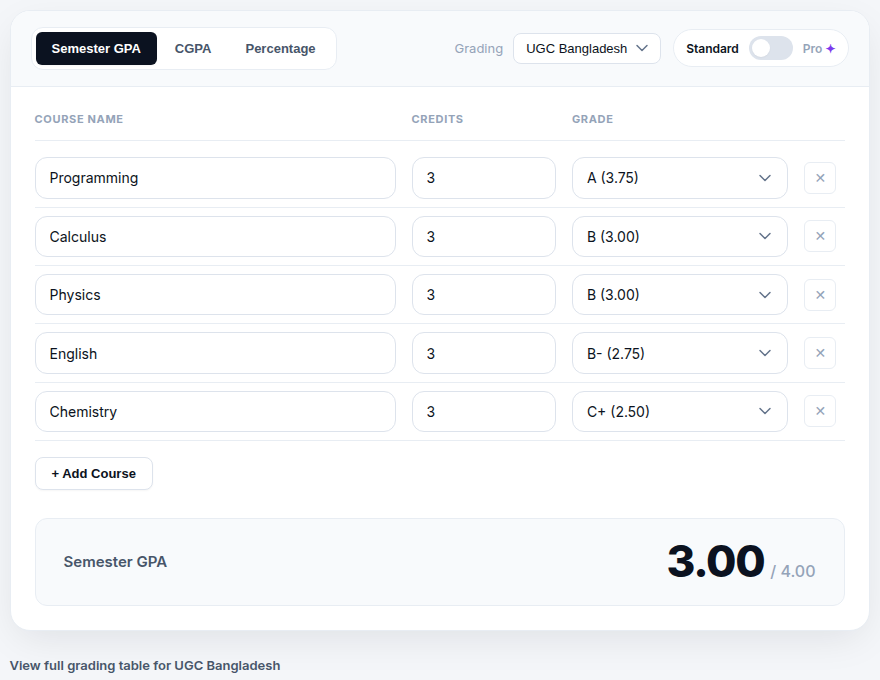
One honest note: scales differ between countries. On the common US 4.0 scale an A is 4.00 and a B+ is 3.30; on HEC Pakistan’s scale an A is 4.00 and a B+ is 3.50. The worked example below uses the UGC Bangladesh scale — the default on this site’s calculator, matching the screenshot further down. If your university uses a different scale, run the same five courses through our free CGPA calculator with your own grade points.
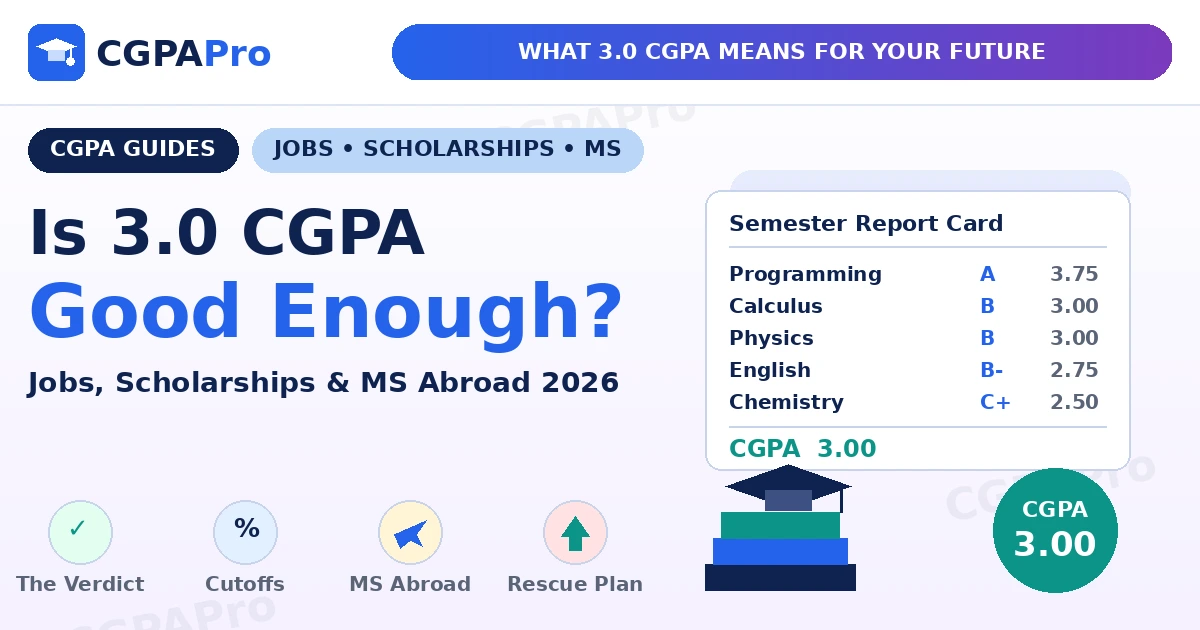
Now watch how those grades combine. Take five 3-credit courses — Programming A (3.75), Calculus B (3.00), Physics B (3.00), English B− (2.75), Chemistry C+ (2.50):
(3.75 + 3.00 + 3.00 + 2.75 + 2.50) / 5 = 15.00 / 5 = 3.00 exactly.
That is the canonical 3.0 profile: one A, a solid B core, one slip, one recovery grade. If your transcript looks like a mix of these, you understand your own CGPA better than most 3.0 students — and you can see why a single retaken C+ matters more than a semester of straight B’s.
For context, here is how 3.0 translates across the systems you’ll encounter — with one critical warning:
| System | 3.0 CGPA equivalent | Warning |
|---|---|---|
| Naive percentage (×25) | 75% | Rough only — never official |
| HEC Pakistan band minimum | 71% | This is the number to use on forms |
| 10-point scale (India) | ≈ 7.5/10 | Rule-of-thumb ×2.5, not certified |
| UK degree classification | On the 2:1 boundary | Chevening says 3.0+ = 2:1; some universities want 3.3 |
| German grade system | ≈ 2.0–2.5 (“gut”) | Via the modified Bavarian formula; convention-dependent |
The 71% figure surprises everyone. HEC maps a CGPA to the minimum percentage of its band, so a 3.00 officially equals 71%, not 75%. If a Pakistani government or bank form asks for your percentage, 71% is the defensible answer — as documented in our CGPA vs GPA vs SGPA guide, and with the method-by-method breakdown in our CGPA-to-percentage conversion guide.
Where Does 3.0 Stand? Per-Country Verdicts
The same number means very different things depending on where you are. Here is the honest verdict for the four countries most of our readers study in:
| Country | What 3.0 means | Verdict |
|---|---|---|
| Pakistan (HEC) | First Division (the 3.00–4.00 band); 71% band-minimum for forms | Solid. You hold the division most application forms ask for. |
| Bangladesh | 1st Class at public universities (3.00–4.00 = 1st Class; 2.25–2.99 = 2nd Class) | First Class at home — but UK universities often set the 2:1 line at 3.3, so it’s borderline abroad. |
| India | ≈ 7.5/10 on the 10-point scale (rough ×2.5 conversion) | Clears the big recruiters’ cutoffs; premium tracks out of reach. |
| Malaysia | Commonly the entry point of Second Class Upper (3.00–3.49) — but it varies by university | On the 2:1 line. Check your own university’s handbook. |
The Bangladesh paradox
This deserves a paragraph because it traps real students. In Bangladesh, a 3.0 CGPA earns a 1st Class degree at public universities — genuinely respectable. But when you apply to the UK, several universities’ country guidance sets the 2:1 bar for Bangladesh at 3.3 (Nottingham’s published country requirements are one example). So the same 3.0 that reads “First Class” on your degree certificate can read “below 2:1” on a UK admissions desk. It is not a contradiction — the two systems simply draw their lines in different places. Know which line each gatekeeper uses before you assume your classification travels.
The Malaysia asterisk
Malaysia has no single national standard, which makes 3.0 the most disputed number in the country. The common convention puts Second Class Upper at 3.00–3.49 — and several universities’ official regulations agree (UPTM’s published scale runs 3.00–3.66 for 2:1). But others draw the line higher: MMU’s handbook starts Second Class Upper at 3.33, which puts a 3.0 in Second Class Lower there. If you’re in Malaysia, your university’s handbook is the only verdict that counts.
Scholarships: The Real GPA Bars for a 3.0
Most “is 3.0 CGPA good” articles wave vaguely at scholarships. Here are the actual published bars — and what they mean when your number is exactly 3.0:
| Scholarship | Published academic bar | Does 3.0 clear it? |
|---|---|---|
| Chevening (UK) | UK 2:1 equivalent — “usually a strong First Class or a CGPA of 3.0+ out of 4.0”, plus 2 years’ work experience | Yes — exactly on the line |
| DAAD EPOS (Germany) | Above-average degree, commonly summarized as ≈ German grade 2.5 ≈ 3.0/4.0, plus 2 years’ relevant experience | Meets the floor; not competitive on grades alone |
| Fulbright (Pakistan, via USEFP) | No official minimum — holistic review; strong undergraduate record expected; GRE carries heavy weight | Eligible, but below the typical successful cohort — GRE must do the lifting |
| Commonwealth (HEC Pakistan) | First-division 16-year bachelor’s + HAT ≥ 60/100; CSC requires UK 2:1 standard | First Division ✓ (HEC: 3.0–4.0); the 2:1 claim is borderline |
| Erasmus+ (EU) | No fixed GPA — merit-based per consortium program | Can apply; competitiveness varies wildly by program |
Chevening: your best shot at 3.0
Chevening is unusually explicit: a CGPA of 3.0+ out of 4.0 counts as 2:1 equivalent (2027–28 eligibility summary). That makes a 3.0 genuinely eligible. But read the rest of the criteria: two years of work experience and selection on leadership potential. At 3.0 you are academically “fine” — the scholarship will be won or lost on your essays and track record, not on your transcript.
DAAD: the floor, not the prize
DAAD’s EPOS program expects above-average results — roughly a German 2.5, which maps to about 3.0 on a 4.0 scale — plus two years of relevant professional experience. A 3.0 meets the floor. It does not make you competitive against 3.5+ applicants from the same pool. If Germany is your target, your energy is better spent on the two years of development-relevant work experience and the motivation letter than on defending a 3.0.
Fulbright and Commonwealth: the honest picture
Fulbright has no official minimum, but its panels reward strong undergraduate records — and a 3.0 is not what they mean by strong. A 320+ GRE and distinctive research or community work can offset it; the transcript alone won’t. Commonwealth via HEC is friendlier on paper: 3.0 sits inside HEC’s First Division band and the HAT score (60+/100) is entirely within your control — but the Commonwealth Scholarship Commission’s own 2:1 requirement means your 3.0 gets scrutinized at the UK end.
The honest summary: 3.0 makes you eligible for most major scholarships and competitive for almost none on grades alone. The compensation levers are real and specific — GRE scores, two years of relevant work experience, a strong HAT score, compelling essays — and they matter more at 3.0 than at any higher CGPA.
Jobs: Where 3.0 Is the Filter Line
Here is the single most important sentence of this section: 3.0 is not above the typical fresher cutoff — it IS the cutoff. Employer surveys (NACE’s annual Job Outlook is the most cited) have repeatedly found that among employers who screen on GPA at all, 3.0 is the typical minimum. That means a 3.0 keeps your CV in the pile; it buys you no margin. A 2.99 can get auto-rejected by the same filter a 3.0 passes. Plan accordingly.
Bangladesh
Multinational companies, banks, and large local groups in Dhaka typically set fresher filters at 3.0–3.25 CGPA. At exactly 3.0, you clear the bottom of that range and miss the top of it. Government jobs (BCS and similar) run on division criteria — your 1st Class degree (3.00–4.00 = 1st Class at public universities) satisfies that comfortably. Practical advice: if you’re hovering at 2.9x in your final year, the jump to 3.0 is the highest-value 0.1 in your degree — it moves you across more filters than any other tenth of a point.
Pakistan
Corporate recruiters in Karachi and Lahore commonly use 3.0 as the minimum screen — at 3.0 you pass; below it you don’t. You’re inside HEC’s First Division bracket (3.0–4.0), which is the classification most government application forms expect. The recurring headache: forms that ask for percentage. Write 71% (the HEC band minimum), not 75% — and keep a copy of the equivalence for verification if asked.
India
On the rough ×2.5 conversion, 3.0/4.0 ≈ 7.5/10 — and the math is kind to you here:
- TCS (Ninja): minimum 60% / 6.0 CGPA — cleared
- Infosys: minimum 65% / 6.5 CGPA — cleared
- Wipro: minimum 60% — cleared
- Premium tracks (Infosys Power Programmer, TCS Digital): 7.0–7.5 cutoffs — you’re at the edge or just below
- Google / Microsoft / Amazon: 8.0+ cutoffs — out on grades; coding tests and interviews dominate anyway
And here is the transcript-vs-market reality nobody puts in a table: most private-sector employers never see your transcript. What they check is degree completion (yes/no), then skills, projects, and internships. CGPA functions as a tiebreaker between otherwise identical freshers and as a hard filter at campus placements — real, but narrow. The students who suffer at 3.0 aren’t the ones with 3.0 and a portfolio full of projects; they’re the ones with 3.0 and nothing else on the CV. If you’re sitting at 3.0 in your final year, an internship or a portfolio project will move your job prospects more than dragging the number to 3.15.
The pattern across all three countries: 3.0 clears the standard corporate screen and nothing above it. And the same decay curve applies as at any CGPA — after your first job, almost nobody asks. Experience and skills take over within two to three years.
MS Abroad With a 3.0 CGPA: Country by Country
A 3.0 is the number US graduate admissions were built around: it’s the floor nearly everyone states. What changes by country is how much room that floor leaves you.
United States: the 3.0 is literally the minimum
Most US programs state a 3.0 minimum GPA outright. Wayne State University’s MS in Engineering Technology, for example, requires a “Minimum 3.0 GPA (B average) in undergraduate or upper-division coursework” (admissions page) — and even admits 2.2–2.9 applicants conditionally. That’s the good news. The honest split: mid-tier and good state universities will take a 3.0 seriously. Top-20 programs admit at averages of 3.7–3.9+, so a 3.0 alone won’t carry you there — but a 3.0 with a 315–320+ GRE, research experience, and strong recommendations absolutely keeps you in the conversation at solid programs. Your strategy at 3.0: target the middle tier aggressively, and let the GRE do the compensating.
Two practical notes for 3.0 applicants to the US. First, get a WES (or similar) credential evaluation early — US admissions offices don’t read your UGC or HEC transcript directly; they read the converted GPA on the evaluation report, and a 3.0 that converts cleanly avoids nasty surprises. Second, non-thesis and professional master’s programs are your friend. Coursework-based programs at state universities admit far more 3.0-range students than funded thesis tracks, cost less, and still qualify for OPT work authorization. A 3.0 with a 315+ GRE, two strong recommendation letters from professors who actually know your work, and a statement of purpose that explains an upward grade trend will beat a 3.4 with a generic application at most mid-tier programs.
Canada: 3.0 (B average) is the common floor
Canadian research universities commonly list a 3.0 / B-average minimum for graduate admission (program pages at e.g. the University of Ottawa and University of Alberta state 3.0 minimums for engineering master’s programs). Coursework-based master’s programs are genuinely accessible at 3.0. Funded thesis-based programs are a different market — supervisors choosing between candidates will usually pick the 3.3+ applicant, so lead with research fit and professor outreach.
The Canadian system has one quirk that matters at 3.0: thesis-based programs admit the student, not just the application. A supervisor who wants you can often pull a 3.0 file through the committee; without a supervisor’s interest, the same file stalls. So your highest-ROI move in Canada is emailing professors with a short, specific research pitch — not polishing the same SOP for twelve programs. Coursework-based options (MEng, course-based MSc) skip this entirely and judge you on the number, where 3.0 clears the bar. And don’t forget the post-study angle: Canada’s Post-Graduation Work Permit (up to 3 years) applies regardless of whether you entered with a 3.0 or a 3.8.
United Kingdom: exactly on the 2:1 line
Chevening’s equivalence (3.0+ = 2:1) is your friend — but individual universities are not Chevening. As the Bangladesh section showed, some UK universities set the 2:1 bar for South Asian applicants at 3.3. Strategy: apply to programs that list a 2:2 minimum or state 2:1 as “typically 3.0”, and keep pre-master’s / graduate-diploma routes in mind as a bridge if your target university wants more.
If your target UK university sets the 2:1 bar above your 3.0, you have two honest routes. Route one: apply to programs listing a 2:2 minimum — plenty of solid UK master’s programs do, especially outside the most competitive London schools. Route two: a pre-master’s or graduate diploma — a 6-to-9-month bridge program that, completed well, guarantees progression into the master’s. It costs extra time and money, so weigh it against simply choosing a 2:2-entry program. For Bangladeshi applicants specifically: because some universities draw the 2:1 line at 3.3, email the admissions office with your transcript before paying the application fee and ask directly which classification they’d assign you. A two-line email can save a wasted application.
Germany: “gut” is good enough
A 3.0 converts to roughly a German 2.0–2.5 (“gut”) via the modified Bavarian formula — comfortably inside the zone most NC-free (non-selective) master’s programs accept. Many programs are fully English-taught; IELTS 6.0+ or a medium-of-instruction certificate is commonly accepted. Germany is arguably the most 3.0-friendly destination on this list: no tuition at public universities, and admissions that weigh your subject fit over your decimal points.
The German application plumbing deserves a paragraph because it confuses first-timers. Many universities require a VPD (preliminary documentation) from uni-assist, which converts your grades to the German scale for you — so you don’t need to argue your own conversion. Budget for the blocked account (Sperrkonto — verify the current required amount before you plan, as it changes) for the student visa, and search the DAAD’s database of international programs for English-taught options in your field; there are far more than students assume. At a 3.0 (≈ “gut”), NC-free programs are genuinely within reach — apply to several, since “no numerus clausus” means the grade bar is published and stable.
Australia: borderline — check each program
A 3.0 sits around the Credit average (65%) boundary, and many Australian coursework master’s list exactly that — a 65% weighted average or a GPA of 4.0–5.0 on the 7.0 scale — as their entry bar. That puts a 3.0 right at the threshold: some programs will take you, some will ask for more. This is the one country on the list where you should verify program by program rather than assume.
Two Australia-specific notes. First, admissions offices convert your 4.0-scale GPA to their 7.0 scale themselves — don’t do it for them on the application; submit your official transcript and let their published conversion tables handle it. Second, the Genuine Student (GS) requirement for the visa cares about your intent and finances, not your grades — a 3.0 doesn’t hurt your visa chances the way a weak financial statement does. Where grades do bite in Australia is scholarships: most merit scholarships want Distinction-level records (6.0+/7.0), so plan your funding around admission first, scholarship second.
The Final-Year Rescue Plan: What the Math Actually Allows
If you’re reading this while still studying, the useful question isn’t “is 3.0 good” — it’s “what can I still move, and by how much?” CGPA math is unforgiving late in a degree, and you should see the real numbers before you set targets.
Rescue scenario 1: “Can I reach 3.2?”
Say you’re at 2.9 after 90 credits, with 30 credits (one final year) remaining, and you want to graduate at 3.2. The required average over those 30 credits:
(3.2 × 120 − 2.9 × 90) / 30 = (384 − 261) / 30 = 4.10
4.10 is above the maximum 4.0. It is mathematically impossible. With straight As in every remaining course, your actual ceiling is (261 + 120) / 120 = 3.175. Nobody will tell you this on a forum — the target itself is the problem, not your effort. If you have 40 credits left instead of 30, the picture changes: you’d need a 3.875 average — near-straight As, brutal but real. The lesson: count your remaining credits before you pick a target number.
Rescue scenario 2: “Can I go from 3.0 to 3.5?”
Say you’re at 3.0 after 60 credits, with two 30-credit semesters (60 credits) left, targeting 3.5 at graduation:
(3.5 × 120 − 3.0 × 60) / 60 = (420 − 180) / 60 = 4.00
You would need a perfect 4.0 — straight As in everything — and even then the ceiling is exactly (180 + 240) / 120 = 3.50. Borderline possible only with a flawless two semesters. The honest read: if you’re past the halfway mark, 3.5 is a fantasy target; 3.2–3.3 is the realistic stretch. Set the achievable target and hit it, instead of missing the fantasy one.
The playbook that actually works
- Retake your worst high-credit courses first. Replacing a C (2.25) with an A (3.75) in a 3-credit course moves your CGPA more than a semester of straight B’s. Grade replacement is the highest-leverage move in the book — our retake guide walks through the math.
- Weight your effort by credit hours. An A in a 4-credit core course is worth twice an A in a 2-credit elective. Study accordingly.
- Front-load final semesters with courses you can ace. Electives aren’t cheating — they’re strategy.
- Protect your major GPA. Admissions committees and some employers look at grades in your major subjects separately. A 3.0 overall with a 3.4 in-major reads very differently from the reverse.
- If MS abroad is the goal, stop chasing the decimal. Past the halfway point, 50 hours spent on GRE prep or a research project buys more admission probability than 50 hours spent dragging a 3.0 to a 3.1.
Common Mistakes 3.0 Students Make
- Writing 75% on official forms. A 3.0 is not 75% in Pakistan — HEC’s band minimum makes it 71%. The ×25 shortcut is fine for conversation, dangerous on paperwork.
- Averaging semester GPAs. Your CGPA is credit-weighted, not a simple average. A 3.5 semester with 12 credits and a 2.5 semester with 18 credits is not a 3.0 — it’s 2.9.
- Assuming “First Class” travels. Your 1st Class degree from Bangladesh doesn’t automatically read as 2:1 in the UK. Check each university’s country guidance.
- Ignoring the major GPA. A 3.0 dragged down by first-year general courses, with strong major-subject grades, is a much better MS applicant than the number suggests. Say so in your SOP.
- Chasing 3.5 instead of compensating. The math above shows what late-stage chasing costs. At 3.0, GRE scores, work experience, and projects are cheaper points than CGPA points.
Frequently Asked Questions
Can I get a job with a 3.0 CGPA?
Yes — 3.0 is where most employers’ screening filters start, so you clear the standard cutoff in Bangladesh, Pakistan, and India. You won’t clear premium-track cutoffs (7.0–7.5/10 in India, 3.3–3.5+ filters at top firms), and you have no margin: a 2.99 can be auto-rejected where a 3.0 passes. After your first job, it stops mattering.
Is 3.0 CGPA enough for an MS in the USA?
It’s the stated minimum at most programs — Wayne State’s MS in Engineering Technology, for example, requires exactly a 3.0 (B average), and some programs admit 2.2–2.9 students conditionally. Mid-tier and state universities are realistic targets; top-20 programs (3.7–3.9+ averages) need a 315–320+ GRE and research experience to offset.
Is 3.0 CGPA a second class or first division?
It depends on the country. In Pakistan it’s First Division (HEC’s 3.00–4.00 band). In Bangladesh it’s 1st Class at public universities. In Malaysia it’s usually the entry point of Second Class Upper — but some universities start 2:1 at 3.33. For the UK, Chevening treats 3.0+ as 2:1 equivalent, though individual universities may want 3.3.
Is 3.0 CGPA good for scholarships?
You’re eligible for most major programs but competitive on grades for almost none. Chevening explicitly accepts 3.0+ as 2:1 equivalent; DAAD EPOS’s floor is roughly 3.0; Fulbright has no minimum but favors stronger records. At 3.0, scholarships are won on GRE scores, work experience, and essays — invest there.
Can I improve my CGPA from 3.0 to 3.5?
Only with near-perfect remaining semesters: at 3.0 after 60 credits with 60 credits left, you’d need a straight-4.0 average — every single A — to land exactly on 3.50. Realistic stretch targets past the halfway mark are 3.2–3.3, best achieved by retaking your worst high-credit courses.
Is 3.0 CGPA the same as 75%?
Only by the rough ×25 shortcut — which no official body uses. HEC Pakistan maps 3.00 to the band minimum of 71%. Use 71% on Pakistani forms; use your university’s own conversion anywhere else.
Should I put my 3.0 CGPA on my CV?
Yes — if the job ad mentions a 3.0 cutoff, stating it gets you past the screen. If no cutoff is mentioned, it’s optional: a 3.0 neither impresses nor harms on a CV, so include it when it’s required or when the rest of your CV is thin, and leave it off when your projects and experience speak louder. Never inflate it — background checks verify degrees.
Does CGPA matter after my first job?
Barely. Within two to three years of work experience, hiring shifts to what you’ve built and shipped. The exceptions are academia, some government tracks, and a second master’s application — all of which ask for transcripts. For everyone else, the 3.0 becomes a line on an old document within a few years.
The Bottom Line
A 3.0 CGPA is decent, and “decent” is a precise technical term here: it means you stand on the threshold of nearly everything — jobs, scholarships, MS programs — without standing safely inside any of them. That’s not a verdict on your ability; it’s a description of where the lines are drawn. Your job now is to stop sitting on the line: retake the courses that drag you down, let the GRE or two years of work experience do the compensating, and aim your applications at the doors calibrated for exactly your number. There are more of them than you think.