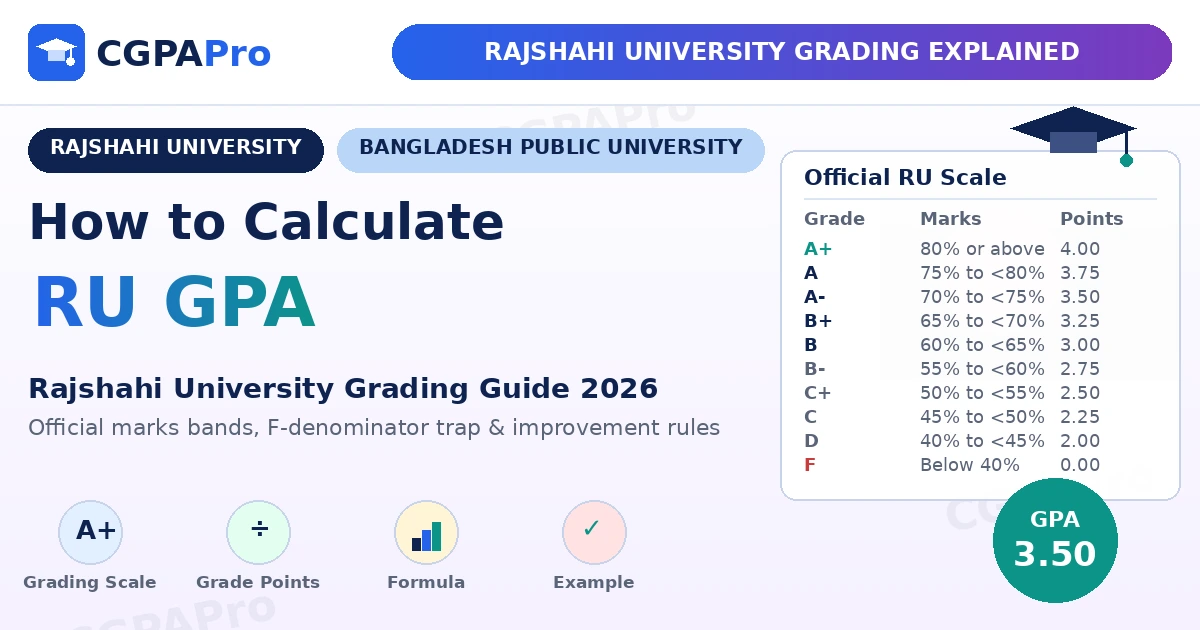
Rajshahi University uses the UGC Bangladesh grading scale: an A+ starts at 80% (4.00), an A at 75% (3.75), and anything below 40% is an F (0.00). Your semester GPA is the credit-weighted average of your grade points — the RU CGPA calculator on this site already has this exact scale pre-loaded. Below: the official marks bands, a fully worked example, and the improvement and dropout rules most RU students only learn the hard way.
How to use the RU CGPA calculator
The fastest way to get your number right is the dedicated Rajshahi University GPA/CGPA calculator. Its grade dropdowns already carry RU’s official grade points (A+ 4.00, A 3.75, A− 3.50, B+ 3.25, B 3.00, B− 2.75, C+ 2.50, C 2.25, D 2.00, F 0.00), so you cannot accidentally pick the wrong scale:
- Add a row for every course in your semester — the course name, its credit hours (from your syllabus: typically 3 or 4 for theory, 1 or 2 for labs and sessionals), and the letter grade you earned.
- Match grades by letter, not by memory. An A− is 3.50 at RU, not 3.70 or 3.67 like in some private-university calculators. Picking the letter in the RU calculator does this for you.
- Read the semester GPA it displays. To project your CGPA, add your previous semesters the same way and let the calculator accumulate the totals — or keep a running sheet (more on the formula below).
- Include failed courses. This matters more than most students think — see the F-grade trap section below. Leave the F rows in; the calculator handles the math the way RU’s own worked examples do.
One caution before you type anything in: the calculator computes whatever you feed it. The number is only as honest as the credit hours you enter — pull them from your department syllabus, not from memory, because a 4-credit course you enter as 3 will silently warp the result.
The official RU grading table (marks → grade → points)
Rajshahi University publishes its grading bands in its departmental ordinances — the Faculty of Business Studies BBA Ordinance 2022–2023, the MSc Physics curriculum, and the M.S.S. syllabus all carry the same table. It is the national UGC template used by Dhaka University and most public universities:
| Marks obtained | Letter grade | Grade point |
|---|---|---|
| 80% or above | A+ (A plus) | 4.00 |
| 75% to less than 80% | A (A regular) | 3.75 |
| 70% to less than 75% | A− (A minus) | 3.50 |
| 65% to less than 70% | B+ (B plus) | 3.25 |
| 60% to less than 65% | B (B regular) | 3.00 |
| 55% to less than 60% | B− (B minus) | 2.75 |
| 50% to less than 55% | C+ (C plus) | 2.50 |
| 45% to less than 50% | C (C regular) | 2.25 |
| 40% to less than 45% | D | 2.00 |
| Less than 40% | F (Fail) | 0.00 |
A couple of details students constantly get wrong. First, the bands are absolute — RU sets the letter from your total marks, not from your rank in the class, so there is no “only the top 10% get an A+” rule to worry about. Second, only the total marks of a course are rounded during tabulation; RU publishes results in letter grades and grade points only. Third, there is an I (Incomplete) grade for students who miss the final exam or cannot finish a course on time — it carries 0.00 and must be cleared under your department’s rules, so don’t treat it as a harmless blank.
The SGPA formula (and how to do it by hand)
Semester GPA at RU is a credit-weighted average. For each course, multiply its credit hours by the grade point of the letter you earned — those are your “quality points” — add them all up, and divide by the total credit hours of the semester:
SGPA = Σ (credit hours × grade point) ÷ Σ credit hours
The steps, concretely:
- List every course of the semester with its credit hours.
- Convert each letter grade to its grade point using the table above (e.g. A = 3.75, B+ = 3.25).
- Multiply: credit hours × grade point = quality points for that course.
- Add all quality points. Add all credit hours.
- Divide total quality points by total credit hours. RU reports the result rounded to two decimal places.
Worked example: a real 5-course semester
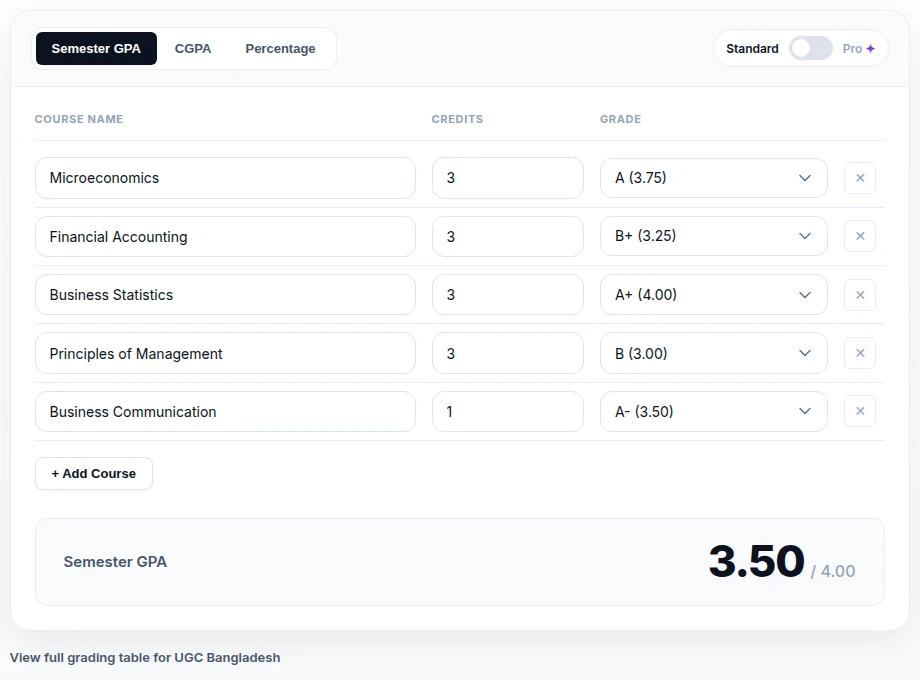
Take a first-year BBA-style semester — five courses, standard credit hours, ordinary grades. This is the exact example captured in the calculator screenshot above:
| Course | Credits | Grade | Grade point | Quality points |
|---|---|---|---|---|
| Microeconomics | 3 | A | 3.75 | 3 × 3.75 = 11.25 |
| Financial Accounting | 3 | B+ | 3.25 | 3 × 3.25 = 9.75 |
| Business Statistics | 3 | A+ | 4.00 | 3 × 4.00 = 12.00 |
| Principles of Management | 3 | B | 3.00 | 3 × 3.00 = 9.00 |
| Business Communication | 1 | A− | 3.50 | 1 × 3.50 = 3.50 |
Total credits: 3 + 3 + 3 + 3 + 1 = 13
Total quality points: 11.25 + 9.75 + 12.00 + 9.00 + 3.50 = 45.50
SGPA = 45.50 ÷ 13 = 3.50
Notice how the weights work: the 3-credit A+ (12.00 points) pulls far harder than the 1-credit A− (3.50). That’s the whole game — protecting your high-credit courses matters more than polishing a 1-credit sessional.
Read more: Dhaka University Grading System 2026 — DU runs the same UGC scale, with its own worked examples.
SGPA vs YGPA vs CGPA — RU’s three numbers
RU tracks performance at three levels, and the middle one trips people up:
- SGPA (Semester GPA) — the weighted average for one semester, computed exactly as above.
- YGPA (Yearly GPA) — the credit-weighted average of the two semesters in an academic year. RU’s own BBA example: semester one earns 54 points over 18 credits, semester two earns 45 points over 18 credits → YGPA = (54 + 45) ÷ (18 + 18) = 99 ÷ 36 = 2.75.
- CGPA (Cumulative GPA) — the same accumulation across every completed year of the degree. Your transcript shows the course grades plus the CGPA, and the final result is published as CGPA with the corresponding letter in brackets — e.g. “CGPA = 3.09 (B)”.
A common question: what’s the difference between GPA, CGPA and SGPA? At RU the answer is scope — one semester, one year, whole degree — all computed with the same weighted-average machinery.
The F-grade trap: a failed course still sits in the denominator
Here is the single most expensive misunderstanding in RU’s grading. Some students assume a failed course “doesn’t count” toward GPA — that is RUET’s rule (failed grades excluded), not RU’s. The BBA Ordinance’s own worked example proves it:
Second semester: seven courses, one of them an F (3 credits, 0 grade points). The ordinance’s tabulation line reads: Total Credit = 18, Total Earned Credit = 15, Total Grade Points = 45.00, and then:
SGPA = 45 ÷ 18 = 2.50
The failed course earns you zero credits (15 of 18 earned) — but its 3 credits stay in the divisor. Had those 3 credits been excluded, the SGPA would have been 45 ÷ 15 = 3.00. The F cost half a grade point of SGPA, not nothing.
Practical fallout: a single F in a 3-credit course drags a 3.50 semester down toward 2.80–2.90 territory. And because only grades are improvable (see next section) — never incourse or viva marks — the F keeps its full weight until you clear it properly. Note: this example comes from the BBA Ordinance; grading conventions can differ slightly between faculties, so confirm with your department’s syllabus if your result looks off.
Can you improve a bad grade? The rules (and the gates)
RU allows improvement, but it is gated — and the gates differ by program. What follows is verified from the ordinances themselves; check your department handbook before planning around any of it.
BBA program (Faculty of Business Studies):
- Improvement is allowed only in courses where the earned grade is below B− — i.e. C+ (2.50) or lower. A B (3.00) cannot be “upgraded”.
- Final-result improvement is limited to a maximum of two theoretical courses of the last (8th) semester, and only in the immediate next regular examination after your result.
- No improvement of incourse, home-assignment, oral-test, or viva-voce marks — ever.
- You must apply to the Examination Committee through your department chairman at least 2 weeks before the semester final exam.
- No improvement after 6 academic years from the start of your degree.
MSc programs (e.g. Physics): students with a GPA below 3.00 may improve courses totalling up to 12 credits, including F grades — but only once, within 3 academic years of first admission, and only courses whose grade point is below 3.00.
The takeaway: “I’ll just retake it” is not a plan at RU — it is a one-shot, course-capped, time-boxed procedure. If you’re banking on improvement, read how retaking a course affects your CGPA and then confirm the exact window with your examination committee.
Readmission, dropout, and the 6-year clock
The ordinances are blunt about failure, and knowing the ladder matters more than fearing it:
- Readmission: if you fail to earn promotion to the next year, you may seek readmission with the next batch — but the grades of the repeated year cease to exist and you redo all coursework and exams. Readmission is allowed only twice.
- Dropout: you are dropped from the program if you fail to earn the required yearly GPA after readmission, or if you fail to clear an F at the second improvement examination.
- The 6-year cap: the degree must be completed within six academic years of admission (BBA/B.Sc. Honours). After that, no improvement, no readmission — the clock simply stops.
This is why the F-denominator math above matters so much: an unaddressed F doesn’t just lower one semester’s number, it starts eating into a very finite number of recovery chances.
Attendance: the quiet grade-killer
RU ties attendance to exam eligibility, and in several programs to marks directly. From the MSc Physics curriculum (confirm your department’s version):
- 75% or above — eligible to sit the final examination.
- Below 75% — “Noncollegiate”: you may still sit, but only after paying a Tk 500 fine.
- Below 60% — “Discollegiate”: not allowed to sit the final examination at all.
In several ordinances attendance also carries its own marks inside the course total. Skipping class is therefore a double loss — fewer attendance marks and, below the thresholds, no exam at all.
What you actually need to graduate
Graduation at RU is not “CGPA above X, done”. The B.Sc. Honours rules (Department of Mathematics syllabus) require, within 6 academic years of admission:
- Minimum CGPA of 2.50 across the four parts.
- Minimum GPA of 2.00 in practical courses in EACH part (Part-1 through Part-4) — you can clear the CGPA bar and still be blocked by one bad practical year.
- Minimum total credit points (TCP) of 144, including 38 from the fourth year.
- An “S” grade in the English course.
Master’s programs differ (e.g. MSc Physics: GPA 2.50, practical/thesis GP 2.00, TCP 32, within 3 academic years). The principle is the same everywhere: check all the graduation gates in your department’s syllabus, not just the CGPA headline.
Read more: RUET Grading System 2026 — the engineering university’s scale and rules, so you never mix the two up again.
RU vs RUET — stop confusing them
University of Rajshahi (RU) and Rajshahi University of Engineering & Technology (RUET) are separate universities with separate ordinances. The letter scales look alike (both descend from the UGC template), which is exactly why students — and quite a few third-party calculator sites — mix them up. Two differences that actually bite:
- F-grade handling: RU’s worked example keeps failed credits in the GPA denominator; RUET excludes F grades from GPA calculation entirely.
- Rules and gates: improvement windows, promotion rules, and graduation thresholds come from different ordinances. A RUET rule quoted on a RU problem (or vice versa) is simply wrong.
If a page or calculator doesn’t say which of the two universities it covers, treat its claims about “Rajshahi” grading with suspicion.
5 mistakes RU students keep making
- Using a private-university scale. A− is 3.50 at RU, not 3.70; B+ is 3.25, not 3.30. Private-university calculators (NSU/BRACU style) will silently inflate or deflate your result. Use the RU calculator or the official points.
- Forgetting the F stays in the divisor. Covered above — the most expensive arithmetic error on this page.
- Assuming “below B−” means any low grade is improvable. At BBA level only C+ and below qualify, only 2 courses, only once. Check before you plan your semester around a retake.
- Ignoring practical-course and English requirements. CGPA 2.50 with a failed practical year or no English “S” is still no degree.
- Converting percentage to CGPA with the wrong formula. RU’s bands are not linear — 79% is an A (3.75) and 80% is an A+ (4.00), a 0.25 jump for one mark. For the general method see how to convert percentage to CGPA.
5 tips to protect (or repair) your RU CGPA
- Weight your effort by credits. A 4-credit theory course at B+ (13.00 points) outweighs a 1-credit lab at A+ (4.00). Study time should follow credit weight, not difficulty feelings.
- Guard the 80/75/70/65 boundaries. One extra mark that pushes you from 79% to 80% buys a full 0.25 grade points. Know your running totals before finals.
- Clear every F at the first opportunity. It dilutes your denominator every semester it sits there, and the second failed improvement attempt ends your enrollment.
- Keep attendance above 75%. The cheapest marks and eligibility insurance you’ll ever get.
- Track YGPA, not just SGPA. RU reports and uses yearly averages for merit positions, scholarships, and stipends — a strong second semester can rescue a weak first one within the same year.
Frequently asked questions
Is Rajshahi University (RU) the same as RUET for grading?
No. They are separate universities with separate ordinances. The grade scales look similar, but rules differ — for example, RU’s BBA worked example keeps failed-course credits in the GPA denominator, while RUET excludes F grades from GPA calculation. Always check which university a calculator or article covers.
What percentage do I need for an A+ at Rajshahi University?
80% or above, officially — that’s the UGC-scale band published in RU’s departmental ordinances (A+ 4.00, A 75–79% at 3.75, A− 70–74% at 3.50, down to F below 40%).
Does an F count in my GPA at RU?
Yes — and this is the trap. RU’s own BBA Ordinance example shows a semester with an F (3 credits, 0 points) computed as 45 ÷ 18 = 2.50: the failed credits stay in the divisor. You earn zero of those credits, but they dilute your GPA all the same.
Can I improve a C or D grade at RU?
In the BBA program, only grades below B− (C+ and lower) are improvable — a maximum of two theoretical courses of the final semester, once, at the immediate next regular exam. Other programs have different windows (e.g. MSc: below 3.00 GPA, up to 12 credits, once within 3 years). Incourse and viva marks can never be improved. Confirm with your department.
What happens if I fail the same course twice at RU?
Under the BBA Ordinance, failing to clear an F at the second improvement examination means you are dropped out of the program. Failing to earn promotion lets you seek readmission (max twice, prior-year grades wiped), but the degree must finish within 6 academic years.
What CGPA do I need to graduate from RU?
It depends on the program. B.Sc. Honours (per the Mathematics syllabus) requires CGPA 2.50 plus GPA 2.00 in practicals every part, TCP 144 (38 in fourth year), and an “S” in English — within 6 years. Always check your own department’s graduation gates, not just the CGPA headline.
Is there an official RU CGPA calculator?
RU doesn’t publish its own online calculator, but the RU CGPA calculator on this site uses RU’s official grade points (verified against the page’s own grade data), so the numbers match the university’s tables exactly.
The bottom line
Rajshahi University’s grading is straightforward once you see it whole: absolute marks bands from 80% down to 40%, credit-weighted SGPA/YGPA/CGPA, results rounded to two decimals. The parts that hurt students are never the formula — they’re the F that stays in the denominator, the improvement window that closes after one chance, and the graduation gates (practicals, TCP, English) hiding behind the CGPA headline. Run your own numbers through the RU calculator, keep your department’s syllabus within arm’s reach, and you’ll never be surprised by a result again.