
Ask five NED students what a B+ is worth and you’ll hear “3.3” more often than not. They’re wrong — and it’s not their fault. Nearly every GPA calculator app on a Pakistani student’s phone ships with the generic HEC grade table, where B+ is 3.3 and there is no A+ at all. NED University of Engineering & Technology doesn’t use that table. Its official regulations print B+ = 3.4, C+ = 2.4, C− = 1.7, D+ = 1.4, and yes — NED awards an A+ (4.0) for 94 marks and above. If you’ve ever compared your transcript against an online calculator and found the numbers don’t match, this is why.
Quick answers: NED grades on an absolute, marks-based scale — your letter comes from fixed percentage bands, never from a class curve. The formula is GPA = Σ (credit hours × grade points) ÷ Σ (credit hours), computed per semester; CGPA is the same calculation stretched across every semester. You need a CGPA of at least 2.0 plus all courses passed to graduate, and falling below 2.0 puts you on probation. When you repeat a course, only the better grade counts. The sections below give you the full verified table, the arithmetic worked by hand, and the rules students actually get tripped up by.
Try the NED GPA calculator
The fastest way to feel the maths is to run a semester through a calculator: type each course, its credit hours, and the grade you expect, and the credit-weighted average does the rest. Here is a real 5-course example on CGPAPro’s general calculator — notice how the two 4-credit A grades do most of the heavy lifting:
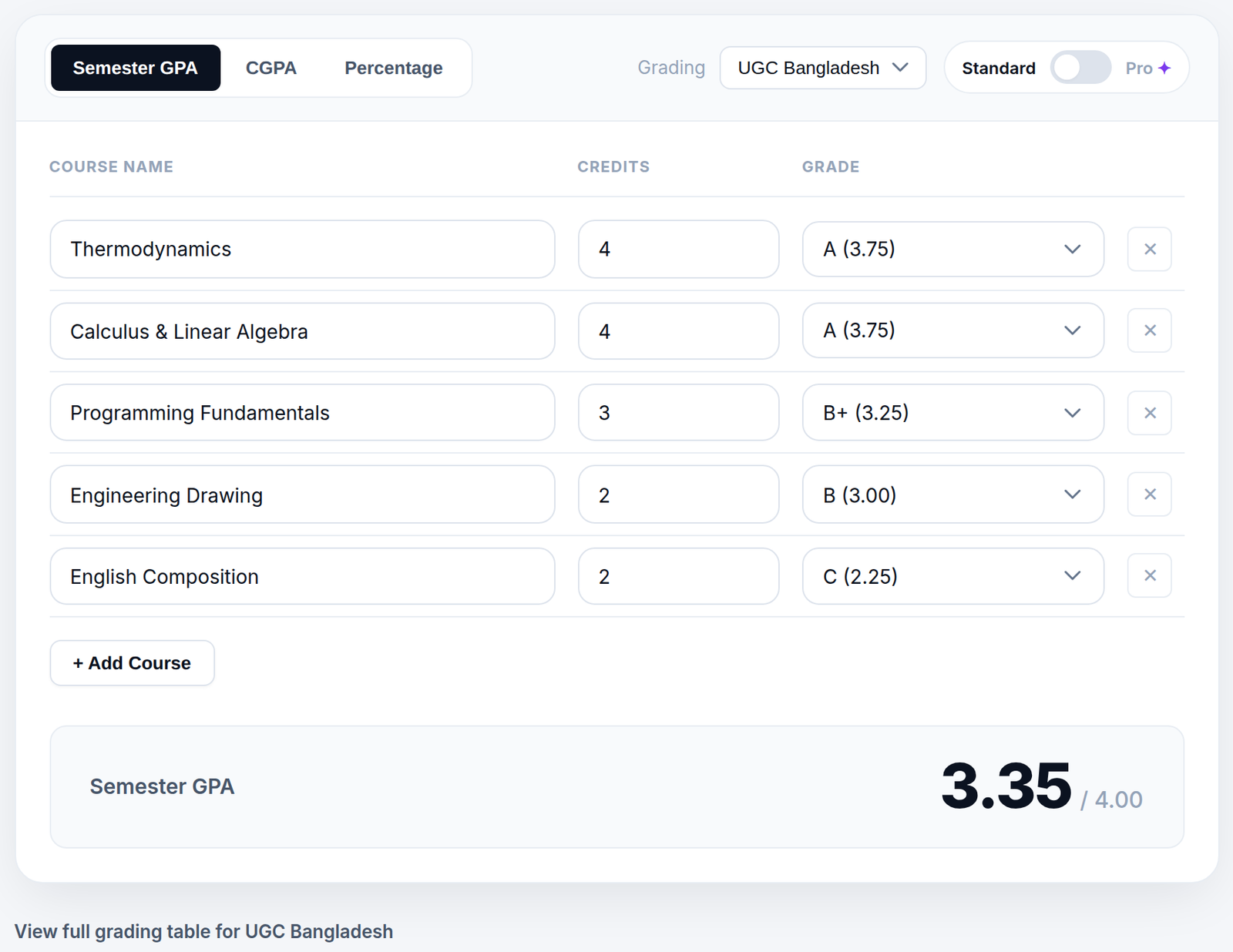
The five courses from the screenshot, worked by hand on the calculator’s scale:
| Course | Credits | Grade | Points | Credits × points |
|---|---|---|---|---|
| Thermodynamics | 4 | A | 3.75 | 15.00 |
| Calculus & Linear Algebra | 4 | A | 3.75 | 15.00 |
| Programming Fundamentals | 3 | B+ | 3.25 | 9.75 |
| Engineering Drawing | 2 | B | 3.00 | 6.00 |
| English Composition | 2 | C | 2.25 | 4.50 |
Total grade points = 15.00 + 15.00 + 9.75 + 6.00 + 4.50 = 50.25. Total credits = 4 + 4 + 3 + 2 + 2 = 15.
Semester GPA = 50.25 ÷ 15 = 3.35 — exactly what the calculator shows.
Now run your own numbers — but read the next section first, because if you feed NED letter grades into a generic calculator, the answer it gives you will be slightly wrong. The table below is the one that actually governs your transcript.
The official NED grade table (verified)
This table comes from NED University’s own published examination regulations (Chapter 7 of the university prospectus, section 7.4 “Grade Points”). It applies to theory, practical, design and Final Year Project courses alike:
| Grade | Grade point | % marks | Remarks |
|---|---|---|---|
| A+ | 4.0 | 94–100 | Extra Ordinary |
| A | 4.0 | 85–93 | Excellent |
| A− | 3.7 | 80–84 | Very Good |
| B+ | 3.4 | 75–79 | — |
| B | 3.0 | 70–74 | Good |
| B− | 2.7 | 67–69 | Above Average |
| C+ | 2.4 | 64–66 | Average |
| C | 2.0 | 60–63 | Satisfactory |
| C− | 1.7 | 57–59 | Adequate |
| D+ | 1.4 | 54–56 | Pass |
| D | 1.0 | 50–53 | |
| F | 0.0 | Below 50 | Fail |
The special grades:
| Grade | Grade point | Meaning |
|---|---|---|
| P | — | Pass in a non-credit course (50–100 marks) |
| IP | — | In Progress — used for the Final Year Project / design courses, evaluated in the Fall semester |
| X | — | Exempted (migration / transfer cases) |
| I | — | Incomplete |
| W | — | Withdrawal |
| WU | — | Withdrawal Unofficially |
Three things about this table surprise almost everyone. First, A+ and A are both worth 4.0 — the A+ is pure distinction; it changes nothing in the arithmetic, only the look of your transcript. Second, the passing floor is 50% (D, 1.0) — below 50 is an outright F, and that F stays in your GPA/CGPA at 0 points until you repeat the course. Third, the in-between values are NED’s own: if your calculator says your B+ earned 3.3, it used somebody else’s table.
A note on currency: the table above is from the university’s published examination regulations. Grade bands at the top (A+/A = 4.0) and the 50% passing floor are confirmed against the current Semester System regulations; if your department’s program handbook shows any revision to the middle bands, the handbook wins for your batch — always check it before disputing a grade.
NED’s table vs the generic HEC table (why your app disagrees with your transcript)
Most online calculators default to the standard HEC 4.0 table. Put the two side by side and the discrepancies jump out:
| Grade | NED (official) | Generic HEC table | Difference |
|---|---|---|---|
| A+ | 4.0 (94–100) | doesn’t exist | NED-only distinction grade |
| A | 4.0 (85–93) | 4.0 | same value, different band |
| A− | 3.7 | 3.7 | same |
| B+ | 3.4 | 3.3 | NED is 0.1 higher |
| B | 3.0 | 3.0 | same |
| B− | 2.7 | 2.7 | same |
| C+ | 2.4 | 2.3 | NED is 0.1 higher |
| C | 2.0 | 2.0 | same |
| C− | 1.7 | 1.7 | same value |
| D+ | 1.4 | 1.3 | NED is 0.1 higher |
| D | 1.0 (50–53) | 1.0 | same |
The differences look tiny — a tenth of a point here and there — but across a 130+ credit-hour degree they compound. A student with five B+ grades earns 0.5 grade points more at NED than the generic table says. That is the entire explanation for the “my app says 3.28 but my transcript says 3.31” mystery that fills NED student groups every result season.
Absolute grading: your marks decide, not your batch
NED uses absolute (marks-based) grading. Your percentage maps to a letter through the fixed bands in the table above — nobody’s grade is adjusted because the class found the paper easy or hard. An 82 is an A− (3.7) whether you’re the topper or the class average.
Two practical consequences. First, you can predict your grade from your marks before results: add up your sessional and final marks, find the band, done. Second, borderline marks matter enormously — the jump from 79 to 80 is worth 0.3 grade points (B+ 3.4 → A− 3.7), while the jump from 85 to 94 is worth nothing at all (A 4.0 → A+ 4.0). If you’re negotiating a recheck or deciding where to spend revision time, the 79/80, 74/75 and 69/70 borders are where the money is.
One more structural fact from the regulations: every course — theory, practical, design studio, Final Year Project — is marked on a 60% final examination + 40% sessional evaluation split. Your sessionals are not a bonus; at 40% weight, a weak sessional score can drag you across a whole grade band before the final even happens.
Step-by-step: calculating your NED GPA
The university’s regulations print the formula as the sum of (credit hours × grade point) over all courses, divided by the total credit hours:
GPA = Σ (credit hours × grade points) ÷ Σ (credit hours)
The steps:
- List every course of the semester with its credit hours.
- Convert each letter grade to grade points using NED’s table above — not your calculator app’s default table.
- Multiply each course’s credit hours by its grade points.
- Add all the products, add all the credit hours, and divide.
Failed courses count as 0 × their credit hours — the credits stay in the denominator, which is what makes an F so expensive (worked out below). Grades of WU, I, W and X are not counted at all: neither their points nor their credits enter the calculation. A P (non-credit pass) likewise carries no grade point.
Worked example: GPA 3.40 on NED’s official scale
A second-semester NED student takes five courses. This time we use NED’s real values — A = 4.0, A− = 3.7, B+ = 3.4, B = 3.0, C = 2.0:
| Course | Credits | Grade | Points | Credits × points |
|---|---|---|---|---|
| Thermodynamics | 4 | A | 4.0 | 16.0 |
| Calculus & Linear Algebra | 4 | A− | 3.7 | 14.8 |
| Programming Fundamentals | 3 | B+ | 3.4 | 10.2 |
| Engineering Drawing | 2 | B | 3.0 | 6.0 |
| English Composition | 2 | C | 2.0 | 4.0 |
Total grade points = 16.0 + 14.8 + 10.2 + 6.0 + 4.0 = 51.0. Total credits = 4 + 4 + 3 + 2 + 2 = 15.
GPA = 51.0 ÷ 15 = 3.40.
Now compare: the identical five grades on a generic HEC-table calculator would read A = 4.0, A− = 3.7, B+ = 3.3, B = 3.0, C = 2.0 → 16.0 + 14.8 + 9.9 + 6.0 + 4.0 = 50.7 → 3.38. Two hundredths of a point lost to the wrong table — on one semester alone. Over eight semesters, students routinely find gaps of 0.03–0.05 between the app and the transcript, and every time, the transcript is right.
Notice the leverage in the table: the two 4-credit A/A− courses contribute 30.8 of the 51.0 points — over 60% of the total from two courses. At NED, core theory courses carry 3–4 credits while labs carry 1–2, so your heavy theory courses decide your GPA. An A− in a 4-credit course is worth twice an A− in a 2-credit lab.
GPA vs CGPA at NED
GPA is one semester. CGPA (Cumulative GPA) is every completed semester combined, still credit-weighted — it is NOT a simple average of your semester GPAs:
CGPA = Σ (semester credits × semester GPA) ÷ Σ (semester credits)
Take the student above. In semester 1 they scored GPA 3.20 over 18 credits (3.20 × 18 = 57.60). In semester 2 they scored 3.40 over 15 credits (3.40 × 15 = 51.00).
CGPA = (57.60 + 51.00) ÷ (18 + 15) = 108.60 ÷ 33 = 3.29.
The heavier semester 1 pulls harder than the lighter semester 2 — a plain average of the two GPAs would have given 3.30. The practical lesson: early, credit-heavy semesters set your CGPA trajectory. A first year of 20-credit semesters at 3.0 takes real effort to climb out of, because every later semester is diluted by the credits already banked.
What one failed course costs your GPA: the F-grade math
Students treat a failed course as a scheduling problem — “I’ll clear it next semester.” It’s also a maths problem, and the maths is harsh, because the failed course’s credits stay in the denominator at zero points. Watch a 20-credit semester with one 4-credit F, graded on NED’s scale:
| Course | Credits | Grade | Credits × points |
|---|---|---|---|
| Calculus & Linear Algebra | 4 | B+ (3.4) | 13.6 |
| Applied Physics | 4 | B (3.0) | 12.0 |
| Programming Fundamentals | 4 | A− (3.7) | 14.8 |
| Engineering Drawing | 2 | C+ (2.4) | 4.8 |
| English Composition | 2 | C (2.0) | 4.0 |
| Thermodynamics | 4 | F (0.0) | 0.0 |
Total = 49.2 points over 20 credits → GPA = 2.46. Now remove the failed course’s drag (as if it never existed): 49.2 ÷ 16 = 3.08. That single F in a 4-credit course costs 0.62 GPA points — the difference between a comfortable 3+ semester and one flirting with probation.
The good news is the repeat rule, which is unusually generous at NED — and it’s the next section.
Repeating a course at NED: only the better grade counts
Under NED’s Semester System regulations, you may repeat a course for two reasons: to clear a fail, or to improve your CGPA. Either way, only the better of the two grades enters your GPA/CGPA. The weaker attempt is effectively overwritten in the arithmetic.
This has a consequence students often miss: repeating a passed course is risk-free on paper. If you repeat a C and somehow perform worse, the C still stands — the repeat can’t drag you down. The real costs are time, the repeat fee, and a semester slot, not grade risk.
How much can a repeat actually move your CGPA? Say you’ve banked 60 credits at a CGPA of 3.00 (180.0 grade points) and you repeat a 3-credit C (2.0), earning an A− (3.7) the second time:
New points = 180.0 − (3 × 2.0) + (3 × 3.7) = 180.0 − 6.0 + 11.1 = 185.1.
New CGPA = 185.1 ÷ 60 = 3.09.
One successful repeat: +0.09 CGPA. The maths also shows where repeats pay best — high-credit courses with the biggest grade-point gap. Repeating a 4-credit D (1.0 → 3.7) moves the needle far more than repeating a 2-credit B. Before you sign up, compute the expected gain exactly like this; if the bump is 0.02, your semester might be better spent protecting your current courses. Our guide to how retaking a course affects your CGPA walks through more of these scenarios.
Probation, attendance and the 2.0 line
The number 2.0 runs NED’s academic standing. A CGPA below 2.00 puts you on probation. A first-year student who falls below 2.00 in the Fall semester stays on probation through the Spring semester — and a student who is still below 2.00 when the probation window ends cannot register for the next semester until the CGPA is back at or above 2.00. Probation isn’t a warning letter; it’s a registration gate.
The same 2.0 is the graduation floor: to be awarded the degree you must pass every prescribed course with a CGPA of at least 2.0. Note the “every course” part — a 3.5 CGPA with one uncleared F is not a degree.
Two more gates students discover the hard way:
- 75% attendance in a course is required to sit its final examination. Shortfalls are condoned only on documented grounds — “the teacher knows me” is not a documented ground.
- Final Year Project registration is allowed only after you’ve completed at least 80% of your courses up to the third year (up to the fourth year for Architecture). Backlogs don’t just hurt your GPA; they can delay your FYDP and your graduation timeline.
Migration, transfers and exempted courses
If you joined NED on migration from another institution, equivalent courses you’ve already passed are marked Exempted (X) — and exempted courses are not counted toward your GPA/CGPA at all; the programme’s total credit hours are reduced accordingly. Your NED CGPA is computed only on courses you actually take at NED. Students admitted through Change of Discipline keep the grades of equivalent courses already passed, carried forward under the new discipline’s course codes. If you studied a course abroad under an approved mobility programme, it can only be exempted with at least 75% content equivalency and a grade of B or above.
Common mistakes NED students make
- Trusting a generic calculator’s numbers. If the app’s table has B+ = 3.3 and no A+, every GPA it reports for you is wrong. Use NED’s table (above) for anything that matters.
- Chasing A+ instead of guarding A− borders. A+ (94–100) pays exactly the same 4.0 as A (85–93). The 79→80 jump (B+ 3.4 → A− 3.7) is worth 0.3 points; the 93→94 jump is worth zero. Spend revision hours on borders, not on perfection.
- Ignoring sessionals. At 40% weight, sessionals can move you a full grade band before the final. A student averaging 70% in sessionals needs roughly 82% in the final just to land an A−.
- Assuming a repeated course averages with the old grade. It doesn’t — the better grade replaces the weaker one entirely. But the reverse mistake is also common: assuming the old F disappears from the transcript. It stays printed; it just stops counting.
- Treating WU like W. An official Withdrawal (W) doesn’t count toward GPA/CGPA. An unofficial one (WU) is also excluded from the calculation — but it signals an uncompleted course on your record and can complicate degree audits. Withdraw properly or not at all.
- Forgetting that credits are the weights. A C in a 4-credit core course hurts more than a C in a 2-credit lab — yet students distribute effort evenly. Weight your study time by credit hours.
Tips for protecting (and lifting) your NED CGPA
- Compute your “border courses” before finals. For each course, work out the final-exam score needed to cross the next grade band. A course sitting at 78 overall needs far less final-exam heroics to hit A− than one sitting at 71 needs to hit B+ — allocate accordingly.
- Front-load effort in credit-heavy semesters. First-year semesters at NED are typically the heaviest; a strong start compounds across all eight semesters, while a weak one takes years to dilute.
- Repeat surgically, not emotionally. Rank candidate repeats by (credit hours × expected grade-point gain) ÷ fee and effort. A 4-credit D→B+ repeat (+1.3 × 4 = 5.2 points) beats two 2-credit C→B repeats.
- Guard the 2.0 line like a wall. If your CGPA is drifting toward 2.1, treat it as an emergency — one bad semester can put you on probation and freeze your registration.
- Convert to percentage correctly for jobs and MS applications. The HEC formula is (CGPA ÷ 4.00) × 100 — so 3.40 ≈ 85%. But note that foreign evaluators like WES work from your actual percentage marks, not the 4.0 number; keep your marks sheets safe. See our CGPA-to-percentage conversion guide for the full breakdown.
Frequently asked questions
Does NED University have an A+ grade, and is it worth more than an A?
Yes, NED awards A+ for 94–100% marks — one of the few Pakistani engineering universities to do so. But both A+ and A carry 4.0 grade points, so the A+ adds nothing to your GPA. Its value is on the transcript: it marks you as extraordinary in that course, which can matter for gold-medal considerations and faculty impressions, just not for the arithmetic.
If I repeat a course at NED, which grade counts toward my CGPA?
Only the better grade. NED’s regulations are explicit: whether you repeat to clear a fail or to improve your CGPA, the higher of the two attempts is the one used in the GPA/CGPA calculation. The weaker attempt remains printed on the transcript but stops counting.
What CGPA do I need to graduate from NED University?
A CGPA of at least 2.0, plus passing every course prescribed for your discipline. A 3.8 CGPA with one uncleared F is not a degree — the failed course must be repeated and passed first.
When is a NED student placed on probation?
When the CGPA falls below 2.00. A first-year student below 2.00 in the Fall semester remains on probation through Spring, and a student still below 2.00 after the probation period cannot register for the next semester until the CGPA recovers to 2.00. Probation is a registration block, not just a warning.
Does NED use relative or absolute grading?
Absolute. Letter grades map to fixed percentage bands (the table above) regardless of how the rest of the class performs. There is no curve at NED — an 82 is an A− whether ten students or a hundred score above you. For contrast, several Indian institutes grade relatively; the mechanics differ completely, as our BUET grading guide and UET Lahore grading guide show for their own absolute scales.
How do I convert my NED CGPA to percentage for jobs or MS abroad?
Use the HEC formula: Percentage = (CGPA ÷ 4.00) × 100. A 3.40 CGPA ≈ 85%. Pakistani employers and HEC attestation accept this universally. But if you’re applying abroad, know that evaluators like WES reconstruct your record from actual percentage marks, not the 4.0 figure — and other universities’ 3.40s aren’t equal to yours, because their grade bands differ. Compare NUST’s grading system and FAST-NU’s grading system to see how much the tables vary across Pakistan.
The bottom line
NED’s grading system rewards students who read the actual table. The differences from the generic HEC scale are small per grade — a tenth of a point on B+, C+ and D+, plus a real A+ — but they compound across 130+ credit hours into the gap between what your phone app says and what your transcript says. Learn the bands, weight your effort by credit hours, guard the 2.0 line, and repeat surgically: those four habits are worth more than any calculator.
Run your own semester through the calculator at the top of this guide — then double-check the letter values against NED’s official table before you believe the number.
Sources: NED University Prospectus, Chapter 7 (Examinations), sections 7.2–7.7 — grade-point table, GPA/CGPA formula, 60/40 marks split, attendance, probation and degree-award rules; Regulations for the Semester System (Notification-4155) via GPAWise’s NED reference for repeat, WU/I and migration rules; official university site: neduet.edu.pk; Higher Education Commission Pakistan for the percentage-conversion formula. Grade bands reflect the university’s published regulations — confirm against your current program handbook for your batch.