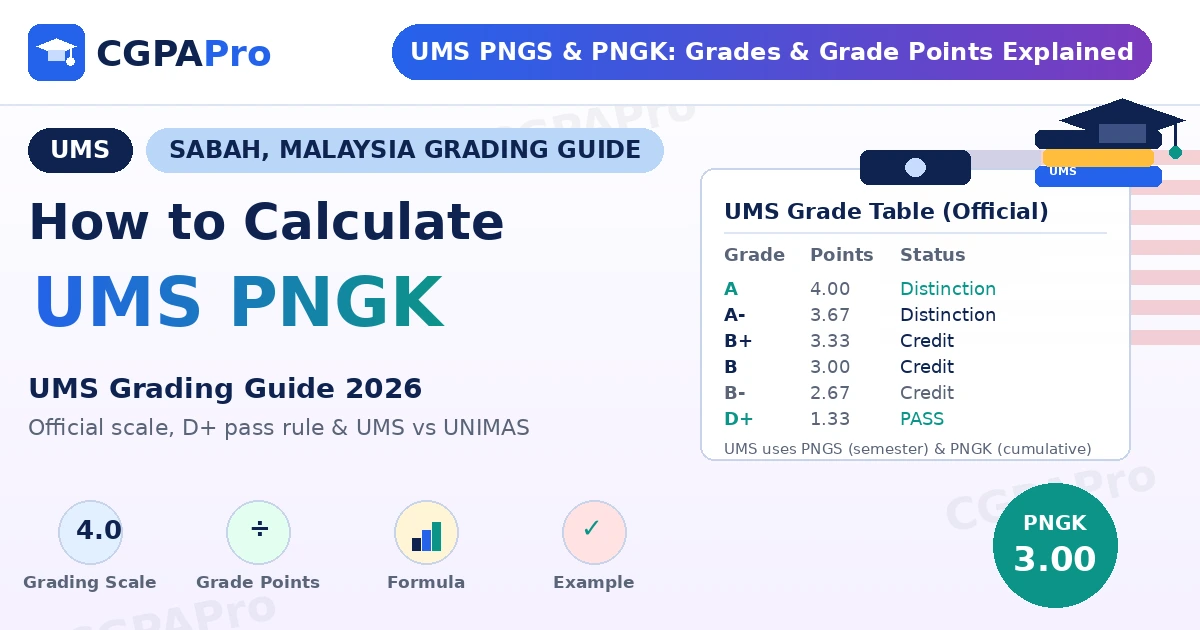
If you study at Universiti Malaysia Sabah, your result slip doesn’t say “GPA” and “CGPA” the way most articles claim. It says PNGS and PNGK — and getting those two mixed up is only the start. UMS also hands out a grade most Malaysian universities don’t use (D+), counts it as a pass, and gets confused with a completely different university (UNIMAS) so often that students swap their grading rules in forums every semester.
This guide is built on UMS’s own documents — the Kaedah Pengajian Prasiswazah UMS 2014 (Pindaan 2019/2021) and an official UMS exam result slip — so every value below is verified, not copied from a generic “Malaysia 4.0 scale” table. You’ll find the official grade table, the exact PNGS and PNGK formulas, a fully worked two-semester example (every number hand-checked), and honest answers where UMS’s published rules run out.
Quick answer: how UMS grading works
- Grade scale: A (4.00), A− (3.67), B+ (3.33), B (3.00), B− (2.67), C+ (2.33), C (2.00), C− (1.67), D+ (1.33), D (1.00), F (0.00).
- PNGS (Purata Nilai Gred Semester) = your semester GPA. PNGK (Purata Nilai Gred Kumulatif) = your cumulative CGPA.
- D+ is a pass at UMS. Your slip literally prints “PASS” next to it.
- Graduation line: PNGK 2.00 or above (“Lulus dan Teruskan Pengajian”). Medicine students need 3.00.
- First Class: PNGK 3.67 and above.
- UMS ≠ UNIMAS. UMS is in Kota Kinabalu, Sabah; UNIMAS is in Sarawak — and their grading rules differ.
Step 1: use the CGPAPro calculator
The fastest way to check your own numbers is the CGPAPro calculator: add each course, set its credit hours, pick the grade, and read off your semester GPA instantly. Below is a screenshot of it filled with this article’s worked example — five first-semester UMS courses (Semester 1, 12 credit hours total). The calculator reads 2.50.
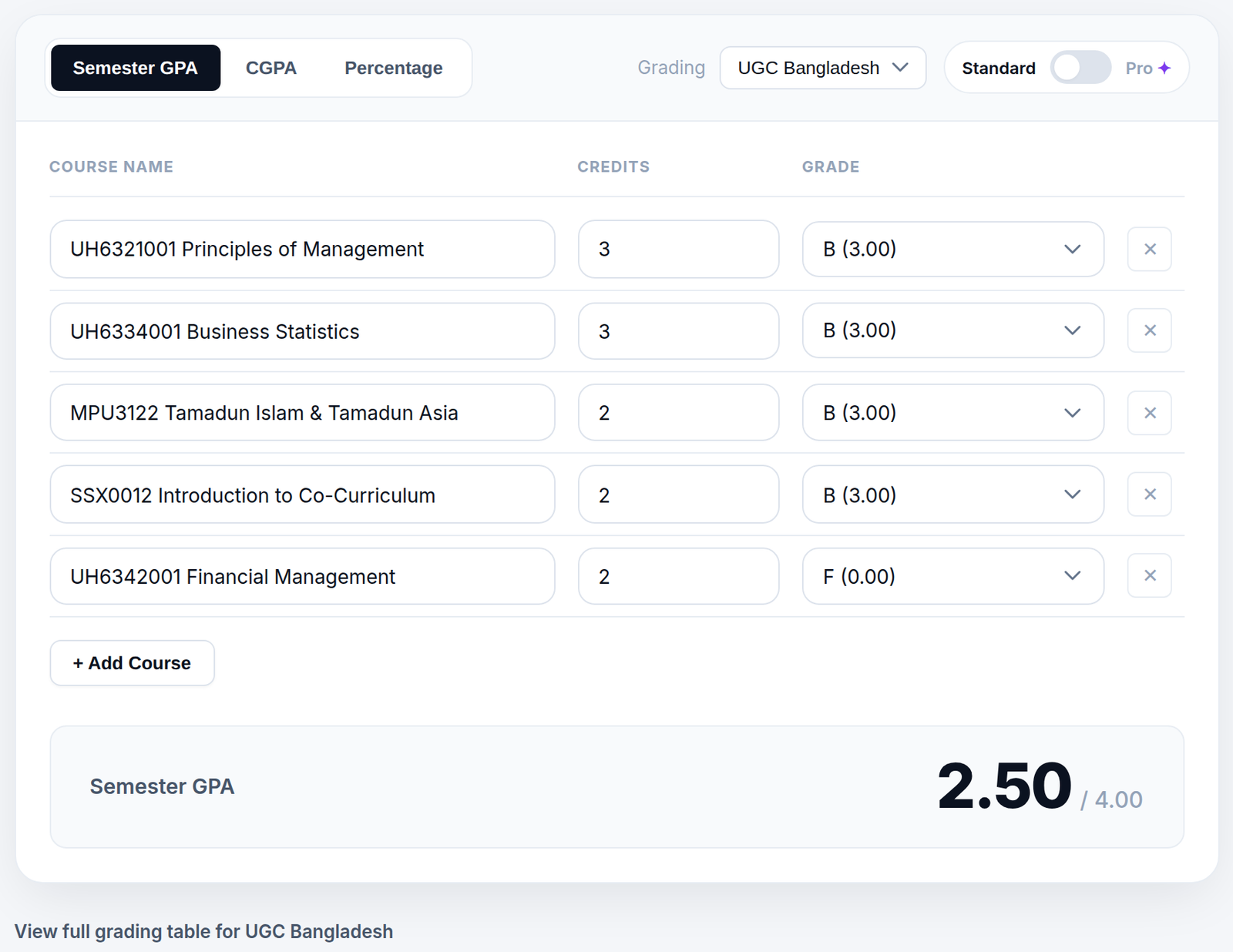
Now let’s see where that 2.50 comes from, and why the official UMS table matters more than the dropdown’s labels.
The official UMS grade table
This table is the heart of the guide. The grades and grade points are verified against UMS’s own academic regulations and an official UMS result slip; the status column (“what UMS prints next to the grade”) comes straight from that slip.
| Grade | Nilai Mata (grade point) | UMS status | Typical marks band* |
|---|---|---|---|
| A | 4.00 | Pass with a Distinction | 80–100 |
| A− | 3.67 | Pass with a Distinction | 75–79 |
| B+ | 3.33 | Pass with a Credit | 70–74 |
| B | 3.00 | Pass with a Credit | 65–69 |
| B− | 2.67 | Pass with a Credit | 60–64 |
| C+ | 2.33 | Pass | 55–59 |
| C | 2.00 | Pass | 50–54 |
| C− | 1.67 | Pass | 45–49 |
| D+ | 1.33 | Pass | 40–44 |
| D | 1.00 | Not confirmed in UMS’s published rules — check your faculty handbook | 35–39 |
| F | 0.00 | Fail | 0–34 |
*The marks bands are the standard Malaysian public-university bands. UMS has not published official undergraduate mark ranges per grade, so treat the band column as a guide and confirm with your faculty if a boundary matters (e.g. you’re sitting on 74 and hoping for an A−).
Three things about this table surprise most students:
- D+ exists and it is a pass. On an official UMS result slip, a D+ appears with the status “PASS” and earns you 1.33 grade points. Popular third-party UMS calculators online omit D+ entirely — they’re wrong. (Compare: at UKM, D+ is a fail.)
- There is no verified A+ for UMS undergraduates. Some student-built calculators assert “A+ ≥ 90”, but UMS’s undergraduate regulations and result slips show no A+. Don’t count on it.
- C− is not a distinction or credit — but it is a pass on the standard scale UMS follows. It still drags your PNGS down, though, which brings us to the formulas.
PNGS and PNGK: the exact formulas
UMS defines both in Bahagian 10.2 of its undergraduate academic regulations. In plain English:
PNGS (Purata Nilai Gred Semester) = total grade value earned in the semester ÷ total credit hours registered that semester.
PNGK (Purata Nilai Gred Kumulatif) = total grade value earned across all semesters ÷ total credit hours accumulated.
“Grade value” for one course = its credit hours × its grade point. Add those up, divide by total credit hours, and round to two decimals.
Two things UMS excludes from both calculations:
- Credit-transfer courses. Transfer credits count toward your graduation total, but their grades are not counted in PNGS or PNGK. At most 30% of your programme’s credits can come from transfer.
- Audited or non-graded courses carry no grade points, so they can’t move your average.
Worked example: two semesters, every number checked
Meet Aina, a first-year UMS business student. Here is her Semester 1, course by course:
| Course | Credits | Grade | Grade point | Grade value |
|---|---|---|---|---|
| UH6321001 Principles of Management | 3 | B | 3.00 | 3 × 3.00 = 9.00 |
| UH6334001 Business Statistics | 3 | B | 3.00 | 3 × 3.00 = 9.00 |
| MPU3122 Tamadun Islam & Tamadun Asia | 2 | B | 3.00 | 2 × 3.00 = 6.00 |
| SSX0012 Introduction to Co-Curriculum | 2 | B | 3.00 | 2 × 3.00 = 6.00 |
| UH6342001 Financial Management | 2 | F | 0.00 | 2 × 0.00 = 0.00 |
| Total | 12 | 30.00 |
PNGS (Semester 1) = 30.00 ÷ 12 = 2.50. That single F (0.00 on a 2-credit course) pulled four Bs down to 2.50 — which is exactly what the calculator screenshot above shows.
Semester 2 goes much better:
| Course | Credits | Grade | Grade point | Grade value |
|---|---|---|---|---|
| UH6325001 Human Resource Management | 3 | A | 4.00 | 3 × 4.00 = 12.00 |
| UH6327001 Marketing Principles | 3 | A− | 3.67 | 3 × 3.67 = 11.01 |
| UH6335001 Operations Management | 3 | B+ | 3.33 | 3 × 3.33 = 9.99 |
| MPU3123 Integriti dan Anti Rasuah | 3 | B | 3.00 | 3 × 3.00 = 9.00 |
| Total | 12 | 42.00 |
PNGS (Semester 2) = 42.00 ÷ 12 = 3.50.
Now the cumulative:
PNGK = (30.00 + 42.00) ÷ (12 + 12) = 72.00 ÷ 24 = 3.00.
Notice what this teaches you: one bad semester doesn’t define your degree. Aina’s 2.50 first semester plus a 3.50 second semester gives a PNGK of exactly 3.00 — a clean recovery, computed on every course, not just an average of the two semester GPAs. (Averaging 2.50 and 3.50 happens to give 3.00 here only because both semesters carry equal credits; with unequal credit loads, that shortcut is wrong.)
PNGS vs PNGK: why the distinction matters
PNGS measures one semester. It decides your semester status and whether you land on probation. PNGK measures your whole degree so far. It decides whether you graduate, your degree class, and what employers and foreign universities look at.
The mix-up is understandable — PNGK is just the Malaysian name for CGPA, and UMS’s own result slips print “GPA” and “CGPA” in English while the regulations say PNGS and PNGK. If a lecturer says “PNG” they almost certainly mean PNGS; the official acronym has the S.
Academic standing: the 2.00 line and what happens below it
UMS classifies your standing every semester:
- L — Lulus dan Teruskan Pengajian (Pass and continue): PNGK 2.00 or above.
- P — Tempoh Percubaan (Probation period).
- LB — Lulus Bersyarat (Conditional pass).
- GB — Gagal dan Berhenti (Fail and dismissed).
The hard rule: PNGK below 2.00 puts you in trouble, and falling below 2.00 three times can end your enrolment. Medicine students face a stricter bar — PNGK 3.00 every semester plus the Professional Exams. The exact credit limits during probation aren’t spelled out in the published regulations, so confirm them with your faculty’s academic office rather than guessing.
For how probation thresholds work across Malaysian universities generally, see our Dean’s List & probation guide.
Degree classification: what PNGK 3.67 gets you
The one band verified for UMS: Kelas Pertama (First Class) at PNGK 3.67 and above — confirmed both by PTPTN’s first-class exemption list (which groups UMS under “CGPA 3.67 dan ke atas”) and by Sabah press coverage of UMS First Class graduates at 3.73–3.85. As a data point, UMS engineering’s Board of Engineers award requires PNGK 3.60+ in the final year.
The bands below First Class (Second Upper, Second Lower, Third) follow the standard Malaysian pattern at most public universities, but UMS hasn’t published them in the documents we could verify — another “check your faculty handbook” item. The general Malaysian classification picture is covered in our Malaysia degree classification guide.
UMS vs UNIMAS: stop mixing them up
This is the confusion that costs students real marks — literally, because the two universities’ grade tables differ:
| UMS (Sabah) | UNIMAS (Sarawak) | |
|---|---|---|
| Location | Kota Kinabalu, Sabah | Kota Samarahan, Sarawak |
| Semester GPA term | PNGS | PNG (per UNIMAS usage) |
| Has D+? | Yes — D+ (1.33) is a PASS | No D+ at all |
| C− (1.67) | Pass | Pass (Lulus) — distinctive UNIMAS rule |
| D (1.00) | Status not confirmed in published rules | Fail (Gagal) |
| A+ | Not verified for undergraduates | Does not exist |
The practical takeaway: if someone tells you “D+ is a fail” or “C− is a pass at UNIMAS”, they’re talking about the other university. Use the wrong table and you’ll miscalculate your own PNGS. Our full UNIMAS grading guide covers the Sarawak side in the same detail.
Repeating a course: the honest answer
Here is where most articles bluff. UMS’s published undergraduate regulations do not spell out the repeat mechanics — which grades you’re allowed to repeat, whether the latest or best grade counts, maximum attempts, or fees. We checked; it isn’t in the public documents.
For context (not UMS rules): neighboring universities differ wildly — some count only the latest attempt, others the best; some let you repeat a C, others only failed courses. The general mechanics are explained in how retaking a course affects your CGPA. For UMS specifically, ask the BPA (Bahagian Pengurusan Akademik) or your faculty’s academic office before you register a repeat — the answer affects your PNGK directly.
Common mistakes UMS students make
- Using a third-party grade table that omits D+. The most-shared UMS calculator online leaves D+ out. If you got a D+, that table undercounts your points. Use the official table above.
- Reading the wrong university’s rules. UNIMAS’s C−-pass and no-D+ system doesn’t apply in Sabah.
- Averaging semester GPAs instead of weighting by credits. PNGK = total grade value ÷ total credits. Averaging 2.50 and 3.50 only worked in our example because both semesters had 12 credits.
- Counting transfer credits in the PNGK. They count toward graduation, not toward the average.
- Assuming a borderline mark rounds up. UMS hasn’t published official mark bands — if you’re on 69.5 hoping for a B+, ask your lecturer how the faculty rounds before you celebrate.
- Ignoring the F’s weight. One F on a 2-credit course cost Aina 0.75 of PNGS in Semester 1. Failed courses stay in the calculation until properly repeated and replaced per faculty rules.
Tips to lift your PNGK at UMS
- Front-load easy wins early. MPU and co-curriculum courses (like Aina’s MPU3122 and SSX0012) are real credits with real points — a B there is worth exactly as much as a B in a core course.
- Protect the 2.00 line first, chase 3.67 second. Below 2.00 three times risks dismissal; at 3.67+ you’re in First Class territory. Know which battle you’re fighting.
- Do the maths before add/drop week ends. Plug your projected grades into the calculator and see what each course is worth to your PNGS.
- A D+ is a pass — but barely. It keeps you enrolled, yet 1.33 drags any average down. If your faculty allows repeats of passed courses, a D+ is the first candidate.
- Keep every result slip. UMS’s English labels (“PASS WITH A CREDIT”) are your evidence if a transcript query ever arises.
UMS abroad: WES and postgraduate applications
Planning an MS abroad or a WES evaluation? The good news: UMS already uses a 4.00 scale, so conversion is near-direct — WES’s course-by-course reports map each of your courses onto the Canadian 4.0 scale and compute an overall GPA, which for UMS graduates tracks your PNGK closely. There is no published UMS-specific WES mapping, so don’t pay anyone who claims to have one. The full process is in our WES CGPA conversion guide.
Read more: WES CGPA Conversion: US & Canada Guide 2026 · Malaysia Degree Classification: 2nd Class Upper & CGPA Bands
Frequently asked questions
Is D+ a pass or fail at UMS?
Pass. UMS’s official result slips print “PASS” next to D+ (1.33 grade points). This is the single most-misreported UMS fact online — many third-party tables either omit D+ or wrongly mark it a fail.
What is the difference between PNGS and PNGK?
PNGS (Purata Nilai Gred Semester) is your semester GPA — one semester’s grade value divided by that semester’s credit hours. PNGK (Purata Nilai Gred Kumulatif) is your cumulative average across all semesters. UMS’s own result slips print “GPA” and “CGPA” in English, which is why the acronyms get mixed up.
Are UMS and UNIMAS the same university?
No. UMS is Universiti Malaysia Sabah (Kota Kinabalu, Sabah); UNIMAS is Universiti Malaysia Sarawak (Kota Samarahan, Sarawak). Their grading rules differ: UMS has a passing D+, UNIMAS has no D+ at all but counts C− as a pass.
What PNGK do I need for First Class at UMS?
3.67 and above — verified via PTPTN’s first-class list and Sabah press reports of UMS graduates. Bands below First Class aren’t published in UMS’s verifiable documents, so confirm Second Upper/Lower thresholds with your faculty.
Can I repeat a course I passed with D+?
UMS’s published undergraduate regulations don’t say — this is genuinely unanswered in public documents. Ask BPA or your faculty’s academic office before registering a repeat, because whether the latest or best grade counts changes your PNGK.
Do transferred credits affect my PNGK?
No. Transfer credits count toward the credits you need to graduate, but their grades are excluded from PNGS and PNGK calculations (maximum 30% of programme credits can be transferred).
How do I convert my UMS PNGK for WES or MS applications abroad?
Near-directly: UMS already uses a 4.00 scale, and WES maps each course onto the Canadian 4.0 scale, so your evaluated GPA tracks your PNGK closely. No UMS-specific conversion table exists — treat any paid “UMS-to-WES chart” with suspicion.
Conclusion
UMS grading is straightforward once you use UMS’s own vocabulary: grades A through F on a 4.00 scale with the unusual but verified passing D+, PNGS for the semester, PNGK for the degree, a 2.00 line you must stay above, and 3.67 for First Class. The traps are all around the edges — wrong third-party tables, the UNIMAS mix-up, and repeat rules that aren’t published. Bookmark this page, run your own numbers through the CGPAPro calculator, and when a rule isn’t in your faculty handbook, ask BPA directly. Your PNGK is too important to calculate from a forum post.
Sources: Kaedah Pengajian Prasiswazah UMS 2014 (Pindaan 2019/2021), Bahagian 10.2 & 11 — via BPA UMS (official) and the indexed regulations copy; official UMS SMP exam result slip (Session 1-2018/2019); PTPTN first-class exemption list; UNIMAS Peraturan Akademik Ijazah Sarjana Muda 2017 (for the comparison table).