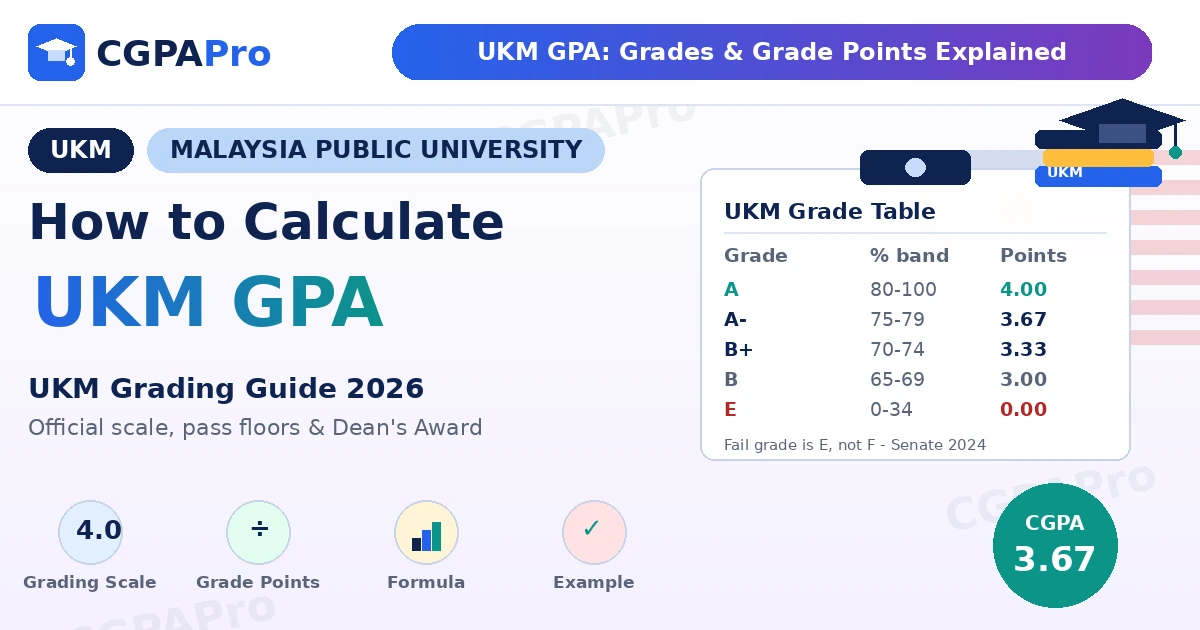
Universiti Kebangsaan Malaysia (UKM) runs on a 4.00 CGPA scale — but it is the odd one out among Malaysia’s public universities in two ways that trip up nearly every new student. First, UKM’s fail grade is E, not F. Second, UKM does not award “First Class” honours at all. And if you use one of the generic “Malaysia CGPA calculators” floating around online, there’s a good chance it’s feeding you the wrong grade points: UKM’s official scale is A− = 3.67, B+ = 3.33, B− = 2.67 — not the rounded 3.70 / 3.30 / 2.70 those sites use. This guide gives you the verified official table with marks bands, shows exactly how UKM computes your PNG and PNGK, and answers the questions students actually argue about — the three different pass floors, the 3.67-vs-3.75 “first class” confusion, the 3.67 Dean’s Award, and what happens when you repeat a course.
Quick answers: graduation needs a PNGK (CGPA) of 2.00 plus 120 credits; the Dean’s Award needs a semester GPA of 3.67 over at least 12 credits; and a failed course must be repeated — but only the latest grade counts toward your PNGK.
Try the UKM CGPA calculator
The fastest way to check your standing is to run your actual courses through a calculator. Add each course with its credit hours and the grade you expect, and it does the weighted maths for you.
The official UKM grade table (verified)
This is Table 3 from UKM’s Regulations (Undergraduate Studies) 2024 — the university’s own published marking scale, approved by UKM’s Senate. Read it once and notice what’s missing: there is no A+, and there is no F.
| Grade | Marks | Grade point |
|---|---|---|
| A | 80–100 | 4.00 |
| A− | 75–79 | 3.67 |
| B+ | 70–74 | 3.33 |
| B | 65–69 | 3.00 |
| B− | 60–64 | 2.67 |
| C+ | 55–59 | 2.33 |
| C | 50–54 | 2.00 |
| C− | 45–49 | 1.67 |
| D+ | 40–44 | 1.33 |
| D | 35–39 | 1.00 |
| E | 0–34 | 0.00 |
Two things to lock in. First, E (0.00) is the fail grade, covering the whole 0–34 band — UKM’s exchange offices have to warn incoming international students about this explicitly, because everyone expects F. Second, there is no A+: A (4.00) is the ceiling, so you can’t offset a B+ with an “extra” grade the way students at some private universities can. Consistency across courses matters more at UKM than spike performances.
Three pass floors in one university
Here’s the part no generic calculator page tells you: whether a grade counts as a pass at UKM depends on your faculty. The same official table assigns different pass/fail statuses to three faculty groups:
| Your faculty group | Pass floor | What it means |
|---|---|---|
| Medicine, Dentistry, Pharmacy (FPER, FFAR, FGG) | B− (60–64) | C−, D+, D and E are all fails — a C− must be repeated |
| Law, Education, Health Sciences, Economics & Management (FUU, FPEND, FSK, FEP) | D+ (40–44) | D and E are fails; C− and D+ pass |
| Engineering, Science & Technology, IT, Islamic Studies, Social Sciences (FKAB, FST, FTSM, FPI, FSSK) | D (35–39) | Only E is a fail |
This is the single biggest source of confusion on campus. A 47% (C−) is a pass for an engineering student and a fail for a medical student — in the same university, under the same regulations. If anyone tells you “the passing mark at UKM is 40” or “the passing mark is 50”, they’re both wrong and both right: it depends which faculty group you’re in. When in doubt, your programme handbook wins over any website, including this one.
PNG and PNGK: UKM’s two numbers
Like most Malaysian public universities, UKM uses Malay names on its official documents: PNG (Purata Nilai Gred — your semester average, i.e. GPA) and PNGK (Purata Nilai Gred Kumulatif — your cumulative average, i.e. CGPA). Same maths, Malay names. “Jaga PNG” means watch your semester GPA; your PNGK is the number on your transcript.
The formula
PNG (one semester) = Σ (grade point × credit hours) ÷ Σ (credit hours that semester)
PNGK (cumulative) = Σ (grade point × credit hours, all semesters) ÷ Σ (all credit hours)
Credit hours are the weight. A 4-credit course moves your PNG twice as much as a 2-credit course with the same grade.
Worked example: a 5-course semester → 3.33
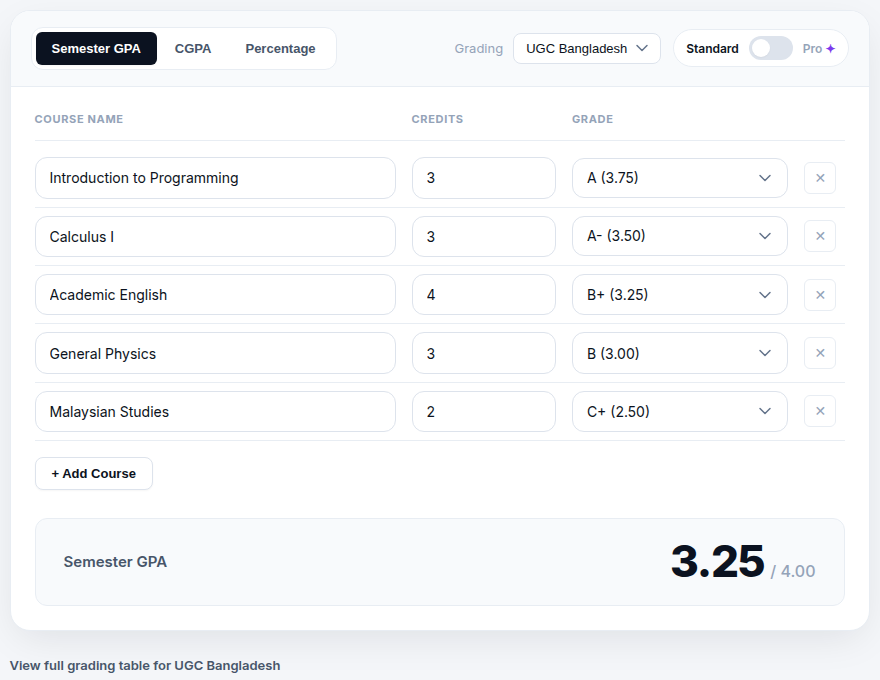
The same five courses from the calculator screenshot above, worked by hand on UKM’s official scale — check every number:
| Course | Units | Grade | Point | Units × Point |
|---|---|---|---|---|
| Introduction to Programming | 3 | A | 4.00 | 12.00 |
| Calculus I | 3 | A− | 3.67 | 11.01 |
| Academic English | 4 | B+ | 3.33 | 13.32 |
| General Physics | 3 | B | 3.00 | 9.00 |
| Malaysian Studies | 2 | C+ | 2.33 | 4.66 |
| Total | 15 | 49.99 |
PNG = 49.99 ÷ 15 = 3.33. Your PNGK is the same calculation stretched across every semester — never the average of your semester PNGs (that trap is covered below).
Fun fact: even UKM’s own regulations include a worked example — and it contains an E. Semester 1: A, B+, A−, E and D across 13 units gives 35.00 points ÷ 13 = 2.69; across two semesters the example lands at 77.98 ÷ 27 = 2.88. The lesson UKM is quietly teaching you: one failed course dents your PNGK, it doesn’t end your degree — as long as you repeat it.
Your UKM calculator may be lying to you
Here’s the uncomfortable bit: plenty of websites offering a “UKM CGPA calculator” use the wrong grade points. The most common wrong scale you’ll see is the rounded one — A− = 3.70, B+ = 3.30, B− = 2.70, C+ = 2.30. UKM’s official scale is 3.67 / 3.33 / 2.67 / 2.33. You saw the damage in the worked example above: identical letters read 3.25 on a generic calculator and 3.33 on UKM’s official table. That’s a 0.08 gap from nothing but the wrong table — enough to wrongly tell a student they’ve missed the Dean’s Award line (more on that below) when they haven’t, or vice versa.
The rule is simple: if a calculator doesn’t let you verify its grade table against UKM’s published scale, don’t trust its number. Use the official points — or a calculator that does.
UKM doesn’t award “First Class” — the 3.67 vs 3.75 myth, settled
Ask around any Malaysian campus and you’ll hear two numbers for “first class”: 3.67 and 3.75. At UKM, the argument is moot for a reason nobody mentions: UKM doesn’t use the words “First Class” at all. The regulations confer exactly two degree classes:
- 3.67–4.00 = Bachelor’s Degree with Honors (Excellent) — Kepujian (Cemerlang)
- 2.00–3.66 = Bachelor’s Degree with Honors — Kepujian
So the correct answer to “is first class at UKM 3.67 or 3.75?” is: neither — UKM’s top class is Kepujian (Cemerlang) and it starts at 3.67. The 3.75 figure comes from other universities’ standards (and from scholarship bodies like PTPTN quoting their own lines). If a sponsor sets its own 3.75 line for an exemption, their rule wins for their money — but on your UKM scroll, 3.67 is the top band. For the full Malaysian classification picture, see our 2nd Class Upper in Malaysia guide.
Recovery math: “my PNGK is 3.40 after year 1 — can I still finish with Cemerlang?”
Yes, with work. Say year 1 was 30 units at 3.40 (102.00 points). A 4-year degree is roughly 120 units, so 90 remain. Cemerlang needs PNGK ≥ 3.67, i.e. 440.40 total points. You need 440.40 − 102.00 = 338.40 from 90 units = 3.76 average across the rest — roughly A− average with plenty of As. Tough, but that’s what the number actually demands. The general formula:
Required future average = (target PNGK × total units − earned points) ÷ remaining units
Dean’s Award: 3.67, not 3.50
Every other public university’s students will tell you the Dean’s List needs 3.50. At UKM it’s the Dean’s Award (Anugerah Dekan), and the bar is higher — verified in the regulations:
- Semester GPA (PNG) of at least 3.67 — not CGPA, the semester’s PNG
- Across a minimum of 12 credits in that semester (credits that don’t count toward GPA are excluded)
- No disciplinary action on record, all university debts settled
- You must not be in an extended study period
Miss one semester and you simply don’t get it that semester — it doesn’t cancel previous awards. Our Dean’s List & probation guide compares UKM’s 3.67 against every other Malaysian university’s threshold — and UKM is the strictest of the lot.
Retakes and repeats — the latest grade counts
Failed courses must be repeated; C− or below may be repeated
UKM’s rule is blunt and clearly written: if you fail a course, you must repeat it (or take the programme’s approved equivalent). If you score C− or below — even though it’s a pass in most faculties — you may repeat it to improve the grade. Many students don’t know that second part exists.
Only the latest grade counts — and that’s a double-edged sword
When you repeat, only the most recent grade goes into your PNGK; the previous grade is excluded. Both attempts stay on your transcript, but the maths uses the new one. Students coming from other universities often assume the best grade counts — at UKM it doesn’t. That cuts both ways: repeat a C− and score a B, and the C− vanishes from your average; repeat a B− and score a C+, and the C+ is what counts even though it’s worse. Never repeat a borderline grade you can’t confidently beat.
The failed grade still hurts until you repeat
One nuance students miss: the failed grade counts in your PNGK until the repeat is done. The regulations are explicit that failing grades are included in the semester’s GPA/CGPA — the exclusion only kicks in for the repeated attempt. So an E in semester 2 drags your PNGK down in semester 2; repeating it in semester 3 and passing is what cleans the slate.
Special Repeat Examination: the final-semester lifeline
If you’re in your final semester and short of credits, UKM offers a Special Repeat Examination — one course, sat once, with grades A–E awarded that count toward your CGPA. The catch: you must apply in writing to your Dean/Director within 4 weeks of the official results. Miss the window and the option is gone. This is the rule to tell any final-year friend who’s panicking — most students have never heard of it.
The ATP / ALB / PGB ladder — and graduation
UKM checks your PNGK every semester (from your second semester onward) and sorts you into one of three statuses:
- ATP — Pass (Lulus): PNGK of 2.00 or above. You’re fine and eligible for degree conferment.
- ALB — Conditional Pass (Lulus Bersyarat): PNGK 1.00 to below 2.00. You get a warning and stay eligible — but you cannot sit in ALB for two consecutive semesters (your first semester doesn’t count).
- PGB — Fail and Terminated (Gagal dan Diberhentikan): PNGK below 1.00 (first semester excluded). Your studies end.
To graduate you need a PNGK of at least 2.00 across all courses plus at least 120 credits (or your programme’s requirement). If your PNGK is hovering near 2.00 in your final year, the regulations explicitly let you accumulate additional credits or re-register passed courses to lift it — a legal, built-in recovery path most students never use.
Postgraduates: stricter than you think
UKM’s postgraduate scale looks similar but bites harder — verified in the university’s Regulations (Graduate Studies) 2021:
- A (4.00) and A− (3.67) = pass with distinction; B+ (3.33) and B (3.00) = pass with merit; B− (2.67), C+ (2.33), C (2.00) = pass
- C− (1.67), D (1.00) and E (0.00) = fail — a C− that passes for most undergraduates fails a master’s student
- Standing: CGPA ≥ 3.00 to pass; 2.00–2.99 is conditional pass/probation (you must climb back to 3.00 the next semester); below 2.00 means dismissal
- Repeats: courses graded B− or below may be repeated to improve, and again only the latest grade counts
If you’re heading to UKM for a master’s, recalibrate: the undergraduate instincts (C is comfortable, C− is fine) will get you failed and dismissed.
Grades that never touch your PNGK
Not every letter on your result slip moves your average. These carry no grade points and are excluded from PNG/PNGK maths: L/K (pass/fail courses), TL (incomplete — finish at least 70% of the coursework, then complete the rest within two weeks of the next semester), SM (in-progress project), U (audit — and note: fail an audit and it’s recorded as “K”), TD (withdrew in weeks 5–8), and TP (postponed exam). Credit transfers are split: vertical transfers don’t count toward your PNGK, but horizontal transfers do — a detail that surprises transfer students every intake.
UKM vs other Malaysian public universities
The grade points are nearly identical across Malaysia’s public universities, but the packaging differs in ways that matter:
| Feature | UKM | UM / UTM / UPM / USM |
|---|---|---|
| Fail grade | E (0–34) | F (most) |
| A+ grade | No | No (most) |
| Pass floor | Varies by faculty (B− / D+ / D) | Usually uniform per university |
| “First Class” | Not awarded — Kepujian (Cemerlang) at 3.67 | 3.67 admin band (USM), varies |
| Dean’s award line | 3.67 (Anugerah Dekan) | 3.50 (most) |
| Repeat rule | Latest grade counts; may repeat passed C− courses | Varies (USM: latest too) |
Comparing results with friends at other universities? Read their guides too: UM, USM, UiTM, and UPM.
Common mistakes UKM students make
- Using a generic calculator’s scale. The 3.25-vs-3.33 gap in this article’s own example. Always use UKM’s official points.
- Averaging semester PNGs for PNGK. Unless every semester had identical credit hours, this is wrong — recompute from total points ÷ total units.
- Assuming “best grade counts” after a repeat. UKM uses the latest grade. Repeat only what you can beat.
- Assuming your faculty’s pass floor is universal. A C− is a pass in Engineering and a fail in Medicine. Know your group.
- Chasing 3.50 for the Dean’s Award. It’s 3.67 at UKM, over at least 12 credits — 3.50 gets you nothing here.
- Ignoring the 4-week special-repeat window in your final semester.
Tips for keeping your PNGK healthy at UKM
- Weight your effort by credit hours. A 4-credit B+ (13.32 points) outweighs a 2-credit A (8.00). Protect heavy courses first.
- Know your A− band: 75–79. At UKM, 76% is an A− (3.67) — a full 0.34 above a B+ (3.33) for a few marks’ difference. Borderline 73–74% papers are the highest-ROI appeals and rechecks you’ll ever file.
- Repeat strategically, not emotionally. A 3-credit C− (5.01 points) lifted to a B (9.00) is worth nearly 4 PNGK points on 15 units — but only if you’re confident.
- Watch the ALB trap. One conditional-pass semester is a warning; a second consecutive one ends your studies. If your PNGK slips below 2.00, treat the next semester as the most important of your degree.
- Use the additional-credit rule. Near 2.00 in your final year? Extra courses you can ace are a legitimate, regulation-backed way to lift your PNGK over the graduation line.
UKM grading FAQ
Is the fail grade at UKM E or F?
E. UKM’s scale has no F — E (0.00) covers the entire 0–34 marks band. If your result slip shows E, that’s a fail and the course must be repeated.
Is first class at UKM 3.67 or 3.75?
Neither, strictly speaking — UKM doesn’t award “First Class”. Its top degree class is Bachelor’s Degree with Honors (Excellent), Kepujian (Cemerlang), at 3.67–4.00. The 3.75 figure comes from other universities’ and sponsors’ standards.
What is the passing mark at UKM?
It depends on your faculty: B− (60%) for Medicine, Dentistry and Pharmacy; D+ (40%) for Law, Education, Health Sciences and Economics & Management; D (35%) for Engineering, Science & Technology, IT, Islamic Studies and Social Sciences. Confirm against your programme handbook.
Can I repeat a C− at UKM?
Yes — students may repeat any course graded C− or below, even passed ones. Only the latest grade counts in your PNGK, so make sure you can beat the original before you register.
What CGPA do I need for the Dean’s Award at UKM?
A semester PNG of 3.67 over at least 12 credits — not 3.50 like most other public universities. No disciplinary record, debts settled, and you must not be in an extended study period.
Can I just average my semester PNGs to get my PNGK?
No — unless every semester had exactly the same credit hours. Always recompute: total grade points ÷ total credit hours across all semesters.
What happens if my PNGK drops below 1.00?
Below 1.00 (after your first semester) means Fail and Terminated (PGB) — your studies end. Between 1.00 and 2.00 you’re on Conditional Pass (ALB) with a warning, and you can’t stay there two semesters in a row.
The bottom line
UKM’s grading system looks like every other Malaysian public university’s until you read the regulations: the E-not-F fail grade, three different pass floors in one university, no “First Class” (just Kepujian (Cemerlang) at 3.67), the 3.67 Dean’s Award, the latest-grade repeat rule, and the Special Repeat Examination lifeline most final-year students have never heard of. Get those right and the rest is arithmetic — arithmetic a calculator will do for you, as long as it’s using UKM’s official points.
Sources: UKM Regulations (Undergraduate Studies) 2024, Table 3 (official grade table, Senate-approved); UKM Regulations (Graduate Studies) 2021 (postgraduate scale and standing rules). Faculty-group pass floors are read from Table 3’s published status bands — confirm your faculty’s floor against your programme handbook. One calculator site reports a new grade scale for the 2026/2027 intake via an academic circular we could not confirm in UKM’s published regulations; treat that as unverified until your faculty confirms it.