Universiti Malaya Grading System 2026: GPA & CGPA Guide
Studying at Universiti Malaya means your marks become letters, those letters become grade points, and those grade points decide everything — your Dean’s Award, your scholarship, your graduation, even whether you stay enrolled. UM runs one of the strictest grading scales among Malaysian public universities, and it has a quirk that catches students every single year: C− is a fail.
Here’s the short version. UM’s undergraduate scale runs A+ (4.00) down to F (0.00) with twelve grades; the passing grade is C, so C− (45–49 marks) and below all fail. Your semester GPA (called PNGS on the UM student portal) and your cumulative CGPA (PNGK) are both credit-weighted: Σ(grade point × credits) ÷ Σ(credits). UM uses 3.70 for A− (not 3.67 like many third-party calculators assume), and A+ and A are both worth 4.00. You need a semester GPA of 3.70 for the Dean’s Award, a final CGPA of 2.00 to graduate, and if your semester GPA drops below 2.00 you’re placed on academic probation. A failed grade still drags your GPA down — and earns you zero credits toward your degree.
This guide is built directly from UM’s official (Bachelor’s Degree) Regulations 2024, the rules every 2026 undergraduate is governed by. It corrects the wrong grade-point values floating around third-party calculator sites, reconstructs the worked example from UM’s own regulations, and answers the questions students actually ask — PNGK vs PNGS, retake rules, what happens at 3.69, and why an A+ doesn’t beat an A.
The Short Answer: UM Grades at a Glance
- Official scale (2024/2025 regulations): A+ 4.00 | A 4.00 | A− 3.70 | B+ 3.30 | B 3.00 | B− 2.70 | C+ 2.30 | C 2.00 | C− 1.70 (fail) | D+ 1.30 (fail) | D 1.00 (fail) | F 0.00 (fail). There is no E grade at UM.
- Passing grade: C. Anything from C− down is a fail — it still enters your GPA divisor, it just earns no degree credit.
- GPA / PNGS = total grade points ÷ total credits taken in the semester. CGPA / PNGK = total grade points ÷ total credits across all semesters from day one.
- Dean’s Award: semester GPA ≥ 3.70 plus ≥15 credits across ≥4 courses, no grade below C, no repeated courses.
- Graduation: final CGPA ≥ 2.00. Probation: semester GPA below 2.00. No rounding up — a 3.69 is not 3.70.
- Retakes: repeat a failed course and UM counts the best grade in your CGPA — the fail is not averaged in.
Calculate It Yourself: The CGPAPro UM Calculator
Before the theory, the practical shortcut. CGPAPro’s Universiti Malaya GPA calculator computes your semester GPA and cumulative CGPA from your courses, credit hours, and UM grades — enter each course exactly as it appears on your student portal, and it does the credit-weighted math for you.
How to use it in about a minute:
- Add each course with its credit hours and the grade you earned (or expect to earn), using UM’s grades from A down to F.
- Include every course — including fails. At UM, a C− still counts in the divisor, so leaving it out gives you a number your portal will never match.
- Check the breakdown to see which courses are costing you the most — then run “what-if” versions with target grades for next semester.
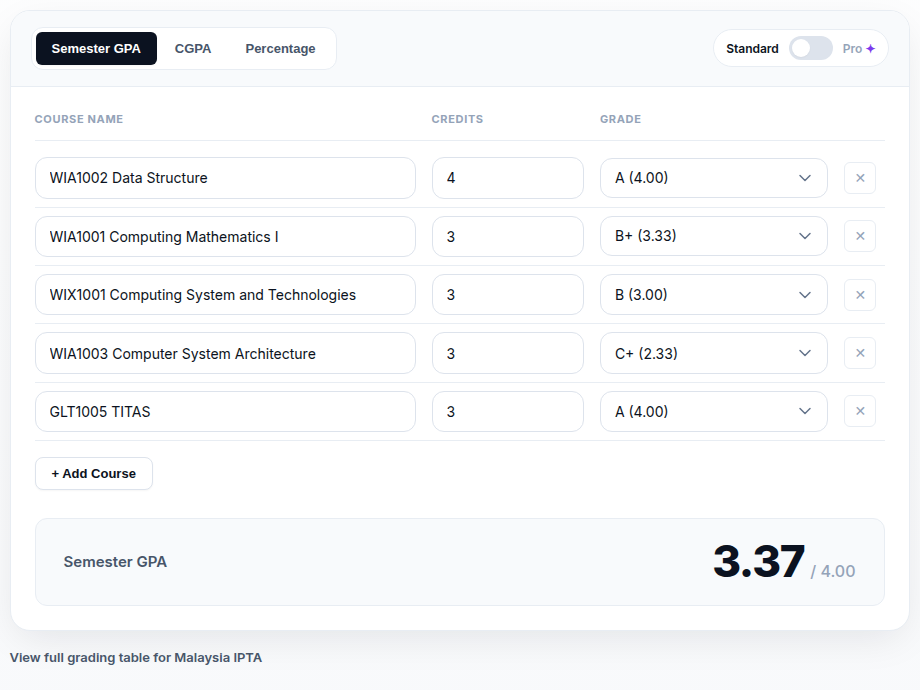
Screenshot: a five-course example semester on the CGPAPro UM calculator (semester GPA 3.37) — the same course names and credit hours used in the worked example below, so you can follow the credit-weighted math step by step. UM’s official grade points (Regulations 2024) are A− 3.70, B+ 3.30, B− 2.70, C+ 2.30 — the grade tables in this guide use those official values.
The general CGPA calculator is handy for what-if planning: plug in your current PNGK and completed credits, add next semester’s expected grades, and see whether that 3.70 target is reachable before results are even released.
Read More: UiTM Grading System 2026: GPA & CGPA Guide — UiTM uses a different scale and different probation rules, so check this if you’re comparing Malaysian public universities.
The Official UM Grading Table (2026)
This table is taken verbatim from Regulation 27 of UM’s (Bachelor’s Degree) Regulations 2024. If you only memorise one thing from this guide, make it this table — because two details in it surprise almost everyone who reads third-party sites first:
| Marks | Grade | Grade Point | Meaning |
|---|---|---|---|
| 90.00 – 100.00 | A+ | 4.00 | High Distinction |
| 80.00 – 89.99 | A | 4.00 | Distinction |
| 75.00 – 79.99 | A− | 3.70 | Distinction |
| 70.00 – 74.99 | B+ | 3.30 | Good |
| 65.00 – 69.99 | B | 3.00 | Good |
| 60.00 – 64.99 | B− | 2.70 | Good |
| 55.00 – 59.99 | C+ | 2.30 | Pass |
| 50.00 – 54.99 | C | 2.00 | Pass |
| 45.00 – 49.99 | C− | 1.70 | Fail |
| 40.00 – 44.99 | D+ | 1.30 | Fail |
| 35.00 – 39.99 | D | 1.00 | Fail |
| 00.00 – 34.99 | F | 0.00 | Fail |
Surprise 1: the minus grades are 3.70, 2.70, 2.30, 1.70, 1.30. A lot of calculator apps and GitHub projects code UM as 3.67 / 3.33 / 2.67 — the scale used by some American universities. UM’s official regulations use 3.70 / 3.30 / 2.70. The difference is small per course, but across 40 courses it can shift your CGPA by a hundredth or two — enough to matter when you’re sitting at 3.69.
Surprise 2: A+ and A are both worth 4.00. UM keeps the A+ as a mark of distinction on your transcript, but it buys you zero extra grade points. If you’re strategising, an 89 (A) and a 95 (A+) contribute identically to your CGPA. The only numbers that matter are the grade points column.
The boundary cliff. UM’s bands are strict: 74.99 is a B+, not an A−. 79.99 is an A−, not an A. One-tenth of a mark can swing 0.40 grade points on a 4-credit course — 1.6 grade points in a single semester. That is why the regulations spell out the bands to two decimal places, and why it is worth knowing exactly where each of your marks sits.
How UM Calculates Your GPA and CGPA — Step by Step
UM’s Regulation 29 defines the two numbers in plain language, and it even includes its own worked example. Here is the process in practice:
- Convert each course grade to its grade point using the official table above (A− → 3.70, B+ → 3.30, and so on).
- Multiply each grade point by the course’s credit hours. A 3-credit course with an A− contributes 3 × 3.70 = 11.10 grade points.
- Add up all the grade points — this is your total grade points for the semester.
- Add up all the credit hours — including the credits of any course you failed. This is the credit counted.
- Divide: GPA = total grade points ÷ total credits taken in that semester.
Your CGPA repeats the same idea across your whole degree: add the grade points from every semester from your first to the current one, add all the credits, and divide. It is not the average of your semester GPAs — a 3.29 semester and a 3.01 semester do not average to 3.15, because the semesters carried different credit loads. This is the single most common arithmetic mistake students make when estimating their own results.
The Formula
Semester GPA (PNGS) = Σ (grade point × credit hours) ÷ Σ (credit hours in that semester)
CGPA (PNGK) = Σ (grade point × credit hours across all semesters) ÷ Σ (credit hours across all semesters)
UM’s regulations add one rule no competitor guide mentions: GPA and CGPA values cannot be rounded up unless the underlying marks are changed. A computed 3.6999 stays 3.69 on your record. It does not become 3.70, and it does not qualify you for the Dean’s Award.
Worked Example: Two Semesters, Real Numbers
Meet a first-year FCSIT student. Here is Semester 1 with five courses (course codes are illustrative; the math is what matters):
| Course | Grade | Grade Point | Credits | Points |
|---|---|---|---|---|
| WIA1002 Data Structure | A− | 3.70 | 4 | 14.80 |
| WIA1001 Computing Mathematics I | B+ | 3.30 | 3 | 9.90 |
| WIX1001 Computing System and Technologies | B | 3.00 | 3 | 9.00 |
| WIA1003 Computer System Architecture | C+ | 2.30 | 3 | 6.90 |
| GLT1005 TITAS | A | 4.00 | 3 | 12.00 |
| Total | 16 | 52.60 |
Semester 1 GPA = 52.60 ÷ 16 = 3.2875 → 3.29. And since this is the first semester, the CGPA is also 3.29.
Semester 2 goes less smoothly — one course lands at C−:
| Course | Grade | Grade Point | Credits | Points |
|---|---|---|---|---|
| WIA1004 Fundamentals of Programming | A | 4.00 | 4 | 16.00 |
| WIA1005 Network Technology Foundation | B+ | 3.30 | 3 | 9.90 |
| WIA1006 Machine Learning | C− (fail) | 1.70 | 3 | 5.10 |
| WIX1002 Project Management | B | 3.00 | 3 | 9.00 |
| GIG1003 Asas Keusahawanan | A− | 3.70 | 3 | 11.10 |
| Total | 17 | 51.10 |
Semester 2 GPA = 51.10 ÷ 17 = 3.0059 → 3.01.
CGPA after two semesters = (52.60 + 51.10) ÷ (16 + 17) = 103.70 ÷ 33 = 3.14. Notice the C− is still inside the divisor — the fail counts against the student in the GPA math while earning nothing toward graduation. Notice also that (3.29 + 3.01) ÷ 2 = 3.15, which is wrong; the correct CGPA is 3.14 because Semester 1 carried fewer credits.
Now the student repeats WIA1006 in Semester 3 and earns a B (3.00). UM’s rule for a repeated failed course: the best grade point counts. The course’s 5.10 points are replaced by 3 × 3.00 = 9.00:
Revised CGPA = (103.70 − 5.10 + 9.00) ÷ 33 = 107.60 ÷ 33 = 3.26.
The repeat recovers the CGPA without being averaged down by the original fail — but it costs one thing permanently: a repeated course disqualifies you from a With Distinction degree. More on that below.
PNGK vs PNGS: The Two Numbers on Your UM Portal
Log into the UM student portal after results are released and you’ll see two abbreviations, not “GPA” and “CGPA”:
- PNGS (Purata Nilai Gred Semester) — your grade-point average for one semester. This is the number that decides probation (below 2.00) and the Dean’s Award (3.70 and above).
- PNGK (Purata Nilai Gred Kumulatif) — your cumulative average across every semester so far. This is the number that decides graduation (2.00 and above) and your degree classification.
They are simply the Malay names for GPA and CGPA. Confusion arises because some students think PNGS is “the important one” — but recruiters, scholarship panels, and UM’s graduation rules all look at PNGK. Your semester number gets you through the door each term; your cumulative number is the one printed on your future.
Read More: UTAR Grading System 2026: GPA & CGPA Guide — another Malaysian university with its own distinct scale, worth comparing if you’re weighing UM against private alternatives.
Retakes: How a Failed Course Really Affects Your CGPA
Failing a course at UM hurts three ways, and students usually only count one of them:
- It drags your GPA. The failed grade’s points (C− = 1.70, D = 1.00, F = 0.00) are multiplied by the course’s credits and stay in the divisor until the course is repeated with a better grade.
- It earns zero degree credit. Per the regulations, failed grades give no “credit obtained” — you still owe those credits toward your programme total.
- It can block your next semester. Any course with a prerequisite requires at least grade C in the prerequisite. A C− doesn’t just fail you — it locks you out of the follow-up course until you pass.
The good news: when you repeat a failed course, only the best grade point counts in your CGPA (Regulation 29(7)(a)). It is not averaged with the fail. If you want to improve your standing beyond repairing fails — say, by taking extra electives — those grades count cumulatively, added to your existing totals (Regulation 29(7)(b)).
One caution the regulations make explicit: repeating a course — failed or otherwise — permanently disqualifies you from a With Distinction degree. Distinction at UM requires a final CGPA of 3.70+, never having obtained an F, never having repeated or upgraded any course, and finishing within the approved duration. If you are chasing With Distinction, the time to protect it is before the repeat, not after.
The Rules That Catch Students Out
1. The Dean’s Award is not a “Dean’s List” — and it’s 3.70, not 3.50. UM officially calls it the Dean’s Award (Anugerah Dekan). You need a semester GPA of 3.70 or above, plus: full-time students must complete at least 15 credits across at least 4 courses in that semester (part-time: 10 credits / 3 courses), every completed course must be grade C or better, and you must not have repeated or upgraded any course that semester. One C−, one repeated elective, or 14 credits — and a 4.00 GPA still gets no award. Students in an extended period of study are excluded entirely.
2. Probation starts below 2.00 — and it caps your load. A semester GPA under 2.00 puts you on probation, and while you’re on it you may register for at most 15 credits in a normal semester (9 in a special semester). The probation period lasts until your semester GPA reaches 2.00 again, and the faculty refers you to an academic advisor.
3. Termination is automatic, not discretionary. UM ends your programme if any one of these happens: you’re on probation and then score a GPA of 1.30 or below for two consecutive semesters; your GPA stays below 2.00 for four consecutive semesters; you get an F three times in the same course; your CGPA falls below 1.00 for two consecutive semesters; or you exceed the maximum study period. Students sometimes think probation is a warning — two bad semesters back-to-back can end the degree.
4. A+ buys nothing over A. Both are 4.00 grade points. The transcript will say High Distinction, but the CGPA math cannot tell them apart. If you’re allocating effort, pushing a 78 (A−) to an 80 (A) is worth far more than pushing a 92 to a 96.
5. 3.69 is not 3.70 — no rounding, ever. UM’s regulations forbid rounding GPA/CGPA upward. A semester GPA of 3.69 misses the Dean’s Award; a final CGPA of 3.69 misses With Distinction. Know where you stand to the second decimal.
6. Some programmes play by stricter rules. These regulations explicitly exclude MBBS, Dentistry, and Law, and professional-body programmes can set their own passing conditions above the general rules. If you’re in one of those, your faculty handbook overrides this guide.
Common Mistakes UM Students Make
- Using 3.67 for A−. Third-party calculators love the 3.67 scale. UM’s official value is 3.70. Verify which scale any calculator uses before trusting it.
- Treating C− as a pass. It is officially a fail — it earns no credit toward your degree and blocks you from courses that need a C prerequisite.
- Leaving fails out of the GPA math. A failed course’s credits still sit in the divisor. Dropping them from your hand calculation inflates the number and hides the damage.
- Averaging semester GPAs for the CGPA. Always weight by credits: (total points) ÷ (total credits).
- Assuming A+ helps the CGPA more than A. It doesn’t — same 4.00.
- Chasing the Dean’s Award with 14 credits. Full-time students need 15 credits across 4+ courses; fall short and the award is off the table no matter your grades.
- Repeating a course to “upgrade” without knowing the cost. It permanently removes the With Distinction degree option.
Tips to Raise Your PNGK at UM
Protect the high-credit courses. At UM, a 4-credit course contributes a third more to your CGPA than a 3-credit one. An A− in a 4-credit course (14.80 points) outweighs an A in a 3-credit course (12.00). Study time follows credit weight.
Repair fails fast. Because the best grade replaces the fail in your CGPA — not an average of the two — retaking is the single highest-leverage move available. Every semester the fail sits in your totals un-repeated is a semester your PNGK carries dead weight.
Guard the boundaries. The bands end in .99: 74.99 is a B+, 79.99 is an A−. If you’re near a boundary, one assignment or exam question is worth 0.40 grade points on a 4-credit course. Know your marks going into finals.
Don’t sacrifice a semester for one course. The Dean’s Award needs all courses at C or better and 4+ registered courses — a single C− in an otherwise stellar semester kills the award. Consistency across all courses beats brilliance in one.
Plan around the probation cap. If you’re at risk of dropping below 2.00, remember you’ll be limited to 15 credits next semester — which slows your recovery. It is better to drop a struggling course (a W) than to fail it, since a withdrawal doesn’t enter your GPA divisor the way an F does.
The source for everything above is UM’s official regulation document — you can read the full text of the UM (Bachelor’s Degree) Regulations 2024 on the university’s own website. If your faculty has its own programme standards (common in engineering and other professional-body programmes), check your faculty handbook too — it can set stricter conditions than the university-wide rules.
Frequently Asked Questions
Is C− a pass at Universiti Malaya?
No. The passing grade for all UM undergraduate courses is C. A C− (45–49 marks) is officially recorded as a fail: it earns no credit toward your degree, and you need at least a C to register for any course that has a prerequisite.
What is the difference between PNGK and PNGS?
PNGS (Purata Nilai Gred Semester) is your semester GPA — one semester only, and the number that decides probation and the Dean’s Award. PNGK (Purata Nilai Gred Kumulatif) is your CGPA — cumulative across all semesters, and the number that decides graduation and your degree classification.
What CGPA do I need for the Dean’s Award at UM?
It is a semester GPA requirement, not CGPA: 3.70 or above in one semester. You also need at least 15 credits across 4+ courses (full-time), no grade below C that semester, and no repeated or upgraded courses. Note there is no rounding — 3.69 does not qualify.
What is the minimum CGPA to graduate from UM?
A final CGPA of 2.00, plus completing your programme’s prescribed credits, faculty requirements, and language requirements. UM also requires your GPA and CGPA to stay at or above 2.00 in every semester — below 2.00 in a semester triggers probation.
If I repeat a failed course at UM, does the new grade replace the old one?
In the CGPA calculation, yes — UM counts the best grade point for a repeated failed course; the fail is not averaged in. But repeating any course permanently disqualifies you from graduating With Distinction.
Does UM round up GPA? Is 3.69 the same as 3.70?
No. UM’s regulations explicitly state GPA and CGPA cannot be rounded up. 3.69 stays 3.69 — it misses both the Dean’s Award and With Distinction thresholds.
Is an A+ worth more than an A at UM?
No. Both carry 4.00 grade points. The A+ appears as “High Distinction” on your transcript, but the CGPA math treats them identically. Pushing an A− (3.70) up to an A (4.00) is far more valuable than pushing an A up to an A+.
Conclusion
UM’s grading system rewards precision: strict .00–.99 bands, no rounding, a hard pass line at C, and probation and termination rules that apply themselves. The two numbers that matter — PNGS each semester and PNGK across your degree — are simple credit-weighted averages, and you now have the official table and the worked math to compute both exactly.
Two takeaways are worth more than the rest. First, use 3.70 for A−, because the 3.67 values in third-party tools are not UM’s numbers — and when you’re sitting at 3.69 versus 3.70, the official values decide real outcomes. Second, a C− is a fail, and a fail that sits un-repeated drags your CGPA every single semester until you fix it. UM gives you the best-grade rule for repeats; use it early, and plan your courses so the high-credit ones get your best hours. Run your numbers through the UM GPA calculator — cross-checking against the official grade points in the table above — and you’ll always know exactly where you stand.