
Universiti Putra Malaysia uses one of the most generous — and most misunderstood — grading scales in the country. Generous, because an A− at UPM is worth 3.75 grade points, not the 3.67 you’ll see on almost every generic Malaysian CGPA calculator online. Misunderstood, because those same generic tools quietly undercount UPM students: they give your B+ a 3.33 when UPM awards 3.50, your B− a 2.67 when UPM awards 2.75, and your C+ a 2.33 when UPM awards 2.50. Over a full semester, that “small” difference can swing your reported PNG by a tenth of a point or more — enough to matter for scholarships, Dean’s List, and postgraduate applications.
This guide sets the record straight with UPM’s official undergraduate grading system, taken directly from the university’s academic regulations (the English-language BGAKA1 academic-matter document): the complete per-mark grade table, the PNG and PNGK formulas UPM actually uses, the deficit-point system behind its academic-standing ladder, the real Dean’s List threshold (it’s higher than most students think), repeat and withdrawal rules, and the teaching-practicum trap that turns passing grades into automatic fails. Every section comes with worked examples using real numbers.
Quick answer: At UPM, your semester GPA is called PNG (Purata Nilai Gred) — the credit-weighted average of grade points in one semester — and your cumulative GPA is PNGK (Purata Nilai Gred Kumulatif). Marks map to grades like this: 80–100 is A (4.00), 75–79 is A− (3.75), 70–74 is B+ (3.50), 65–69 is B (3.00), 60–64 is B− (2.75), 55–59 is C+ (2.50), 50–54 is C (2.00), 47–49 is C− (1.75), 44–46 is D+ (1.50), 40–43 is D (1.00), and 39 or less is F (0.00, fail). Good academic standing needs a PNGK of at least 2.00, and the Dean’s List bar is a PNG of 3.75 — not 3.50.
How to calculate your UPM GPA in seconds
The fastest way to check your semester PNG is our free UPM CGPA calculator. Select “Semester GPA”, add each course with the credit hours shown on your registration slip, choose the letter grade you earned, and the tool computes your PNG instantly. The screenshot below shows a real semester filled in:
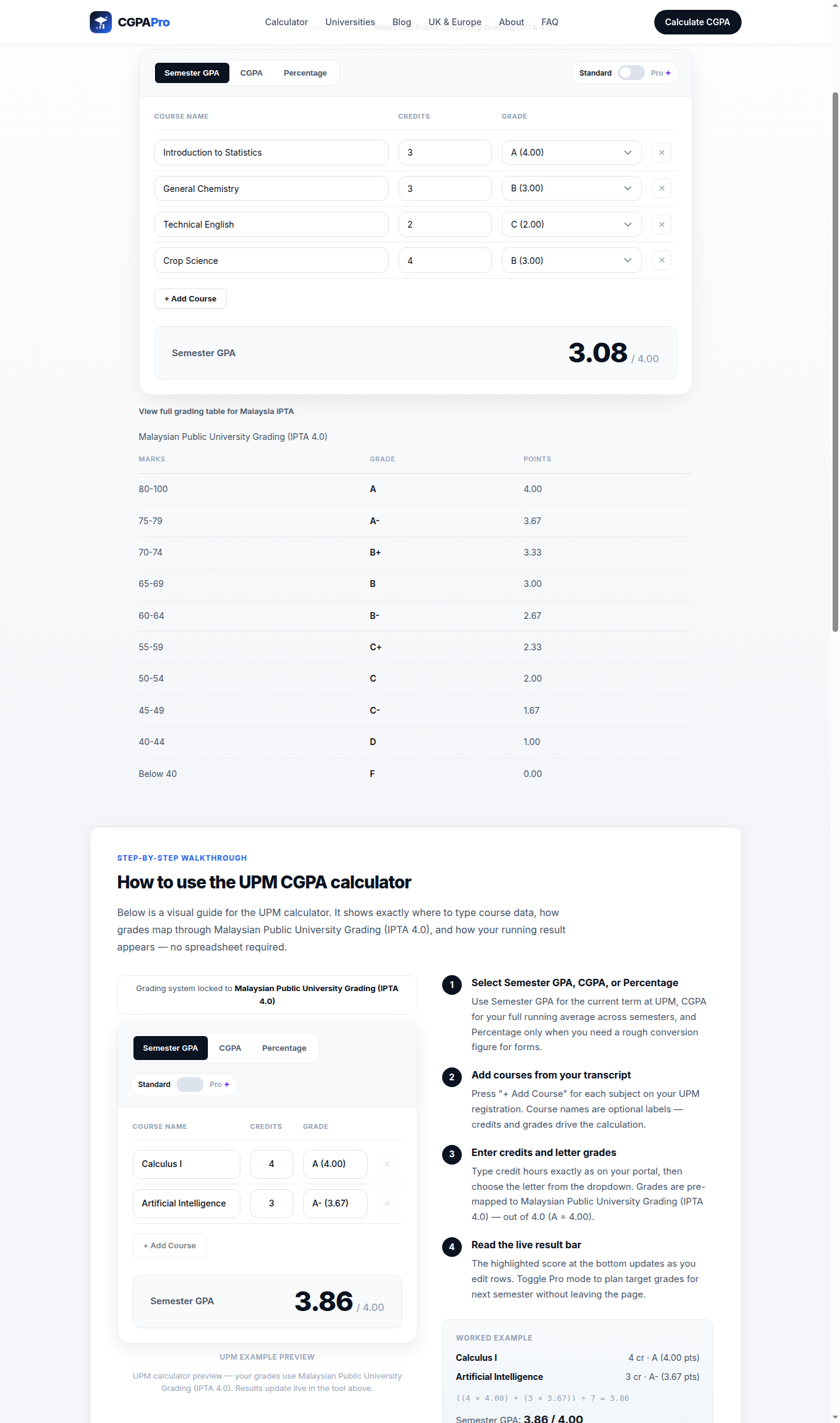
One honest note before you use it: our calculator page currently applies the generic Malaysian band scale (A− 3.67, B+ 3.33, B− 2.67, C+ 2.33 and so on). UPM’s official scale is more generous — A− is 3.75, B+ is 3.50, B− is 2.75, C+ is 2.50. We’re updating the calculator page to UPM’s official values; until then, use the official table below for your exact number and treat the tool as a quick estimate. The example above uses only A, B, and C grades, so its 3.08 matches both scales exactly.
The official UPM grade table
This is the grading scale straight from UPM’s undergraduate academic regulations, verified against the university’s own published documents. Two things to notice right away: the quarter-point grades (3.75, 2.75, 1.75) that set UPM apart, and the C− band, which starts at 47 — not 45 like at many other universities.
| Marks | Grade | Grade point | Standing |
|---|---|---|---|
| 80 – 100 | A | 4.00 | Excellent |
| 75 – 79 | A− | 3.75 | Very good |
| 70 – 74 | B+ | 3.50 | Very good |
| 65 – 69 | B | 3.00 | Good |
| 60 – 64 | B− | 2.75 | Good |
| 55 – 59 | C+ | 2.50 | Satisfactory |
| 50 – 54 | C | 2.00 | Satisfactory |
| 47 – 49 | C− | 1.75 | Weak |
| 44 – 46 | D+ | 1.50 | Weak |
| 40 – 43 | D | 1.00 | Very weak |
| 39 or less | F | 0.00 | Fail |
Four facts about this table change how you should read your results.
1. The gap between A− and A is tiny. At UPM, an A− (75–79 marks) earns 3.75 — only 0.25 below a full A. On the generic scale most online tools use, A− is 3.67, a 0.33 gap. If you scored 78 in a 4-credit course, the generic calculator credits you 14.68 points; UPM credits you 15.00. That 0.32-point difference is real, and it compounds across every A−, B+, B−, and C+ on your slip. Always use UPM’s own numbers.
2. The C− line is higher than you might expect. UPM’s C− band is 47–49, worth 1.75. Some students assume the C band extends down to 45 (it does at several other universities). At UPM, 46 marks is D+ (1.50), not C−. Borderline students should know exactly where they sit — ask your lecturer for your raw mark, not just the letter.
3. Only F is a formal fail — but grades still have consequences. Under the regulations, the symbols that fail you outright are F (39 marks or less). C−, D+, and D grades are passes that drag your PNG down and, through the deficit-point system below, can push you into warning or probation. There is one important exception: teaching-practicum (LMI) students. The Faculty of Educational Studies’ grading rules state that C, C−, D+, and D grades in the teaching practicum are considered failed — the student receives an automatic F and must repeat the practicum the following year. If you’re an education major, treat anything below C+ in your practicum as a fail.
4. Your grade comes from your marks, not from a curve. The regulations state it plainly: the alphabetical grade is determined by the mark you obtained, and the grade point is determined by that grade times the course’s credit hours. There’s no hidden bell curve — a 76 is an A− (3.75) regardless of how the rest of the class performed.
PNG and PNGK: the formulas UPM actually uses
UPM uses Malay abbreviations on every result slip and transcript, and students mix them up constantly:
- PNG — Purata Nilai Gred: your semester GPA, computed from one semester’s courses.
- PNGK — Purata Nilai Gred Kumulatif: your cumulative GPA, computed across all semesters.
The official formulas from the academic regulations:
PNG = (sum of [grade point × credit hours] for the semester) ÷ (total credit hours in the semester)
PNGK = (sum of [grade point × credit hours] across all semesters) ÷ (total credit hours across all semesters)
There is also a third number that matters enormously and that almost nobody explains to new students: the deficit point. It measures how far your accumulated points fall short of the 2.000 benchmark:
Deficit points = 2 × (total cumulative credit hours taken) − (total cumulative grade points obtained)
If your PNGK is exactly 2.00, your deficit is zero. If it’s higher, the deficit is negative (you’re ahead of the benchmark). If it’s lower, the deficit is positive — and it is this number, not your CGPA alone, that decides your academic status:
- Deficit points below 12 → Warning status.
- Deficit points 12 or more → Probation status.
- On warning, if you fail to reach a PNGK of 2.000 by the end of the next semester → moved to Probation.
- On probation, if you fail to reach a PNGK of 2.000 by the end of that semester → Terminated.
- Deficit points of 24 or more → Terminated directly, no further warnings.
A “good” status simply lets you continue your studies next semester — the regulations note it doesn’t carry over into non-academic matters. Note the sequence: UPM gives you two formal chances (warning, then probation) before termination, but a deep enough hole (24 deficit points) skips the queue.
Step-by-step: calculating a semester PNG
Let’s work through a realistic first-year semester. Meet Aina, an agriculture student with five courses:
| Course | Credits | Grade | Grade point | Points earned |
|---|---|---|---|---|
| Biostatistics | 3 | B+ | 3.50 | 3 × 3.50 = 10.50 |
| Soil Science | 3 | A− | 3.75 | 3 × 3.75 = 11.25 |
| Technical English | 2 | B | 3.00 | 2 × 3.00 = 6.00 |
| Agricultural Extension | 3 | C+ | 2.50 | 3 × 2.50 = 7.50 |
| Crop Physiology | 4 | A | 4.00 | 4 × 4.00 = 16.00 |
| Total | 15 | 51.25 |
PNG = 51.25 ÷ 15 = 3.42.
Now compare with what a generic calculator would have said: A− at 3.67 (11.01 instead of 11.25), B+ at 3.33 (9.99 instead of 10.50), C+ at 2.33 (6.99 instead of 7.50). That’s 47.99 ÷ 15 = 3.20 — a full 0.22 lower than Aina’s true 3.42. One semester of wrong-scale arithmetic, and she’s the difference between “just above 3.20” and “well above 3.40” on paper. This is why the official table matters.
To extend this to PNGK: suppose Aina’s previous cumulative record was 30 credits with 96.00 points (PNGK 3.20). Add semester 2: (96.00 + 51.25) ÷ (30 + 15) = 147.25 ÷ 45 = 3.27 PNGK. Never average the two PNGs directly ((3.20 + 3.42) ÷ 2 = 3.31 would be wrong) — PNGK always weights by credit hours, and Aina’s heavier first load pulls the average toward it.
Dean’s List at UPM: the threshold is 3.75, not 3.50
This is the single most common misconception about UPM academics. At several Malaysian universities the Dean’s List starts at 3.50. At UPM, the academic regulations set it at a PNG of 3.75 to 3.999 for the semester. Everything else must also hold for the evaluated semester:
- no TM (unsatisfactory) grade in any course,
- no repeated courses in the evaluated semester,
- replacement or special-examination grades don’t count,
- no disciplinary action against you,
- registered for at least 12 credit hours — underloaded semesters don’t qualify.
The award is recorded in your transcript and your name goes on the faculty notice board. And if you hit a perfect PNG of 4.000, you move up a tier: the Vice Chancellor’s List, issued by the Registrar each semester, with the same conditions. So the ladder is clean: 3.75–3.999 earns the Dean’s List, 4.000 earns the VC’s List.
Practical implication: if your PNG is sitting at 3.70, you are close but not there. One B+ (3.50) in a 3-credit course can pull a 15-credit semester from 3.80 down to 3.73 — below the line. When you’re chasing the list, guard your 3-credit core courses hardest.
Repeat, withdrawal, and incomplete grades
UPM’s rulebook has specific symbols and deadlines that students trip over every year:
- TL (Tidak Lengkap — Incomplete). If you can’t complete part of a course’s requirements, you get a TL. It is valid only until the end of the second week of the following semester — finish the work and get a real grade by then, or the TL converts to an F automatically.
- TD (Withdraw). You may withdraw from a course after week 3 but before week 7, with your Dean’s approval. Withdraw within the first three weeks (with your academic adviser’s consent) and nothing is recorded at all — no grade, no symbol. After week 7, you’re in for the final exam.
- AU (Audit). Registered, attended, and sat the exams, but the course doesn’t count toward your degree. Audited courses are marked M or TM.
- Skipped the final exam? Students who register for a course but don’t sit its examination receive zero marks for that course. There’s no coursework-only rescue.
Repeating courses: UPM’s published undergraduate regulations focus repeat rights on the graduation track — a student who finishes without meeting the PNGK 2.000 requirement may be granted up to two additional semesters to repeat failed courses or take at least 12 credits per semester to repair their standing (subject to Senate rule 72). The exact treatment of a repeated course’s grade in the PNGK — replacement versus both-attempts-count — is applied at faculty level, so confirm with your academic adviser before you bank on a replacement.
Common mistakes UPM students make
1. Using a generic calculator’s scale. The 3.67/3.33/2.67 scale is the single most common source of wrong PNGs for UPM students. Use 3.75/3.50/2.75/2.50 or use UPM’s official table directly.
2. Assuming Dean’s List is 3.50. It’s 3.75 at UPM. Students who celebrate a 3.60 semester are understandably confused when the list comes out without them.
3. Ignoring deficit points. A PNGK of 1.85 sounds “close to 2.00”, but over 60 credits it means 9 deficit points — one bad semester from probation. Track the deficit number, not just the PNGK.
4. Leaving a TL unresolved. An incomplete grade feels like a pause button; it isn’t. Two weeks into the next semester it becomes an F — zero points, full credit weight, and a permanent dent in your PNGK.
5. Withdrawing at the wrong time. Dropping a course in week 2 leaves no trace; dropping in week 8 is impossible. If you’re struggling, talk to your academic adviser before week 7, not after.
6. Education students: treating C in practicum as a pass. In the teaching practicum (LMI), C, C−, D+, and D are automatic fails with mandatory repetition the following year. The practicum is graded under faculty-specific rules that override the normal pass line.
Tips for raising your PNG at UPM
Protect the quarter-point grades. Because UPM pays 3.75 for an A− and 3.50 for a B+, the jump from B+ to A− (0.25) is the same size as from A− to A (0.25). At many universities the B+-to-A− jump is smaller and feels optional; at UPM it’s a full quarter point — always worth chasing across a borderline.
Front-load effort into high-credit courses. A 4-credit A (16.00 points) outweighs a 2-credit C+ (5.00) more than threefold. UPM’s formula is strictly credit-weighted, so your heaviest courses deserve your heaviest revision.
Watch the 47-mark line. UPM’s C− starts at 47, a point higher than some universities’ 45. If a lecturer’s moderation policy moves borderline marks, the difference between 46 and 47 is the difference between D+ (1.50) and C− (1.75) — a 0.25 swing per credit.
Keep semesters at 12+ credits if you want the lists. Both the Dean’s and VC’s Lists require at least 12 registered credit hours. A light, high-scoring semester feels great but earns no listing.
Frequently asked questions
Is a C− a fail at UPM?
No — in normal courses, C− (47–49 marks, 1.75) is a pass, officially described as “weak”. Only F (39 marks or less) is a formal fail. The one exception is the Faculty of Education’s teaching practicum (LMI), where C, C−, D+, and D are all treated as failures and the student gets an automatic F with mandatory repetition the following year.
What is the difference between PNG and PNGK?
PNG (Purata Nilai Gred) is your semester GPA — one semester’s credit-weighted average. PNGK (Purata Nilai Gred Kumulatif) is your cumulative GPA across all semesters. Scholarships and the Dean’s List look at your PNG for a specific semester; graduation and most postgraduate applications look at your PNGK.
What PNG do I need for the Dean’s List at UPM?
A PNG of 3.75 to 3.999 for the semester, plus at least 12 credit hours, no TM grades, no repeated courses, and no disciplinary action. A perfect 4.000 earns the higher Vice Chancellor’s List instead.
What are deficit points and how do I know my status?
Deficit points = 2 × (cumulative credits) − (cumulative grade points). Below 12 means warning status; 12 or more means probation; 24 or more means termination. Example: 45 credits with 78.00 points → deficit = 90 − 78 = 12 → probation. Keep this number, not just your PNGK, because it’s what the university acts on.
Can I repeat a course to replace a bad grade?
The regulations guarantee repeat rights on the graduation track: students who don’t reach PNGK 2.000 may get up to two extra semesters to repeat failed courses or take more credits. Whether the new grade replaces the old one in your PNGK is decided at faculty level — confirm with your academic adviser before you repeat, so you know exactly how the maths will work.
Is a 3.50 PNGK good at UPM?
Yes — solidly above average and comfortably clear of every standing threshold. But note it won’t earn a Dean’s List (needs 3.75), and it’s below the 3.75 line that many postgraduate programmes and scholarships treat as the excellence mark. If you’re aiming higher, your cheapest wins are converting B+ grades (3.50) into A− (3.75) in 3–4 credit courses.
What happens if I miss my final exam?
You receive zero marks for the course — coursework marks don’t save it. If a genuine emergency kept you away, contact your faculty immediately about a replacement/special examination; the regulations provide for one, but it’s discretionary, not automatic. Don’t assume it.
The bottom line
UPM’s grading system rewards precision: the official scale (A− 3.75, B+ 3.50, B− 2.75, C+ 2.50, C− 1.75) is kinder than the generic tables most calculators use, the deficit-point system gives you a clear numeric read on your standing, and the 3.75 Dean’s List bar is high but reachable with the right course-weight strategy. Use the official numbers — they were verified from UPM’s own academic regulations — and keep an eye on that deficit-point count. It, more than anything, decides how much room for error you have.
Check your current standing anytime with our free UPM CGPA calculator, compare with the UiTM and UTHM guides to see how other Malaysian public universities differ, and read what repeating a course does to your CGPA before you commit to a retake.
Official sources: UPM Undergraduate Academic Regulations (English, BGAKA1) via the Academic Division; UPM LMI (teaching practicum) grading rules via the Faculty of Educational Studies.