Universiti Tun Hussein Onn Malaysia (UTHM) does something almost no other Malaysian university does: it doesn’t use grade bands. At most universities, every mark from 75 to 79 is worth the same 3.67 — a band. At UTHM, every single mark has its own grade point. A 79 is worth 3.94. A 78 is worth 3.88. One mark up or down always moves your grade point, which means generic GPA calculators quietly give UTHM students the wrong CGPA — sometimes by more than a quarter of a point on a single course.
This guide lays out UTHM’s official grading system exactly as it appears in the university’s Academic Regulations (8th Edition): the complete per-mark grade table, the PNG and PNGK formulas UTHM actually uses, the Dean’s List rules most students misunderstand, how repeating and upgrading courses really affect your CGPA, the academic-standing ladder that leads to dismissal, and degree classifications. Everything below comes with worked examples using real numbers.
Quick answer: At UTHM, your semester GPA is called PNG (Purata Nilai Gred) — the credit-weighted average of grade points in one semester. Your cumulative GPA is PNGK (Purata Nilai Gred Kumulatif) — the credit-weighted average across all semesters. Marks map to grade points per mark: 85–100 is A+ (4.00), 80–84 is A (4.00), then every mark 40–79 has its own point (79 = 3.94, 74 = 3.62, 63 = 2.88, 40 = 1.00), and 0–39 is E (0.00, fail). The minimum passing grade is D (40 marks). Good academic standing (KB) needs a PNGK of 2.00 or above.
How to calculate your UTHM GPA in seconds
The fastest way to check your semester PNG is our free UTHM CGPA calculator. Choose “Semester GPA”, add each course with its credit hours from your SMAP registration slip, pick the letter grade you earned, and the tool computes your PNG instantly. The screenshot below shows a real semester filled in:
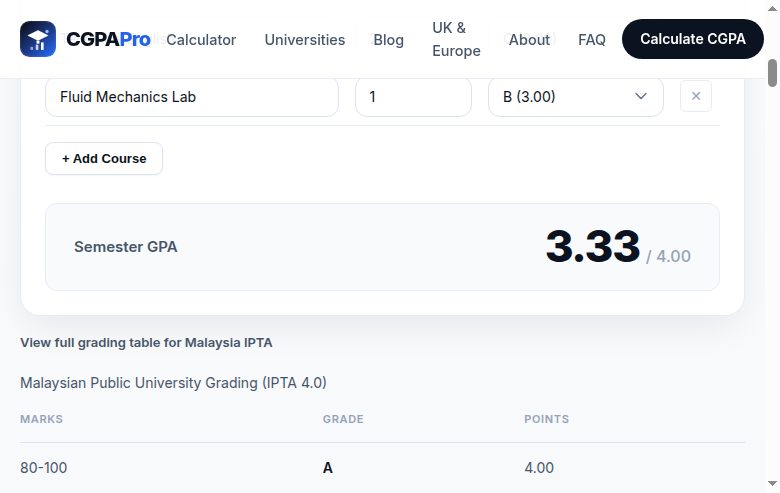
One honest note before you use it: our calculator page currently uses the generic Malaysian band scale (A− 3.67, B+ 3.33, and so on). UTHM’s official system is finer than that — it assigns a point to every individual mark, so a 79 at UTHM is officially 3.94, not 3.67. We’re updating the calculator page to the per-mark table; until then, use the official table below for your exact number and treat the tool as a quick estimate. The band version is close, but on borderline marks it can be off by up to 0.27 grade points per course.
The official UTHM grade table
This is the grading scale straight from UTHM’s Academic Regulations for Bachelor Degree and Diploma Programmes (8th Edition, Table 7), verified against the university’s own published PDF. Read it carefully — it works differently from the band tables you’ve seen for other universities:
| Marks | Grade | Grade point |
|---|---|---|
| 85 – 100 | A+ | 4.00 |
| 80 – 84 | A | 4.00 |
| 79 | A− | 3.94 |
| 78 | A− | 3.88 |
| 77 | A− | 3.82 |
| 76 | A− | 3.76 |
| 75 | A− | 3.70 |
| 74 | B+ | 3.62 |
| 73 | B+ | 3.54 |
| 72 | B+ | 3.46 |
| 71 | B+ | 3.38 |
| 70 | B+ | 3.30 |
| 69 | B | 3.24 |
| 68 | B | 3.18 |
| 67 | B | 3.12 |
| 66 | B | 3.06 |
| 65 | B | 3.00 |
| 64 | B− | 2.94 |
| 63 | B− | 2.88 |
| 62 | B− | 2.82 |
| 61 | B− | 2.76 |
| 60 | B− | 2.70 |
| 59 | C+ | 2.62 |
| 58 | C+ | 2.54 |
| 57 | C+ | 2.46 |
| 56 | C+ | 2.38 |
| 55 | C+ | 2.30 |
| 54 | C | 2.24 |
| 53 | C | 2.18 |
| 52 | C | 2.12 |
| 51 | C | 2.06 |
| 50 | C | 2.00 |
| 49 | C− | 1.90 |
| 48 | C− | 1.80 |
| 47 | C− | 1.70 |
| 46 | C− | 1.60 |
| 45 | C− | 1.50 |
| 44 | D | 1.40 |
| 43 | D | 1.30 |
| 42 | D | 1.20 |
| 41 | D | 1.10 |
| 40 | D | 1.00 |
| 0 – 39 | E | 0.00 (FAIL) |
Four things about this table change how you should think about your marks.
1. Every mark has its own point — there are no “wasted” marks at UTHM. At a band-scale university, a 76 and a 79 are both A− = 3.67; the extra three marks earn you nothing. At UTHM, 76 = 3.76 and 79 = 3.94. Chasing a single extra mark is always worth something, and the classic borderline heartbreak — “I got 79, one mark from an A” — barely exists here: 79 already earns you 3.94, only 0.06 below a full A. If you’re deciding whether to push for one more mark on a final, UTHM is the university where that push literally always pays.
2. The grade letters don’t stop where generic calculators think. Several online calculators apply a one-size-fits-all Malaysian scale to UTHM — typically with D+ and D− grades, or an A− worth a flat 3.67, or an E band starting at 0–34. UTHM has no D+ or D−. Its A− spans 75–79 with points 3.70–3.94. And E covers 0–39 — the pass line is a hard 40. If a tool shows you an A− = 3.67 for a 79-mark course, it has just short-changed you by 0.27 grade points times the course credits.
3. D is the minimum passing grade. The regulations say it plainly: grade D (40 marks) is the minimum pass — though your faculty can set a higher passing bar for specific courses with Senate approval. Below 40 is E, which carries 0.00 and, as we’ll see, has to be redeemed.
4. Miss the final exam and you get zero — for the whole course. Under the regulations, a student who skips the final examination gets an automatic 0 for that course, regardless of coursework marks. No appeal arithmetic rescues it.
The PNG and PNGK formulas, step by step
UTHM’s regulations use the terms GPA and CGPA in English, but on your SMAP portal and in Malay documents you’ll see PNG (Purata Nilai Gred, your semester average) and PNGK (Purata Nilai Gred Kumulatif, your cumulative average). They’re the same credit-weighted formulas every Malaysian public university uses — the difference at UTHM is only in the per-mark points feeding into them:
PNG (semester) = Σ (grade point × credit hours) ÷ Σ (credit hours), over one semester’s courses.
PNGK (cumulative) = Σ (grade points × credits, all semesters) ÷ Σ (all credits counted).
The procedure, in order:
- List every course you completed this semester with its credit hours, exactly as registered (your SMAP slip shows these — typically 12 to 20+ credits per regular semester).
- Convert each course’s final marks to a grade point using the per-mark table above — not a band table. A 79 is 3.94, a 74 is 3.62, a 63 is 2.88.
- Multiply each course’s grade point by its credit hours. These are your quality points (JMN — Jumlah Mata Nilai).
- Add up all quality points and divide by the total credit hours (JKK — Jumlah Kredit Kira) of the semester. That’s your PNG.
- For PNGK, repeat across every semester so far — total quality points ever earned divided by total credits ever counted.
Failed (E) courses count in your PNG and PNGK at 0.00 until they’re redeemed — they don’t disappear on their own. Repeating works differently though, and that’s where UTHM students leave CGPA points on the table (more on the repeat rule below).
Worked example: a real UTHM semester
Meet Aina, a second-year mechanical engineering student at UTHM’s Parit Raja campus. Her semester results are in, and she wants her PNG. Notice how every mark maps to its own point — no bands:
| Course | Credits | Marks | Grade | Grade point | Quality points |
|---|---|---|---|---|---|
| Thermodynamics | 3.0 | 82 | A | 4.00 | 3 × 4.00 = 12.00 |
| Engineering Mathematics III | 3.0 | 74 | B+ | 3.62 | 3 × 3.62 = 10.86 |
| Fluid Mechanics | 3.0 | 68 | B | 3.18 | 3 × 3.18 = 9.54 |
| Technical English | 2.0 | 57 | C+ | 2.46 | 2 × 2.46 = 4.92 |
| Fluid Mechanics Laboratory | 1.0 | 79 | A− | 3.94 | 1 × 3.94 = 3.94 |
Total quality points: 12.00 + 10.86 + 9.54 + 4.92 + 3.94 = 41.26
Total credits: 3.0 + 3.0 + 3.0 + 2.0 + 1.0 = 12.00
PNG = 41.26 ÷ 12.00 = 3.44
Now compare: a generic band calculator would read her 74 as B+ = 3.33 (instead of 3.62), her 68 as B = 3.00 (instead of 3.18), and her 79 as A− = 3.67 (instead of 3.94). That’s 0.29 + 0.54 + 0.27 quality points missing — her “band-calculator PNG” would come out around 3.30 instead of the official 3.44. Fourteen hundredths of a PNG, lost to the wrong table. Over several semesters, this is exactly how students end up believing their PNGK is lower than it really is — or, worse, misjudging whether they’re on track for First Class.
PNG vs PNGK: what each one controls
PNG covers a single semester. It decides two things: whether you make the Dean’s List that semester (PNG ≥ 3.50, plus a credit condition — see below), and whether a bad semester triggers the dismissal ladder.
PNGK is your running total across every semester. It decides your academic standing (KB / KS / KG), your degree classification at graduation, and whether you graduate at all.
The math connects them cleanly: your new PNGK is the credit-weighted average of your old PNGK and your current PNG. If Aina’s previous PNGK was 3.30 over 24 credits, and this semester she earned a 3.44 over 12 credits, her new PNGK is (3.30 × 24 + 3.44 × 12) ÷ 36 = 120.48 ÷ 36 = 3.35. The heavier the semester, the harder it pulls.
Dean’s List: the award students misunderstand
UTHM’s Dean’s List (officially the Dean’s Award / Dean’s List Award) goes on your transcript — but the eligibility rules trip up even strong students:
- Semester PNG of 3.50 or above — not PNGK. A 3.60 cumulative with a 3.45 this semester doesn’t qualify; a 3.55 this semester with a 3.20 cumulative does.
- You must have registered for at least 12 credits that semester. This is the trap. Take 11 credits, score a 3.80, and you still don’t get the award. Upgrade (TB) repeat credits don’t count toward the 12.
- Full-time students only.
The 12-credit rule is the single most common reason students miss the Dean’s List despite qualifying marks — they simply never knew the credit floor existed. If you’re chasing the award, build your semester around at least 12 credits of courses you can genuinely ace, and don’t dilute the semester with a brutal extra course that drags the PNG below 3.50.
Note the asymmetry: Dean’s List is PNG-based, but degree classification is PNGK-based — and the First Class bar (3.70) sits above the Dean’s List bar (3.50). Regular Dean’s List semesters don’t guarantee First Class.
Academic standing: KB, KS, and the dismissal ladder
At the end of every regular semester, UTHM assigns you a standing based on your PNGK:
| Standing | Malay term | PNGK range |
|---|---|---|
| KB — Good | Kedudukan Baik | 2.00 and above |
| KS — Conditional | Kedudukan Bersyarat | 1.70 to below 2.00 |
| KG — Fail / Terminated | Kedudukan Gagal | below 1.70 |
KS is a warning; KG is the exit. The regulations draw a precise ladder:
- Three consecutive semesters of KS → KG → you’re terminated. One good semester anywhere in the run breaks the chain.
- Semester PNG below 1.00 with PNGK between 1.70 and 2.00 → terminated. A catastrophic single semester can end it even without three strikes.
- Semester PNG below 1.00 but PNGK still 2.00 or above → the university may order deferment instead of termination.
Two lifelines exist. A student who lands in KG in their first semester can apply to re-register (DS) for a small fee — but if they don’t reach KB that semester, they’re out. And unpaid financial debt to the university can itself trigger termination or bar you from final exams, so clear your fees before results season.
Standing is not assessed in Semester III (the short semester) — though the PNGK still rolls forward. You can’t be terminated in a short semester, but you can quietly slide toward the ladder.
Repeating failed courses: the original grade disappears
This is the rule UTHM students least believe until they see it in the regulations. When you repeat a failed course (UK — Ulang Kursus), the original failed attempt is abolished from the calculation — its credits and its 0.00 grade point are removed, and only the repeat attempt counts. You do not carry both. Students on forums routinely compute their “recovered” CGPA with both attempts included, which understates the recovery.
Watch what that means for Aina’s friend Daniel, who failed a 3-credit course (E, 0.00) in a 15-credit semester. Before the repeat, his semester contributed 36.00 quality points over 15 credits (PNG 2.40). After repeating the course and scoring 68 marks (B, 3.18): the E’s 0.00 × 3 is deleted, and the new attempt contributes 3 × 3.18 = 9.54. His semester re-computes as (36.00 − 0.00 + 9.54) ÷ 15 = 3.04 — a full 0.64 higher, not the ~3.0-with-both-attempts his friends predicted. The replacement rule is generous; the mistake is not knowing it exists.
Two refinements worth knowing: if you failed an elective, you may swap in a different elective instead of repeating the same course — the original is still abolished. And if you simply missed the final exam (automatic 0), no special exam is available for skipped finals — you repeat the course normally.
Upgrading passed courses: the TB loophole most students miss
UTHM also lets you repeat courses you passed — a formal “Tambah Baik” (TB, Upgrade) pathway. The rules:
- You may upgrade courses graded C and below — once per course.
- The highest grade counts. If the upgrade attempt goes worse, your original grade stands. The risk is mostly time and the registration fee, not your CGPA.
- Final-semester students graduating with KS standing may upgrade any course.
- You need faculty approval and must pay the course registration fee.
The cost/benefit is worth doing properly. Upgrading a 3-credit C+ (2.30) to a B (3.00) adds 2.10 quality points to your lifetime total — on a 120-credit degree, that’s +0.0175 to your PNGK. That sounds small, but at classification boundaries (2.99 → 3.00, 3.69 → 3.70) it’s exactly the kind of nudge that flips Second Upper to First Class. Target your highest-credit, lowest-grade courses first, and only courses where you genuinely believe you can add a full grade.
Degree classifications and graduation requirements
Your degree class is set by your final PNGK:
| Programme | Classification | PNGK required |
|---|---|---|
| Bachelor’s degree | First Class Honours | 3.70 and above |
| Second Class Honours (Upper) | 3.00 – 3.69 | |
| Second Class Honours (Lower) | 2.30 – 2.99 | |
| Third Class Honours | 2.00 – 2.29 | |
| Diploma | First Class Diploma | 3.50 and above |
| Second Class Diploma | 2.00 – 3.49 |
But a qualifying PNGK alone doesn’t graduate you. The regulations require all of the following: every programme course passed, total credits completed, KB standing (PNGK ≥ 2.00), a credit in Bahasa Melayu at SPM level (or equivalent), and MUET Band 3.0 or above for bachelor’s students. Miss the BM/MUET requirements while clearing everything else and you get KBTP status — “programme completed with good standing” — valid for two years to sort out the language requirements before you lose eligibility for conferment. International students are exempt from the BM requirement. Check your faculty’s exact MUET expectation too, since some programmes set their own bar by intake.
Special exam: the final-semester safety net
A final-semester student with KB standing who fails courses totalling 6 credits or fewer may sit a Peperiksaan Khas (special examination) instead of repeating a whole semester. Two quirks to know: if you pass the special exam, your grade is recorded as D — but its point value is not counted in your PNG/PNGK at all. It’s a pass that neither helps nor hurts the math. (A medical-emergency special exam is different: the actual grade obtained counts normally.) And there’s no special exam for coursework-only courses, or for courses whose final you simply skipped.
Five mistakes UTHM students keep making
1. Using a band-scale calculator for a per-mark university. The most expensive mistake on this list. Every UTHM-specific number in this guide exists because the generic “Malaysian scale” tools miscalculate UTHM results — wrong A− points, phantom D+/D− grades, a pass line at 35 instead of 40. Always compute from the per-mark table, or from a calculator built on it.
2. Thinking Dean’s List is CGPA-based. It’s PNG-based (this semester only), and it has a 12-credit floor. A 3.90 PNGK student on an 11-credit semester gets nothing; a 3.30 PNGK student with a 3.55 semester on 15 credits gets the award.
3. Counting both attempts after a repeat. UTHM abolishes the original failed attempt. If your spreadsheet still carries the E alongside the repeat, your projected PNGK is wrong — and pessimistic.
4. Not knowing upgrades exist. C-and-below courses can be re-sat once, highest grade counts. Students who assume “passed is passed” leave recoverable PNGK points untouched.
5. Ignoring the attendance and appeal mechanics. Attendance must not fall below 80% of total contact hours. And if you believe a grade was miscalculated, you can request a grade review — RM50 per course, within 7 working days of the results announcement. Both are cheap insurance most students only discover after the window closes.
How to protect and raise your PNGK: practical tips
Target marks, not grades. Because every mark has its own point, the payoff curve is smooth — but the steepest jumps sit at grade boundaries: 79→80 jumps 3.94→4.00, 74→75 jumps 3.62→3.70, 64→65 jumps 2.94→3.00. In the last two weeks before finals, rank your courses by (marks needed to the next boundary) × (credit hours) and attack the cheapest gains first.
Weight effort by credits. A 3-credit B (3.00) contributes 9.00 quality points; a 1-credit A+ contributes 4.00. An hour spent lifting a 3-credit course from B to B+ (+0.18–0.38/course point depending on marks) beats an hour polishing a 1-credit lab.
Use the 12-credit Dean’s List floor deliberately. If you’re at 11 registered credits with a strong semester forming, adding one manageable 1–2 credit course you can ace can unlock the transcript-recorded award.
Plan repeats and upgrades around the ladder. If you’re hovering near KS (PNGK 1.70–2.00), one abolished E via repeat can move you more than a semester of B’s. And if you’re in your final semester with KS standing, the upgrade-any-course rule is your last big lever — use it on your highest-credit weak course.
Keep the MUET/BM clock in view. The KBTP two-year window is generous until it isn’t. Final-year students should clear MUET Band 3.0 and the SPM BM credit before their last semester, not during the graduation rush.
For quick what-if planning — “what PNG do I need this semester to hit 3.50?” — the UTHM CGPA calculator handles the arithmetic; just remember to sanity-check borderline marks against the official per-mark table above.
Frequently asked questions
What PNG do I need for the Dean’s List at UTHM?
A semester PNG of 3.50 or above, with at least 12 credits registered that semester (upgrade/TB credits excluded), as a full-time student. It’s based on that semester’s PNG, not your cumulative PNGK — and the award is recorded on your transcript.
Does UTHM have an A− grade?
Yes — unlike some summaries claim, UTHM’s official table includes A− for 75–79 marks, worth 3.70 to 3.94 depending on the exact mark. What UTHM does not have is D+ or D−; the scale runs D (40–44) straight to E (0–39).
If I fail a course and repeat it, does the F stay in my CGPA?
No. Under UTHM’s repeat rule, the original failed attempt’s credits and grade point are abolished from the calculation — only the repeat attempt counts. Failed electives can even be replaced with a different elective.
Can I repeat a course I already passed to raise my CGPA?
Yes, through the Upgrade (Tambah Baik) pathway: courses graded C and below can be re-sat once per course, and the highest grade counts. Final-semester students with KS standing may upgrade any course. Faculty approval and a registration fee apply.
What CGPA do I need to graduate from UTHM?
A final PNGK of at least 2.00 (KB standing), all courses passed, total credits completed — plus a credit in SPM Bahasa Melayu and MUET Band 3.0 (bachelor’s). Missing the language requirements gives KBTP status, valid two years.
What happens if my CGPA drops below 1.70?
You get KG (fail) standing and face termination. Three consecutive KS semesters also lead to termination, as does a single semester PNG below 1.00 with PNGK under 2.00. First-semester KG students may apply to re-register once.
Why does my CGPA look different on different calculators?
Because most calculators use generic Malaysian band points (e.g., A− = 3.67 flat) while UTHM officially assigns a point to every individual mark (79 = 3.94, 74 = 3.62). The per-mark table in this guide is the official one — always compute from it for your exact number.
Conclusion
UTHM’s grading system rewards precision: every mark carries its own grade point, repeats genuinely erase failures, passed courses can be upgraded, and the Dean’s List has a credit floor that catches the unprepared. The students who do best here are the ones who compute from the official per-mark table instead of a generic calculator, who know the KB/KS/KG ladder before they ever touch it, and who treat borderline marks as the cheapest PNGK points they’ll ever earn. Bookmark the table, run your numbers honestly, and let the per-mark system work for you — at UTHM, no mark is ever wasted.