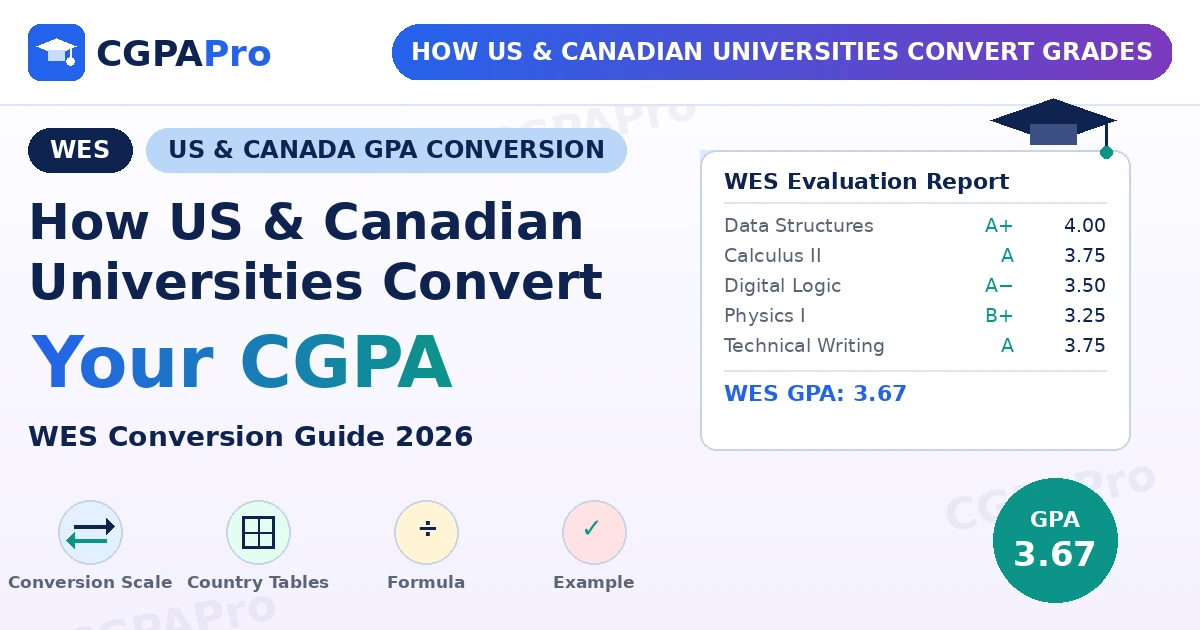
Short answer: WES does not convert your CGPA number — it goes back to your raw marks, converts every course one by one into US letter grades on a 4.0 scale, and computes a brand-new GPA. A Pakistani 3.5, an Indian 8.2, or a Bangladeshi 3.7 on your transcript will rarely survive that process unchanged. This guide shows you exactly how the conversion works in 2026, with real numbers, the official tables (and where they hide), and the worked examples every other article skips.
If you are applying for an MS in the US or a program in Canada, sooner or later you will hit a field on an application form that says “GPA (4.0 scale)”. You have a CGPA from a university in Lahore, Dhaka, or Delhi. These are not the same number, and guessing wrong can quietly sink an application — either you look weaker than you are, or you look dishonest. Let’s fix that properly.
Step 1: Know your local CGPA exactly
Before you convert anything, you need a clean, credit-weighted CGPA on your home scale — not the rough number in your head. WES works from your individual course marks anyway, but every application still asks for both numbers, and most students botch the local calculation too. Use the CGPAPro calculator on the homepage: add each course with its credits and your letter grade, and it does the credit-weighted math for you.
Here is a real example. A student has five courses on the standard 4.0 scale used by most Bangladeshi universities (UGC scale):
- Data Structures — 4 credits — A+ (4.00) → 16.00 grade points
- Calculus II — 4 credits — A (3.75) → 15.00
- Digital Logic — 3 credits — A− (3.50) → 10.50
- Physics I — 3 credits — B+ (3.25) → 9.75
- Technical Writing — 2 credits — A (3.75) → 7.50
Total grade points: 58.75. Total credits: 16. Semester GPA: 58.75 ÷ 16 = 3.67. This is the number we will follow through the rest of the article — keep it in mind.
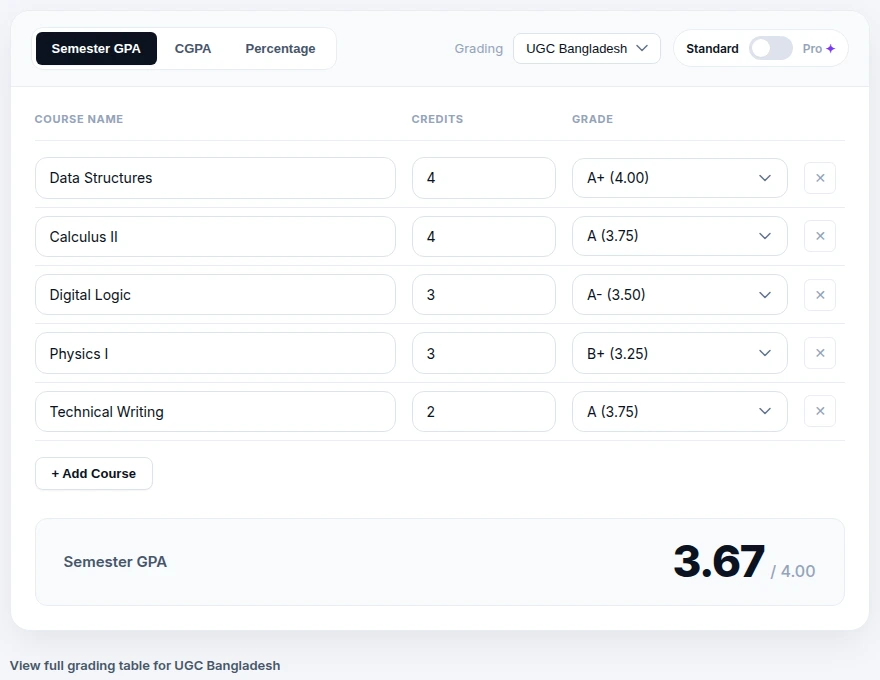
Screenshot: the exact 5-course scenario above, calculated on the CGPAPro homepage calculator. Result: 3.67. (Real capture from cgpacalculatorpro.com, October 2026.)
The math behind it is simple but unforgiving: every course is weighted by its credits. A B+ in a 4-credit course drags you down twice as hard as a B+ in a 2-credit one. If you want the full mechanics, read our guide on how to convert percentage to CGPA — and if the three acronyms confuse you, CGPA vs GPA vs SGPA, explained sorts them out.
The one thing almost nobody tells you: WES converts your marks, not your CGPA
Read that again, because this is where 90% of the confusion lives. When a university asks for a “WES evaluation,” WES does not take the CGPA printed on your transcript and run it through a formula. Instead, a credential evaluator looks at your actual transcript — every subject, every mark — and:
- converts each course’s mark into a US letter grade using WES’s country-specific conversion table,
- assigns US semester credits to each course,
- computes a fresh, credit-weighted GPA on the 4.0 scale.
Your home CGPA is effectively ignored. A student with a 3.6 from FAST and a student with a 3.6 from a small college with easy grading get different WES GPAs if their course marks convert differently. This is also why two students with the same “8.2 CGPA” from two Indian universities can walk away with WES GPAs half a point apart.
Official conversion tables (and where to find them)
WES used to publish a public “Grade Conversion Guide” with a suggested scale per country. As of 2026, that page sits behind a WES login — you can no longer browse the country tables freely, which is exactly why so much guessing goes around. Below are the tables that matter, with honest sourcing.
Pakistan: HEC’s official bands
The Higher Education Commission of Pakistan publishes an official GPA ↔ percentage conversion. Note it is not linear — this trips up everyone who just multiplies by 25:
| CGPA (4.0 scale) | Percentage |
|---|---|
| 3.63 – 4.00 | 90 – 100 |
| 3.25 – 3.62 | 80 – 89 |
| 2.88 – 3.24 | 70 – 79 |
| 2.50 – 2.87 | 60 – 69 |
| 1.80 – 2.49 | 50 – 59 |
| 1.00 – 1.79 | 40 – 49 |
| 0.00 – 0.99 | Below 40 |
So a 3.50 CGPA maps to roughly 86% under HEC bands — not 87.5% as the naive “×25” formula gives. Universities like NUST, LUMS, FAST, and COMSATS follow HEC-style scales (NUST is a touch stricter — the A floor is often 87%). Always check the grading legend printed on the back of your own transcript; that legend beats any online table.
The commonly reported WES pattern for Pakistani transcripts
Because WES’s own table is now login-gated, the pattern below is widely reported by students and consultants — treat it as an estimate, not gospel:
| Percentage | Typical WES grade | Grade points |
|---|---|---|
| 80 – 100 | A | 4.0 |
| 70 – 79 | B | 3.0 |
| 60 – 69 | C | 2.0 |
| 50 – 59 | D | 1.0 |
| Below 50 | F | 0.0 |
Notice how harsh this is compared to HEC bands: a 79% that your university calls a solid B+ (3.3) becomes a flat B (3.0) in WES’s eyes, while an 80% jumps to a full A (4.0). One percentage point can swing a whole grade point. That is the “conversion shock” students post about on forums.
India: the 10-point scale reality
Most Indian universities use a 10-point CGPA. The popular linear estimate is US GPA = (CGPA ÷ 10) × 4 — so an 8.5 becomes a 3.4. That formula is fine for rough shortlisting, but WES’s actual treatment is widely reported to be sharper: a “first class” (60%+) is generally treated as roughly a US B (3.0), and students consistently report WES GPAs landing a bit below the linear estimate — e.g., an 82% aggregate converting to roughly 2.8–2.9 on the 4.0 scale rather than the 3.28 the naive formula suggests. The commonly cited descriptor mapping (third-party estimate):
| 10-point CGPA | Estimated WES GPA | US descriptor |
|---|---|---|
| 9.50 – 10.00 | 4.00 | Outstanding |
| 9.00 – 9.49 | ~3.90 | Excellent |
| 8.50 – 8.99 | ~3.75 | Very good |
| 8.00 – 8.49 | ~3.50 | Good |
| 7.50 – 7.99 | ~3.25 | Good |
| 7.00 – 7.49 | 3.00 | Above average |
| 6.50 – 6.99 | ~2.75 | Average |
| 6.00 – 6.49 | ~2.50 | Satisfactory |
Bangladesh: UGC scale to US grades
Bangladeshi public and private universities mostly use the UGC 4.0 scale (A+ 4.00, A 3.75, A− 3.50, B+ 3.25, B 3.00, B− 2.75, C+ 2.50, C 2.25, D 2.00, F 0.00). Letter grades map essentially one-to-one to US letters, so WES conversion is the least painful here — the main thing to watch is that your university’s percentage bands (e.g., 80%+ = A+ at many universities) are generous compared to WES-style bands, so a transcript in marks needs the course-by-course treatment rather than a straight letter copy.
How WES actually evaluates you: the 6-step process
Understanding the process kills the anxiety. Here is what happens after you apply for a WES course-by-course evaluation:
- Documents. You apply online and your university sends transcripts directly to WES (or through approved digital channels). You do not convert anything yourself at this stage.
- Credential identification. WES identifies your degree and its US/Canadian equivalent (e.g., “Bachelor of Science, equivalent to a US bachelor’s degree”).
- Course-by-course conversion. Each course’s mark is mapped to a US letter grade using WES’s country table for your country. This is the step that decides your GPA.
- Credit assignment. Each course gets US semester credits, usually matching your transcript’s credit hours. Courses without credit hours get WES’s best estimate.
- GPA computation. Grade points × credits, summed and divided by total credits — the same weighted formula as any GPA, just with WES’s grades.
- Report. You get the evaluation report (Basic, or ICAP which also stores verified transcripts for future use). Universities receive the WES GPA — not your home CGPA.
Two things students miss: failed courses count as 0.0 and drag the average down hard, and a cleared backlog usually counts at the passing grade — but the failed attempt can still show on the detailed report. If you retook courses, read how retaking a course affects your CGPA before you apply, because WES and your home university may treat the retake differently.
The formulas everyone quotes (and their limits)
For quick estimation — shortlisting universities, filling “expected GPA” fields, sanity checks — these are the standard formulas. Use them as estimates, never as the final number:
- 10-point CGPA (India): US GPA ≈ (CGPA ÷ 10) × 4. Example: 8.2 → 3.28.
- 4-point CGPA (Pakistan/Bangladesh): US GPA ≈ your CGPA directly, adjusted down if your university grades generously — WES’s bands are harsher at the boundaries.
- Percentage: US GPA ≈ (percentage ÷ 100) × 4 for a rough cut; then cross-check against the country tables above.
- 5-point scale: US GPA ≈ (CGPA ÷ 5) × 4.
Why “estimate”? Because WES converts course-by-course from marks, applies institution-specific judgment, and counts failed attempts — none of which a single formula can capture. Forum after forum shows the same lesson: one student’s WES GPA came out higher than a competing evaluator’s (2.59 → 3.47), another’s came out lower. The formula gives you a neighborhood; WES gives you an address.
Worked example: Pakistani marks through WES-style conversion
Let’s run a full course-by-course conversion the way WES does it, using the commonly reported Pakistan bands. A student has these final marks (all courses 3 credits):
| Course | Marks | WES grade | Points | Grade points (×3 cr) |
|---|---|---|---|---|
| Programming Fundamentals | 82% | A | 4.0 | 12.0 |
| Calculus | 76% | B | 3.0 | 9.0 |
| English Composition | 85% | A | 4.0 | 12.0 |
| Physics | 68% | C | 2.0 | 6.0 |
| Islamiat | 74% | B | 3.0 | 9.0 |
Total grade points: 48.0. Total credits: 15. WES-style GPA: 48 ÷ 15 = 3.20.
Now compare: this student’s home university (HEC-style bands) would likely show around 3.3–3.4 for the same marks. The 76% that earned a B+ (3.3) at home becomes a flat B (3.0) under WES bands. Multiply that boundary effect across 40 courses and you see exactly why the forum posts say “my GPA went down the drain” — and why you must compute from marks, not from your transcript’s CGPA.
6 mistakes that cost students admissions
- Treating the linear formula as the final answer. (CGPA ÷ 10) × 4 is a screening tool. WES’s course-by-course recomputation routinely lands 0.2–0.5 away from it.
- Assuming WES copies your CGPA. It recomputes from raw marks. A generous home grading scale does not survive the trip.
- Ignoring HEC band non-linearity. Pakistani students converting CGPA → percentage with “×25” get a number HEC itself would not recognize. Use the HEC bands.
- Forgetting backlogs and failed attempts. A failed course is 0.0 grade points in the WES math. Clear your academic record’s skeletons before estimating.
- Ordering the wrong WES product. US graduate admissions usually need the course-by-course evaluation; Canadian immigration (Express Entry) needs the ECA. They are different reports with different prices — order the one your recipient asks for.
- Confusing WES US with WES Canada. Separate organizations, separate applications, separate logins. Applying to both countries? You may need both.
5 practical tips for 2026 applicants
- Run the free WES iGPA calculator first. WES’s own iGPA calculator is now free (it used to cost about $5 — many older guides still say otherwise). Enter your actual course marks and get WES’s own estimate before you pay for anything. Their help article explains exactly what it does.
- Read your transcript’s grading legend. The conversion table printed on the back of your transcript is the document WES’s evaluators start from. Photograph it.
- Ask each university. Many US admissions offices recompute international grades with their own tables — some applicants report school-computed GPAs half a point above or below the WES number. A short email to the admissions office (“what is your conversion policy for Pakistani transcripts?”) can change your target list.
- Start documents early. The evaluation itself takes roughly 7–10 business days once WES has everything, but getting your university to send transcripts can take 3–4 weeks. Total: plan for a month or more.
- Know your number before you apply. If your realistic WES-style GPA is around 3.0–3.2, target programs accordingly — and read is a 3.0 CGPA good for jobs, scholarships, and abroad? for an honest breakdown. If it’s below where you want it, these CGPA improvement strategies still apply to your remaining semesters.
FAQ: the questions students actually ask
Will WES convert my CGPA or my marks?
Your marks — course by course. The CGPA on your transcript is not an input to the WES calculation. This is the single most misunderstood fact in the whole process.
My WES GPA came out lower than my home CGPA. Is that normal?
Completely normal, especially for Pakistani and Indian transcripts. WES’s percentage bands are harsher at the boundaries than HEC or most Indian university bands — a 76–79% that was a B+ at home becomes a B (3.0). Forum reports show swings of ±0.5 either way depending on the transcript.
Do backlogs or repeated courses lower my WES GPA?
Yes. Failed attempts count as 0.0 grade points in the weighted average. If you cleared the backlog, the passing grade is typically what counts toward the GPA, but the failed attempt may still appear on the detailed course-by-course report that universities see.
Can I just use the free WES iGPA calculator instead of paying for an evaluation?
For estimating — yes, and you should. For applying — only if the university accepts it. Most US graduate programs that require credential evaluation want the official paid report. Check each program’s admissions page; when in doubt, email them.
Is the WES GPA the number universities use?
Often, but not always. Many admissions offices do their own conversion with their own tables, and some applicants report school-computed GPAs noticeably different from the WES figure. Treat the WES number as your baseline, not your destiny.
WES US or WES Canada — which one do I need?
They are separate services. US university admissions → WES US (usually course-by-course). Canadian immigration (Express Entry/PR) → WES Canada ECA. Canadian university admissions vary by school — check what each one asks for.
Bottom line
WES conversion is not a formula — it is a recomputation. Your marks go in, course by course; a US 4.0 GPA comes out. The students who get surprised are the ones who multiplied their CGPA by something and stopped thinking. The students who get in are the ones who ran their actual marks through the bands, used the free iGPA calculator, and asked each school what it wanted. Do the second thing. Start with your local number on the CGPAPro calculator — like the 3.67 in our worked example — then convert from marks, not from memory.