If you have ever stared at your result card and wondered whether your CGPA is your GPA, whether your friend’s SGPA is the same thing with a different name, or which of these numbers a scholarship form actually wants — you are not alone. This is the single most confusing acronym soup in student life, and a surprising number of articles on the internet explain it wrong.
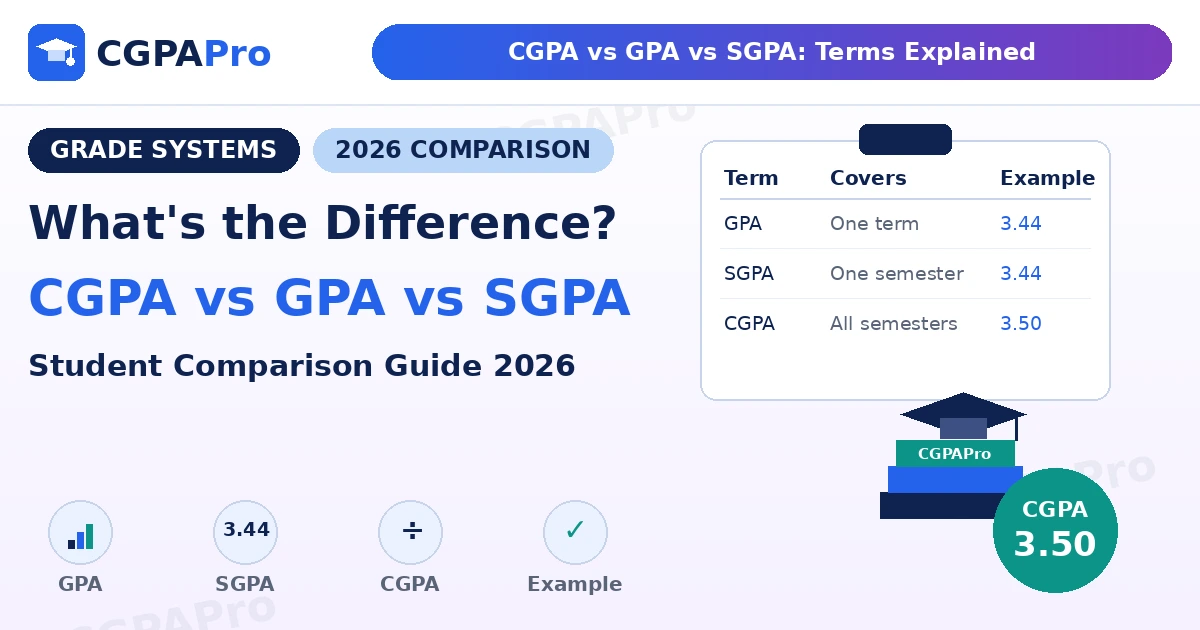
Quick answer: GPA (or SGPA) measures one semester. CGPA measures all semesters together. “SGPA” is the official term in India; in Pakistan, Bangladesh, and Malaysia the same per-semester number is officially called “GPA”. They are the same concept with different passports. And no — you cannot find CGPA by simply averaging your SGPAs. This guide shows the correct math with real numbers, the official rules behind each term, and exactly which number goes on your CV, internship applications, and scholarship forms.
Try It: Calculate Your Semester GPA
Before the theory, here is the tool doing the work. CGPAPro’s free CGPA calculator computes your semester GPA live as you enter courses — the screenshot below shows a real four-course semester on the UGC Bangladesh scale:
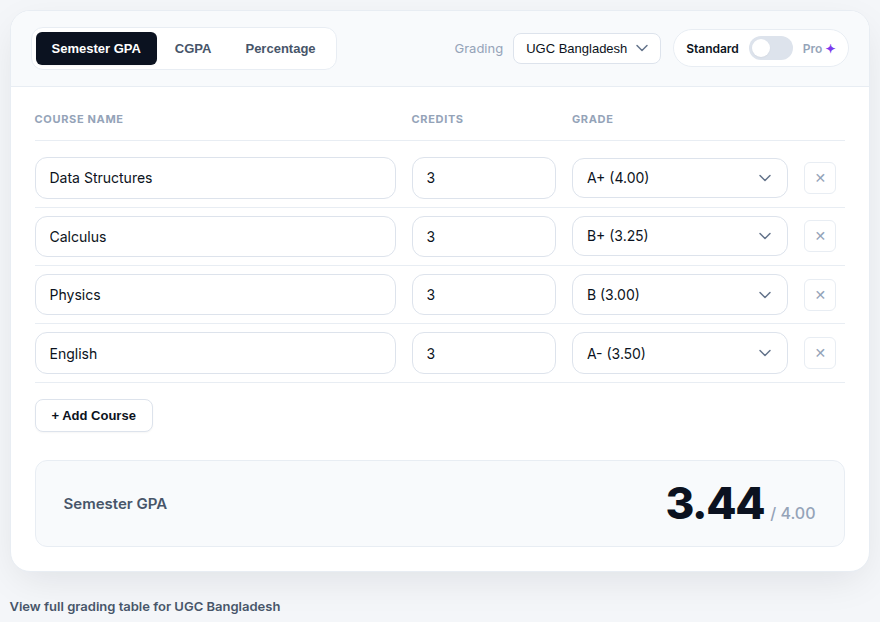
Worked example on the UGC Bangladesh scale: (12.00 + 9.75 + 9.00 + 10.50) ÷ 12 credits = 41.25 ÷ 12 = 3.44. That 3.44 is this semester’s GPA — the number the next section calls SGPA in India. Try your own grades on the CGPAPro CGPA calculator.
The Country Naming Map: Why Everyone Is Confused
The confusion is not your fault. Universities in different countries literally use different names for the same per-semester number:
| Country | Per-semester figure is called | Cumulative figure is called | Scale |
|---|---|---|---|
| India | SGPA (Semester Grade Point Average) | CGPA | 10-point (UGC CBCS) |
| Pakistan | GPA | CGPA | 4.0 (HEC) |
| Bangladesh | GPA | CGPA | 4.0 (UGC uniform) |
| Malaysia | GPA | CGPA | 4.0 |
The Indian UGC’s Choice Based Credit System guidelines define SGPA and CGPA on a 10-point scale. Pakistan’s HEC semester examination policy defines GPA (per semester) and CGPA (cumulative) — the word “SGPA” does not appear in the HEC policy at all. In Bangladesh, the UGC’s uniform grading system likewise uses GPA per semester: an official International Islamic University Chittagong notice states students must obtain “minimum GPA 2.00 in each semester” and “minimum CGPA 2.50 for awarding degree”. Malaysian universities use GPA/CGPA the same way.
So when a Pakistani or Bangladeshi student says “my GPA is 3.44” and an Indian student says “my SGPA is 8.2”, they are talking about exactly the same thing: one semester’s weighted average. The concept is identical; only the name on the transcript differs.
What Each Term Actually Means
GPA — Grade Point Average (one semester or term)
GPA is the weighted average of your grade points for the courses in a single semester or term. In Pakistan, Bangladesh, and Malaysia this is the official name of the number. It resets every semester: your GPA in semester 3 says nothing about semesters 1 and 2.
SGPA — Semester Grade Point Average (one semester, India)
SGPA is India’s official name for the same thing. The UGC defines it as:
SGPA = Σ(Ci × Gi) ÷ ΣCi
…the sum of (credits × grade point) for every course in the semester, divided by the total credits of that semester. UGC requires SGPAs to be rounded to two decimals on transcripts.
CGPA — Cumulative Grade Point Average (your whole degree so far)
CGPA is the weighted average across all semesters completed so far. It is the number on your final degree, the number scholarship committees ask for, and the number employers mean when a job ad says “minimum CGPA 3.0”. The UGC defines it as:
CGPA = Σ(Ci × Si) ÷ ΣCi
…where Si is the SGPA of semester i and Ci is that semester’s total credits. Pakistan’s HEC defines it the same way: the sum of (credit hours × grade points) for all courses in all semesters, divided by total credit hours taken in all semesters.
The two sentences that end 90% of the confusion:
- GPA/SGPA = how you did in one semester.
- CGPA = how you have done across everything so far.
The Math Trap: Why “Averaging Your SGPAs” Is Wrong
Here is the mistake the internet keeps teaching. Plenty of calculator sites and blogs say: “CGPA = sum of all your SGPAs ÷ number of semesters.” That formula is only correct if every semester has exactly the same number of credits — which almost never happens.
Let me prove it with the UGC’s own numbers. Take three semesters:
- Semester 1: 20 credits, SGPA 6.9
- Semester 2: 22 credits, SGPA 7.8
- Semester 3: 25 credits, SGPA 5.6
The wrong way (simple average): (6.9 + 7.8 + 5.6) ÷ 3 = 20.3 ÷ 3 = 6.77
The right way (credit-weighted, per the UGC formula):
(20 × 6.9 + 22 × 7.8 + 25 × 5.6) ÷ (20 + 22 + 25)
= (138.0 + 171.6 + 140.0) ÷ 67
= 449.6 ÷ 67 = 6.71
The simple average overstates the CGPA by 0.06 — and the gap grows wider when credits differ more (a project-heavy final year, for example). The semester with more credits counts more. Always weight by credits; never just average.
Same rule on a 4.0 scale, for Pakistani and Bangladeshi students:
- Semester 1: 15 credits, GPA 3.20
- Semester 2: 18 credits, GPA 3.60
CGPA = (15 × 3.20 + 18 × 3.60) ÷ 33 = (48.0 + 64.8) ÷ 33 = 112.8 ÷ 33 = 3.42. A simple average would give 3.40 — close, but wrong, and wrong in the direction that costs you when a cutoff is 3.42.
One more truth the numbers teach: a single great semester barely moves a long CGPA. If your CGPA after five semesters is 3.10, even a perfect 4.00 sixth semester of equal credits only lifts it to about 3.25. That is why early semesters matter so much — and why retaking a failed or low-grade course can be the highest-leverage move available.
Side-by-Side Comparison
| GPA | SGPA | CGPA | |
|---|---|---|---|
| Full form | Grade Point Average | Semester Grade Point Average | Cumulative Grade Point Average |
| Covers | One semester | One semester | All semesters so far |
| Official where | Pakistan, Bangladesh, Malaysia | India (UGC CBCS) | Everywhere |
| Resets each semester? | Yes | Yes | No — it accumulates |
| On your final degree | No | No | Yes — this is the number |
| What goes on scholarship forms | Almost never | Almost never | Yes |
| Example | 3.44 (one term) | 3.44 / 8.20 (one semester) | 3.50 / 7.90 (cumulative) |
Anatomy of a Transcript: Where Each Number Lives
Picture a typical semester result card. At the bottom of the semester’s course list sits the semester GPA (or SGPA) — “this is how you did this term.” Below that, or in a running summary box, sits the CGPA — “this is how you have done since day one.”
Early in your degree the two numbers swing close together, because one semester is most of your history. By final year they diverge: your semester GPA can be 3.80 while your CGPA sits at 3.45, because the CGPA still carries every earlier semester. Neither number is “wrong” — they just answer different questions.
Which Number Goes Where: The Practical Guide
This is the part no competitor article answers properly. Use this decision rule:
- Your CV / resume — final CGPA (with scale: “CGPA 3.50/4.00”). Never a single semester’s GPA.
- Mid-degree internship applications — latest semester GPA/SGPA and CGPA to date. Recruiters read “latest semester 3.80, CGPA 3.45” as “improving trajectory” — it tells a better story than either number alone.
- Scholarship and government forms — exactly what the eligibility line says, and it says CGPA nine times out of ten. HEC’s Overseas PhD requires CGPA 3.0/4.0; Malaysia’s MTCP and Malaysia International Scholarship both require CGPA 3.0; several Malaysian scholarships require maintaining CGPA 3.00 in the latest semester. When a form asks for “CGPA”, your semester GPA is never the right answer.
- Study-abroad applications — the scale the receiving university asks for, using their conversion table. Do not home-brew a conversion: a 3.0/4.0 is a strong B under HEC’s bands but maps to 6.0 (“average”) on India’s 10-point scale — the scales are not proportional, and multiplying by 2.5 is fiction. Check the university’s own equivalency table (WES, DAAD, or the admissions page).
What Each Number Actually Gates: The Stakes
These terms are not just labels — they are thresholds with real consequences:
- Graduation floors (Pakistan, HEC): minimum CGPA 2.00 for a BS degree, 2.50 for MS/MPhil. Fall below and you do not graduate.
- Probation lines: Malaysian universities commonly put students on academic probation when CGPA dips under 2.00 (UiTM’s published threshold). In Bangladesh, the UGC uniform system requires minimum GPA 2.00 each semester.
- Degree classes (Bangladesh): CGPA 3.00–4.00 = 1st class, 2.25–2.99 = 2nd class, 2.00–2.24 = 3rd class. A 3.0 in Bangladesh carries real classification weight.
- Scholarship lines: CGPA 3.0/4.0 is the magic number across HEC, MTCP, and MIS applications.
- Pakistan’s percentage gotcha: HEC maps a CGPA to the minimum percentage of its band — a 3.00 CGPA officially equals 71%, not 75%. If a form wants your percentage, use the band minimum, not a straight multiplication. (Our CGPA-to-percentage guide covers this in full.)
Common Mistakes Students Make
- Averaging SGPAs to get CGPA. The #1 math error on the internet — weight by credits, always.
- Reading the latest SGPA as the CGPA. “My 7th-semester SGPA is 8.2, so my CGPA is 8.2” — no. Your CGPA includes semesters 1–6 too.
- Writing GPA where the form asks for CGPA. Semester numbers inflate or deflate your record; scholarship committees check the cumulative figure.
- Assuming 1st-class in one country equals 1st-class in another. A 3.00/4.00 in Bangladesh is 1st class; on India’s 10-point scale 6.0 is firmly average. Context travels with the scale.
- Converting scales by multiplying. “8.5 CGPA × 0.4 = 3.4 GPA” is not a real conversion. Only the receiving institution’s table counts.
- Thinking “GPA” and “SGPA” are different concepts. They are the same weighted-average idea with different national names. If your Pakistani transcript says GPA 3.44, an Indian reader should read it as SGPA 3.44.
Tips to Keep Your Numbers Healthy
- Protect early semesters. Because CGPA is credit-weighted and cumulative, a weak first year drags for the rest of the degree. The earlier you stabilize, the cheaper every future semester becomes.
- Attack low-credit courses last. A 1-credit lab moves the needle far less than a 4-credit theory course — allocate study hours proportionally to credit weight.
- Use retakes strategically. Many universities replace the old grade when you repeat a course — one replaced F can lift a CGPA more than a semester of B’s. Check your university’s exact replacement rule first.
- Track both numbers monthly. Know your current semester GPA (where you stand now) and your CGPA (where you stand overall) — the gap between them tells you whether you are climbing or sliding.
- Put the scale on everything. “3.50” is meaningless without “/4.00” or “/10”. Always write CGPA with its scale on CVs and forms.
Frequently Asked Questions
Is CGPA the same as GPA?
No. GPA (or SGPA) covers one semester; CGPA covers all semesters cumulatively. The one exception is the US system, where “GPA” is often used for the cumulative figure — which is exactly why international students get confused.
Is SGPA the same as GPA?
Yes, in practice. SGPA is the official Indian term for the per-semester weighted average; Pakistan, Bangladesh, and Malaysia officially call the same number “GPA”. Same concept, different passport.
How do I calculate CGPA from SGPA?
Credit-weight it: CGPA = Σ(semester credits × semester SGPA) ÷ Σ(semester credits). Do not take a simple average unless every semester has identical credits. See the worked example above.
Which is more important, GPA or CGPA?
CGPA — it is on your degree, and it is what scholarships, graduate schools, and employers ask for. Semester GPA matters as the building block and as a trend signal (“improving every semester” reads well in interviews).
Can I convert my CGPA from a 4.0 scale to a 10-point scale?
Not with a universal formula. The scales are not proportional — grade bands differ by country and institution. Use the receiving university’s official equivalency table.
What is a good CGPA?
On a 4.0 scale, 3.50+ is strong in most contexts; 3.00 is the common scholarship and 1st-class cutoff. On India’s 10-point scale, 8.0+ is the equivalent strong zone. (See Is 3.5 CGPA Good? for the full breakdown.)
Does a retaken course change my CGPA or my GPA?
Both — the new grade enters the semester it was retaken in (changing that semester’s GPA/SGPA) and flows into the cumulative CGPA. Many universities use grade replacement, which makes retakes the highest-leverage CGPA move available.
The Bottom Line
GPA and SGPA are the same per-semester number wearing different national uniforms; CGPA is the running total of all of them, credit-weighted — never simply averaged. Get the names right for your country, get the math right with credit weights, and always put the cumulative CGPA (with its scale) on any form that matters. Your transcript already computes these numbers for you; understanding them means you can plan them.
Calculate your own numbers with the free CGPAPro CGPA calculator, and if you are in Pakistan, also check the admission aggregate guide for how CGPA feeds into university merit formulas.