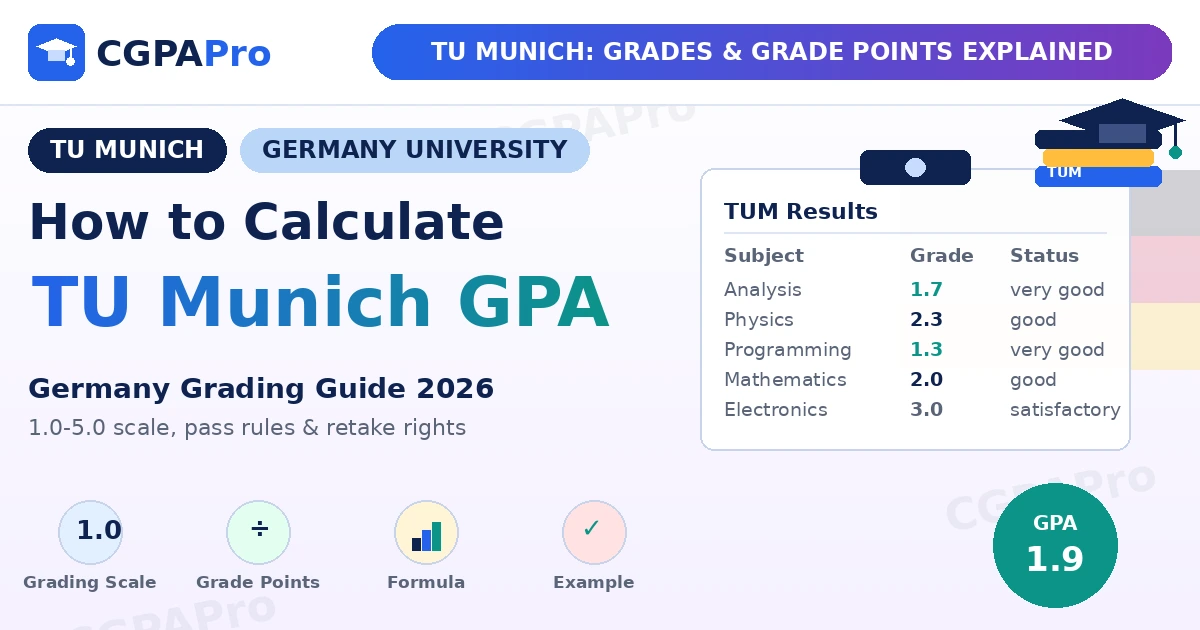
Quick answer: TU Munich grades on the German 1.0–5.0 scale, where 1.0 is the best grade and 4.0 is the lowest passing grade — anything 4.1 or worse is a fail. A 1.7 is “very good,” a 2.0 is solidly “good,” and there is no such thing as a 4.7 on a TUM transcript: the fail grade is simply 5.0. If you are converting to a US-style GPA, treat 1.0 ≈ 4.0 and 4.0 ≈ 2.0–2.5 as a rough approximation — but read the conversion section below before you put any number on a résumé, because doing it wrong is the most common mistake TUM students make.
Every year, thousands of students arrive at the Technische Universität München — Germany’s top-ranked technical university — and run straight into a grading system that feels upside down. In most of the world, bigger numbers mean better grades. In Germany, the smaller the number, the better you did. A 1.0 is perfection. A 5.0 means you failed. And the rules that decide what sits on your final transcript come not from your professor’s mood but from a university-wide regulation called the APSO (the general academic and examination regulations), which this guide follows section by section.
Below you will find the official TUM grade scale, the exact pass/fail boundaries, how module and overall grades are calculated (including the truncation rule almost every blog gets wrong), retake rights, the truth about ECTS grades at TUM, and honest German-to-US GPA conversion — all with worked examples.
Use the TU Munich GPA Calculator
Before the theory, here is the fastest way to get a number. Open our TU Munich GPA calculator, add your courses one by one, enter the credit weight of each, and pick the band closest to your German grade — Sehr gut for the 1.x range, Gut for 2.x, Befriedigend for 3.x, Ausreichend for 4.x. The tool instantly shows your GPA on the familiar 4.0 scale. Here is a filled-in example:
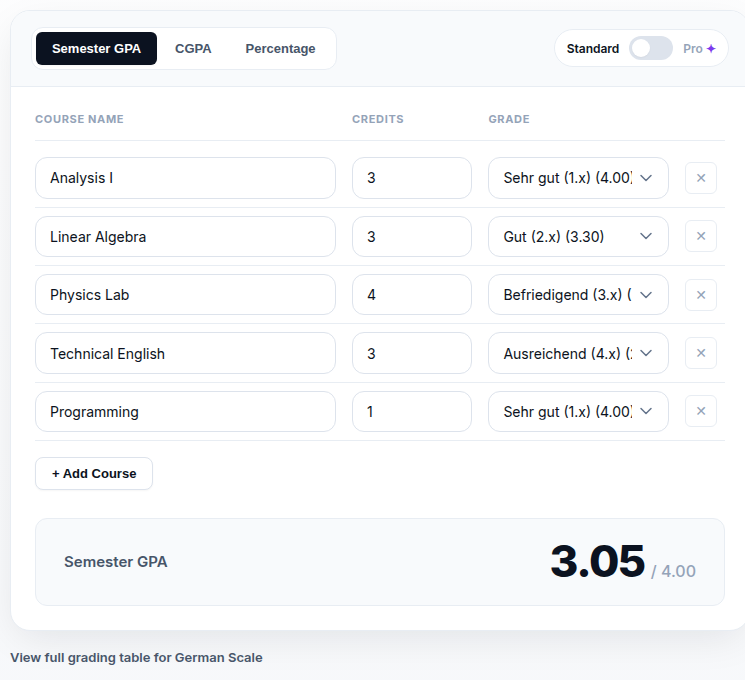
Screenshot: a 5-course example on the live calculator — Analysis I (Sehr gut), Linear Algebra (Gut), Physics Lab (Befriedigend), Technical English (Ausreichend) and Programming (Sehr gut), 14 credits in total, giving 42.70 grade points ÷ 14 = 3.05. Note: the calculator maps whole German bands to US-style GPA values as an approximation; TUM itself never converts grades this way. For the official German average, use the APSO method in the worked example below.
The calculator is a planning aid. Your transcript, your retake rights, and your degree classification all run on the official German numbers — which is what the rest of this guide covers.
The Official TUM Grade Scale (APSO §17)
TUM’s grading rules live in §17 of the APSO. There are two layers to understand: the grades an examiner can actually award for a single exam, and the averaged grades that decide pass/fail and your degree classification.
Exam grades — what your professor can give you
For an individual exam, the examiner awards whole grades 1 (“very good”) through 5 (“fail”), and may differentiate each by ±0.3 — except that 0.7 and 5.3 are excluded. So the complete list of grades that can appear on an exam is:
| Grade | German designation | Meaning |
|---|---|---|
| 1.0, 1.3 | sehr gut | very good |
| 1.7, 2.0, 2.3 | gut | good |
| 2.7, 3.0, 3.3 | befriedigend | satisfactory |
| 3.7, 4.0 | ausreichend | sufficient |
| 5.0 | nicht bestanden | fail |
Two things to notice. First, there is no 4.3 and no 4.7 as an awarded grade — examiners jump straight from 4.0 to 5.0. Second, when several examiners grade the same exam, their grades are averaged to one decimal place and all further decimals are discarded without rounding. An average of 2.57 becomes 2.5, not 2.6. This truncation rule — not rounding — applies everywhere at TUM, and it is the detail most grade calculators on the internet get wrong.
Module grades — where pass and fail are decided
A module (a course unit, usually made of several exams or components) is graded on the averaged scale, and this is the scale that decides whether you passed:
| Module average | Designation | Result |
|---|---|---|
| up to 1.5 | very good | ✅ Pass |
| 1.6 – 2.5 | good | ✅ Pass |
| 2.6 – 3.5 | satisfactory | ✅ Pass |
| 3.6 – 4.0 | sufficient | ✅ Pass — 4.0 is the lowest pass |
| 4.1 and above | fail | ❌ Fail |
This table answers the single most-asked question about German grading: is 4.0 a fail? No. 4.0 is the lowest passing grade. The fail zone starts at 4.1. And yes — 4.7 is a fail, even though no examiner ever awards it; any averaged grade from 4.1 upward is “fail” under §17(4), and a module only counts as passed when it is graded at least “sufficient” (4.0) under §23(1).
Your Diploma Designation: What the Final Number Says
When you graduate, your overall grade carries one of five official designations (§17(6)):
| Overall grade | Diploma designation |
|---|---|
| up to 1.2 | passed with high distinction |
| 1.3 – 1.5 | passed with distinction |
| 1.6 – 2.5 | passed with merit |
| 2.6 – 3.5 | satisfactorily passed |
| 3.6 – 4.0 | passed |
If you are job-hunting in Germany, know this table cold. German employers read these designations fluently: anything in the “merit” band (1.6–2.5) is a strong degree, and “distinction” (1.3–1.5) is genuinely elite. Many international students underestimate themselves here — a 2.0 that feels mediocre next to a 4.0-scale GPA is, in German eyes, a firmly good degree.
How TUM Calculates Your Grades: Step by Step
Step 1 — The module grade (credit-weighted)
A module grade is the average of its component grades, weighted by their credit weights (§17(3)). Suppose your “Mathematics” module has a written exam (weight 4) graded 2.3 and a coursework component (weight 2) graded 1.7:
Module grade = (2.3 × 4 + 1.7 × 2) ÷ (4 + 2) = (9.2 + 3.4) ÷ 6 = 12.6 ÷ 6 = 2.10 → 2.1 (“good”).
Remember the truncation rule: had the average come out 2.17, the recorded module grade would be 2.1, not 2.2. Decimals beyond the first are simply cut off.
Step 2 — The overall grade (ECTS-weighted)
Your overall grade is the weighted average of all your modules — including the final thesis module — where each module’s weight is the number of ECTS credits it awards (§17(5)). Modules that consist only of coursework (ungraded pass/fail) do not enter the calculation. Worked example for a first-year student:
| Module | ECTS | Grade | Weight contribution |
|---|---|---|---|
| Mathematics | 8 | 1.7 | 13.6 |
| Physics | 6 | 2.3 | 13.8 |
| Programming | 5 | 1.3 | 6.5 |
| Technical Drawing | 4 | 3.0 | 12.0 |
| Seminar | 3 | 2.0 | 6.0 |
| Total | 26 | 51.9 |
Overall grade = 51.9 ÷ 26 = 1.9961… → truncate to one decimal → 1.9. That lands in the 1.6–2.5 band: “good,” and a degree finished at this level would be “passed with merit.” Notice how the 8-credit Mathematics module pulls more than twice the weight of the 3-credit Seminar — at TUM, heavy modules decide your final number.
Two fine-print rules worth knowing: if you complete more elective credits than your program requires, you must tell the Examination Committee which results should count (your choice is binding). If you say nothing, the best results up to the required credit total are counted — a small mercy built into the regulations. And individual programs can override the weighting in their own examination regulations (FPSO): in TUM’s BSc Aerospace, for example, the bachelor’s thesis counts double on top of its 12 credits.
The formula, in one line
Overall grade = Σ (module grade × ECTS credits) ÷ Σ (ECTS credits), truncated to one decimal place.
German Grades vs GPA vs CGPA
Students coming from 4.0-scale systems constantly mix up three different numbers:
- German grade (TUM): 1.0 (best) to 5.0 (fail), per module and overall, calculated as above. This is the only number that officially exists at TUM.
- GPA (US-style): 0.0–4.0, where 4.0 is best. TUM does not award this. Any “TUM GPA” you see is a conversion someone made after the fact.
- CGPA: the cumulative version of GPA across semesters — again, a 4.0-scale concept. At TUM the equivalent idea is simply your overall grade so far, still on the 1.0–5.0 scale.
The direction of the scale is the entire trap: on a German transcript, your number should go down over time as you improve. A student who “raised their GPA from 2.8 to 2.1” at TUM has actually gotten much better — while the same sentence at an American university would mean the opposite.
Retakes at TUM: Your Rights After a Fail
TUM’s retake rules (§24) are more generous than most students fear — and stricter than most hope — in specific ways:
- Failed exams in required and required-elective modules must be repeated, normally within 6 months of the result notification, and a repeat sitting is offered every semester.
- Only failed exams may be repeated. You cannot re-sit a passed exam to polish a 3.3 into a 2.0 — unless your program’s own regulations explicitly allow one voluntary repeat (§24(10)), in which case the better of the two grades counts.
- Ordinary failed module exams can be repeated as often as necessary — there is no fixed “three attempts and you’re out” rule at the APSO level. The real constraint is §10’s progress-monitoring deadlines: fall too far behind overall and your examination entitlement ends.
- GOP (fundamentals/orientation) exams are the exception: programs typically allow only one repeat of a failed GOP exam, so treat those sittings as precious.
- Failed elective modules can simply be swapped for a different elective module you pass — you are not chained to a subject that isn’t working.
- The final thesis and colloquium can be repeated only once. A second failure there ends the degree.
- One procedural safeguard: if your supervisor grades the thesis “not passed,” a second examiner is mandatory, and the average is rounded to the nearest scale grade — ties go to the better grade (§18).
The strategic takeaway: at TUM, a fail is recoverable and the system gives you time — but it gives you almost no way to improve a grade you already passed. Put your energy into first sittings, not rescue plans.
ECTS Grades at TUM: The Table That Doesn’t Exist
Search “German grade to ECTS” and you will find neat tables mapping 1.0 → A, 1.3–1.7 → B, and so on. Those tables do not describe TUM. Under APSO §17(7), TUM issues cohort-based ECTS Grading Tables for each module, computed from the actual results of the preceding two years — passed examinations only. Your ECTS grade tells a reader where you stood relative to your own cohort in that module, not where your 1.7 sits on a fixed international chart.
This matters whenever someone asks for your “ECTS grade”: the honest answer is the cohort table on your TUM transcript documents, not a conversion chart from a blog. Any article handing you a fixed 1.0=A table and calling it TUM’s is working from the pre-2009 ECTS system TUM no longer uses.
Converting German Grades to US GPA (Read This Before Your Résumé)
Here is the uncomfortable truth: there is no official German-to-US-GPA conversion table. WES (World Education Services) evaluates German credentials course-by-course and publishes no German conversion table at all. So what should you actually do?
- For applications through TUM itself (e.g., if you earned grades outside Germany and are applying in), TUM uses the modified Bavarian formula: x = 1 + 3 × (Nmax − Nd) ÷ (Nmax − Nmin), truncated to one decimal — where Nmax is the best achievable grade, Nmin the lowest pass, and Nd your grade. Example: a score of 80 on a 50–100 scale → 1 + 3 × (100 − 80) ÷ (100 − 50) = 1 + 1.2 = 2.2. TUM even runs its own official online grade-conversion tool for this.
- For US résumés and applications, the most-cited institutional approximation is Princeton’s published conversion chart — and Princeton adds a strict phrasing rule: always print both values, e.g. “3.3 (USA) ≈ 1,7 (Germany)”, so no reader mistakes your converted number for an official one. A common rough mapping used in practice: 1.0–1.5 ≈ 4.0, 1.6–2.0 ≈ 3.7, 2.1–2.5 ≈ 3.3, 2.6–3.0 ≈ 3.0, 3.1–3.5 ≈ 2.7, 3.6–4.0 ≈ 2.0–2.5. Treat every such table as an approximation, never as an official conversion — and see our WES CGPA conversion guide for how credential evaluators actually handle German transcripts.
📖 Read more: WES CGPA Conversion Guide 2026 — how WES evaluates German and other international grades for US/Canada applications.
Common Mistakes TUM Students Make
- Thinking 4.0 is a fail. It is the lowest pass. Celebrate it, then move on.
- Assuming 4.7 exists. No examiner awards it. If a module average lands at 4.1 or above, it is simply a fail.
- Rounding instead of truncating. A 2.59 module average is recorded as 2.5. Over a full degree, truncation systematically shaves hundredths off — plan for it.
- Converting grades with a random blog table and calling it official. On applications, write the German grade and mark conversions as approximate. Misrepresenting a converted GPA as awarded can backfire in background checks.
- Trying to re-sit a passed exam. Not allowed (unless your FPSO grants the voluntary repeat). Your 3.3 is your 3.3.
- Ignoring the 6-month repeat window. Failed required exams must normally be repeated within 6 months of notification — the clock starts whether you feel ready or not.
- Forgetting ECTS weights. A 1.0 in a 3-credit seminar does not cancel a 4.0 in a 10-credit core module. Weight your effort by credits.
Tips for a Strong TUM Grade Average
- Front-load effort into high-credit modules. The overall grade is ECTS-weighted, so a 6-credit module moves your average twice as much as a 3-credit one.
- Declare your best electives. If you overshoot the required elective credits, notify the Examination Committee which results count — otherwise the best ones are picked automatically, which is fine, but an explicit declaration avoids surprises.
- Protect your GOP sittings. With typically only one repeat allowed, fundamentals exams deserve disproportionate preparation.
- Use the voluntary repeat if your program offers it. One grade-improvement re-sit per program can be worth a full tenth on your overall grade — check your FPSO.
- Track your running average every semester with the TU Munich calculator so there are no surprises in your final year.
Frequently Asked Questions
Is a 1.7 a good grade at TU Munich?
Yes — very good, literally. 1.7 sits in the “very good” examiner band, and any overall average up to 1.5 earns “passed with distinction” on the diploma. A 1.7 overall puts you comfortably in the top slice of graduates.
Is 4.0 a pass or fail at TUM?
Pass — it is the lowest passing grade (“sufficient”). The fail zone starts at 4.1 for averaged module grades, and the exam-level fail grade is 5.0.
Does TUM round grades up?
No. Averaged grades keep one decimal place and further decimals are discarded without rounding: 2.57 becomes 2.5. The one exception is thesis grading with two examiners, where the average is rounded to the nearest scale grade (ties to the better grade).
How many times can I retake a failed exam at TUM?
Ordinary failed module exams can be repeated as often as necessary, subject to overall progress-monitoring deadlines — but GOP/fundamentals exams are usually limited to one repeat, and the thesis to one repeat total. Failed exams must normally be repeated within 6 months.
Can I retake an exam I passed to improve my grade?
Generally no. Passed exams cannot be re-sat for grade improvement unless your program’s examination regulations (FPSO) explicitly allow a voluntary repeat — and even then, only the better grade counts.
What is a good GPA equivalent of a 2.0 German grade?
Roughly 3.7 on the US 4.0 scale — but there is no official conversion. WES evaluates German transcripts course-by-course, and Princeton’s guidance is to always show both numbers (e.g., “3.3 (USA) ≈ 1,7 (Germany)”) and label conversions as approximate.
Does TUM use ECTS A–F grades?
Not as a fixed table. TUM issues cohort-based ECTS Grading Tables per module, computed from the previous two years of passed results. Fixed “1.0 = A” charts you find online do not reflect TUM’s system.
Conclusion
The TU Munich grading system looks intimidating because it runs backwards — but it is one of the most precisely documented systems in European higher education. Remember the load-bearing facts: 1.0 is best, 4.0 is the lowest pass, 5.0 is the fail; averages truncate instead of rounding; your overall grade is ECTS-weighted across every module including the thesis; failed exams can be repeated but passed ones (almost) never improved; and there is no official ECTS letter table or US-GPA conversion — only cohort tables and honest approximations.
Run your numbers through the TU Munich GPA calculator each semester, weight your effort by ECTS credits, and guard your GOP sittings. Do that, and the upside-down scale starts working in your favor.
📖 Read more: UK Degree Classification to CGPA Conversion — how British First/2:1/2:2 classes map to GPA scales, useful if you are comparing German and UK offers.
Sources: TUM APSO (General Academic and Examination Regulations), English clean version — official PDF; TUM grade conversion formula for grades earned outside Germany — tum.de; Princeton GPA conversion instructions & chart — german.princeton.edu.