If you are staring at a UK university’s entry requirements and trying to work out uk degree classification to cgpa conversions, here is the truth that can save you a rejected application: there is no single conversion table. The same university — the University of Sheffield — officially draws the 2:1 line at CGPA 3.25 for students from Bangladesh and at CGPA 2.8 for students from Pakistan. Same course, same requirement, two different numbers. So if you are converting your degree class into a CGPA — or your CGPA into a UK class — the only table that counts is the one published by the university you are actually applying to. This guide lays out the system, the official tables side by side, the borderline rules nobody tells you about, and worked applicant scenarios you can check yourself against.
The Quick Answer
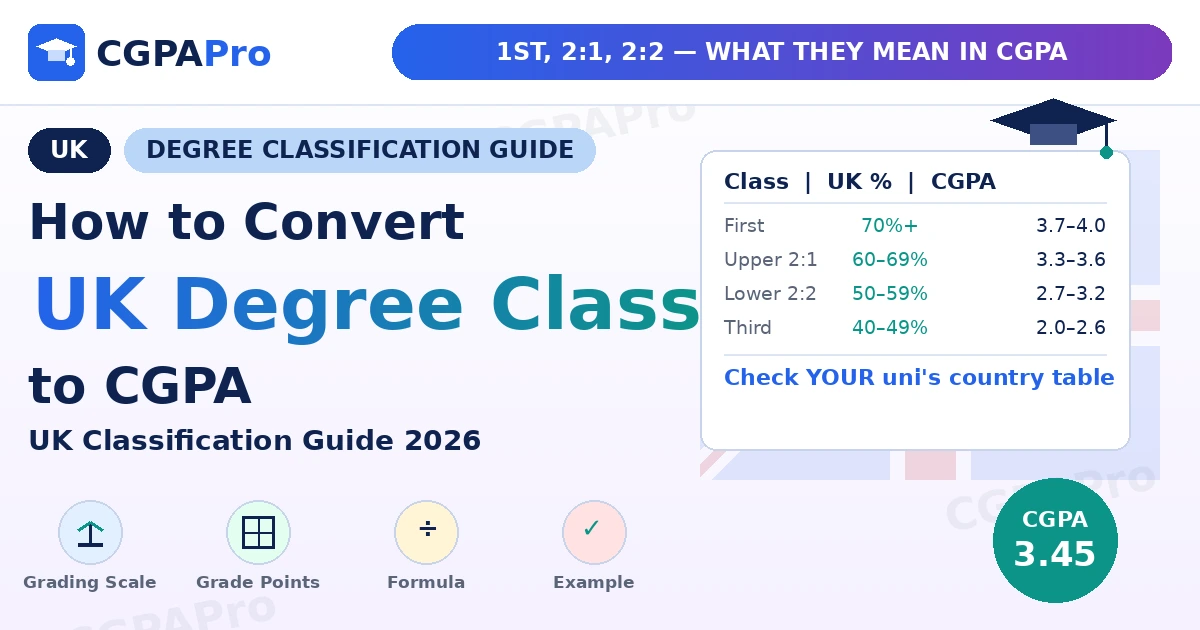
| UK class | UK marks | Rough CGPA (4.0) |
|---|---|---|
| First Class Honours | 70% and above | 3.7 – 4.0 |
| Upper Second Class Honours (2:1) | 60 – 69% | 3.3 – 3.6 |
| Lower Second Class Honours (2:2) | 50 – 59% | 2.7 – 3.2 |
| Third Class Honours | 40 – 49% | 2.0 – 2.6 |
That is the commonly quoted rough mapping — the one you will find on study-abroad sites like postgrad.com. It is useful as a first orientation and dangerous as a final answer, because individual universities set different lines by country. The rest of this article shows you exactly where those lines sit and which one applies to you.
Try It Yourself: Compute Your CGPA in 60 Seconds
Before matching your number against any table, get your number right. Open the Semester GPA calculator on the cgpacalculatorpro.com homepage and add one row per course: the credit hours, then your letter grade from the dropdown. Hit calculate. If you are still studying, try the grades you expect next semester and see where your CGPA would land — that is the number you will be comparing against the tables below.
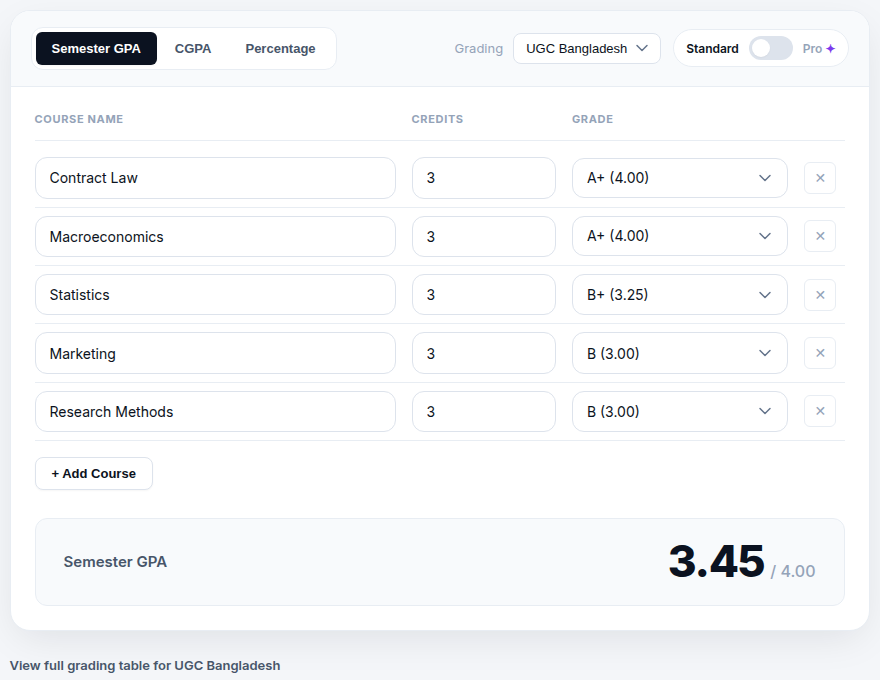
Screenshot: the homepage Semester GPA calculator with the official UGC Bangladesh 4.0 scale selected (A+ 4.00, A 3.75, A− 3.50, B+ 3.25, B 3.00, B− 2.75, C+ 2.50, C 2.25, D 2.00, F 0.00). Five 3-credit courses — two A+ (4.00), one B+ (3.25), two B (3.00). The worked example deliberately uses grades that carry identical points on any standard 4.0 scale, so the arithmetic below is the same wherever your transcript comes from.
Worked Example: Five Courses to Exactly 3.45
Let us hand-check the calculator, course by course. Five 3-credit courses on a standard 4.0 scale:
| Course | Credits | Grade | Grade points | Weighted |
|---|---|---|---|---|
| Contract Law | 3 | A+ (4.00) | 4.00 | 3 × 4.00 = 12.00 |
| Macroeconomics | 3 | A+ (4.00) | 4.00 | 3 × 4.00 = 12.00 |
| Statistics | 3 | B+ (3.25) | 3.25 | 3 × 3.25 = 9.75 |
| Marketing | 3 | B (3.00) | 3.00 | 3 × 3.00 = 9.00 |
| Research Methods | 3 | B (3.00) | 3.00 | 3 × 3.00 = 9.00 |
| Total | 15 | 51.75 |
The arithmetic, exactly as the calculator shows it: grade points 12 + 12 + 9.75 + 9 + 9 = 51.75 ÷ 15 = 3.45/4.00.
Hold that 3.45 in your head. We are going to run it against the real university tables below, and the result will surprise you.
The UK Classification System, Properly Explained
The British honours system runs on four classes, awarded on your final average percentage — not on a GPA:
| Class | Average marks | What it signals |
|---|---|---|
| First Class Honours (1st) | 70% and above | The top band — the one competitive master’s courses and top employers prize |
| Upper Second Class Honours (2:1) | 60 – 69% | The standard graduate-school and grad-scheme threshold |
| Lower Second Class Honours (2:2) | 50 – 59% | Honours, but below the 2:1 filter many employers apply |
| Third Class Honours (3rd) | 40 – 49% | The lowest honours award |
Below the honours line sits the Ordinary (or Pass) degree, roughly 35–39%, and anything below 40% is a Fail. Taught master’s degrees use different labels but the numbers rhyme with the undergraduate ladder: Distinction at 70%+, Merit at 60–69%, Pass at 50–59%, Fail below 50%.
Now the thing that confuses every South Asian student: UK marking is deliberately strict. In a Pakistani, Bangladeshi or Indian exam system, 90%+ is an achievable top mark that strong students hit regularly. In the UK, 70% is the ceiling that defines excellence — a first-class mark. A UK 70% carries roughly the weight of a 90%+ back home, and marks above 80 are genuinely rare. These days roughly a third of UK graduates leave with a First and nearly half with a 2:1, which means a “mere” 2:1 is a genuinely strong result — it is the outcome half the country’s graduates are aiming for.
For the standard plain-English walkthrough of how UK grades work, Prospects’ guide to understanding UK university grades is the reference most students and advisers use.
How Your Class Is Actually Computed (It Is Not What You Think)
If you assume classification is just “average all my module marks,” you are missing the two things that actually decide borderline cases.
1. Credit weighting, with a heavier final year. Your classification comes from a credit-weighted average of your module marks, and most UK universities load the final year more heavily — commonly the second and third years counted in something like a 40:60 or 30:70 ratio. A 68 in a 20-credit final-year module moves your average more than a 72 in a 10-credit second-year one. This is why final-year students feel every mark twice over: the credits that count most are the ones you are earning now, when it matters most.
2. Borderline protocols. This is the part no converter tool ever models. UK universities publish explicit borderline rules — zones just below a class boundary where examiners can upgrade you if your mark profile is strong enough:
- Birmingham operates a borderline zone of 68.0–69.5 for a First — land in it and your mark profile gets a second look against the upgrade criteria.
- UCL uses a 68.50 borderline rule for the same upgrade decision.
- Leicester offers an alternative route: 70% in 120 credits including at least 30 credits at level 6, plus a 68% average, can earn you the higher class even when your headline average falls short.
The takeaway that should kill every flat converter tool: marks × 4 ÷ 100 is wrong. Your class is not a percentage remapped onto a 4.0 scale; it is the product of credit weighting, final-year loading, and borderline regulations. Two students with the same raw average can graduate with different classes at different universities — and they do, every summer.
The Core Insight: Every University Publishes Its Own Table
Here is what the thin competitor articles never show you. UK universities publish country-specific entry-equivalency tables, and the numbers differ by country because grading cultures differ. I have lined the official ones up so you can see the disagreements for yourself.
University of Sheffield — Bangladesh (official country page)
| UK class | Sheffield’s Bangladesh equivalent |
|---|---|
| First Class | 75% / GPA 3.75/4.0 |
| 2:1 | 65% / GPA 3.25/4.0 |
| 2:2 | 55% / GPA 2.75/4.0 |
Source: Sheffield’s official Bangladesh entry-requirements page.
University of Sheffield — Pakistan (official country page)
| UK class | Sheffield’s Pakistan equivalent |
|---|---|
| First Class | 75%+ / GPA 3.3/4.0 |
| 2:1 | 65% / GPA 2.8/4.0 |
| 2:2 | 55% / GPA 2.4/4.0 |
Source: Sheffield’s official Pakistan entry-requirements page.
Read those two tables again, because this is the whole article in one collision: a Pakistani CGPA of 3.0 clears Sheffield’s 2:1 line (2.8), but a Bangladeshi CGPA of 3.0 does NOT clear Nottingham’s 2:1 line of 3.3. Two students, the same CGPA, the same target country, opposite answers — because the home country matters as much as the number. The generic “3.0 = 2:1” table that every thin article repeats is wrong for both of them.
Now the wider field, so you can see how little agreement there is between institutions:
- Sheffield – Malaysia: First 3.5/4.0, 2:1 3.0/4.0, 2:2 2.5/4.0. (Compare with our Malaysia 2nd class upper guide — a Malaysian 3.0 is a Sheffield 2:1 by definition.)
- Nottingham: for Bangladesh, 3.3 = 2:1 — a full 0.45 CGPA points above Pakistan’s Sheffield line, at a different university in the same country.
- Oxford: a “strong 2:1” means 80% (B+) or GPA 3.5/4.0 — Oxford sets its own bar, well above the standard 60–69% band.
- University of Manchester / UC Irvine international GPA table: First = 3.6, 2:1 = 3.0, 2:2 = 2.0, Third = 1.0 — one of the simplest published mappings, used for study-abroad equivalency.
- BlackRock’s degree-equivalency table (yes, the asset manager publishes one for graduate hiring): Pakistan 3.2 = 2:1; India 60–80% = 2:1; Malaysia 3.3–3.5 (IIUM 3.0–3.2) = 2:1; USA 3.0–4.0 = 2:1; Canada 3.3/B+ = 2:1.
- University of Amsterdam (UvA): equates a Pakistani 3.45/4.00 with a UK 2:1 — which happens to be the exact CGPA from our worked example above. Coincidence, but a useful one: 3.45 is a 2:1 in Amsterdam’s eyes.
- postgrad.com’s US-GPA→UK mapping: 3.7+ = First; 3.3–3.6 = 2:1; 2.7–3.2 = 2:2; 2.0–2.6 = Third — the source of the “typical” quick-answer table at the top of this article.
- LSE’s affiliate letter-grade table: First 68–79 = A−/A/A+; 2:1 60–67 = B+; 2:2 55–59 = B, 50–54 = B−; Third 45–49 = C+, 40–44 = C.
- admitx’s India 10-point mapping: 8.0–8.4 = 2:1, 7.5–7.9 = 2:1, 7.0–7.4 = 2:1, 6.5–6.9 = 2:2.
UCL, Birmingham, Leicester and Westminster maintain their own country pages and borderline policies too — which is exactly the point. Always check the country page of YOUR target university. The internet’s generic table is somebody’s table, and it is probably not yours.
Worked Applicant Scenarios
Let us run four real cases through the tables above.
(a) Bangladeshi student, CGPA 3.25, applying to Sheffield. Sheffield’s Bangladesh 2:1 line is 3.25 — you are sitting exactly on it. 2:1 ✓. Note how tight this is: the same 3.25 at Nottingham (line 3.3) would fall short. If Sheffield is your target, you clear it; if Nottingham is, you need a stronger transcript or a different course.
(b) Pakistani student, CGPA 3.0. At Sheffield, the Pakistan 2:1 line is 2.8 — a 3.0 clears it comfortably. 2:1 ✓. But Oxford’s “strong 2:1” wants 3.5, so Oxford is a no. Same transcript, two universities, two answers. This is the no-single-table rule in action.
(c) Indian student, 7.2/10 CGPA. On the admitx 10-point mapping, 7.0–7.4 sits in the 2:1 zone. 2:1 ✓ — treat this as a planning estimate rather than a promise, since it is a third-party mapping; confirm against the specific university’s India page before you rely on it.
(d) Malaysian student, CGPA 3.0. Sheffield’s Malaysia 2:1 line is exactly 3.0 — you are on the line. 2:1 ✓. And note the quirk: if you studied at MMU, that 3.0 is second class lower at home — but Sheffield’s country table is what governs the UK application, not your home university’s classification label.
And remember the 3.45 from the worked example? It clears every 2:1 line on this page except Oxford’s 3.5 — and it sits exactly on UvA’s Pakistani 2:1 line. That is the difference between guessing from a generic table and checking the real ones.
Reverse Direction: UK Class → US GPA
Going the other way — writing a US job application or graduate-school form with a British degree in hand — the postgrad.com mapping runs in reverse: First ≈ 3.7–4.0, 2:1 ≈ 3.3–3.6, 2:2 ≈ 2.7–3.2, Third ≈ 2.0–2.6. A 2:1 on your CV becomes a 3.3–3.6 on a US application; a First becomes 3.7–4.0. For official credential evaluations, a service like WES does its own document-by-document assessment, which can differ from the university’s table — our WES conversion guide walks through when WES’s number beats the university’s (short version: when the employer asks for WES, WES wins).
Common Mistakes
1. The flat % × 4 / 100 conversion. A UK 65% does not equal a 2.6 CGPA — the percentage is the UK’s own marking scale, where 70 is already the top. Running it through a linear formula invents a number no university uses. Our percentage-to-CGPA guide covers the correct way to move between the two systems.
2. Thinking 70% is “just passing.” In the UK, 70% is a First — the rough equivalent of 90%+ in South Asian systems. Students from Pakistan, Bangladesh and India routinely undersell themselves because 65% “feels” like a near-fail. It is not. It is a 2:1, and it opens doors.
3. Rounding 3.29 up to a 2:1 line. Classification and equivalency cut-offs are hard floors. A 3.29 against a 3.3 line is a miss, not a rounding error — the same no-rounding rule that applies in every grading system we cover.
4. Trusting generic converter tools over the uni’s own country page. The tools repeat one table (usually the 3.7/3.3/2.7 one). The university publishes its own. When they disagree — and they do, by up to half a CGPA point — the university’s page is the one the admissions officer reads.
What a 2:1 Actually Unlocks
The 2:1 is the most load-bearing grade in British higher education. Here is what sits behind that line:
- Most UK taught master’s courses require a 2:1 or its country equivalent — it is the default entry line on course pages, and the reason these equivalency tables exist at all.
- Chevening Scholarships require an upper second-class honours degree (2:1) or equivalent — the scholarship’s own wording, applying to Pakistan, Bangladesh and India applicants alike.
- UK graduate schemes — the big corporate hiring pipelines — routinely filter applications on a 2:1. Miss it and the application often dies in the first automated screen, before any human reads your name.
This is why the Sheffield-BD-vs-PK collision matters in real money: the same transcript that clears a master’s entry line for one nationality misses it for another, and Chevening shortlists read the same tables.
Frequently Asked Questions
Is a 3.0 CGPA a 2:1?
It depends on your country and your target university. A Pakistani 3.0 clears Sheffield’s 2:1 line (2.8) ✓. A Bangladeshi 3.0 misses Sheffield’s Bangladesh line (3.25) — and misses Nottingham’s Bangladesh line (3.3) too. There is no universal answer; check the specific university’s country page. Our is-3.0-CGPA-good guide breaks down what a 3.0 unlocks more broadly.
Can I apply with a 2:2?
Yes, but your options narrow. Some UK master’s courses accept a 2:2, and Sheffield’s tables explicitly publish 2:2 lines (2.75 for Bangladesh, 2.4 for Pakistan). Competitive courses, Chevening and most grad schemes want the 2:1.
Does 69.4% become a First?
Maybe — this is exactly what borderline protocols are for. At Birmingham, 69.4% sits inside the 68.0–69.5 borderline zone for a First, and at UCL the 68.50 rule applies. Whether you get upgraded depends on your mark profile (enough high-scoring credits at the higher level) and the examiners’ discretion. It is not automatic, so ask your department how the zone is applied.
Is a 2:2 enough for UK masters?
For some courses, yes — universities that publish a 2:2 equivalency line accept 2:2-equivalent applicants. But the default master’s requirement is a 2:1, and the more competitive the course, the firmer that line gets.
How do I write my class on my CV?
Write what your transcript says. If your degree is from the UK, write the class (e.g. “BSc Economics, Upper Second Class Honours (2:1)”). If your degree is from South Asia, write your CGPA and, where relevant, the equivalence your target institution publishes — never invent a UK class for yourself. Employers do check, and a fabricated class is worse than a modest real one.
WES evaluation vs the university’s own table — which wins?
Whichever the receiving institution asks for. If a UK university publishes its own country table (like Sheffield’s), that table governs the UK application — WES is for US and Canada. If an employer asks for a WES evaluation, WES’s number wins for that application. They are different tools for different audiences, and using the wrong one is a common, avoidable mistake.
Does my university’s reputation change the line?
Sometimes, explicitly. Sheffield’s own pages state that “the score required will depend on the university you have attended” — the same CGPA from a more selective home university can be read more generously. This is one more reason the country table is a starting point and the admissions office’s judgment is the finish line.
The Bottom Line
“UK degree classification to CGPA” is a question with a university-specific, country-specific answer: Sheffield draws the 2:1 line at 3.25 for Bangladesh and 2.8 for Pakistan, Nottingham asks 3.3 from Bangladesh, Oxford wants a 3.5 for a strong 2:1. The generic tables are not wrong so much as incomplete — they are somebody’s table, and it is probably not yours. Your move is simple: compute your real CGPA, open your target university’s own country page, and match your number to their table. Land on or above the 2:1 line and UK master’s programs, Chevening and the graduate schemes stay on the table. Land below it and you now know exactly how far — and which universities set the line lower.