Here is the single fact that separates IBA Karachi from almost every other university in Pakistan: at IBA, an A starts at 93% — not 85%, not 90%. If you walked in from a college where 85% meant an A, your first semester at IBA can feel like the ground shifted under you. It did. And the grading table is only half the story.
The other half is what students call “survival math”: three CGPA lines — 2.0, 2.2, and 2.5 — each of which unlocks or kills something different. Drop below 2.0 and you are out. Sit between 2.0 and 2.2 and you are on probation with one semester to fix it. Dip under 2.5 and your financial assistance goes on probation. No calculator site connects these lines to the grade table. This guide does, using IBA’s own Academic Policy Manual (the latest consolidated official policy published by IBA) as the source for every rule below.
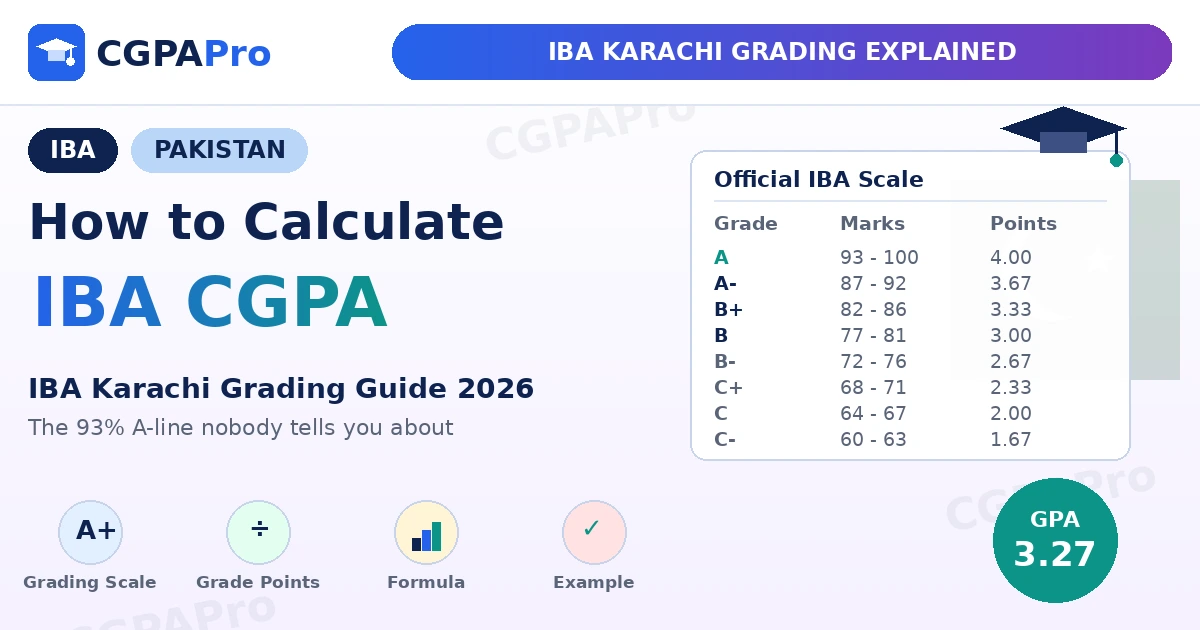
Quick answer: IBA Karachi uses a fixed 4.00 scale where A = 93–100 (4.00), A− = 87–92 (3.67), B+ = 82–86 (3.33), B = 77–81 (3.00), B− = 72–76 (2.67), C+ = 68–71 (2.33), C = 64–67 (2.00), C− = 60–63 (1.67), and F = below 60 (0.00). Semester GPA and CGPA are credit-weighted: sum of (credit hours × grade points) ÷ total credit hours. You need a 2.2 CGPA to stay enrolled and to graduate.
Try it: calculate your semester GPA
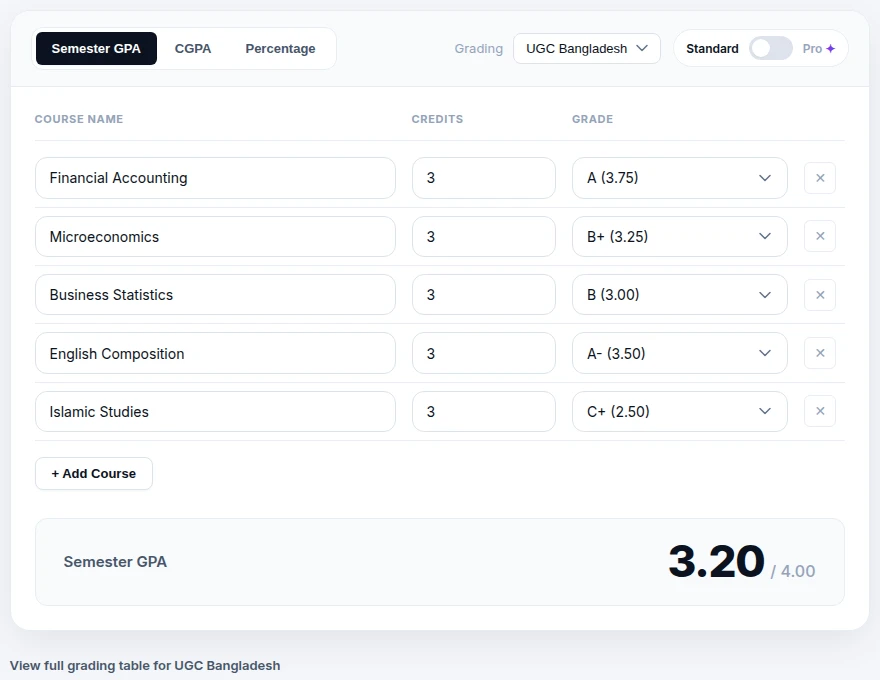
Before the theory, get your hands dirty. Enter your courses below — credits and the letter grade for each — and the calculator does the credit-weighted math for you. (Heads-up: the calculator below runs on our site’s generic scale, so treat it as a practice tool; the worked example right after it uses IBA’s official grade points, which give a slightly different number — and that difference is exactly what this article is about.)
IBA Karachi’s official grading table (Spring 2010 → present)
IBA’s Academic Board adopted this grading plan in March 2010 “with effect from spring 2010 for all IBA Programs,” and it was re-confirmed in the 2014–15 Program Announcement — the latest official publication of the consolidated policy. Unless IBA’s Controller of Examinations tells you otherwise, this is the table that governs your transcript:
| Grade | Percentage band | Grade points | What it means |
|---|---|---|---|
| A | 93 – 100 | 4.00 | Outstanding — starts higher than at most Pakistani universities |
| A− | 87 – 92 | 3.67 | Excellent |
| B+ | 82 – 86 | 3.33 | Very good |
| B | 77 – 81 | 3.00 | Good — the honest middle of an IBA transcript |
| B− | 72 – 76 | 2.67 | Above average |
| C+ | 68 – 71 | 2.33 | Average |
| C | 64 – 67 | 2.00 | Satisfactory |
| C− | 60 – 63 | 1.67 | Minimum pass — the lowest grade that counts as passing |
| F | 0 – 59 | 0.00 | Fail — must be retaken |
| I | — | — | Incomplete — excluded from CGPA; converts to an alternate letter grade if coursework isn’t finished in time |
| W | — | — | Withdrawn — excluded from CGPA, not treated as failure |
Three things jump out. First, there is no D or E grade — below 60% is simply F. Second, a C− (60%) passes the course but contributes only 1.67 points, which drags a semester average down fast. Third, compare this with the generic HEC-style tables floating around calculator sites, where an A starts at 85%: at IBA, an 88% is an A− (3.67), and an 85% is a B+ (3.33). Students who import generic scales into their planning consistently overestimate where they stand.
The formula: credit-weighted, always
IBA’s official formula is simple and unforgiving:
Semester GPA = Σ (credit hours × grade points) ÷ Σ credit hours
Your CGPA is the same formula applied across all completed semesters, and IBA recomputes it at the end of every semester. The key word is weighted: a 3-credit course counts three times as much as a 1-credit lab. An A in a 1-credit course cannot rescue a C in a 3-credit core course — the math doesn’t work that way, and this is the single most common calculation mistake students make.
Worked example: a BBA-style semester, step by step
Take five typical first-year BBA courses, each 3 credit hours. The grades are illustrative; the grade points are IBA’s official ones:
| Course | Credits | Grade | Grade points | Quality points |
|---|---|---|---|---|
| Financial Accounting | 3 | A | 4.00 | 3 × 4.00 = 12.00 |
| Microeconomics | 3 | B+ | 3.33 | 3 × 3.33 = 9.99 |
| Business Statistics | 3 | B | 3.00 | 3 × 3.00 = 9.00 |
| English Composition | 3 | A− | 3.67 | 3 × 3.67 = 11.01 |
| Islamic Studies | 3 | C+ | 2.33 | 3 × 2.33 = 6.99 |
| Total | 15 | 48.99 |
Semester GPA = 48.99 ÷ 15 = 3.266 → 3.27
Notice how the C+ in Islamic Studies cost this student: replace it with a B and the GPA jumps to 3.40. That’s the leverage of credit weighting — every 3-credit course swings the semester average by roughly 0.07–0.13 points per grade step.
And the CGPA continuation: say this student had a 3.10 CGPA over 30 completed credits before this semester. New CGPA = (3.10 × 30 + 3.266 × 15) ÷ 45 = (93.00 + 48.99) ÷ 45 = 141.99 ÷ 45 = 3.16. Early credits anchor your CGPA — a weak first year takes multiple strong semesters to unwind, which is why the probation rules below matter so much.
Read more: How Retaking a Course Affects Your CGPA (2026) — grade-replacement rules, worked examples, and when a retake is actually worth it.
The 2.0 / 2.2 / 2.5 survival map (read this twice)
This is the part no grade table tells you. Three CGPA lines run through every IBA student’s life, and each controls something different:
| CGPA line | What it controls | Source |
|---|---|---|
| 2.0 | Dropout line. Fall below 2.0 cumulative and you are dropped from the rolls — dismissed. | Academic Policy Manual, Minimum GPA Requirements |
| 2.2 | Probation + graduation line. Between 2.0 and 2.2 puts you on probation for one semester; you must reach 2.2 by the next semester. A second probation is possible, but still below 2.2 after that means dismissal. And you cannot graduate with less than 2.2 — you’d have to repeat courses until you clear it. | Academic Policy Manual, Minimum GPA Requirements |
| 2.5 | Financial assistance line. Need-based aid requires a minimum 2.5 CGPA; fall below and your assistance goes on probation, then is discontinued. | iba.edu.pk/financialassistance (current) |
The confusion students walk into: passing your courses is not the same as being safe. A semester full of C grades (2.00 each) passes every course — and parks you below the 2.2 line, straight into probation. “I passed everything, why am I on probation?” is probably the most asked question in IBA corridors, and the table above is the answer.
Probation and dismissal, step by step
Here’s exactly how IBA’s probation machinery works, from the Minimum GPA Requirements section of the official manual:
- CGPA drops below 2.0 → you are dropped from the rolls. No probation, no warning semester.
- CGPA lands between 2.0 and 2.2 → probation for one semester. You must bring the cumulative CGPA to 2.2 or above in the chronologically following semester.
- It improves but stays below 2.2 → a second (and final) probation.
- Still below 2.2 after the second probation → dropped from the rolls.
- No semester break is allowed during this period for full-time students — you can’t pause the clock.
One nuance for freshmen: in the morning program, your initial CGPA for probation/dropout decisions is computed on your first six completed courses (remedial courses, W and I grades excluded; F grades included). So the first six courses you finish effectively decide whether your IBA journey continues — choose your early course load with that in mind.
And the graduation lock: if your final CGPA is below 2.2 when you finish your coursework, IBA won’t award the degree until you repeat courses (or take additional ones) to clear 2.2. The 2.2 line follows you from admission to convocation.
The repeat paradox: F disappears, but it costs you
IBA’s repeat policy sounds generous at first — and it is, until you read the fine print. From the Improvement of Grades section:
- Better of the two attempts counts — no averaging. Your CGPA is computed on the better grade only.
- You cannot hurt yourself by repeating. If the new grade is lower, the old one stands.
- An F is replaced by the new grade and not counted in the CGPA (Academic Board decision, July 2010).
- The new grade appears on the transcript alongside the old one — the history doesn’t vanish, only the math changes.
Now the paradox — the part students discover too late:
- Repeating a course disqualifies you from Dean’s List and Gold Medal nominations. One repeat, and those doors close for good.
- Repeats carry an additional course fee.
- Repeated courses are not covered by financial assistance — you pay out of pocket.
- In the evening/MBA program, a failed course must be retaken, and a course can be repeated only once.
So the decision framework is: repeat if you need the CGPA points to clear 2.2 or to rescue your average — but know that you’re trading away Dean’s List and medal eligibility to do it. For a student at 3.6 chasing a gold medal, a repeat is almost never worth it; for a student at 2.05 fighting dismissal, it’s the obvious move. Our retake guide walks through the ROI math in detail.
Withdrawal and attendance: the two silent F-generators
Two policies quietly manufacture F grades every semester:
Withdrawal. Full-time students may withdraw from up to two courses per semester — but only on the prescribed forms, and only within one week of the second term-exam result. A W is not treated as failure and doesn’t touch your CGPA. Miss the deadline, though, and you’re stuck. Worse: if you’ve already exceeded the permissible absences in a course, withdrawal is not allowed at all — you take the F.
Attendance. IBA stipulates 90% attendance for full-time students (75% for part-time). The concrete limits: 6 absences in a 1-hour course, 4 in a 75/90-minute course, 3 in summer courses. Cross the line and you’re barred from the final exam — which effectively means an F. Latecomers are marked absent even if late by a minute, no excuses accepted, and there are no absences on the first or last day of the semester. The takeaway: attendance isn’t a soft rule at IBA; it’s a grade.
Grade composition, for context: roughly 60% semester work, 40% final exam — typically 1–3 term exams plus quizzes, assignments, and class participation feeding the 60%.
Dean’s List, gold medals, and the merit scholarship
IBA’s honors system has three tiers, each with a hard CGPA gate:
Dean’s List — all of these must hold in the same semester: top 5% of the class, minimum 3.5 CGPA, no C or lower grade in any course, no disciplinary action, and a normal course load (typically 6 courses). Hit a 90%+ semester average and it’s the Dean’s List with Distinction. Perks include the IBA-logo star on your ID card, book discounts, and the mark on your transcript and graduate directory.
Gold Medals — for BBA/BS overall medals (Gold, Silver, Bronze go to the top 3): highest CGPA with no failure, CGPA ≥ 3.5, and no C+ or lower grade in any subject — ties broken by higher average percentage. Specialization medals (Marketing, Finance, MIS) need at least 2 electives in the field with an A in both. And remember: one repeated course disqualifies you from medal nominations entirely.
Merit Scholarship — the top 10% of admitted BBA and MBA candidates get a 50% tuition fee reduction (with work-study). The catch: you must hold a 3.5 CGPA at the end of each academic year or lose it. It can be regained the next semester once you’re back at 3.5, but there’s no back-payment for the lost semester.
Notice the pattern: 3.5 is IBA’s excellence line the way 2.2 is its survival line. Everything prestigious at IBA starts at 3.5.
Read more: Dean’s List CGPA Requirements & Probation Rules 2026 — how IBA’s 3.5/2.2 lines compare with LUMS, UPM, UTM, BRACU and other universities.
GPA vs CGPA at IBA (30 seconds)
Semester GPA covers one semester. CGPA is cumulative across everything you’ve completed — and it’s the CGPA that the 2.0/2.2/2.5 lines, the Dean’s List, medals, and scholarships all read. A great semester GPA of 3.8 moves a 3.10 CGPA only to about 3.24 (over 45 credits) — the anchor effect from the worked example above. If the terminology still feels slippery, our CGPA vs GPA vs SGPA guide breaks it down with country-by-country naming.
Three more rules students discover too late
The 7-year clock. A BBA must be completed within 7 years of admission (MBA: 5 years). Repeats, probations, and withdrawn semesters all consume that clock. Combined with the no-semester-break rule during probation, time is a genuinely scarce resource at IBA.
Relative grading is officially encouraged. IBA’s policy explicitly encourages relative grading, but gives each instructor the flexibility to choose absolute or relative — and requires them to disclose the choice in the course outline at the start of the semester. This is why your friend in another section got an A with the same marks you got a B+ for. Day-one action: read every course outline, specifically the grading plan section.
You can challenge your final paper. If a grade looks wrong, you can apply to the Controller of Examinations for a re-check of the final paper. The fee is Rs. 5,000 — refunded if the re-check actually changes your grade. Worth knowing before you accept a borderline C+.
Common mistakes IBA students make
- Using a generic grade scale. An 88% is an A on half the calculator sites on the internet and an A− at IBA. Always map marks through IBA’s table.
- Averaging semester GPAs instead of credit-weighting. (3.5 + 3.0) ÷ 2 = 3.25 is wrong if the semesters had different credit loads. Always go back to Σ(credits × points) ÷ Σcredits.
- Thinking C grades are “safe.” Every course passed, CGPA 2.05, probation letter in the inbox. The 2.2 line is the real pass mark.
- Ignoring the attendance tripwire. A handful of casual absences → barred from the final → F → a repeat that kills your medal eligibility. The most expensive absences in Pakistani higher education.
- Withdrawing after the deadline. The one-week-after-second-term-exam window is short. Mark it in your calendar the day results come out.
- Forgetting the transcript shows both attempts. A repeat fixes the CGPA math, but employers and grad schools reading the full transcript still see the original F.
Tips for staying above the lines
- Protect the 2.5 line, not just the 2.2. If you’re on financial assistance, 2.5 is your real floor — build your semester targets around it.
- Front-load effort into 3-credit cores. Credit weighting means one core course moves your GPA more than two 1-credit courses combined.
- Know your section’s grading plan on day one. Relative vs absolute changes how you should interpret your midterm marks.
- Do the repeat math before you repeat. Compute exactly how many quality points the repeat buys you — and weigh it against the lost Dean’s List/medal eligibility.
- Guard the first six courses. Your initial CGPA (first six completed courses) decides early probation/dropout calls. Don’t stack all the killer courses into semester one.
Read more: How to Improve Your CGPA: Proven Strategies for 2026 — the target-grade formula, credit-leverage arithmetic, and retake ROI tables.
FAQs
What is the minimum CGPA required at IBA Karachi?
You must maintain a 2.2 cumulative CGPA throughout your stay and at graduation. Below 2.0 means dismissal; 2.0–2.2 means probation. Need-based financial assistance separately requires 2.5.
Is 60% a pass at IBA?
Yes — C− (60–63%, 1.67 points) is the lowest passing grade. Anything below 60% is an F. But remember: passing every course with C grades still leaves you under the 2.2 survival line.
If I fail a course and retake it, does the F disappear from my CGPA?
For CGPA math, yes — the better of the two attempts counts and the F is not included. But the repeat disqualifies you from Dean’s List and Gold Medal nominations, costs an extra fee, isn’t covered by financial assistance, and both attempts still appear on your transcript.
What CGPA do I need for the Dean’s List at IBA?
Top 5% of your class with a minimum 3.5 CGPA, no C or lower in any course that semester, no disciplinary action, and a normal course load. A 90%+ semester average earns the Dean’s List with Distinction.
Does IBA use relative grading?
It’s officially encouraged but not mandatory — each instructor chooses absolute or relative grading and must disclose the choice in the course outline at the start of the semester. That’s why identical marks can earn different grades in different sections.
How many courses can I withdraw from in a semester?
Up to two courses, on the prescribed forms within one week of the second term-exam result. A W doesn’t affect your CGPA — but you can’t withdraw from a course where you’ve already exceeded the absence limit.
What happens if my attendance falls short?
Full-time students need 90% attendance (6 absences max in a 1-hour course, 4 in a 75/90-minute course). Exceed it and you’re barred from the final exam — effectively an F.
Conclusion
IBA Karachi’s grading system rewards precision: a 93% A-line, a credit-weighted formula with no room for sloppy averaging, and three CGPA lines — 2.0, 2.2, 2.5 — that decide dismissal, probation, graduation, and financial aid respectively. The students who thrive here aren’t just the ones who study hardest; they’re the ones who calculate — who know exactly what each course is worth, what a repeat really costs, and which line they’re defending. Run your numbers through the official table above, guard the 2.5 line if you’re on aid, read your course outlines on day one, and you’ll never be surprised by your own transcript.
Policy sources: IBA Academic Policy Manual 2013–14 v0005 (Grading Plan, Grading Policy, Minimum GPA Requirements, Improvement of Grades, Withdrawal, Attendance, Dean’s List, Gold Medal Rules, Merit Scholarship, Maximum Program Completion Time) and the current Financial Assistance page on iba.edu.pk. This article concerns IBA Karachi, Pakistan — not IBA Dhaka. Confirm current-year specifics with the Controller of Examinations.