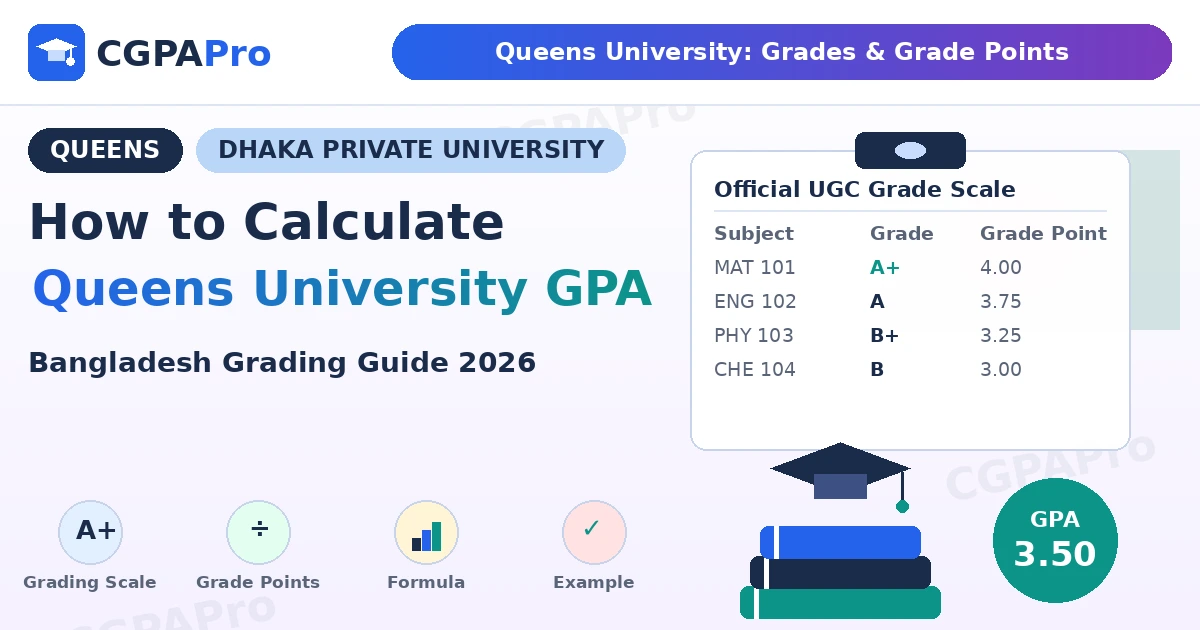
Quick answer: Queens University in Banani, Dhaka, Bangladesh uses the UGC Bangladesh uniform 4.00 grading scale: A+ = 4.00, A = 3.75, A- = 3.50, B+ = 3.25, B = 3.00, B- = 2.75, C+ = 2.50, C = 2.25, D = 2.00, F = 0.00. Your CGPA is (total grade points earned) / (total credit hours), where each course contributes its credit hours multiplied by its grade point. The university’s own academic rules set CGPA 2.00 as the passing threshold: fall below 2.25 and you land on academic probation; fall below 2.00 across two probationary semesters and you face dismissal. Note: this guide is for Queens University, Bangladesh – not Queen’s University in Canada, which uses a different 4.3 scale.
Which “Queens University” Is This Guide For?
Before a single number: a warning that will save you from the most common mistake Bangladeshi students make. Three different institutions share the “Queens” name, and search engines mix them up constantly:
- Queens University, Banani, Dhaka, Bangladesh (this guide) – a private university established in 1996 under the Private University Act 1992, recognized by the University Grants Commission (UGC) of Bangladesh. Official website: queensuniversity.edu.bd.
- Queen’s University, Kingston, Ontario, Canada – a public Canadian university that uses a 4.3 GPA scale (A+ = 4.3, A = 4.0, A- = 3.7). If you Google “Queens University GPA calculator,” most of the top results describe this Canadian school.
- Queens University of Charlotte, USA – a private American university with its own US-style 4.0 scale.
Why does this matter? Because calculator pages built for the Canadian Queen’s – including several “Queens GPA Calculator” tools ranking right now – will happily compute your GPA on the 4.3 scale. Plug a Bangladeshi transcript into one of those and every number it gives you is wrong for your university. A Canadian A+ (4.3) does not exist on your transcript; your A+ is worth 4.00. This guide covers only the Dhaka institution and the UGC Bangladesh scale it follows.
How to Calculate Your Queens University GPA With the CGPAPro Calculator
The fastest way to get an exact number is the free calculator at cgpacalculatorpro.com. It ships with the UGC Bangladesh scale built in, so you do not have to look up grade points by hand:
- Open the CGPAPro calculator and make sure the Grading dropdown is set to UGC Bangladesh.
- Stay on the Semester GPA tab for one semester’s result (switch to the CGPA tab when combining multiple semesters).
- For each course, type the course name, type the credit hours, and pick the letter grade from the dropdown (it shows both the letter and the point value, e.g. “A+ (4.00)”).
- Click + Add Course for every additional subject.
- Read your Semester GPA at the bottom – it updates live as you type.
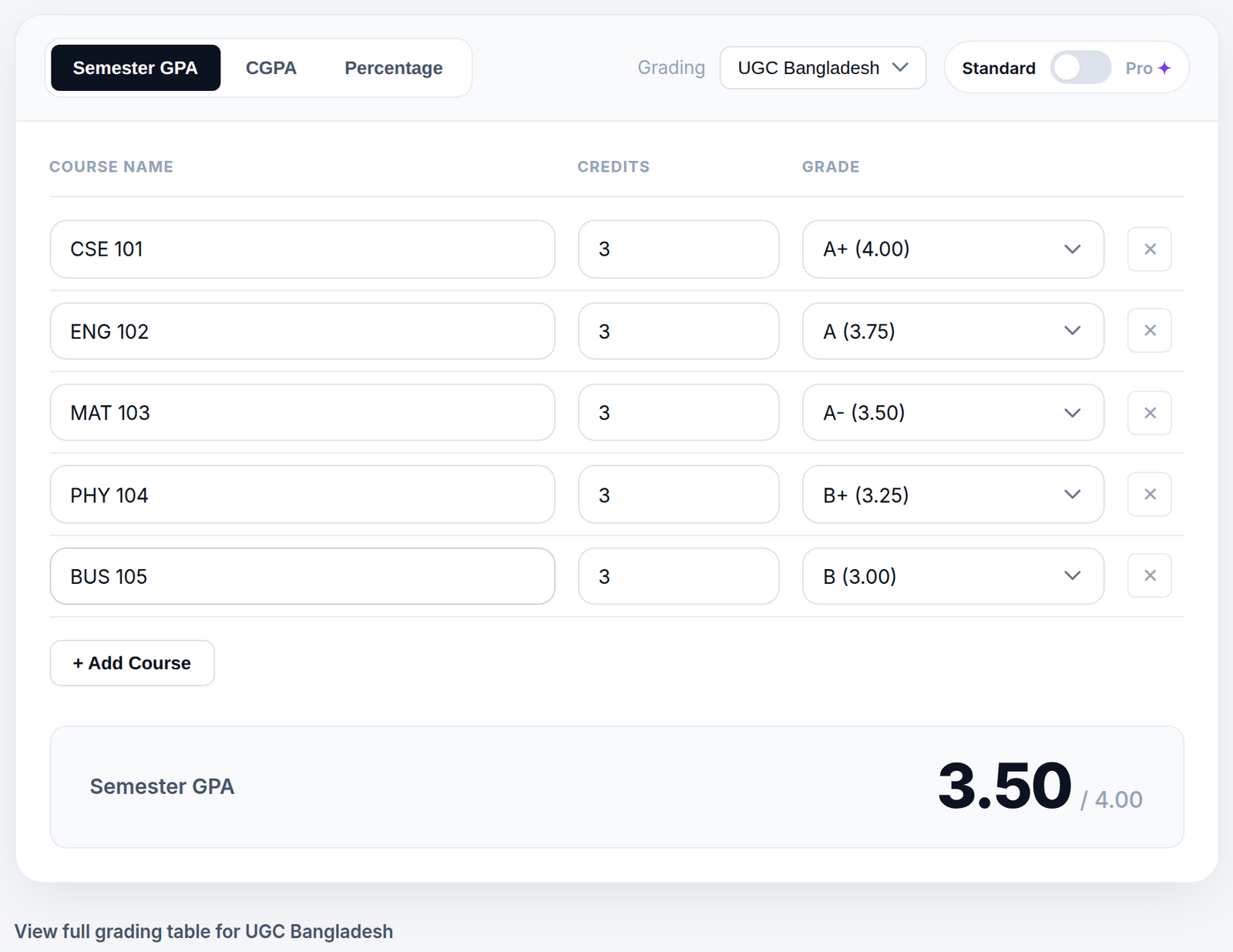
One quirk to know about: the credit boxes look like they already contain “3”, but the calculator only counts a value you type yourself. Always type the credit hours for every row, even if the number looks right already. And when you pick grades, match by the letter (A, B+, C) rather than the number – two different grades never share a letter on this scale.
The Official Grading Table for Queens University (Bangladesh)
Here is something you will not find on the university’s own website: Queens University publishes no letter-grade table on queensuniversity.edu.bd. Its Academic Policies page states the CGPA thresholds (more on those below) but never maps letters to points. Since QU is a UGC-affiliated private university, the correct table is the UGC uniform grading system, recommended by the University Grants Commission of Bangladesh for all public and private universities with effect from the 2006-2007 session. This is the same scale verified in the CGPAPro calculator’s “UGC Bangladesh” option:
| Marks obtained | Letter grade | Grade point | Meaning |
|---|---|---|---|
| 80% and above | A+ | 4.00 | Outstanding |
| 75% to below 80% | A | 3.75 | Excellent |
| 70% to below 75% | A- | 3.50 | Very good |
| 65% to below 70% | B+ | 3.25 | Good |
| 60% to below 65% | B | 3.00 | Above average |
| 55% to below 60% | B- | 2.75 | Average |
| 50% to below 55% | C+ | 2.50 | Below average |
| 45% to below 50% | C | 2.25 | Passing, weak |
| 40% to below 45% | D | 2.00 | Minimum pass |
| Below 40% | F | 0.00 | Fail |
Three things about this table trip students up, so read them twice:
First, it is not the American 4.0 scale. On a US transcript, an A is 4.0 and a B+ is 3.3. On your transcript, an A is 3.75 and a B+ is 3.25. If you use an American GPA calculator, your converted GPA will be inflated in some places and deflated in others – either way, wrong.
Second, it is not the Canadian 4.3 scale. Queen’s University (Canada) awards 4.3 for an A+. Your university’s maximum is 4.00. Any tool or table showing 4.3 is describing the wrong country.
Third, the pass mark is 40%. A D (2.00) is the lowest passing grade. Anything below 40% is an F worth zero grade points – and because the F contributes 0 while its credit hours still count in the denominator, a single F drags a GPA down hard. We will quantify exactly how hard in the worked examples.
Queens University’s own academic standing rules (from the official site)
While the university does not publish the letter table, its Academic Policies page does publish the CGPA rules that decide whether you stay enrolled. These are verified verbatim from the official source:
- Satisfactory performance: a CGPA of 2.00 is the passing grade.
- Academic probation: a student whose CGPA is below 2.25 but not below 2.00 is placed on academic probation for the following semester, and may be restricted in the number or type of courses they can register for.
- Dismissal: if a student’s CGPA falls below 2.00 and they fail to earn a GPA of 2.00 or better during two subsequent probationary semesters, the student is dismissed from the university.
- Attendance: a minimum of 60% attendance is required to sit the final semester examination.
- Fees: dues must be cleared on time or the student is debarred from the semester final examination.
Practically speaking: 2.00 keeps you alive, 2.25 keeps you off probation, and 3.00+ is where “good” begins – in Bangladesh, CGPA 3.00 and above is conventionally First Class, 2.25-2.99 Second Class, and 2.00-2.24 Third Class. Many government jobs and graduate programs ask for 3.00 or higher.
Step-by-Step: How the Calculation Works
Every GPA and CGPA at QU follows the same credit-weighted recipe. Do it by hand once and you will never be confused by a transcript again:
- List every course in the semester with its credit hours and the grade you earned.
- Convert each grade to grade points using the UGC table above (A+ becomes 4.00, B becomes 3.00, and so on).
- Multiply each course’s credit hours by its grade point. This gives that course’s quality points (sometimes called grade points earned).
- Add up all the quality points. Add up all the credit hours separately.
- Divide total quality points by total credit hours. That is your Semester GPA (SGPA).
- For CGPA, do the same thing across all semesters combined: total quality points from every semester divided by total credit hours from every semester.
The formula
SGPA = (sum of [credit hours x grade point] for the semester) / (total credit hours in the semester)
CGPA = (sum of [credit hours x grade point] for all semesters) / (total credit hours for all semesters)
The critical word is weighted: a 4-credit course influences your GPA more than a 1-credit lab. Averaging your letter grades – or averaging your semester GPAs without weighting – gives the wrong answer whenever credit hours differ. (When every course carries identical credits, the weighted average and the simple average coincide, which is why the mistake goes unnoticed for so long.)
Worked Example 1: One Semester at Queens University (GPA 3.50)
Take a typical first-semester load: five 3-credit courses. The grades are realistic – strong start, one weaker subject:
| Course | Credits | Grade | Grade point | Quality points |
|---|---|---|---|---|
| CSE 101 | 3 | A+ | 4.00 | 3 x 4.00 = 12.00 |
| ENG 102 | 3 | A | 3.75 | 3 x 3.75 = 11.25 |
| MAT 103 | 3 | A- | 3.50 | 3 x 3.50 = 10.50 |
| PHY 104 | 3 | B+ | 3.25 | 3 x 3.25 = 9.75 |
| BUS 105 | 3 | B | 3.00 | 3 x 3.00 = 9.00 |
| Total | 15 | 52.50 |
SGPA = 52.50 / 15 = 3.50. This is the exact semester shown in the calculator screenshot above – run the same five courses through the CGPAPro calculator on the UGC Bangladesh scale and you will get 3.50, matching to the decimal. A 3.50 sits comfortably in First Class territory and well clear of any probation line.
Worked Example 2: Combining Two Semesters Into a CGPA
Now the second semester is tougher – a 4-credit mathematics course and a C+ in one subject:
| Course | Credits | Grade | Grade point | Quality points |
|---|---|---|---|---|
| CSE 201 | 3 | A | 3.75 | 3 x 3.75 = 11.25 |
| ENG 203 | 3 | B+ | 3.25 | 3 x 3.25 = 9.75 |
| MAT 204 | 4 | B | 3.00 | 4 x 3.00 = 12.00 |
| BUS 206 | 3 | C+ | 2.50 | 3 x 2.50 = 7.50 |
| Total | 13 | 40.50 |
Semester 2 SGPA = 40.50 / 13 = 3.12 (3.1154 rounded). Now combine both semesters – not by averaging 3.50 and 3.12:
CGPA = (52.50 + 40.50) / (15 + 13) = 93.00 / 28 = 3.32.
The naive average of the two SGPAs would give (3.50 + 3.12) / 2 = 3.31 – close here, but only because the credit totals are similar. With a 21-credit semester against a 12-credit one, the naive average can be off by a tenth or more, which is the difference between First and Second Class. Always weight by credits. If you are comparing with friends at other Bangladeshi universities on the same national scale, the University of Dhaka calculator page uses the identical UGC table, while private universities with their own stricter tables – like BRAC University or North South University – compute differently, so never swap their numbers with yours.
Worked Example 3: “What Do I Need to Escape Probation?”
This is the calculation QU students actually lose sleep over. Suppose you finished 12 credits with a CGPA of 2.40 – above the 2.00 dismissal line but deep in probation territory (below 2.25 is probation; you are at 2.40, safe but fragile). You want to reach 2.75 after one more 3-credit course. Is it possible?
Current quality points: 12 x 2.40 = 28.80. Target after 15 credits: 15 x 2.75 = 41.25. Needed from the new course: 41.25 – 28.80 = 12.45 quality points from 3 credits, i.e. 12.45 / 3 = 4.15 grade points per credit.
Impossible – the scale tops out at 4.00. Even a perfect A+ (4.00) gives (28.80 + 12.00) / 15 = 40.80 / 15 = 2.72. One course cannot fix it; you would need strong grades across several courses. This is the hard truth about GPA recovery: early semesters dominate because they hold the most credits, and climbing from the low 2s takes sustained A-range grades, not one heroic final. Use the calculator’s CGPA tab to model “what-if” scenarios before the semester starts – it is far better to learn the math is impossible in week 1 than in week 14.
GPA vs CGPA: What QU Means by Each
Students use the two interchangeably; the university does not:
- Semester GPA (SGPA) – the credit-weighted average for one semester only. This is what the calculator’s “Semester GPA” tab computes.
- CGPA (Cumulative GPA) – the credit-weighted average across all completed semesters. This is the number on your transcript, the number employers ask for, and the number the probation/dismissal rules (2.00 / 2.25) are judged against.
A strong final semester cannot “replace” a weak first year in the CGPA – it only dilutes it. And note the asymmetry in QU’s rules: probation is judged on CGPA, so one bad semester early can put you on probation even while your latest SGPA looks healthy.
5 Common Mistakes Queens University Students Make
- Using the Canadian 4.3 scale. The single most damaging error. Queen’s University (Canada) tables show A+ = 4.3. Your A+ is 4.00. Every GPA computed on the wrong scale is fiction.
- Using the American 4.0 scale. US tables set A = 4.0 and B+ = 3.3; yours are 3.75 and 3.25. Close enough to look plausible, wrong enough to mislead.
- Averaging grades instead of weighting by credits. (B+ + A) / 2 is not a GPA. Multiply by credits first, then divide by total credits.
- Averaging semester GPAs. CGPA is not the mean of your SGPAs unless every semester had identical credit hours. Pool the quality points and the credits, then divide once.
- Converting CGPA to percentage with the wrong formula. There is no official universal CGPA-to-percentage conversion in Bangladesh. Multiplying by 25 is a rough rule of thumb, not a rule; the “multiply by 9.5” formula floating around online belongs to India’s CBSE board, not to Bangladeshi universities. If an application asks for a percentage, check what the receiving institution expects – and QU publishes no official conversion of its own.
Tips to Protect (or Repair) Your CGPA at QU
- Front-load effort into high-credit courses. A 4-credit core course moves your GPA more than two 1-credit labs combined. Allocate study time proportionally to credits, not to how much you like the subject.
- Guard the 2.25 line, not just the 2.00 line. Probation at QU starts below 2.25 and brings registration restrictions, which can delay graduation. Treat 2.25 as your real floor.
- Keep attendance above 60%. It is an official examination-eligibility rule, not a suggestion – missing it can zero out a semester regardless of your grades.
- Clear fees before deadlines. Fee defaulters are debarred from final examinations, which turns into failed courses and a cratered CGPA.
- Model “what-if” scenarios early. Before a semester begins, plug target grades into the calculator and see what your CGPA becomes. Worked Example 3 shows why: recovery math is unforgiving, and knowing the required grades in advance beats discovering them after results.
- Do not trust foreign “Queens” tables. Bookmark this page or the UGC table, not a Canadian GPA tool. If a table shows 4.3 anywhere, close the tab.
For a broader view of how Bangladeshi universities compare, the Bangladesh universities directory lists calculators for other institutions on the national scale.
What Queens University Has NOT Published (Read Before You Assume)
Honesty matters more than completeness, so here is what we could not verify on the university’s official site or any authoritative source. Do not treat any of the following as QU policy – confirm each with your department or the Controller of Examinations:
- Retake / repeat rules: whether a failed (F) course can be retaken, whether the new grade replaces the F in the CGPA, and whether the F remains visible on the transcript. Neighboring private universities typically allow one retake counting the new grade, but QU publishes no such rule.
- Grade improvement: whether D or C grades may be retaken purely to raise the CGPA.
- Dean’s List / academic honors: no published criteria for semester honors at QU.
- Graduation CGPA floor: not published explicitly (the 2.00 passing threshold strongly implies it, but the university does not state a graduation minimum).
- Incomplete (“I”) and withdrawal (“W”) grades: the UGC guideline allows these notations, but QU publishes no policy on how they are awarded or converted.
- SGPA vs CGPA presentation on transcripts: how the two appear on official QU transcripts is not documented publicly.
If your department handbook contradicts anything in this guide – particularly the grade table – your department handbook wins. University-published rules always override a general guide, including this one.
Frequently Asked Questions
1. Is the “Queens University grading system” I found online about Bangladesh or Canada?
Check the scale. If the table shows A+ = 4.3, it is Queen’s University in Kingston, Canada – the wrong institution. If it shows A+ = 4.00 with A = 3.75 and B+ = 3.25, it is the UGC Bangladesh scale used by Queens University in Dhaka. When in doubt, look for “Banani, Dhaka” or the domain queensuniversity.edu.bd.
2. Is the CGPA scale at Queens University Dhaka 4.0 or 4.3?
4.00. QU follows the UGC Bangladesh uniform 4.00 scale (maximum grade point 4.00 for A+). The 4.3 scale belongs to the Canadian Queen’s University and does not apply to any Bangladeshi transcript.
3. What grade points do A+, A, A-, B+, B-, C+, C, D, and F carry?
A+ = 4.00, A = 3.75, A- = 3.50, B+ = 3.25, B = 3.00, B- = 2.75, C+ = 2.50, C = 2.25, D = 2.00, F = 0.00. These are the UGC uniform values, confirmed against the calculator’s UGC Bangladesh scale.
4. What is the minimum CGPA to pass and stay enrolled at Queens University?
Per the university’s official Academic Policies: CGPA 2.00 is the passing grade. Below 2.25 (but at or above 2.00) you are placed on academic probation with possible registration restrictions. Below 2.00 across two probationary semesters, you are dismissed.
5. How do I calculate my SGPA and CGPA step by step?
Multiply each course’s credit hours by its grade point, add all those quality points up, and divide by total credit hours – that is your SGPA for the semester. Do the same pooling across all semesters for CGPA. Worked Examples 1 and 2 above walk through both with real numbers, and the free calculator does it instantly on the correct UGC scale.
6. Can I retake a course to improve my grade at Queens University?
The university does not publish a retake policy on its official site, so there is no verified answer. Ask your department or the Controller of Examinations directly – and get the answer in writing, because whether the old grade is replaced or averaged changes your CGPA math completely.
7. What CGPA counts as First Class in Bangladesh?
The national convention is: 3.00 and above = First Class, 2.25-2.99 = Second Class, 2.00-2.24 = Third Class. Many government jobs and master’s programs require at least 3.00, so that is the practical target for most QU students.
Conclusion
Queens University (Banani, Dhaka) runs on the UGC Bangladesh uniform 4.00 scale – A+ at 4.00 down to F at 0.00, with the fractional steps (3.75, 3.50, 3.25) that make it distinct from both the American and Canadian systems. Your CGPA is simply total quality points divided by total credit hours, judged against the university’s own lines: 2.00 to pass, 2.25 to stay off probation, 3.00+ for First Class. The biggest risk is not the math – it is using the wrong country’s table, because the internet’s “Queens University” results mostly describe a Canadian school on a 4.3 scale. Use the Dhaka table, weight by credits, verify against the worked examples above, and when your department handbook says something different, the handbook wins.
Ready to compute yours? Open the CGPAPro calculator, set grading to UGC Bangladesh, and type in this semester’s courses – it takes less than a minute.