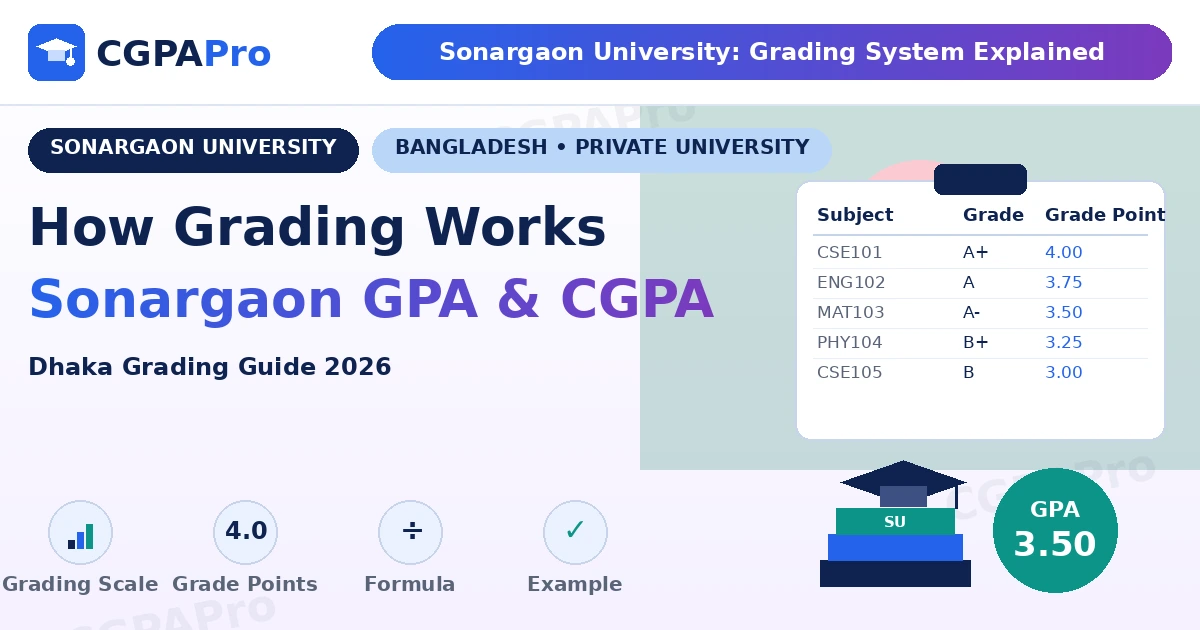
Quick answer: Sonargaon University (SU), Dhaka grades every undergraduate course on the 4.00 scale – A+ (4.00) for 80 percent and above down through D (2.00), with F (0.00) as fail. Your semester GPA is the credit-weighted average of your grade points, and here is the detail most students miss: Sonargaon excludes F grades from the GPA calculation entirely, per its own Academic Regulations (effective 2019). You graduate with a minimum CGPA of 2.00 – though the BBA department’s revised syllabus demands 2.25, a discrepancy this guide flags rather than hides. Below you will find SU’s official grade table with the meanings the university itself assigns, the exact formulas, a hand-checked worked example, the repeat/retake/improvement rules, and SU’s own official CGPA-to-percentage conversion formula.
One clarification before we start. “Sonargaon” is also the name of a historic city in Narayanganj, so search results mix up the old capital of Bengal with the university. This guide covers Sonargaon University (SU), the private university in Dhaka – Campus-1 at JA-146, Wireless Gate, Mohakhali, and Campus-2 at 147/i, Green Road, Tejgaon, Dhaka-1215. Its admission materials live on su.edu.bd. If that is where you study CSE, EEE, civil, textile, BBA, architecture, law, or journalism, every rule below comes from SU’s own published Academic Rules and Regulations.
Calculate Your Sonargaon GPA in 30 Seconds
The fastest way to check your GPA is the free calculator on this site. Select the “UGC Bangladesh” grading scale – it carries the exact grade values Sonargaon University uses, so the result matches your result sheet:
- Open the CGPAPro GPA calculator.
- Add one row per course. Type the course name and its credit hours, then pick the letter grade – not the marks. SU transcripts report letter grades, so this mirrors how the university itself records your results.
- Read your Semester GPA from the result box. Add all your semesters’ courses the same way and you get the CGPA.
Here is a real example run on the calculator, using the five courses from the worked example further down this page:
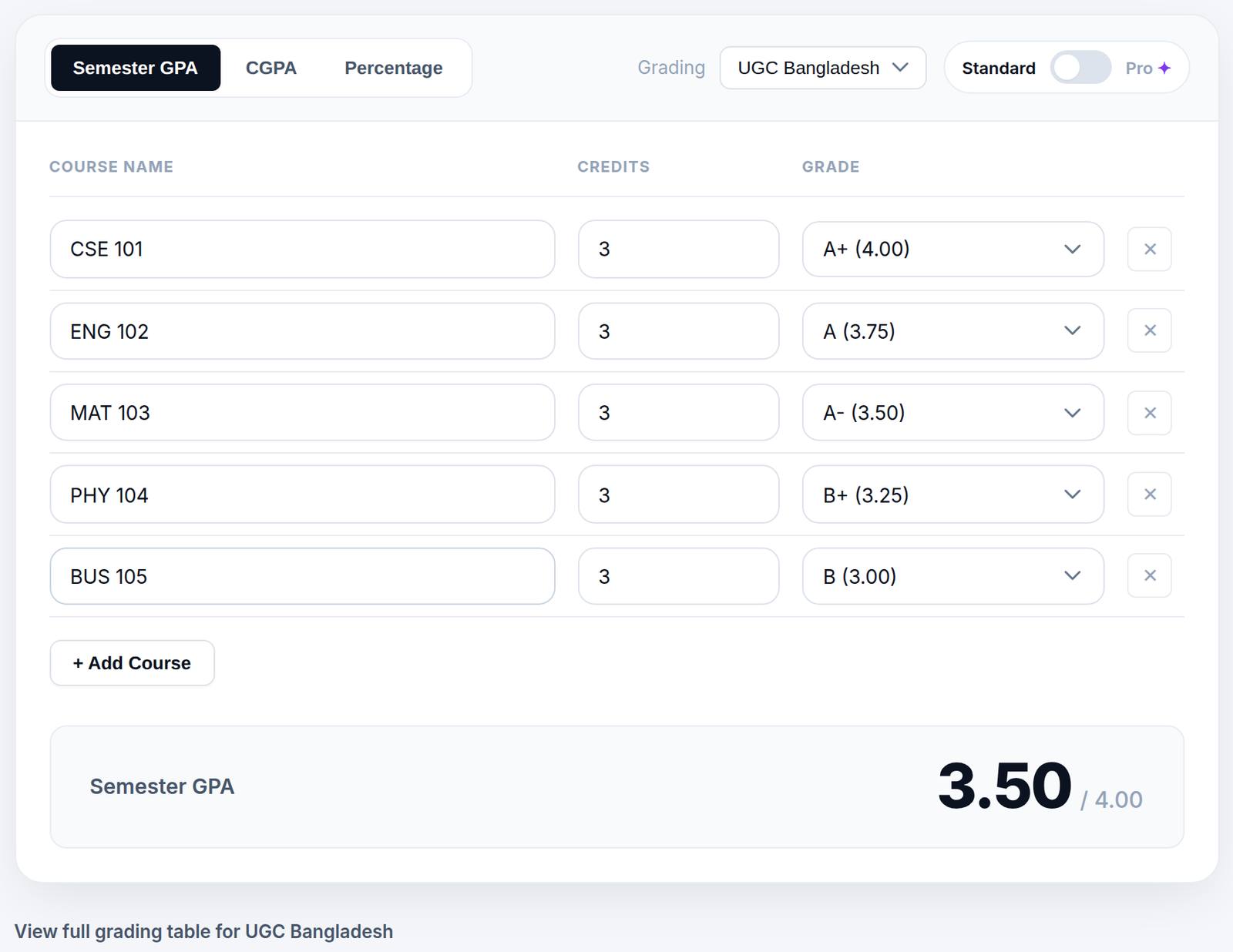
The calculator uses the same grade values SU follows, so this 3.50 is exactly what your result sheet would show for these grades.
Sonargaon University’s Official Grade Table
This table is taken directly from SU’s Academic Rules and Regulations for Undergraduate Studies (Article 12.1), and it is repeated word-for-word in the departmental syllabi for BBA, Journalism and Media Studies, and Architecture. The meanings column is SU’s own:
| Marks (%) | Letter Grade | Grade Point | What SU Calls It |
|---|---|---|---|
| 80 and above | A+ | 4.00 | Outstanding |
| 75 to less than 80 | A | 3.75 | Excellent |
| 70 to less than 75 | A- | 3.50 | Very Good |
| 65 to less than 70 | B+ | 3.25 | Good |
| 60 to less than 65 | B | 3.00 | Above Average |
| 55 to less than 60 | B- | 2.75 | Average |
| 50 to less than 55 | C+ | 2.50 | Below Average |
| 45 to less than 50 | C | 2.25 | Poor |
| 40 to less than 45 | D | 2.00 | Pass |
| Less than 40 | F | 0.00 | Fail |
Two things worth noticing. First, D is a passing grade – 40 percent in a course still earns you the credits, though it drags the average down. Second, this matches the UGC Bangladesh uniform 4.00 scale point for point, so nothing in SU’s policy conflicts with the national framework; the university simply published it in its own regulations.
How Your Marks Turn Into a Letter Grade
Your final mark in a theory course is assembled from four pieces, per Article 13.1 of the regulations:
- Class participation and attendance: 10%
- Assignments and spot tests: 10%
- Class tests and quizzes: 10%
- Mid-semester examination: 30%
- Semester final examination: 40%
The continuous-assessment block (the first three items, 30 percent) is carried forward if you later sit a supplementary exam – only the final-exam portion is re-taken. And here is the gate students forget: you must attend at least 60 percent of the classes held for each course, or you are not allowed to sit the semester final at all. Attendance is not just the 10 percent slice; it is also the ticket into the exam hall.
The GPA Formula, Step by Step
SU defines GPA as the weighted average of the grade points of the courses you passed or completed in a semester. In plain steps:
- Convert each course’s letter grade to its grade point using the table above.
- Multiply each grade point by that course’s credit hours. This gives the course’s quality points.
- Add up all the quality points.
- Add up all the credit hours of the passed/completed courses.
- Divide total quality points by total credit hours.
- Round to two decimal places – SU reports GPA to the second decimal.
Formula: GPA = (sum of grade point x credit hours for each passed course) / (total credit hours)
The critical detail is step 4. SU’s regulations state plainly: “F” grades will not be counted for GPA calculation. If you failed a course, its zero does not enter the numerator or the denominator. That is more generous than many students assume, but it does not mean the failure is free – you still need those credits for the degree, and the F sits on your transcript until you clear the course through the repeat or retake route.
Worked Example: A 15-Credit Semester
Take a typical first-year semester – five 3-credit courses – and walk the math yourself:
| Course | Credits | Grade | Grade Point | Quality Points |
|---|---|---|---|---|
| CSE 101 | 3 | A+ | 4.00 | 3 x 4.00 = 12.00 |
| ENG 102 | 3 | A | 3.75 | 3 x 3.75 = 11.25 |
| MAT 103 | 3 | A- | 3.50 | 3 x 3.50 = 10.50 |
| PHY 104 | 3 | B+ | 3.25 | 3 x 3.25 = 9.75 |
| BUS 105 | 3 | B | 3.00 | 3 x 3.00 = 9.00 |
| Total | 15 | 52.50 |
GPA = 52.50 / 15 = 3.50. That is the exact result the calculator screenshot above shows. Notice how the credits act as weights: the A+ and the B count the same here only because both courses carry 3 credits. A 4-credit lab with a C would pull harder than a 2-credit theory course with an A, which is why students who only count letter grades end up surprised.
GPA vs CGPA at Sonargaon University
GPA covers one semester. CGPA covers your whole degree: total weighted grade points accumulated since your first semester, divided by total credit hours. Say your first semester gave 52.50 quality points over 15 credits (GPA 3.50), and your second semester gave 54.40 quality points over 17 credits (GPA 3.20):
CGPA = (52.50 + 54.40) / (15 + 17) = 106.90 / 32 = 3.34 (rounded to two decimals).
The common mistake here is averaging the two GPAs: (3.50 + 3.20) / 2 = 3.35, which is wrong because the semesters carry different credit loads. Always go back to quality points and credits. That 3.34 sits above the 2.00 graduation floor with room to spare, but below the 3.80 a department topper needs for the Vice-Chancellor’s Gold Medal.
Convert Your CGPA to a Percentage
Job applications and foreign universities often ask for a percentage. Most Bangladeshi students guess by multiplying CGPA by 25. Sonargaon University actually publishes its own conversion rule in Article 29 of its regulations – and it is not x25:
- For CGPA from 3.75 to 4.00: Percentage = 79 + 80 x (CGPA – 3.75)
- For CGPA from 2.00 up to 3.75: Percentage = 44 + 20 x (CGPA – 2.00)
So a CGPA of 3.50 converts to 44 + 20 x 1.50 = 74 percent, and a CGPA of 3.80 converts to 79 + 80 x 0.05 = 83 percent. The naive multiply-by-25 rule would claim 87.5 and 95 – comfortably wrong in both directions. Use the university’s own formula whenever an application form asks, and cite the regulation if anyone questions it.
Failed or Missed an Exam? The Repeat, Retake, and Improvement Ladder
SU has three separate routes for a course that went wrong, and students mix them up constantly. They are not the same:
Repeat (supplementary exam). If you got an F in a theory course – whether you sat the final and failed, or sat the mid but missed the final – you may sit a supplementary exam. Two conditions: you failed in at most three theory courses and at most 10 credit hours in that semester final, and the exam happens within two weeks of the results. The exam carries 70 percent of the course marks on the full syllabus; your continuous-assessment marks carry forward. Whatever you score, the highest grade you can earn is A-. No supplementary exams for sessional or design courses.
Retake. If you were absent from both the mid-semester and the final (marked X on the result), or you did not appear in – or failed – the supplementary exam, the course becomes a Retake. You register it alongside your regular courses within three consecutive semesters, attend classes, and sit both exams again. Again, the maximum grade is A-.
Improvement. This one is a privilege, not a right. You may re-register a course to improve its grade only if the grade was below B+ – you cannot touch a B+ or above. Limits: one improvement course per regular semester, at most 7 courses over a 4-year program (8 for a 5-year program), registration within two consecutive semesters of the original result, and none after the 4th year’s 3rd semester. The transcript keeps the higher of the two grades, and the cap is A-. You also cannot improve a course you already took as a repeat, retake, or self-study.
The A- ceiling across all three routes is the pattern to remember: SU lets you recover, but it will not let a recovered course score higher than an A-.
Probation and Suspension: The 2.00 Line
The number that governs your academic standing at Sonargaon is 2.00. You are placed on academic probation if your semester GPA falls below 2.00 or your CGPA falls below 2.00. The minimum probation period is one semester (usually one academic year), during which you must pass your retake courses, and the Head of Department may restrict your course load and extracurricular activities.
Probation is a warning, not a punishment – but it has teeth. A student on probation who fails to hold a GPA of at least 2.00 for two consecutive semesters may be suspended from the university. A first suspension can be appealed to the Vice-Chancellor with a written petition; a second suspension goes to the Academic Council for a final decision. The practical takeaway: a single bad semester puts you on the list, and two bad semesters in a row can end your enrollment.
Common Mistakes SU Students Make
Counting F in the GPA. SU’s regulations exclude failed courses from GPA math. Students who add a zero-weighted course into the denominator understate their own GPA and panic over nothing.
Averaging semester GPAs for CGPA. CGPA is quality points over credits, not the average of averages. Unequal semester credit loads make the shortcut wrong every time.
Assuming a recovered course can reach A+. Supplementary, retake, and improvement exams all cap at A-. Budget your expectations – and your study hours – accordingly.
Mixing up repeat and retake. Missed the final but sat the mid? That is the supplementary (repeat) route with a two-week window. Missed both exams? That is a retake, registered within three semesters. The routes have different deadlines and different paperwork.
Trying to improve a B+. Improvement is only for grades below B+. One improvement course per semester, and it cannot be a course you already repeated or retook.
Using multiply-by-25 for percentages. SU publishes its own conversion formula (above). The generic shortcut inflates high CGPAs and understates mid ones – exactly the numbers employers check.
Ignoring attendance until the final. Below 60 percent attendance in a course means no final exam, which means an F, which means the supplementary clock starts ticking.
Tips for Protecting Your CGPA
The continuous-assessment block is 30 percent of every theory course – attendance, class tests, assignments. Students who treat the final as the whole course leave nearly a third of the marks to luck. Lock in the 30 percent and the final becomes a cushion, not a cliff.
Watch the 2.00 line from your first semester. Probation triggers on either a sub-2.00 semester GPA or a sub-2.00 CGPA, and recovering a CGPA takes far longer than protecting one. If a semester goes badly, the supplementary exam is your fastest repair – it runs within two weeks, before the F settles into your record.
Aim deliberately if you want the honors. SU’s Dean’s List is closed to anyone with an F, retake, or improvement grade in any course across three consecutive regular semesters – so a single recovered course ends that year’s candidacy. The Vice-Chancellor’s Gold Medal needs a department-first finish with CGPA 3.80 or above (3.90 for the Chancellor’s Gold Medal), completed in consecutive years with a clean record. A recent SU civil engineering graduate finished at 3.93 and took the Vice-Chancellor’s Gold Medal – that is the benchmark at the top.
Finally, re-scrutiny is real but narrow: if you believe your theory-course marks were added up wrong, you have five days from result publication to apply to the Head of Department. The reviewer only checks for unmarked answers and totaling errors – scripts are never re-examined.
Frequently Asked Questions
What is the minimum CGPA to graduate from Sonargaon University?
The Academic Regulations (Article 21) set the floor at CGPA 2.00 for a Bachelor degree, with all degree credits completed. Note one departmental wrinkle: the revised BBA OBE syllabus requires a minimum CGPA of 2.25. If you are a BBA student, follow your department’s stricter rule and confirm it with your advisor.
Does an F count in my GPA calculation?
No. SU’s regulations state that F grades are not counted in GPA calculation – the failed course drops out of both the numerator and the denominator. You still owe the credits for graduation, and the F stays on your transcript until you clear it, but it does not drag the GPA number down the way most students fear.
What happens if I miss both the mid-semester and the final exam?
Your result shows X (absent), and the course becomes a Retake. You must register it with your regular courses within three consecutive semesters, attend classes, and sit both exams. The highest grade you can earn on a retake is A-.
What is the highest grade I can get in a supplementary, retake, or improvement exam?
A-, in all three cases. No matter what marks you score, SU caps recovered courses at A- (3.50). Only first-attempt regular exams can earn A or A+.
Can I improve my B+ grade?
No. Improvement is only allowed for courses graded below B+, and it is capped at one improvement course per regular semester, seven courses total for a 4-year program, with registration within two semesters of the original result. The transcript keeps the higher of the two grades.
How do I convert my CGPA to a percentage for job applications?
Use SU’s official formula from Article 29, not the multiply-by-25 shortcut: Percentage = 79 + 80 x (CGPA – 3.75) for CGPA 3.75 to 4.00, and Percentage = 44 + 20 x (CGPA – 2.00) for CGPA 2.00 to 3.75. A 3.50 CGPA converts to 74 percent.
Is 60% attendance really required to sit the final exam?
Yes. Article 19.1 requires at least 60 percent attendance in each course to be eligible for the semester final. Attendance also feeds the 10 percent class-participation slice, so it pays twice.
Sonargaon University’s grading system rewards consistency more than brilliance: the 30 percent continuous assessment, the two-decimal rounding, the F-exclusion rule, and the A- recovery caps all favor students who show up, submit everything, and repair damage quickly. Compute your numbers with the table and formulas above, and when in doubt, your department’s copy of the Academic Regulations – the document every rule here is sourced from – is the final word.