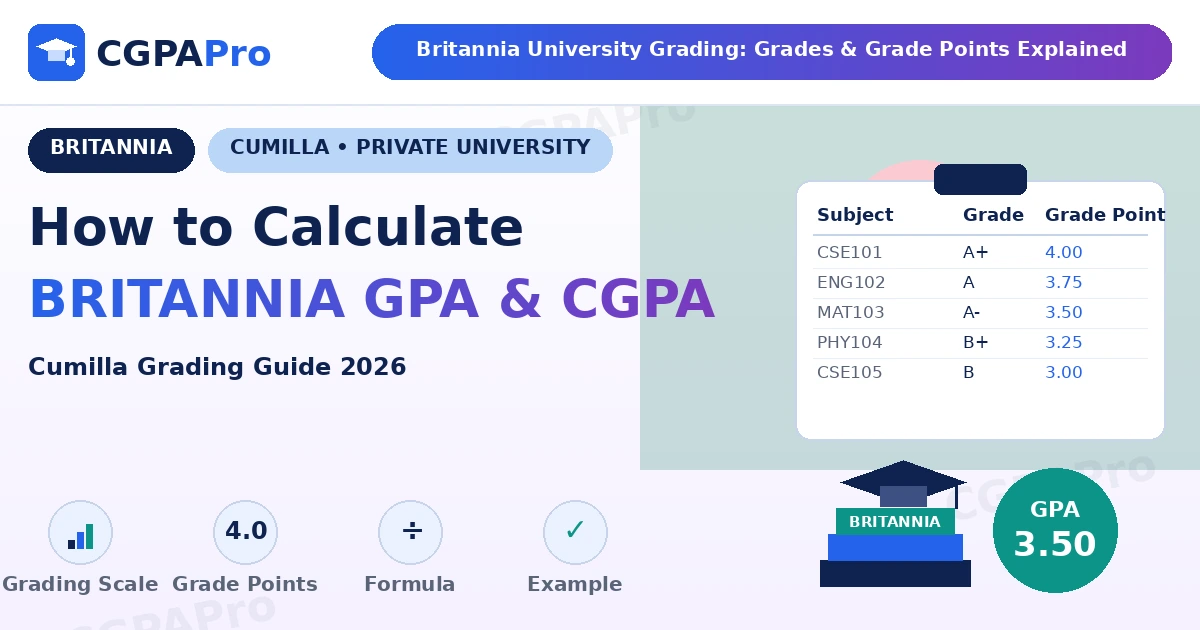
If you are a student at Britannia University (BU) in Cumilla, you have probably noticed something odd: one official-looking university page says an A starts at 75% and runs “to less than 80%”, while your BBA or LLB program page says the same A runs “75% to less than 79%”. So which one applies — and what happens if you score 79.5%? This guide settles that question, gives you Britannia’s complete verified grading table for 2026, walks you through real SGPA calculations with the university’s own marks split, and explains in plain language what retakes, probation, waivers, and awards actually mean for your CGPA.
How to Calculate Your GPA with the CGPAPro Calculator
The fastest way to turn your letter grades into a semester GPA is to use the calculator below. Britannia follows the UGC uniform grading scale for Bangladesh, so select “UGC Bangladesh” in the scale dropdown, add one row per course, and enter the credit hours exactly as they appear on your registration sheet. The tool computes the weighted average for you.
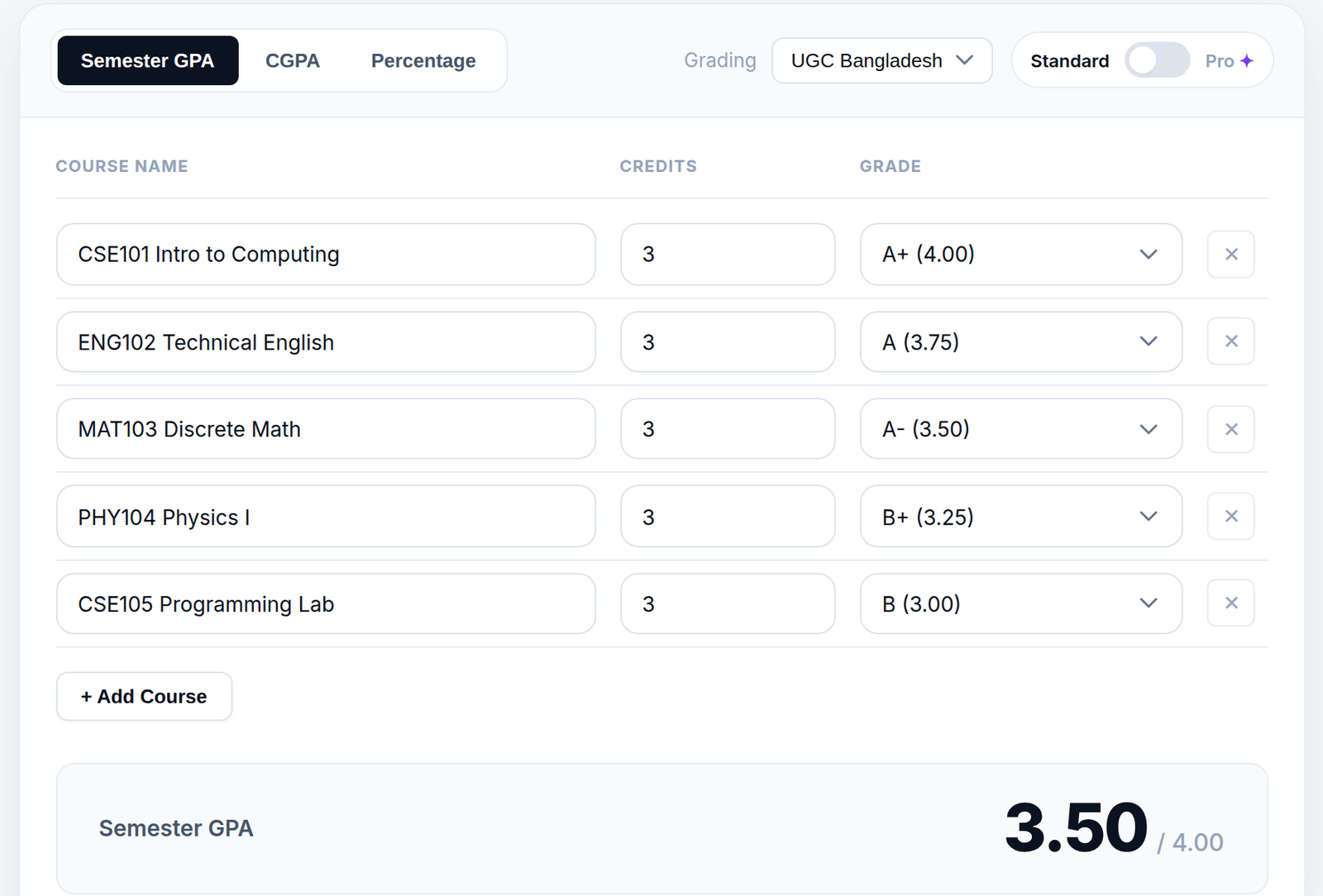
The result updates as you type. Keep it open in another tab — we will use the same five-course example step by step later in this article.
Britannia’s Official Grading Table (Verified)
Britannia University states on its Evaluation & Grading System page that it follows “the Letter grades and Grade point system introduced by the UGC as a uniform grading system for public and private universities in Bangladesh.” Here is the table exactly as the university publishes it:
| Numerical Marks | Letter Grade | Grade Point |
|---|---|---|
| 80% and above | A+ | 4.00 |
| 75% to less than 80% | A | 3.75 |
| 70% to less than 75% | A− | 3.50 |
| 65% to less than 70% | B+ | 3.25 |
| 60% to less than 65% | B | 3.00 |
| 55% to less than 60% | B− | 2.75 |
| 50% to less than 55% | C+ | 2.50 |
| 45% to less than 50% | C | 2.25 |
| 40% to less than 45% | D | 2.00 |
| Less than 40% | F | 0.00 |
Two extra grades exist outside this table: I (Incomplete, carries no grade point) and — when you retake a course — R (recorded for the lower of the two attempts; more on that below). Passing grades are A through D; only F is a fail.
One important policy that surprises many students: your Britannia transcript shows only letter grades, grade points, and CGPA — never your raw percentage marks. That makes the boundary lines above more important than they look, because employers and foreign universities will read your A or B+ without ever seeing whether it was a 65.5% or a 69.8%. (We will come back to this in the transcript section.)
Which Table Is Right? The Boundary Discrepancy No One Talks About
Here is the honest part most guides skip. Britannia’s dedicated Evaluation & Grading System page prints the clean table above — A is “75% to less than 80%”, matching the UGC uniform scale. But several of the university’s own program pages (BBA, LLB, English) print a different version: A is “75% to less than 79%”, A− is “70% to less than 74%”, D is “40% to less than 44%” — and so on. Those ranges leave one-mark gaps: a student scoring 79.5% or 74.5% falls into no band at all.
That is plainly a copy-editing error on the program pages, not a second grading system. The fix is simple: follow the official Evaluation & Grading System page (the “less than 80 / 75 / 70 …” version), because it is the university’s dedicated grading document and it matches the UGC uniform scale every other Bangladeshi private university uses. If you land in one of the ghost zones — say 79.5% — the authoritative table says you earned an A (3.75), not an A−. If a course teacher ever grades you by the program-page wording, show them the Evaluation & Grading System page; it is the university’s own document.
Note: Britannia’s older archived site shows yet another wording of the same ranges. Ignore the archive; the current britannia.edu.bd grading page is the one that counts.
Step-by-Step: How to Calculate Your SGPA at Britannia
The university’s formula is the standard weighted average:
GPA / CGPA = Σ (Grade Point × Credit Hours) ÷ Σ (Credit Hours)
Follow these steps every time:
- Convert each course’s percentage to a grade point using the official table above.
- Multiply each course’s grade point by its credit hours. A 3-credit course counts three times as much as a 1-credit course.
- Add up all the credit hours. That is your divisor.
- Add up all the (grade point × credit hours) values. That is your total quality points.
- Divide total quality points by total credit hours.
Two Britannia-specific notes before the worked example. First, theory course credits equal contact hours per week, and practical/sessional credits equal half the contact hours — so a 3-hour weekly lab counts as 1.5 credits, not 3. Second, whether failed (F) courses or retaken courses count in the credit divisor is not published by the university — ask your department’s program coordinator how your semester’s divisor was computed rather than guessing.
Worked Example: 5 Courses to an SGPA of 3.50
Take a realistic first-year BSc CSE semester at Britannia — five courses, 3 credit hours each:
| Course | Grade | Point | Credits | Quality Points |
|---|---|---|---|---|
| CSE101 – Intro to Computing | A+ | 4.00 | 3 | 12.00 |
| ENG102 – Technical English | A | 3.75 | 3 | 11.25 |
| MAT103 – Discrete Math | A− | 3.50 | 3 | 10.50 |
| PHY104 – Physics I | B+ | 3.25 | 3 | 9.75 |
| CSE105 – Programming Lab | B | 3.00 | 3 | 9.00 |
| Total | 15 | 52.50 |
SGPA = 52.50 ÷ 15 = 3.50.
Notice what the weighting does: the single A+ (12.00 quality points) contributes as much as the B+ (9.75) plus one more credit hour. When your credits differ between courses, the heavy-credit courses decide your GPA — a B+ in a 3-credit course moves the needle three times as much as a B+ in a 1-credit course. That is why protecting your high-credit courses during finals week is the highest-leverage GPA move you can make. For a deeper walkthrough of this weighting, see our CGPA improvement guide.
If you got an F in one course and want to understand how failures flow into your CGPA, read our dedicated guide on calculating CGPA with failed subjects and backlogs.
GPA vs SGPA vs CGPA: What Each Means at Britannia
- GPA — the grade point average for a single semester’s courses (what the worked example above computed).
- SGPA — the same thing; at Britannia the two terms are used interchangeably for the semester figure.
- CGPA — your cumulative average across all semesters, computed with the same formula over every completed course. This is the number printed on your final transcript, and it is the number employers and universities ask for.
The number that matters most for staying enrolled is the CGPA: drop below 2.00 and you enter the probation system, which we map out in full below.
Where Your 100 Marks Come From: Britannia’s Assessment Breakdown
A Britannia letter grade never comes from a single exam. The official split for theory courses (out of 100) is:
| Component | Weight |
|---|---|
| Class attendance | 10% |
| Quizzes | 15% |
| Assignment / Presentation (or Viva) | 5% |
| Midterm examination | 30% |
| Final examination | 40% |
For lab courses (out of 100): Attendance 10% · Assignment 20% · Class performance 20% · Presentation 10% · Lab final 40%.
Read those weights like a strategist: attendance + quizzes + assignments are 30% of your grade before the final even starts. Students who treat attendance as optional are donating 10 marks they will never recover — and at Britannia, attendance below 75% bars you from sitting the final exam at all (unless the Dean or Controller grants a genuine-case exception).
Walkthrough: How Many Marks Do You Need on the Final to Secure an A?
Say your course total so far looks like this: attendance 8/10, quizzes 11/15, assignment 4/5, midterm 22/30. That is 8 + 11 + 4 + 22 = 45 marks banked out of 60. To land an A you need a total of 75%.
75 − 45 = 30 marks needed on the final, out of 40 — that is 75% on the final itself. So: you need three-quarters of the final paper to hold your A. With a stronger midterm (say 25/30), you would need only 27/40. Run this arithmetic before every final; it tells you exactly which courses to allocate study hours to.
“Will I Graduate?” — Britannia’s Degree Checklist
Every Britannia degree requires a minimum CGPA of 2.00 at graduation. The total credit requirements differ by program (all published by the university):
| Program | Total Credits |
|---|---|
| BBA | 124 |
| BSc in CSE (incl. diploma-engineer track) | 156 |
| BA in English | 120 |
| LLB (Hons) | 135 |
| BSS in Economics | 120 |
Three more rules from the university’s academic guidelines:
- Time limit: finish your degree within twice the normal duration — a 4-year degree must be completed within 8 years.
- Trimester calendar: Spring (February–May), Summer (June–September), Fall (October–January), with 14 weeks per semester (13 weeks of classes plus a final week).
- Credit transfer: up to 50% of degree credits can transfer in, with a minimum prior CGPA of 2.50 — but only the course count appears on your BU transcript, not the transferred grades, and transferred students cannot win the Dean’s Award or the Chancellor’s Gold Medal.
Grades → Money: Performance Waivers and the Dean’s Award
This is the section no other guide gives you: at Britannia, grades are literally money.
Performance-based tuition waiver (effective Fall 2024, regular registration only):
| CGPA Band | Tuition Waiver |
|---|---|
| 3.95 – 4.00 | 35% |
| 3.90 – 3.94 | 20% |
| 3.85 – 3.89 | 15% |
| 3.80 – 3.84 | 5% |
And the rules that can kill your waiver:
- Any F in a subject blocks the fee waiver for the next two semesters — even if your CGPA is 3.9.
- Retake/repeat subjects get no waiver at all — you pay the full fee for the repeated course.
The Dean’s Award (per regular semester) sets different bars by faculty: CGPA of 3.75+ for Business Studies, Law, and Science & Technology; 3.65+ for Arts & Social Science. Every course must carry a grade point of at least 3.25, and you must be in the top merit position. Credit-transfer students, re-admitted students, and anyone with a retake, recourse, improvement, or withdrawal on record is ineligible — with one narrow exception the committee may consider for a single genuine illness-related retake. There is also a Chancellor’s Gold Medal based on cumulative career CGPA, but the university has not published its exact cutoff.
Retake, “R”, Probation, and Dismissal: The Survival Map
These rules come straight from Britannia’s Academic Rules page. Here is what they mean in practice:
Retaking a course. When you retake, the better of the two grades appears on your transcript and grade report; the lower grade is recorded as “R”. So retaking is grade-safe in the sense that a failed first attempt cannot drag your CGPA down forever — but it costs you: the repeated subject gets no fee waiver, the exact retake fee is not published by the university, and retakes disqualify you from the Dean’s Award. How the “R” course is treated inside the CGPA divisor is also not published — confirm with your coordinator.
Withdrawal (W). Withdraw officially by the academic-calendar deadline and the course is marked W; drop before the deadline and it leaves no record at all.
Incomplete (I). Only for missing the final exam for reasons beyond your control — illness, accident, death in the family, other emergencies. You must inform your course teacher and the Controller of Examinations in writing within 3 working days (medical certificate required for illness/accident), or the grade becomes F.
Probation and dismissal — the timeline that matters:
- CGPA and/or GPA below 2.00 → you are placed on academic probation.
- You get a maximum of 3 semesters to pull your CGPA/GPA back to 2.00 or above.
- Fail to recover within 3 semesters → dismissal. (Also: GPA below 2.0 in three consecutive semesters means you are dropped from the program, though you may appeal to the Dean/Head/Coordinator with strong evidence of changed ability.)
- After dismissal, you may re-apply only after 3 academic years, with documented evidence of improvement such as further study or work experience. Academic counselling is available on request.
The university also reserves the right to dismiss a student at its discretion. The message is unambiguous: treat a 2.00 CGPA as a hard floor, not a target.
Your Transcript Shows No Marks — Why That Matters
Britannia prints only letter grades, grade points, and CGPA on the official transcript. No percentages. That has two consequences worth thinking about:
- Boundary marks matter disproportionately. A 79.9% and a 75.1% both become A (3.75) on your transcript — but a 74.9% becomes A− (3.50). There is no “almost an A” on paper, which is exactly why the boundary-wording discrepancy above is worth knowing about.
- Foreign credential evaluation (WES and similar services) reads your transcript’s letter grades and grade points, not marks. Because Britannia’s scale is the standard UGC 4.00 scale, conversions are usually straightforward — but only if your program pages and the grading page agree on where the boundaries sit. They do on the official grading page; keep a saved copy of it for your records.
Want to see how your CGPA translates into a percentage for job applications? Use our guide on converting between CGPA and percentage — and remember the difference between the HEC (Pakistan) and UGC (Bangladesh) scales if you ever compare across borders.
Britannia University vs Comilla University: Do Not Confuse the Two
Britannia University (BU) is a private university in Cumilla. It is not Comilla University (CoU), the public university in the same city — they have different administrations, different admission processes, and different grading documents. Some third-party calculator pages (for example, the CoU calculator on gpawise.com) cover Comilla University only and will not match Britannia’s rules. If a search result does not say “Britannia”, it is not your university.
Common Mistakes Britannia Students Make
- Reading the wrong grade table. Using the program-page wording (“less than 79%”) instead of the official grading page (“less than 80%”) — and losing a grade point they actually earned.
- Ignoring the 10% attendance marks. Skipping classes costs marks twice: once in the attendance component and once when the 75% rule bars you from the final.
- Treating all courses equally. A B in a 3-credit course costs you 0.75 quality points more than a B in a 1-credit course. Weight your effort by credit hours.
- Assuming the old F disappears. The lower attempt is recorded as “R” and retakes lose the fee waiver — retaking is safe but not free.
- Forgetting that one F freezes the waiver. A single F in an easy elective can block your tuition waiver for two semesters even with a 3.9 CGPA.
Tips to Maximize Your GPA at Britannia
- Bank the 30% early. Attendance (10%) + quizzes (15%) + assignments (5%) are the cheapest marks in the course — earn them before the midterm.
- Do the final-marks math for every course. The 75% walkthrough above takes two minutes and tells you exactly where to spend study hours.
- Protect high-credit courses. In CSE, your 3-credit theory courses move the CGPA more than anything else.
- Guard the 3.80 line. That is where the tuition waiver starts (5%) — and every band above it multiplies your savings.
- Never let CGPA touch 2.00. Probation gives you 3 semesters to recover; dismissal gives you a 3-year wait. A withdrawal (W) before the deadline is always better than an F.
- Track everything in the calculator. Plug your current grades into the CGPAPro CGPA calculator each semester and model what different finals scenarios do to your CGPA.
Frequently Asked Questions
Which grading scale does Britannia University use?
Britannia follows the UGC uniform grading scale for Bangladesh: A+ = 4.00 (80%+), A = 3.75, A− = 3.50, B+ = 3.25, B = 3.00, B− = 2.75, C+ = 2.50, C = 2.25, D = 2.00, F = 0.00 (below 40%). The official table is published on the university’s Evaluation & Grading System page.
My program page says A is “75% to less than 79%” — is that correct?
No. Several program pages contain a wording error that leaves one-mark gaps (e.g. 79.5% falls into no band). The university’s dedicated Evaluation & Grading System page uses “75% to less than 80%”, which matches the UGC uniform scale — that is the authoritative version.
Is a D grade a pass at Britannia?
Yes. A through D are all passing grades; only F is a fail. But you still need a minimum CGPA of 2.00 to graduate, so a string of D’s will put you on probation.
Does Britannia allow retakes, and what happens to my old grade?
Yes. When you retake a course, the better of the two grades shows on your transcript and the lower one is recorded as “R”. Retaken subjects get no tuition fee waiver, and retakes disqualify you from the Dean’s Award.
What happens if my CGPA falls below 2.00?
You are placed on academic probation with a maximum of 3 semesters to recover to 2.00. If you do not recover, you are dismissed; re-application is possible only after 3 academic years with documented evidence of improvement.
How does the tuition fee waiver work?
Performance-based waivers (effective Fall 2024): CGPA 3.95–4.00 gets 35%, 3.90–3.94 gets 20%, 3.85–3.89 gets 15%, 3.80–3.84 gets 5%. Any F blocks the waiver for two semesters, and retake subjects never qualify.
Do my percentage marks appear on the transcript?
No. Britannia transcripts show only letter grades, grade points, and CGPA — never raw marks. Keep the official grading page saved, because the exact boundary lines decide what anyone reading your transcript sees.
The Bottom Line
Britannia University’s grading system is the standard UGC 4.00 scale — simple on the surface, but the details decide real outcomes: the boundary-wording error on program pages, the 75% attendance gate, the way a single F freezes your fee waiver for two semesters, and the 3-semester probation clock. Now you have the verified table, the formula, two worked examples in the university’s own marks split, and the survival map. Bookmark the official grading page and the academic rules, plug your courses into the calculator above, and check your CGPA every semester — before the rules check it for you.