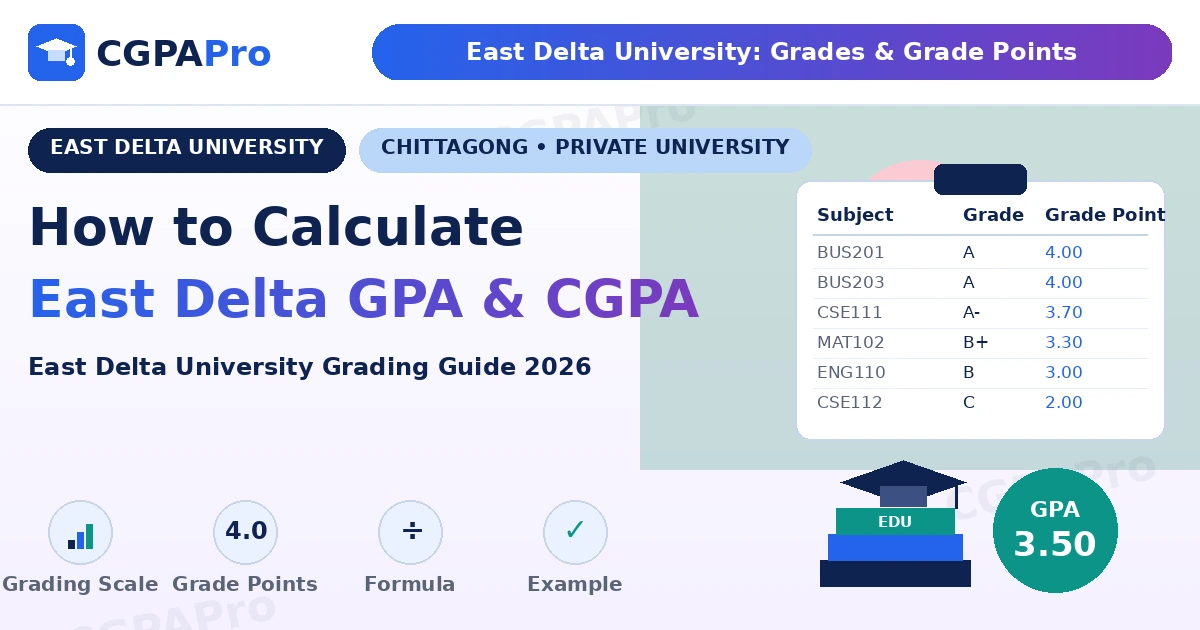
Quick answer: East Delta University (EDU), Chittagong, publishes its own grading table — and it is not the UGC uniform scale you see on most Bangladeshi grading websites. EDU’s official scale is American-style: A (93% and above) is 4.0, A− (89–93%) is 3.7, B+ (86–89%) is 3.3, B (82–86%) is 3.0, down through D (60–65%) at 1.0, and F (below 59%) at 0.0. There is no A+ at EDU. Your semester GPA is the credit-weighted average of those grade points, and your CGPA is the same math stretched across every semester. One number runs your academic life at EDU: 2.0 — drop below it and you are on probation. This guide transcribes EDU’s official table, walks a real 3.50 worked example, and covers the probation, retake, and scholarship rules from EDU’s own pages.
One clarification first, because it genuinely confuses students. East Delta University (EDU) in Chittagong (eastdelta.edu.bd) is a completely different institution from Eastern University in Dhaka (easternuni.edu.bd). Same country, similar-sounding name, different universities — and different academic rules. Eastern University puts students on probation below a 2.50; EDU’s floor is 2.0. If you study at the EDU campus in Khulshi, Chattogram — BBA, CSE, EEE, English, Economics — this article is for you.
Calculate Your EDU GPA in 30 Seconds
The fastest way to check your GPA is the free calculator on this site. One critical step for EDU students: the calculator opens on the UGC Bangladesh scale by default, but EDU’s published table matches the US 4.0 Scale option instead — A is 4.0, A− is 3.7, B+ is 3.3, exactly like EDU’s own page. Switch the scale dropdown first, or your numbers will be wrong:
- Open the CGPAPro GPA calculator.
- In the grade-scale dropdown, select US 4.0 Scale — this is the one that mirrors EDU’s official table. (Leave it on UGC Bangladesh and an A− will score 3.50 instead of EDU’s 3.7; that error compounds fast.)
- Add one row per course. Type the course name and its credit hours, then pick the letter grade — not the marks. EDU transcripts show letter grades, so this mirrors how the university sees your results.
- Read your Semester GPA from the result card. Add every term’s courses the same way and you get the CGPA.
Here is a real example run, using the six courses from the worked example further down this page:
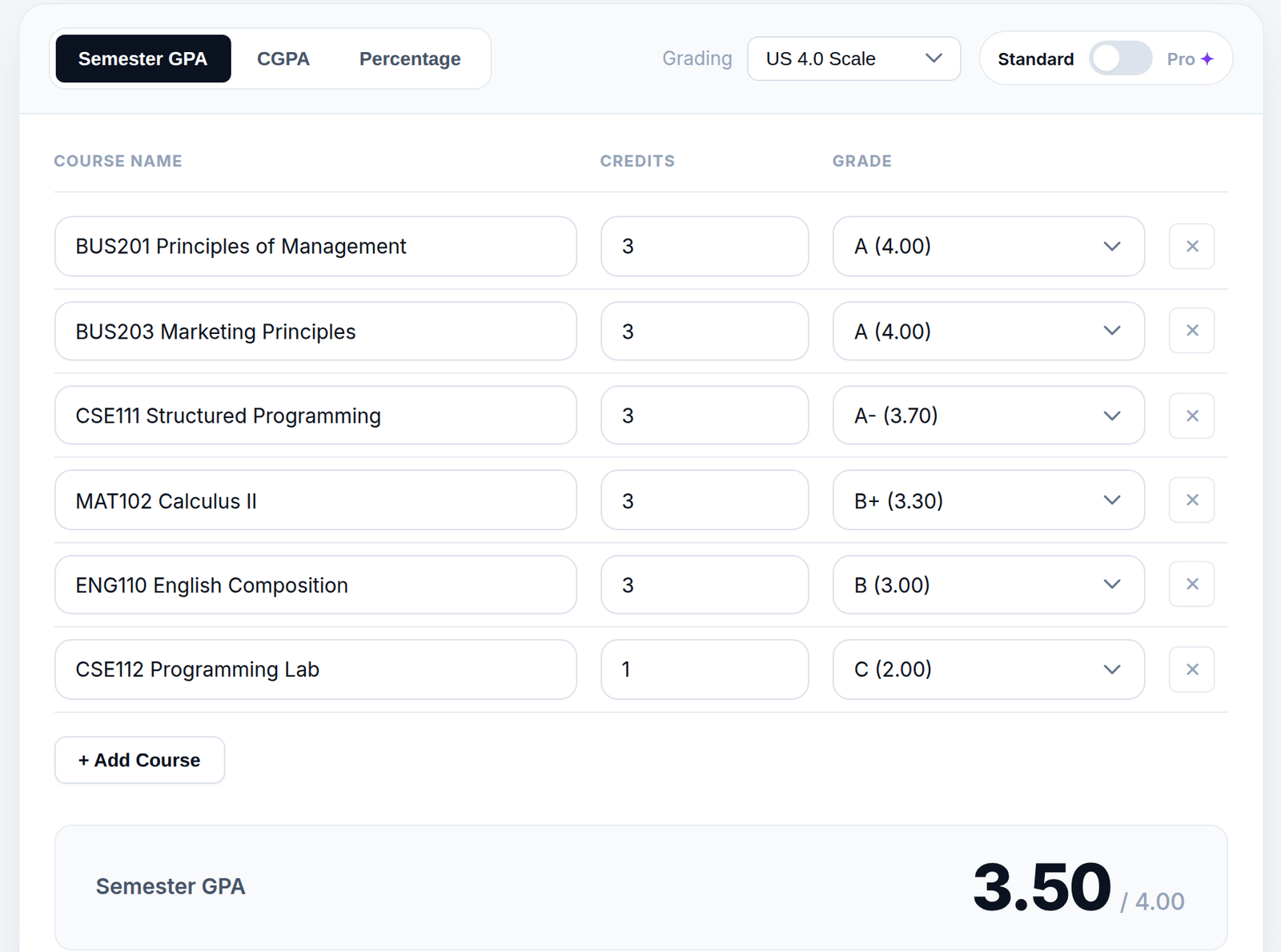
The calculator on the US 4.0 scale uses EDU’s exact grade values, so this 3.50 is precisely what your result sheet would show for these grades.
EDU’s Official Grade Table (Transcribed from eastdelta.edu.bd)
Most Bangladeshi grading articles hand you the UGC uniform table and call it a day. I fetched EDU’s actual grading page (eastdelta.edu.bd/about-us/grading-system) and transcribed the table it publishes. It is the American-style scale, not the UGC one:
| Percentage (marks) | Letter grade | Grade point |
|---|---|---|
| 93% & above | A | 4.0 |
| 89% – below 93% | A− | 3.7 |
| 86% – below 89% | B+ | 3.3 |
| 82% – below 86% | B | 3.0 |
| 79% – below 82% | B− | 2.7 |
| 75% – below 79% | C+ | 2.3 |
| 72% – below 75% | C | 2.0 |
| 69% – below 72% | C− | 1.7 |
| 65% – below 69% | D+ | 1.3 |
| 60% – below 65% | D | 1.0 |
| Below 59% | F | 0.0 |
Three things worth noticing. First, there is no A+ at EDU — the ceiling is a straight A at 4.0. If you come from an SSC/HSC background where A+ is normal, recalibrate: at EDU, 93% is the top of the world. Second, the bands are narrow — an 88.5% is a B+ (3.3), not an A−; a single percentage point at a band edge is worth 0.3–0.4 grade points. Third, the page’s own bands leave a small gap (D runs “60% – below 65%”, F is “below 59%”), which is almost certainly a typo on the university’s page — treat anything below 60% as a fail in practice, and check your current program handbook if a 59% ever lands on your transcript.
A word on sourcing, because the table looks unusual for a Bangladeshi university. Some of the grading page’s wording reads like it was adapted from an American template (it mentions a “credit/no credit option” and a “re-admission prayer”), but the numbers above are what EDU itself publishes, and every rule in this article comes from that same official page or EDU’s program and scholarship pages. If a future handbook shows a revised row, the handbook wins — but as of this writing, this is the table the university stands behind.
How Your Final Grade Is Built: The Assessment Calendar
EDU doesn’t grade you on one final exam alone. According to the university’s own page, assessment is continuous: weekly or fortnightly tests on top of the major examinations, a mid-semester examination in the 8th or 9th week, and the final examination in the 17th week, with a one-week class break before the final. And here is the line students underestimate: class participation is a major criterion for assessment. Showing up, speaking up, and submitting the small weekly work is not bonus behavior at EDU — it is part of the grade. After you successfully complete a course, you earn three credits for it (labs and some courses carry different weights; your course outline confirms the number).
Step-by-Step: How GPA and CGPA Work at EDU
EDU states both definitions plainly. The grade point average (GPA) is the total number of grade points earned divided by the number of credits for the semester. The cumulative grade point average (CGPA) is the total grade points divided by the total credits — across all semesters.
The formula, written out:
GPA = Σ (grade point × credit hours) ÷ Σ (credit hours)
In plain steps:
- Convert each letter grade to its grade point using EDU’s table above — A is 4.0, A− is 3.7, B+ is 3.3, and so on.
- Multiply each course’s grade point by its credit hours. A 3-credit B+ becomes 3 × 3.3 = 9.9 “quality points.”
- Add up all the quality points and all the credit hours separately.
- Divide total quality points by total credits. That is your GPA for the semester.
For CGPA, do the identical math but include every course from every semester — total quality points across your whole degree divided by total credits. Failed courses (F) still count: they contribute 0.0 quality points but their credits stay in the denominator, which is why one F drags a GPA down far more than one low-but-passing grade.
Worked Example: A Real EDU Semester (GPA 3.50)
Let’s run a realistic semester — six courses, the kind of mix a BBA or CSE student actually sees — through EDU’s official scale. Watch how the American-style values change the math versus the UGC table: an A− here is worth 3.7, not 3.50.
| Course | Credits | Grade | Grade point | Quality points |
|---|---|---|---|---|
| BUS201 Principles of Management | 3 | A | 4.0 | 3 × 4.0 = 12.00 |
| BUS203 Marketing Principles | 3 | A | 4.0 | 3 × 4.0 = 12.00 |
| CSE111 Structured Programming | 3 | A− | 3.7 | 3 × 3.7 = 11.10 |
| MAT102 Calculus II | 3 | B+ | 3.3 | 3 × 3.3 = 9.90 |
| ENG110 English Composition | 3 | B | 3.0 | 3 × 3.0 = 9.00 |
| CSE112 Programming Lab | 1 | C | 2.0 | 1 × 2.0 = 2.00 |
Total quality points = 12.00 + 12.00 + 11.10 + 9.90 + 9.00 + 2.00 = 56.00. Total credits = 3 + 3 + 3 + 3 + 3 + 1 = 16.
GPA = 56.00 ÷ 16 = 3.50 exactly.
Notice two things. First, the 1-credit lab barely moves the needle — even though it’s a C, it only contributes 2.00 quality points out of 56. That is the whole logic of credit weighting: your 3-credit theory courses decide your GPA, not the labs. Second, compare with the UGC table: on the UGC scale this same semester would score 55.25 ÷ 16 = 3.45 (A− would be 3.50, B+ would be 3.25). A 0.05 difference per semester becomes a 0.05 CGPA gap at graduation — enough to matter for Latin honors, which start at 3.50. This is why using the right scale is not pedantry; it is points on your transcript.
GPA vs CGPA: What Each One Does at EDU
Your semester GPA is the number in the worked example — one term, its courses, done. Your CGPA is the running average across every semester you have completed. At EDU, each one has a distinct job:
- Semester GPA decides your Dean’s list status (3.5+ with 12 or more letter-graded hours in the term) and the Vice Chancellor’s list (a clean 4.0 on top of Dean’s list standing).
- CGPA decides probation (below 2.0), graduation honors (3.50 and up, in three Latin bands), and your scholarship continuation (3.5 / 3.0 / 2.5 depending on the award).
The practical implication: a bad first semester never fully disappears — it stays in the CGPA denominator forever — but a strong later semester dilutes it. That is exactly why EDU’s repeat policy exists.
The 2.0 Line: Probation, Suspension, and Dismissal
This is the section most EDU students never read until they need it. The rules below are quoted from EDU’s official grading page:
- CGPA below 2.0 means the university considers you to be making “unsatisfactory progress towards the earning of the Degree.” You are placed on probation for one semester to improve. If no improvement occurs, you may face dismissal for one semester — after which a re-admission request would be considered.
- New freshmen and transfer students face academic suspension if their first-semester GPA falls below the probation range. You may re-enroll for the next session only with permission from the academic council.
- Academic dismissal also applies if your average falls below the probation range, or if you spend three consecutive semesters on probation without making strong academic gains.
Two honest observations. First, 2.0 is a lower floor than at several other Bangladeshi private universities (Eastern University in Dhaka uses 2.50, for example), which is one more reason not to mix the two schools up. Second, the page does not publish a detailed “probation range” table — so if you are anywhere near 2.0, talk to your program office before the semester ends, not after.
Retakes, Incompletes, Withdrawals: The Special Grades
EDU’s transcript has more than letter grades. Each of these has a published rule:
- I (Incomplete): given when you have fulfilled the majority of a course’s requirements but could not complete it. You must finish the remaining work before the end of the following semester, in consultation with the instructor — otherwise the I converts to an F. You do not need to re-register for the course. The trap: students treat an Incomplete as paused time. It is a deadline.
- R (Repeat): you may repeat a course if you feel grade improvement is possible — even one you passed. Re-registration and payment of all applicable fees are required, and the repeated course is marked (R) on your transcript. What the page does not spell out is whether the new grade replaces the old one in the CGPA calculation or both attempts count — confirm that with your program office before paying for a repeat, because it changes whether retaking is worth it.
- W (Withdraw): you can withdraw from a course after the add/drop period and before the mid-term; the transcript shows W and the payment is non-refundable.
- Credit/No Credit: undergraduates may take some courses on a credit/no-credit basis. You earn credit (CR) toward graduation with a grade of C− or better, and a maximum of 25 semester hours of CR credit may count toward an undergraduate degree.
Honors, Dean’s List, and the Numbers Worth Chasing
EDU runs an American-style recognition system, which fits its American-style scale:
- Dean’s list: 12 or more letter-graded EDU hours in a semester and a semester GPA of 3.5 or higher.
- Vice Chancellor’s list: Dean’s list standing plus a 4.0 semester GPA.
- Graduation with honors: CGPA 3.90–4.00 Summa cum laude; 3.75–3.89 Magna cum laude; 3.50–3.74 Cum laude.
Notice how 3.50 is the magic line — it is the floor for Cum laude, the Dean’s list threshold, and (as the next section shows) the Chairman’s scholarship continuation line. One number, three rewards. If you are going to aim at anything, aim at 3.50.
Scholarships: The CGPA Ladder That Keeps Your Funding
EDU’s merit scholarships are generous at admission and strict afterwards. From the university’s own program and scholarship pages:
- Board of Trustees Chairman’s Distinguished Scholarship (Golden GPA 5.00 in both SSC & HSC at entry): automatically applied for your first three semesters regardless of CGPA — then you must hold CGPA 3.5+ and take at least 12 credits per semester to keep it. Drop below 3.5 and the BoT Grant is awarded automatically until you climb back to 3.5.
- BoT Grant (combined 9.00 SSC+HSC at entry): continuation requires CGPA 3.0+. Fall below and it stays cancelled until you are back at 3.0.
- Vice Chairman’s Aid (combined 8.00 SSC+HSC at entry): continuation requires CGPA 2.5.
- Children of freedom fighters must maintain 2.50; students from underdeveloped areas must maintain 3.00.
The takeaway: your scholarship does not care about your semester GPA — it reads your CGPA, every term, with a 12-credit minimum course load. A light semester taken to “protect the GPA” can cost you the funding.
7 Mistakes EDU Students Keep Making
- Using the UGC table. The most common error, and the most expensive. Every generic Bangladeshi grading site teaches A+ 4.00 / A 3.75 / A− 3.50 — EDU’s own page says A 4.0 / A− 3.7 / B+ 3.3. An A− is worth 0.2 more at EDU than the UGC table says; a B+ is worth 0.05 more. Calculate on the wrong scale all four years and your self-tracked CGPA will disagree with your transcript at graduation.
- Inventing an A+. There is no A+ at EDU. Marking yourself “A+ (4.00)” on a calculator when you scored 95% gives the right number by accident (4.0) — but writing A+ on a study-abroad application when your transcript says A creates an awkward mismatch. Use the letter your university uses.
- Forgetting that F keeps its credits. An F gives 0.0 quality points, but its credits stay in the denominator. In the worked example above, turning that 1-credit C into an F would drop the GPA from 3.50 to 3.38 — and a 3-credit F would drag it to 3.31. Failing a heavy course hurts twice: you lose the points and keep the weight.
- Ignoring the band edges. 88.9% is a B+, not an A−. Because bands are 3–4 points wide and each step is 0.3–0.4 grade points, one mark at the edge is worth more than a whole grade’s effort elsewhere. If your course outline shows how marks split between tests, the mid, the final, and participation, spend your effort where the edge is reachable.
- Treating class participation as optional. EDU’s own page calls participation a major assessment criterion. In a continuous-assessment system, the weekly tests and participation are the marks you bank before the 17th-week final — skipping them means the final has to do all the work.
- Sleeping on an Incomplete. An I becomes an F if you don’t finish by the end of the next semester. It is not a pause button; it is a countdown.
- Mixing up the two “East” universities. Searching “eastern university grading system” lands you on Eastern University (Dhaka) articles — including one on this very site. Its probation floor (2.50) and its rules are not yours. When you look up any policy, check the domain: eastdelta.edu.bd is you.
Tips That Actually Move Your EDU CGPA
- Lock the 3.50 line early. Cum laude, Dean’s list, and the Chairman’s scholarship all read 3.50. A 3.50 in your first two semesters buys you a buffer; chasing it in your final year, when every credit is diluted across 120+, is much harder.
- Play the credit weights. A 3-credit A− (11.10 quality points) outweighs a 1-credit A (4.00). Rank your study time by credit × realistic gain, not by which subject you like.
- Bank the continuous assessment. Weekly and fortnightly tests plus participation are the cheapest marks in the course — small, frequent, and predictable. Students who treat them seriously walk into the 17th-week final needing a B instead of an A.
- Do the retake math before you pay. Repeating a passed course costs re-registration and full fees, and the page doesn’t promise the old grade disappears from your CGPA. Ask your program office exactly how (R) grades are averaged, then compute whether the gain is worth the money and the semester.
- Protect the 12-credit floor. Scholarship continuation needs 12 credits a semester. Dropping to 9 credits to “focus” can silently void a Chairman’s scholarship worth lakhs.
- Track with the right scale. Use the calculator’s US 4.0 Scale option every time you estimate — the UGC Bangladesh option will quietly misprice every A−, B+, and B− on your sheet.
Frequently Asked Questions
Does East Delta University use the UGC 4.00 grading scale?
No — and this surprises most students. EDU’s own published grading page uses an American-style scale: A = 4.0 (93%+), A− = 3.7, B+ = 3.3, B = 3.0, B− = 2.7, C+ = 2.3, C = 2.0, C− = 1.7, D+ = 1.3, D = 1.0, F = 0.0. There is no A+, and the percentage bands differ from the UGC uniform table (which has A+ at 4.00 and A at 3.75). When using any GPA calculator, choose the US 4.0 scale option for EDU — not the UGC Bangladesh one.
What CGPA puts me on probation at East Delta University?
A CGPA below 2.0. The university considers that unsatisfactory progress toward the degree: you get one semester of probation to improve, and if there is no improvement, you may be dismissed for a semester, after which a re-admission request is considered. Freshmen and transfer students whose first-semester GPA falls below the probation range face academic suspension, and three consecutive probation semesters without strong gains can mean dismissal.
Can I retake a course I already passed to improve my grade?
Yes. EDU’s official policy says students may repeat a course if they feel grade improvement is possible. The catch: you must re-register and pay all applicable fees, and the repeat is marked (R) on your transcript. The page does not specify whether the new grade replaces the old one in the CGPA average, so confirm the exact math with your program office before you pay — it determines whether a retake is actually worth it.
What happens to an Incomplete (I) grade at EDU?
You must complete the remaining coursework before the end of the following semester, in consultation with the course instructor. If you don’t, the I automatically converts to an F. You don’t need to re-register for the course, but the deadline is real — don’t let it slide.
What CGPA do I need to keep my EDU scholarship?
It depends on the award: 3.5+ for the Board of Trustees Chairman’s Distinguished Scholarship (with at least 12 credits per semester — drop below and the BoT Grant kicks in automatically until you’re back at 3.5), 3.0+ for the BoT Grant, 2.5 for the Vice Chairman’s Aid, 2.50 for children of freedom fighters, and 3.00 for students from underdeveloped areas. All of these read your CGPA, not a single semester’s GPA.
Is East Delta University the same as Eastern University?
No. East Delta University (EDU) is in Chittagong/Chattogram (eastdelta.edu.bd); Eastern University is in Dhaka (easternuni.edu.bd). They are separate institutions with separate rules — for instance, Eastern University’s probation floor is 2.50 while EDU’s is 2.0. Always check which university an article or policy page is about before applying its numbers to yourself.
What is the passing grade at East Delta University?
D (60% to below 65%, worth 1.0 grade point) is the lowest passing grade; anything below 59% is an F worth 0.0. Note the page’s bands leave 59% to below 60% in a grey zone — almost certainly a typo on the university’s page — so treat anything under 60% as a fail and check your program handbook if it ever matters.
The Bottom Line
East Delta University’s grading system rewards students who read the actual table instead of the generic one. Use the US-style scale — A 4.0 down to F 0.0, no A+ — keep your CGPA at or above 3.50 and you collect the Dean’s list, Cum laude, and the Chairman’s scholarship line all at once. Stay above 2.0 and probation never enters the picture. Bank your continuous-assessment marks, respect the Incomplete deadline, and do the retake math before you pay for it. Run your numbers on the CGPAPro calculator with the US 4.0 scale selected, and the number it shows is the number your transcript will show.