Short answer: Chittagong Independent University (CIU) uses the UGC Bangladesh 4.0 grading scale — 80% and above earns an A+ worth 4.00 grade points, and anything below 40% is an F worth zero. Your semester GPA is the sum of (grade point × credit hours) for every course, divided by your total credit hours. The full official table, two hand-checked worked examples, and CIU’s actual retake, withdrawal, and Incomplete rules are all below.
If you are a CIU student, read the next section first — because there is a trap in the search results that has misled a lot of students, and it starts with the university’s own name.
First: Make Sure You’re Reading About the Right CIU
Before we touch a single number, let’s clear up a confusion that costs real students real GPA points. “CIU” and “Independent University” appear in search results attached to five different institutions:
- Chittagong Independent University (CIU) — the private university in Chattogram this article is about. Official site: ciu.edu.bd. Uses the UGC Bangladesh 4.0 scale (A+ = 4.00, A = 3.75, A− = 3.50…).
- Independent University, Bangladesh (IUB) — a different private university in Dhaka. Its name is almost identical, and its grading documents dominate the search results — but it uses a US-style scale (A = 4.0, A− = 3.7, B+ = 3.3…). If you copy IUB’s table into a CIU GPA calculation, every grade from A downward comes out wrong.
- University of Chittagong — the public university, a separate institution entirely. We covered its grading system in a dedicated guide: University of Chittagong Grading System 2026.
- Cyprus International University and Caucasus International University (Georgia) — both also abbreviate to “CIU” and both pollute “CIU CGPA calculator” search results. Neither has anything to do with Chattogram.
This matters more than it sounds: when you search “CIU grading system,” the top documents are frequently IUB-Dhaka’s catalogues. An A− at IUB is 3.7; at your university it is 3.50. On a 15-credit semester, mixing up the two scales can shift your computed GPA by a tenth of a point or more — enough to miss a scholarship cutoff. Everything below is verified against CIU’s own published curricula on ciu.edu.bd, not against any other university’s documents.
Calculate Your CIU GPA the Easy Way
The fastest way to get an accurate number is to use the calculator below. CIU follows the UGC Bangladesh uniform scale, so select the “UGC Bangladesh” grade scale in the calculator — it carries CIU’s exact table (A+ 4.00 down to F 0.00). Enter each course, its credit hours, and the letter grade you earned or expect, and the calculator does the credit-weighted math for you:
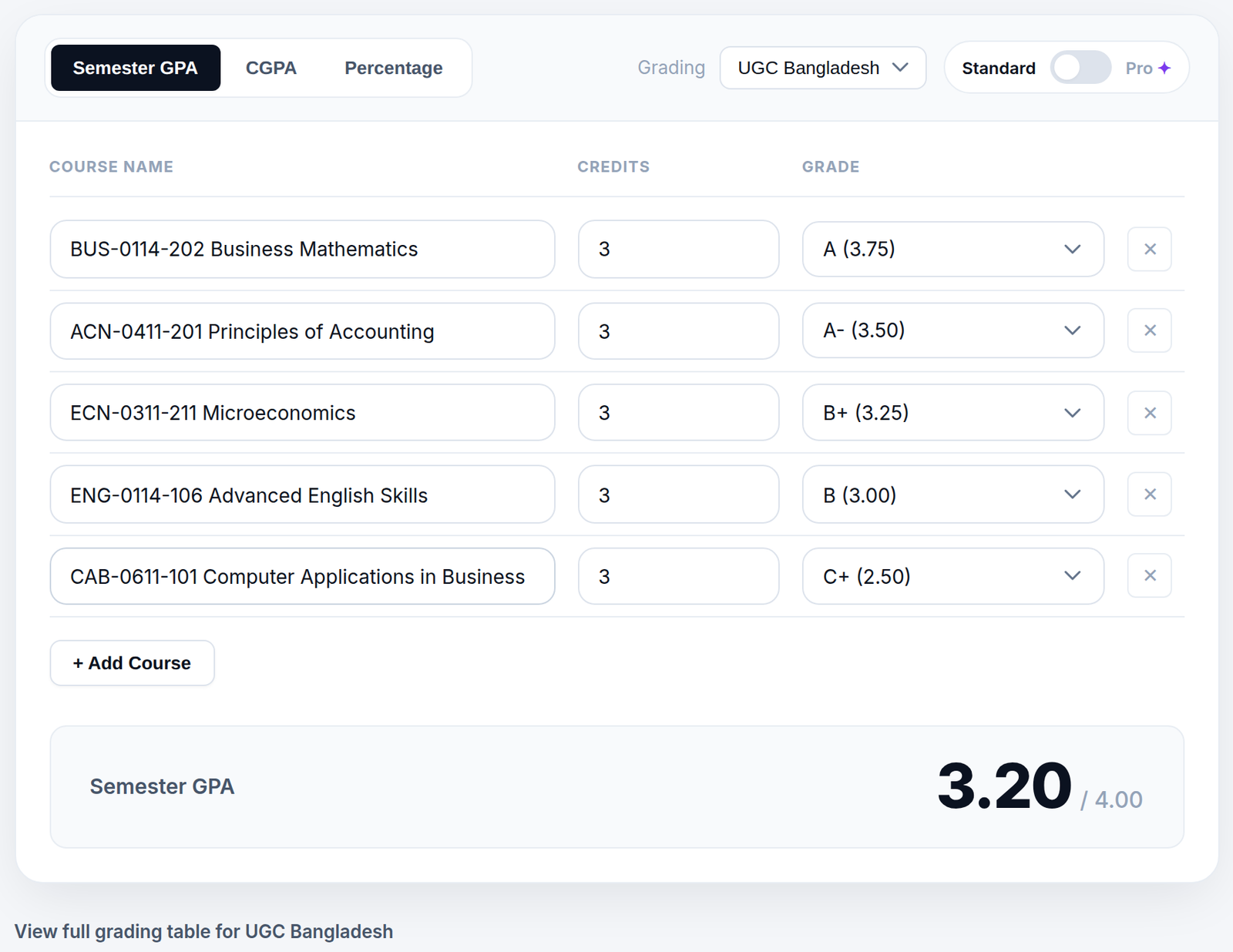
Quick start: type the course name, type the credit hours (CIU courses are usually 3 credits; labs and some foundation courses differ — check your course outline), pick the letter grade from the dropdown, and add a row per course. The result updates as you go. The example above reproduces Worked Example 1 further down this page — try matching it to check your own entries.
One caution the screenshot doesn’t show: the calculator’s credit fields can look pre-filled while their actual value is still empty — always click into each credit box and type the number yourself, then confirm the result matches your hand calculation before trusting it.
CIU’s Official Grading Table (2026)
CIU’s curricula documents (Part-D, “Grading Policy”) state that the university follows the UGC-prescribed grading system per UGC Circular No. Sha/464/04/2690-100, dated 13.6.2006. Here is the table exactly as CIU publishes it:
| Numerical Grade (Marks) | Letter Grade | Grade Point |
|---|---|---|
| 80% and above | A+ (A Plus) | 4.00 |
| 75% to less than 80% | A (A regular) | 3.75 |
| 70% to less than 75% | A− (A minus) | 3.50 |
| 65% to less than 70% | B+ (B Plus) | 3.25 |
| 60% to less than 65% | B (B regular) | 3.00 |
| 55% to less than 60% | B− (B minus) | 2.75 |
| 50% to less than 55% | C+ (C Plus) | 2.50 |
| 45% to less than 50% | C (C regular) | 2.25 |
| 40% to less than 45% | D (D regular) | 2.00 |
| Less than 40% | F (Fail) | 0.00 |
Three things worth noticing. First, there is no A+ band ambiguity: 80% is the line, and CIU publishes the bands as “75% to less than 80%” and so on — so 79.6% is an A, not an A+. Second, D (2.00) is the lowest passing grade; below 40% you get an F worth nothing. Third, compare this with IUB-Dhaka’s table and the difference jumps out: IUB has no A+ at 4.00 and prices A− at 3.7. At CIU, A− is 3.50 and B+ is 3.25 — the UGC scale is a quarter-point lower than the American scale at nearly every step, which is exactly why using the wrong university’s table silently deflates or inflates your GPA.
How GPA Is Calculated at CIU — Step by Step
CIU’s official definition is short: “The Grade Point Average (GPA) and Cumulative Grade Point Average (CGPA) are calculated by Total Grade points divided by Total Credits.” In practice, that means a credit-weighted average. Follow these steps for any semester:
- Convert each letter grade to its grade point using the official table above. A 72% in Microeconomics is an A−, worth 3.50 — not 3.7, not 3.67.
- Multiply each grade point by the course’s credit hours to get that course’s quality points. A 3-credit course with an A (3.75) contributes 3.75 × 3 = 11.25 quality points.
- Add up all quality points across the semester.
- Add up all credit hours attempted (including any F — a failed course contributes 0 quality points but its credits still count in the denominator).
- Divide total quality points by total credits. That is your semester GPA.
Your CGPA uses the same formula, but across every semester you have completed: total quality points earned since enrollment divided by total credits attempted. Our SGPA formula guide with examples walks through the same credit-weighted logic with additional cases if you want more practice.
The Formula
Semester GPA = Σ (Grade Point × Credit Hours) ÷ Σ (Credit Hours)
CGPA = Σ (Quality Points, all semesters) ÷ Σ (Credit Hours, all semesters)
Worked Example 1: A CIU BBA Semester (GPA 3.20)
Take a typical five-course BBA semester, all 3-credit courses, using real CIU course codes:
| Course | Credits | Grade | Grade Point | Quality Points |
|---|---|---|---|---|
| BUS-0114-202 Business Mathematics | 3 | A | 3.75 | 3.75 × 3 = 11.25 |
| ACN-0411-201 Principles of Accounting | 3 | A− | 3.50 | 3.50 × 3 = 10.50 |
| ECN-0311-211 Microeconomics | 3 | B+ | 3.25 | 3.25 × 3 = 9.75 |
| ENG-0114-106 Advanced English Skills | 3 | B | 3.00 | 3.00 × 3 = 9.00 |
| CAB-0611-101 Computer Applications in Business | 3 | C+ | 2.50 | 2.50 × 3 = 7.50 |
| Total | 15 | 48.00 |
Adding the quality points: 11.25 + 10.50 + 9.75 + 9.00 + 7.50 = 48.00. Total credits: 15. Semester GPA = 48.00 ÷ 15 = 3.20 exactly. Notice how the single C+ drags the average: without it, the other four courses alone would average (11.25 + 10.50 + 9.75 + 9.00) ÷ 12 = 40.50 ÷ 12 = 3.375. One weak 3-credit course cost this student nearly 0.18 GPA points — which is precisely why the retake policy below matters.
Read more:
How to Improve Your CGPA: Proven Strategies for 2026 — a full playbook for lifting a weak semester, including when a retake beats extra effort in current courses.
Worked Example 2: What a Retake Actually Does to Your CGPA
Suppose a student has completed 60 credits with a CGPA of exactly 3.00 — that means 180.00 quality points banked (3.00 × 60). One of those courses was a 3-credit C (2.25), contributing 6.75 of those points. The student retakes it under CIU’s retake policy and earns an A (3.75).
CIU’s rule: after a retake, the higher grade counts toward the CGPA. So the C’s 6.75 quality points are replaced by the A’s 11.25 — a net gain of (3.75 − 2.25) × 3 = +4.50 quality points.
New totals: 180.00 + 4.50 = 184.50 quality points over the same 60 credits. New CGPA = 184.50 ÷ 60 = 3.075, reported as 3.08. One retaken course moved the needle by 0.08 — small, but on a 60-credit base that’s the realistic scale of a single retake, and it’s exactly how you should model the decision before re-registering.
Also note the safety net built into the rule: if the retake had gone worse than the C, the original higher grade would still count. The risk of a retake at CIU is the tuition fee and the semester slot, not your existing grade.
GPA vs CGPA: Don’t Mix Them Up
Your semester GPA measures one term. Your CGPA measures your entire degree — and it is the number that appears on your transcript, determines your class standing, and gets asked about in job interviews and graduate applications. Because CGPA is cumulative, early semesters carry disproportionate weight: a 2.60 first year over 30 credits needs a lot of 3.60+ semesters later to pull the average back up, since every new semester is diluted by the credits already banked.
The practical consequence: check your CGPA trajectory every semester, not just the term GPA. If the cumulative number is drifting below where you need it (scholarship cutoffs, graduate admission floors), that is the moment to plan retakes or adjust your course load — not two semesters later. For the full breakdown of how the three measures relate, see CGPA vs GPA vs SGPA: the Difference Explained.
CIU’s Retake and Grade Improvement Policy (Official)
This is the section most CIU students have never read, and it comes straight from the university’s published curricula:
- Only B− and below can be retaken. If you earned a B or higher, you cannot retake the course to chase a better grade — the door is closed.
- The higher grade counts. After a retake, whichever grade is higher (original or retake) is the one used in your CGPA.
- Maximum two retakes per course before graduation.
- An F must be retaken in the immediate successive enrolled semester — you cannot park a failed course and deal with it later.
- A missed prerequisite grade must likewise be retaken in the immediate successive enrolled semester.
Strategically, this means retakes are a scarce resource: two per course, B−-and-below only. Spend them on high-credit courses where the grade-point gap is largest — retaking a 3-credit C to an A gains 4.50 quality points, while retaking a 1-credit lab C to an A gains only 1.50. Do the before/after math (Worked Example 2 above) before you re-register and pay the fee.
Withdrawal, Add/Drop, Incomplete, and the CN Grade
Course withdrawal
CIU allows withdrawal from only one course per semester, by the published deadline, with the consent of both the instructor and your academic advisor. You must provide valid reasons with supporting documents. Withdrawing from the whole semester is possible only case-by-case with valid documented reasons. A W is recorded on your transcript — and withdrawing does not discharge your financial liability for the course. If a semester is going badly, one strategic withdrawal can protect your GPA, but you only get one per term, so choose the course where the damage is worst.
Add/Drop
Courses can be added or dropped within the stipulated drop/add period using the official Add/Drop form, which requires your academic advisor’s signature. Handle this in week one — after the window closes, your options narrow to the single withdrawal described above.
Incomplete (I) grades
An I is given only if you have completed at least 75% of a course but could not finish due to illness or another acceptable reason. You then complete the remaining 25% before the end of the following semester, in consultation with the instructor — no re-registration needed. Key details: I grades are strongly discouraged and need approval from both the instructor and the Dean of School; if the instructor is unavailable, the Dean assigns the replacement grade; and if you don’t finish in the following term, the I may convert to an F. If illness struck before you reached 75% attendance, the policy instead asks you to withdraw from the course and retake it.
The CN (Continuation) grade
One CIU-specific mark you won’t find in generic guides: CN, the Continuation grade, given when an internship, thesis, seminar paper, or senior project is still in progress. It can be carried for a maximum of three semesters. If you see CN on your grade report, it simply means the work isn’t finished yet — it is not a penalty grade.
Read more:
University of Chittagong Grading System 2026 — the public university’s scale and rules, for students comparing the two Chattogram institutions (or making sure they’re on the right page).
Common Mistakes CIU Students Make
- Using IUB-Dhaka’s grade table. The single most common error, driven by the near-identical university names in search results. IUB’s A− is 3.7; yours is 3.50. Always verify against CIU’s own UGC-based table.
- Averaging the original and retake grades. CIU doesn’t average — the higher grade counts. Students who assume an average undervalue their retakes.
- Trying to retake a B. The policy allows retakes only for B− and below. A B (3.00) is final.
- Forgetting that F credits still count. A failed 3-credit course adds 0 quality points but 3 credits to the denominator — it drags the GPA twice, once in the numerator and once in the denominator, until you retake it.
- Treating all credits equally. A 6-credit internship moves your CGPA twice as much per grade point as a 3-credit course. Weight your effort (and your retake choices) by credit hours.
- Missing the one-withdrawal limit. Planning to drop two sinking courses in one semester isn’t possible — you get one withdrawal per term.
- Ignoring the F retake deadline. An F must be retaken in the immediate successive enrolled semester. Delaying it isn’t an option under the official policy.
CIU’s Semester Calendar and Credit Loads
CIU runs two regular semesters plus one short semester each year: Spring (January–April), Summer (May–August), and Autumn (September–December). For reference, Autumn 2026 runs: classes commence 20 September 2026, mid-term examinations 1–5 November 2026, classes end 10 December 2026, final examinations 13–17 December 2026, with grades due at the Controller of Examinations on 30 December 2026.
Program sizes vary: CSE and EEE are 160 credit hours each, the BBA is 125 credits (36 foundation + 57 core + 23 major + 9 LFE/internship), and the MBA is 66 credits. The Summer semester is short — lighter loads there are normal, and it’s a good window for retaking an F without overloading a regular term. Transfer students should note the residential requirement: at least 60 credits (undergraduate) or 36 credits (graduate) must be completed at CIU itself, with a minimum incoming CGPA of 2.50 — see CIU’s admission eligibility page for the full criteria.
Probation, Graduation, and Scholarships: What We Can (and Can’t) Confirm
An honest note: CIU’s published curricula detail the grade table, withdrawal, Incomplete, and retake rules — but they do not publish a detailed probation ladder or an explicit graduation CGPA floor. We will not fill that gap with another university’s rules (most search results here are IUB-Dhaka’s, which do not apply to you). The widely applicable UGC norm is a minimum CGPA of 2.00 for graduation, and CIU’s own graduate-admission pages require 2.00–2.50 at the undergraduate level — but confirm your program’s exact standing rules with your advisor or the Registrar, since individual schools can set higher bars.
What is confirmed is that CIU rewards top performers publicly: the SSE Dean’s and Performance Award goes to the students with the highest semester CGPA (Autumn 2023, Spring 2024, and Summer 2024 cohorts were celebrated in November 2024), alongside the semesterly Academic Excellence Award ceremonies and the Youngone–CIU Academic Excellence Scholarship. The university reports BDT 445 million in scholarships and waivers over the last five years. High semester GPAs here convert directly into recognition — and in some cases funding — so the retake and withdrawal math in this guide has a financial payoff, not just an academic one. For context on how probation and Dean’s-list thresholds generally work in the region, see Dean’s List & Academic Probation: CGPA Thresholds.
Tips for Raising Your CGPA at CIU
- Attack high-credit, low-grade courses first. Quality points scale with credits — a 3-credit C→A retake (+4.50 QP) beats a 1-credit lab retake (+1.50 QP) by 3×.
- Use your one withdrawal deliberately. One per semester, documented reasons required. Spend it on the course doing the most denominator damage, not the one you merely dislike.
- Retake F grades immediately — the policy requires the next enrolled semester anyway, and every semester the F sits in your denominator it suppresses your CGPA.
- Protect the 75% line. If illness hits mid-semester, the difference between 74% and 76% attendance is the difference between “withdraw and retake” and “Incomplete with a path to finish.” Document everything.
- Front-load effort in Autumn and Spring. The short Summer term is better suited to a focused retake or a lighter load than to your hardest core courses.
- Model before you register. Run the before/after arithmetic (Worked Example 2) for every candidate retake — some “obvious” retakes move the CGPA by less than 0.05 and aren’t worth the fee and the semester slot.
Frequently Asked Questions
Is Chittagong Independent University the same as IUB?
No. Chittagong Independent University (CIU, Chattogram, ciu.edu.bd) and Independent University, Bangladesh (IUB, Dhaka) are separate private universities with different grading scales. CIU uses the UGC Bangladesh 4.0 scale (A+ = 4.00, A = 3.75, A− = 3.50); IUB uses a US-style scale (A = 4.0, A− = 3.7). Do not use IUB’s table or IUB-specific calculators for CIU grades.
What grading scale does CIU actually use?
The UGC Bangladesh uniform 4.0 scale, published in CIU’s own curricula per UGC Circular No. Sha/464/04/2690-100 (13.6.2006): A+ 4.00 (80%+), A 3.75 (75–80%), A− 3.50 (70–75%), B+ 3.25, B 3.00, B− 2.75, C+ 2.50, C 2.25, D 2.00 (40–45%), F 0.00 (below 40%).
If I retake a course at CIU, are both grades averaged?
No. CIU’s official retake policy states that the higher of the two grades counts toward your CGPA. Retakes are allowed only for courses graded B− or below, at most twice per course.
How many courses can I withdraw from in one semester at CIU?
One. Withdrawal needs the consent of your instructor and academic advisor, valid documented reasons, and must be done by the deadline. A W appears on your transcript, and you still owe the course fee.
What does a “CN” grade on my CIU transcript mean?
CN is the Continuation grade, given when an internship, thesis, seminar paper, or senior project is still in progress. It can be held for a maximum of three semesters and is not a penalty.
What happens if I don’t finish an Incomplete (I) grade?
You must complete the remaining coursework before the end of the following semester. If you don’t, the I may be converted to an F through the grade-change procedure.
Do I have to retake a failed course right away?
Yes. CIU’s policy requires a course graded F to be re-taken in the immediate successive enrolled semester — and remember its credits keep dragging your GPA until you do.
Conclusion
CIU’s grading system is straightforward once you anchor it to the right source: the UGC 4.0 table in the university’s own curricula, credit-weighted exactly like the formula and examples above. The details that actually move your CGPA are the policy edges — the B−-and-below retake limit, the higher-grade-counts rule, the single withdrawal per semester, and the F retake deadline. Run your numbers through the CGPA calculator with the “UGC Bangladesh” scale, model your retakes before you pay for them, and when a rule isn’t in CIU’s published documents (like the probation ladder), ask your advisor rather than trusting another university’s handbook that happens to share your initials.