Quick answer: Metropolitan University, Sylhet (MU) uses the UGC Bangladesh uniform grading system: A+ (4.00) at 80% and above down to D (2.00) at 40%, with F (0.00) below 40%. Grades D and above earn credit; F earns nothing and the course must be retaken. Term GPA is total grade points divided by total credit hours. To graduate you need a minimum GPA of 2.0 in all courses plus the full credit hours of your program — a lower bar than most Dhaka private universities. MU also publishes two unusual grade codes, S (Supplementary) and AB (Absence), and states plainly that every plus and minus is worth exactly 0.25 grade points. Read on for the official table, a hand-checked worked example, the retake and transfer rules, and the gaps in the official pages nobody else explains.
First, make sure you mean the right “Metropolitan University”
This guide is about Metropolitan University in Sylhet, Bangladesh — official site metrouni.edu.bd, founded in 2003 by Dr. Toufique Rahman Chowdhury, with a permanent campus in Sylhet and 6,000+ enrolled students. It is often shortened to MU.
You can calculate any MU term GPA in under a minute:
- Open the calculator at cgpacalculatorpro.com and select the UGC Bangladesh grade scale. This is the scale MU officially follows — the page states it “follows the grading system approved by the University Grants Commission of Bangladesh.” Remember: A+ is 4.00 and A is 3.75. Using a generic 4.0 scale (or worse, Toronto Metropolitan’s 4.33 scale) silently corrupts every result.
- Click Add Course until you have one row per course.
- Type each course’s credit hours — don’t trust the “3” that renders in the box; make sure you type the value yourself.
- Pick the letter grade for each course from the dropdown (A+, A, A−, B+, B, B−, C+, C, D, F).
- Read your GPA. For CGPA across terms, keep adding courses, or enter earned points and credits from previous result sheets.
MU official grading table (2026)
The following is the official table from MU’s examination page, reproduced exactly. Note the two extra codes — S and AB — that most UGC tables don’t have:
| Numerical Score | Letter Grade | Grade Points per Credit |
|---|---|---|
| 80 and above | A+ | 4.00 |
| 75 to less than 80 | A | 3.75 |
| 70 to less than 75 | A− | 3.50 |
| 65 to less than 70 | B+ | 3.25 |
| 60 to less than 65 | B | 3.00 |
| 55 to less than 60 | B− | 2.75 |
| 50 to less than 55 | C+ | 2.50 |
| 45 to less than 50 | C | 2.25 |
| 40 to less than 45 | D | 2.00 |
| Less than 40 | F (Failure) | 0.00 |
| — | I (Incomplete) | 0.00 |
| — | W (Withdrawal) | 0.00 |
| — | S (Supplementary) | 0.00 |
| — | AB (Absence) | 0.00 |
A few things worth noticing that most students miss:
- D is a passing grade at MU. The official rule: a course in which a student has obtained ‘D’ or a higher grade counts as earned credit hours. Only F fails.
- Every plus and minus is worth exactly 0.25 grade points. MU states this on the page (“The ‘+’ and ‘–’ has a value of 0.25 grade point”) — so A+ is just A plus 0.25, B− is B minus 0.25, and so on. Once you see this, the whole table is one number you memorize (the whole-letter steps) plus the 0.25 modifier.
- Beware a popular wrong table. A well-known programming problem (“CGPA, the Golden Egg!”) set at MU Sylhet prints the 40–44 band as “C-” (2.00) instead of D (2.00). There is no C− on MU’s official table. If you ever copy a grade table from a forum or coding site, check it against the official examination page, not the other way round.
- S and AB are MU-specific codes — Supplementary and Absence. Like I and W, they carry 0.00 and don’t enter your GPA math.
How MU grades are built: the marks behind the letters
MU evaluates students through continuous assessment: attendance and participation, assignments, class tests, mid-term exam, and final exam. Lab-based courses are evaluated through lab tasks assigned by the teachers. The published marks split is:
- Mid-term examination — 30
- Class test — 20
- Attendance and participation — 10
- Final examination — 40
An honest flag: the page prints the total row as “10o” instead of 100 — a typo, but the four rows above it (30 + 20 + 10 + 40) unambiguously add to 100. The practical takeaway: attendance and participation is worth a full 10 marks, not a rounding error — a student skipping classes is giving away the easiest 10 marks of the course.
Also note the seriousness of exam absence: a student may apply through the course teacher to remain absent from an exam only for “appalling reasons” (serious illness, fatal accident, death of near and dear ones) with evidence, and if convinced, gets an Incomplete (I) grade — see the I-grade rule below.
The formula: GPA and CGPA at MU
MU states the computation directly: GPA = Sum of (Grade points × Credits) / Sum of credits attempted.
In plain English: multiply each course’s grade point by its credit hours, add everything up, and divide by the total credit hours attempted.
Term GPA = (sum of grade point × credit hours for each course) ÷ (total credit hours)
CGPA = (sum of all grade points earned across all terms) ÷ (total credit hours attempted across all terms)
One nuance worth knowing: the official page’s footnote says that credits for F-graded courses “can not apply for graduation and marks will not be included in the calculation of grade point average.” Taken literally, that means F marks are excluded from the GPA entirely — but the printed formula divides by credits attempted, which normally includes failed courses. MU’s own page doesn’t resolve this tension. Until it does, compute your GPA both ways and compare against your official transcript: if a failed course shows 0 points but its credits in the denominator, your registrar uses the standard method.
Worked example 1: term GPA (hand-checked)
Take an MU engineering student with five 3-credit courses (the course codes are real MU codes from the university’s exam routines):
| Course | Marks | Grade | Grade Point | Credits | Grade Points |
|---|---|---|---|---|---|
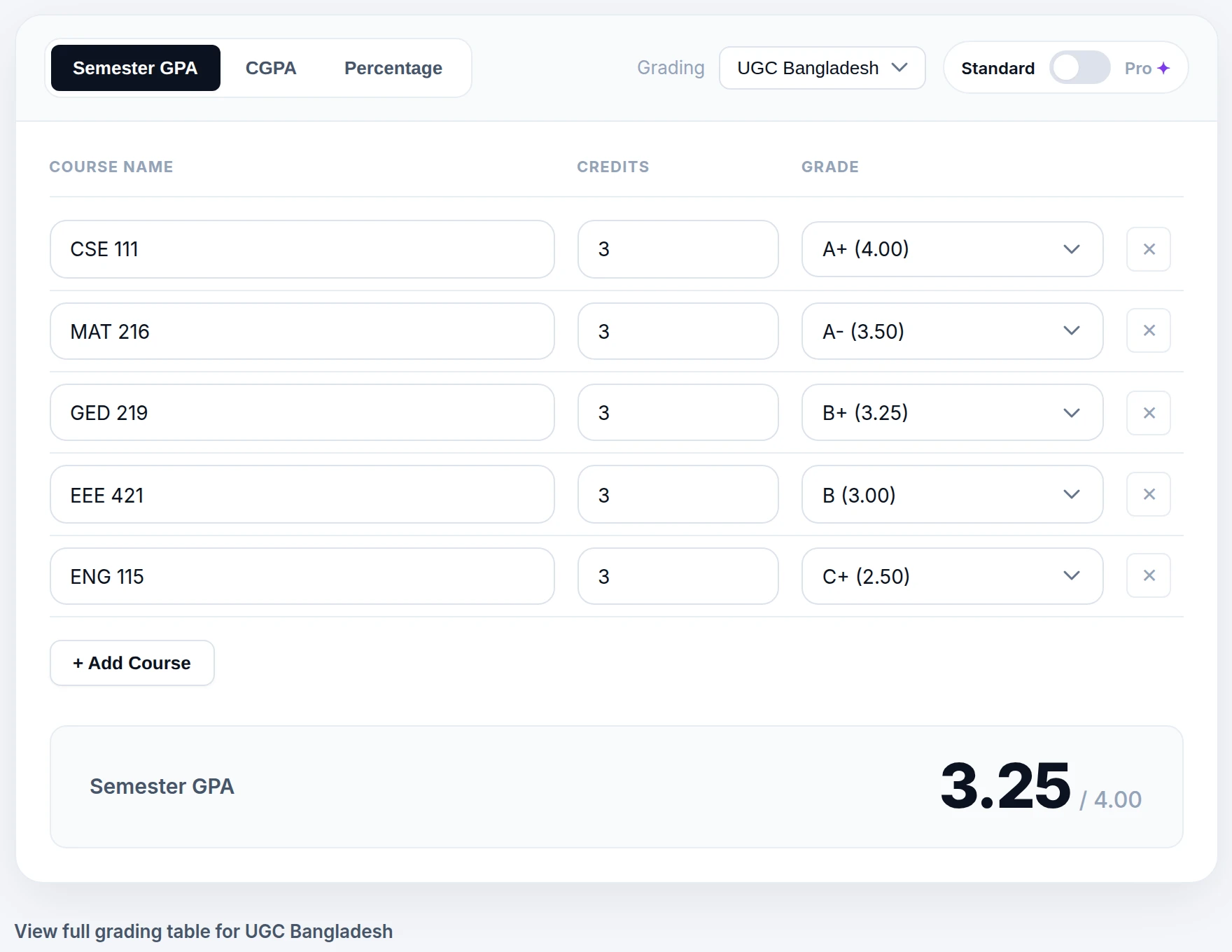
| CSE 111 | 84% | A+ | 4.00 | 3 | 12.00 |
| MAT 216 | 72% | A− | 3.50 | 3 | 10.50 |
| GED 219 | 67% | B+ | 3.25 | 3 | 9.75 |
| EEE 421 | 61% | B | 3.00 | 3 | 9.00 |
| ENG 115 | 52% | C+ | 2.50 | 3 | 7.50 |
Step by step:
- Convert marks to grades and grade points using the table above (84% → A+ → 4.00; 72% → A− → 3.50; 67% → B+ → 3.25; 61% → B → 3.00; 52% → C+ → 2.50). Notice how the 0.25 rule works: B+ is just B (3.00) plus 0.25.
- Multiply each grade point by 3 credits: 12.00, 10.50, 9.75, 9.00, 7.50.
- Add: 12.00 + 10.50 + 9.75 + 9.00 + 7.50 = 48.75 grade points.
- Total credits: 5 × 3 = 15.
- GPA = 48.75 ÷ 15 = 3.25.
The screenshot above shows this exact example entered on the CGPAPro calculator — same five courses, same credits, same grades, result 3.25. No rounding tricks, no approximations.
Worked example 2: CGPA across terms
Suppose the same student finished two earlier terms with 30 credits at a 2.75 GPA — that’s 82.50 earned grade points. Adding the new term:
- Prior: 30 credits → 82.50 points
- Current: 15 credits → 48.75 points
- Total: 45 credits, 131.25 points
- CGPA = 131.25 ÷ 45 = 2.92
Note the effect: a strong 3.25 term lifted the CGPA from 2.75 to 2.92, but the older 30 credits weigh twice as much — CGPA moves slowly. Early terms matter enormously, which is why retaking a failed course promptly matters too.
Read more: CGPA vs GPA vs SGPA: What’s the Difference? (2026) — the full breakdown of term GPA vs cumulative GPA. And to see how MU’s rules compare with another Sylhet campus, read Leading University Grading System 2026.
Terms, not semesters: MU’s three-term calendar
MU runs three terms a year: Spring (January–April), Summer (May–August), and Autumn (September–December), with admission tests administered for all three. One honest flag: the university’s own admission page first says “two semesters … namely Spring and Summer” and then lists all three terms — the program pages (entry times January/May/September) confirm three intakes, so the “two semesters” line is stale wording.
What this means for your GPA math: three result cycles a year instead of two. A bad term hurts sooner, and a good one repairs sooner. Plan retakes around the term calendar — and note that students who “fail to be promoted to the next term” or drop out must go through readmission (with fees) via their head of department.
Retake, I-grades, transfer credits, and graduation rules
This is the section MU’s official pages scatter across paragraphs, assembled here in one place:
Retakes
- F earns nothing and the course must be retaken. The official examination page is explicit: a course scored ‘F’ does not count toward earned credit — “in such case she/he will have to retake the course.”
- Retaking is real and routine at MU: exam routine notices specifically address “students who are taking retake courses,” noting they need clearance before sitting mid-term exams.
- How retaking a course affects your CGPA walks through the replacement math before you decide which courses to retake.
- Honest qualifier: MU’s public pages state no retake cap (unlike some universities that cap at two courses per term). Whether your department limits retakes, charges per-course fees, or replaces the old grade is in your department handbook — confirm there before registering.
Incomplete (I) grades — the one-month rule
An I grade is for students who miss an exam for serious, documented reasons. It carries no grade point — but it is temporary: the student must take the initiative to sit for a make-up exam and remove the I grade within one month of the next term. Miss that window and the I automatically converts to an F. Treat an I as an emergency, not a postponement.
Transfer credits and the 50% residency rule
MU accepts credit transfer from other universities with “acceptable academic systems and standards” — but at most 50% of the required credits can be transferred in. The graduation rules mirror this: an undergraduate must earn at least 50% of the required credits at Metropolitan University itself. Transferring students should plan their MU residency from day one.
Graduation requirements
- Minimum GPA of 2.0 in all courses — note this is lower than the 2.50 bar at many Dhaka private universities (WUB, NSU, IUB, BRACU all require 2.50). MU’s official page states 2.0, though the “in all courses” wording is worth confirming with your department for its exact interpretation.
- Completion of the full required credit hours of your program: BBA 123, B.Sc. CSE 150 (the School of Science & Technology page prints 152 — MU’s own pages disagree, so confirm with the CSE department), B.Sc. EEE (diploma) 127.
- At least 50% of required credits earned at MU (undergraduates); full residency for graduate programs.
- No F-graded course can apply toward graduation.
What about probation? An honest answer
MU’s public pages publish no academic probation ladder — no published thresholds, no probation-to-suspension chain. The only “probation” on the university’s site is disciplinary probation in the student code of conduct (a conduct matter, not a GPA matter). This article won’t invent a GPA-based probation chain. If your CGPA is falling, the number that matters is the published one: stay at or above the 2.00 graduation bar, and get the actual probation/standing rules from your department handbook — they exist, they’re just not on the public website.
Read more: How to Improve Your CGPA: 12 Proven Strategies (2026) — practical tactics for climbing back above the line.
Common mistakes MU students make
- Using the wrong “Metropolitan” calculator. The top search results for “Metropolitan University GPA calculator” are for Toronto (4.33 scale). One wrong scale choice and every grade point is wrong.
- Copying the toph.co grade table. The popular MU-themed programming problem labels 40–44 as “C-” — there is no C− at MU. The official grade is D (2.00), and it earns credit. Students using the wrong table misjudge their own standing.
- Assuming the graduation bar is 2.50. Most Dhaka private universities require 2.50; MU’s published requirement is 2.0. Good news — but verify the “in all courses” interpretation with your department.
- Counting F the wrong way. MU’s footnote says F marks are excluded from GPA; the formula says divide by credits attempted. Know which method your transcript uses before arguing with it.
- Letting an I grade expire. One month into the next term, an unresolved I becomes a permanent F.
- Ignoring the 10 attendance marks. Attendance and participation is a full 10 marks — and being barred from sitting exams is worse than losing them.
- Forgetting the 50% residency rule. Transfer students who assume all their old credits count can discover late that half the degree must be earned at MU.
Tips for MU students
- Memorize the 0.25 rule. MU’s own statement — every plus/minus is 0.25 — means you can reconstruct the entire table from A+ = 4.00 downward.
- Protect high-credit courses. MU’s major courses carry 3–4 credits and labs 1–2; a 3-credit A− moves your GPA far more than a 1-credit A+. Allocate study time by credit weight.
- Retake failures immediately. An F earns zero and must be retaken — and per the exam notices, retake students need clearance before mid-terms, so register early.
- Guard the I-grade deadline. One month from the start of the next term — put it on your calendar the day the I is awarded.
- Plan around three terms. Spring, Summer, Autumn — three GPA resets a year. Use a strong term to cushion the next, and don’t carry a weak term’s habits into the next intake.
- Check the transcript math. Compute your GPA both with and without F credits in the denominator and match it to your official result sheet — know your registrar’s method.
FAQ
Is Metropolitan University (Sylhet) the same as Toronto Metropolitan University?
No. They are entirely different institutions in different countries. MU Sylhet (metrouni.edu.bd) uses the UGC Bangladesh 4.00 scale; Toronto Metropolitan uses a 4.33 scale. Never use a Toronto-based GPA calculator for MU Sylhet grades.
Does MU Sylhet use the UGC Bangladesh grading scale?
Yes. MU’s official examination page states it “follows the grading system approved by the University Grants Commission of Bangladesh” — the uniform scale: A+ 4.00 at 80%+, down to D 2.00 at 40%, F 0.00 below 40%.
Is D a passing grade at Metropolitan University?
Yes. MU’s official rule counts any course with ‘D’ or higher as earned credit hours. Only F fails. But a transcript full of D grades will drag your GPA toward the 2.00 graduation floor, so “passing” is not the same as “comfortable.”
What CGPA do I need to graduate from Metropolitan University?
The published requirements: a minimum GPA of 2.0 in all courses, completion of your program’s required credit hours (BBA 123, CSE 150, EEE diploma 127), at least 50% of those credits earned at MU, and no F-graded course counting toward graduation. Confirm the “2.0 in all courses” interpretation with your department.
What happens if I get an Incomplete (I) grade?
You must sit for a make-up exam and remove the I within one month of the next term. If you don’t, it automatically converts to an F — which must then be retaken.
Can I transfer credits to Metropolitan University?
Yes, up to 50% of your program’s required credits from another university with acceptable standards, evaluated by MU’s Equivalence Committee. At least 50% of your degree must still be earned at MU.
Do failed courses affect my GPA at MU?
An F earns zero grade points and the course must be retaken. The official page’s footnote says F marks are excluded from the GPA calculation, but the printed formula divides by “credits attempted” — check your official transcript to see which method your registrar uses, and plan retakes accordingly.
Wrapping up
MU Sylhet’s grading system is the familiar UGC Bangladesh scale, but the details around it are what make or break a degree: the 0.25 step that lets you reconstruct the whole table, D-as-passing with earned credit, the one-month I-grade deadline, the F-must-be-retaken rule, the 50% residency requirement for transfer students, and — most unusually — a 2.00 graduation bar that is lower than most private universities’ while the published pages stay silent on probation. Add the name-collision trap (Toronto’s 4.33 scale) and the mislabeled toph.co table, and it’s clear why MU students need a page that checks every claim against the official source. That checking is done for you here — and for the arithmetic itself, plug your real marks into the UGC Bangladesh scale on the CGPAPro calculator and verify against the worked example above. The source of every rule in this article is MU’s own examination page; program credit totals come from the official BBA program page and the School of Science & Technology pages.