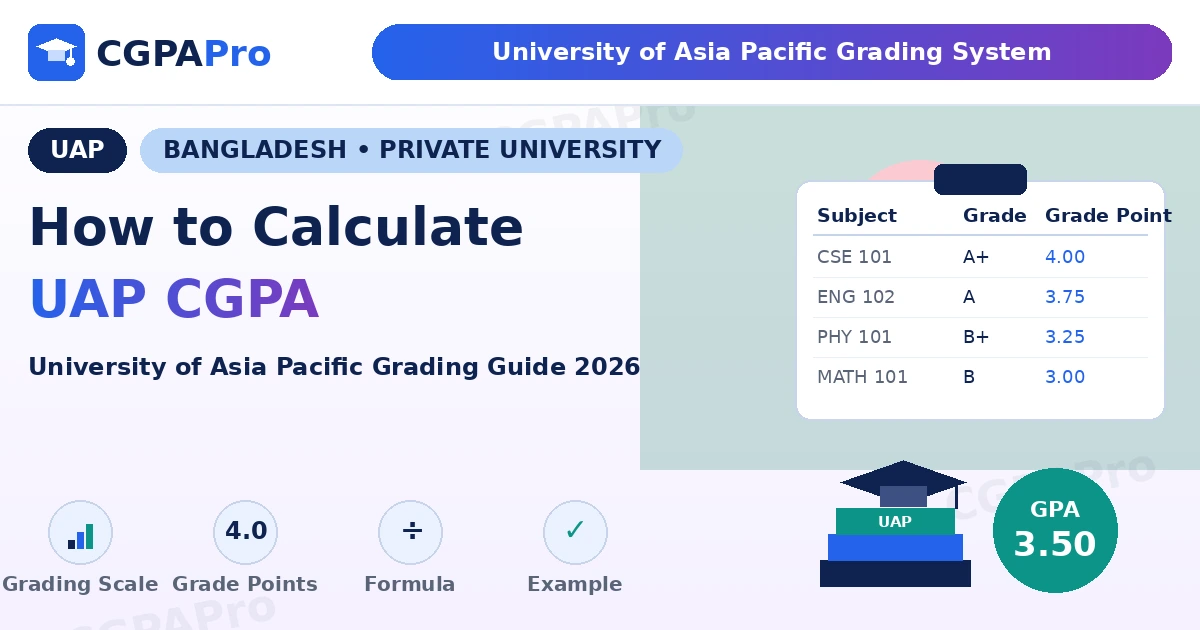
Quick answer: The UAP grading system follows the official University Grants Commission (UGC) of Bangladesh grading scale — the uniform 4.00 scale where 80% and above earns an A+ (4.00) and anything below 40% is an F. UAP says this on its own website, in plain words: “Grades will be calculated as University Grants Commission of Bangladesh (UGC) grading scale.” The minimum passing grade is a D (40–44 marks), and your semester GPA is the credit-weighted average of your grade points. This guide gives you the full official table, the exact formulas, two fully worked UAP examples, and the UAP-specific rules that actually affect your CGPA — retakes, grade improvement, repeat examinations, and the merit-waiver CGPA line that can be worth real money.
If you are looking at the University of Asia Paci
Worked Example 1: One UAP Semester (GPA 3.50)
Meet a fictional UAP freshman, Tanvir, in his first semester. Four courses, 3 credits each:
| Course | Marks | Grade | Grade Point | Credits | Quality Points |
|---|---|---|---|---|---|
| CSE 101 | 84% | A+ | 4.00 | 3 | 12.00 |
| ENG 102 | 77% | A | 3.75 | 3 | 11.25 |
| PHY 101 | 68% | B+ | 3.25 | 3 | 9.75 |
| MATH 101 | 61% | B | 3.00 | 3 | 9.00 |
Total quality points: 12.00 + 11.25 + 9.75 + 9.00 = 42.00
Total credits: 3 + 3 + 3 + 3 = 12
Semester GPA: 42.00 ÷ 12 = 3.50
Notice how the 77% became an A (3.75) while 84% became an A+ (4.00) — those band boundaries are doing real work here. And notice that 61% is a B (3.00), not anything to panic about: at UAP, a B is a solid, respectable grade.
Worked Example 2: CGPA Across Three Semesters (3.51)
Tanvir continues. Here are his semester results:
| Semester | GPA | Credits | GPA × Credits |
|---|---|---|---|
| Semester 1 | 3.50 | 12 | 42.00 |
| Semester 2 | 3.25 | 13 | 42.25 |
| Semester 3 | 3.75 | 14 | 52.50 |
Total: 42.00 + 42.25 + 52.50 = 136.75 quality points
Total credits: 12 + 13 + 14 = 39
CGPA: 136.75 ÷ 39 = 3.51
This also shows the most common CGPA mistake in action: the simple average of the three GPAs is (3.50 + 3.25 + 3.75) ÷ 3 = 3.50, but the true CGPA is 3.51. The difference is small here, but when semesters carry very different credit loads — say a 9-credit semester against a 15-credit one — averaging the GPAs directly gives you a wrong number. Always weight by credits.
Worked Example 3: What One F Does to a Semester
Same four courses as Example 1, but Tanvir missed the MATH 101 final exam without an approved reason. Automatic F:
- CSE 101: A+ → 12.00 quality points
- ENG 102: A → 11.25 quality points
- PHY 101: B+ → 9.75 quality points
- MATH 101: F → 0.00 quality points (credits still count)
Total quality points: 33.00. Total credits: 12.
Semester GPA: 33.00 ÷ 12 = 2.75
One F dragged a 3.50 semester down to 2.75. That is the mathematics of the denominator: the 3 failed credits still divide the total. This is why UAP’s rules about retaking failed courses (next section) matter so much — and why missing a final exam is the most expensive mistake a UAP student can make.
GPA vs CGPA at UAP
Your GPA is one semester’s number. Your CGPA is the running credit-weighted total across every semester so far. Three practical consequences:
- Early semesters weigh more than they feel. A weak first year never disappears from the CGPA — it just gets diluted. A 2.75 first semester needs several strong semesters to pull the CGPA back above 3.50.
- Employers and scholarship committees read CGPA, not individual GPAs. UAP’s own merit waiver uses CGPA (more on that below) — a single bad semester can cost you a semester’s tuition discount.
- Failed courses stay in the math. Retaking an F lets you earn the credit, but plan your recovery around the weighted formula, not wishful thinking.
How Your 100 Marks Are Split
UAP publishes one concrete component breakdown — for its MBA program — and it is a useful template for how UAP thinks about assessment:
- Continuous assessment: 40% — quizzes, assignments, presentations, term papers, case reports, class performance, attendance. Your course teacher publishes these marks in the last week of class.
- Mid-semester examination: 20% — held to the academic calendar; classes are suspended and the exam wraps up within a week.
- Semester final examination: 40% — three hours, with question papers moderated by a moderation committee.
One honest caveat: undergraduate theory courses at UAP don’t all follow this exact 40/20/40 split — the precise breakdown is circulated in each course outline at the start of the semester. Always check your own course outline rather than assuming. What does not change is the grading scale itself, which is university-wide.
Failed a Course? UAP’s Retake and Repeat-Exam Rules
If you earn an F, UAP’s rule is straightforward: you can complete the failed course in the next semester along with your regular courses. Failed courses are treated as back-logs, not as the end of your degree.
There is also a formal Repeat Examination route, published by UAP’s Department of English, with some genuinely unusual details:
- You may appear at repeat examinations if you fail in three theory courses or fewer, not exceeding 10 credit hours.
- The repeat exam is held on 50% of the marks for the course; your class-assessment and mid-semester marks are carried forward.
- Results come out within three weeks of the semester-final results.
- There are no repeat examinations for sessional (lab/practical) courses.
- The grade you can earn is capped: UAP’s page states the maximum grade in a repeat examination is in the B range — the page’s own band table for repeat exams gives 60% and above as a B (B Regular), then B−, C+, C, D and F below. (The page also mentions “B−” as the cap in one line, so the two statements don’t perfectly agree — treat the repeat exam as capped in the B range and confirm the exact cap with your department.)
That cap is worth understanding before you plan a recovery: a repeat exam will clear your F, but it will not hand you an A. For the full general picture of how retakes move your CGPA, see our guide on how retaking a course affects your CGPA.
Can You Improve a Grade You Already Passed?
Yes — within tight limits. UAP’s grade-improvement provision applies only to courses where you earned a C or lower. The details:
- You may improve a maximum of two courses.
- Improving means surrendering the earlier grade — the new grade stands, whatever it is.
- You can apply any time during your study, but not beyond two weeks after the publication of your last semester’s results.
This is a strategic tool, not a casual one. Surrendering a C+ to chase a B is only worth it if you are confident — and if the course is a high-credit one, because that is where the CGPA leverage lives. A 3-credit C improved to a B moves the needle; a 1.5-credit lab course barely registers.
Think Your Script Was Marked Wrong? Re-evaluation
UAP allows re-evaluation of final-examination answer scripts. You apply to the Controller of Examinations through your advisor and Head of Department, paying 700 taka per script, within 7 working days of the final results being published. A week is a short window — if you suspect a marking error, move fast and keep your advisor in the loop from day one.
Why Your CGPA Is Worth Real Money at UAP
Here is the part of the UAP grading system that hits your wallet. UAP’s published tuition policy ties semester waivers directly to performance:
- Top 3% of students: 100% tuition waiver
- Next 6%: 50% waiver
- Next 10%: 25% waiver
And the disqualification list is strict: below 3.5 CGPA for the merit waiver, any F grade, not taking full credits, any disciplinary action, or discontinuing the semester — any one of these kills the waiver. So the difference between a 3.49 and a 3.50 CGPA at UAP isn’t just a number on a transcript; it can be a semester’s tuition. There are also full free studentships (6% of students, per the Private University Act 2010) and special waivers for poor-but-meritorious students. If money matters to your family — and for most Bangladeshi families it does — treat every semester’s GPA as a financial target, not just an academic one.
7 Common Mistakes UAP Students Make
- Using the wrong calculator preset. Many generic CGPA sites split scales into “public” and “private” presets, and their “private” preset is the NSU-style scale (A starts at 90%). UAP is private but uses the UGC scale. Pick “UGC Bangladesh” — always.
- Mixing up the HSC 5.00 scale with the university 4.00 scale. Fresh out of HSC, your brain is calibrated to 5.00. UAP runs on 4.00. A “3.5” means something completely different in each system.
- Thinking 60% is the pass line. At UAP, 40% (a D) passes. Students who assume a 60% threshold either panic unnecessarily or — worse — miscalculate which courses are actually in danger.
- Ignoring the 70% attendance rule. You can have 60% in classwork and still end the semester with an F if you are barred from the final exam.
- Averaging semester GPAs instead of weighting by credits. As Worked Example 2 showed, (3.50 + 3.25 + 3.75) ÷ 3 is not your CGPA. Weight by credits, every time.
- Assuming a retake erases the F. A retake clears the back-log and earns you the credit, but the F semester already happened — and repeat exams are grade-capped in the B range. Plan recovery around the capped, weighted reality.
- Sleeping on an “I” grade. An Incomplete that never gets resolved becomes an F. If you have an I on your record, the repeat exam is not optional.
5 Practical Tips to Raise Your UAP CGPA
- Attack high-credit courses first. A 3-credit course at A− (3.50) contributes 10.50 quality points; a 1.5-credit lab at the same grade contributes 5.25. Same effort, double the CGPA leverage. Put your study hours where the credits are.
- Protect the 70% attendance line from week one. Track it yourself — don’t discover in week 12 that you are two absences from being barred from the final.
- Use the improvement provision deliberately. You get two course improvements, C-or-lower only. Spend them on high-credit courses where a one-letter jump buys the most quality points.
- Chase the 3.50 line, not just “passing.” With the merit waiver disqualifying below 3.5 CGPA, there is a concrete financial reason to aim above 3.50 every semester.
- Withdraw beats failing. UAP lets you withdraw from a course within two weeks of classes starting (with your advisor). If a semester is going badly early, a strategic withdrawal beats an F that will sit in your CGPA math all the way to graduation.
For a deeper playbook, read our guide to improving your CGPA.
UAP Grading System — Frequently Asked Questions
Does UAP use the same grading scale as NSU or BRAC?
No — and this is the single most important fact in this article. NSU and BRAC use their own scales where an A starts around 90%. UAP officially follows the UGC Bangladesh scale (80%+ = A+, 4.00), as stated on UAP’s own grading page. Using an NSU-style preset in a calculator gives you wrong grade points for every course.
What is the minimum passing grade at UAP?
D (40–44 marks, 2.00 grade points). Score 40% or above and you pass the course and earn its credits. Below 40% is an F.
What happens if I miss my final exam at UAP?
An unexcused absence from the semester final examination results in an automatic F for the course. If the absence was for reasons beyond your control, you may be given an I (Incomplete), which you must resolve through the repeat examination — otherwise it converts to an F.
How do retakes work at UAP?
Failed courses can be completed in the next semester alongside regular courses. There is also a formal repeat-examination route for students failing up to three theory courses (max 10 credit hours): the repeat exam covers 50% of the marks, class and mid-semester marks carry over, and the grade you can earn is capped in the B range. There are no repeat exams for sessional/lab courses.
Can I retake a course I passed to get a better grade?
Only if you earned a C or lower, only for a maximum of two courses, and you must surrender the earlier grade. Apply any time during your studies but no later than two weeks after your last semester’s results are published.
What does an I (Incomplete) grade mean?
It means you missed the final exam for reasons beyond your control. The I converts to the actual grade you earn in the repeat examination — but if you don’t sit that exam, the I converts to an F.
How does my CGPA affect my tuition fees at UAP?
Directly. UAP’s merit waiver gives the top 3% of students a 100% tuition waiver, the next 6% a 50% waiver, and the next 10% a 25% waiver. You are disqualified from the merit waiver with a CGPA below 3.5, any F grade, less than full credits, or any disciplinary action.
Conclusion
The UAP grading system is the official UGC Bangladesh 4.00 scale — 80% and above for an A+, a D (40%) to pass, and your GPA as the credit-weighted average of your grade points. The table itself is simple; what decides your CGPA is everything around it: the 70% attendance gate that lets you sit the final, the repeat-exam route that clears F grades (capped in the B range), the two-course improvement provision for C-or-lower grades, and the 3.50 CGPA line that protects your merit waiver. Calculate your own numbers on our free CGPA calculator with the UGC Bangladesh scale selected, keep every semester credit-weighted, and check your program handbook for anything this guide flags as department-specific.
Read More
- Primeasia University Grading System 2026: GPA & CGPA Guide — another Dhaka private university on the UGC scale.
- DIU Grading System 2026: GPA & CGPA Guide — compare with Daffodil International University’s rules.
Read More
- How to Improve Your CGPA: 12 Proven Strategies for 2026 — the recovery playbook, from credit-weight targeting to the improvement provision.
Sources: UAP official grading page (mba.uap-bd.edu); UAP CSE course outline, Appendix-3 UAP Grading Policy; UAP tuition and waiver policy. Probation thresholds and minimum graduation CGPA vary by program — check your current program handbook.
fic, let’s clear up the name soup first. UAP is a private university in Dhaka, founded in 1996. It is not United International University (UIU) — a completely different university with its own grading guide here — it is not Primeasia University, and it is definitely not UPTM in Malaysia. Every rule in this article is verified from UAP’s own published pages (uap-bd.edu and its department sites), not copied from a generic table.
Calculate Your UAP GPA in 60 Seconds
Before the theory, here is the fastest way to get your number. UAP uses the UGC Bangladesh scale, and the calculator below is pre-set to that exact scale:
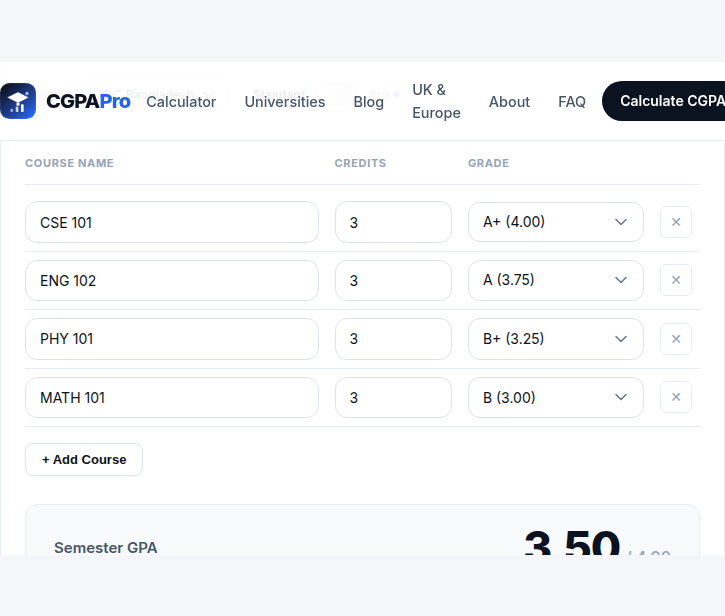
- Choose “UGC Bangladesh” as the grading scale. This is the one UAP officially follows — never the generic or “private university” preset (more on that trap below).
- Add one row per course. Type the course code, enter the credit hours, and pick the letter grade from the dropdown.
- Read your GPA. The calculator multiplies each grade point by its credits, adds them up, and divides by total credits — the same formula UAP’s grading pages describe.
- Do all your semesters the same way, then combine them for your CGPA (explained with a worked example later).
Tip: run the numbers yourself on our free CGPA calculator as you follow the examples below, so the method sticks.
UAP Official Grading Table (2026)
UAP publishes the same grading policy across its departments — you will find the identical table in the CSE department’s approved course outlines (“Appendix-3 UAP Grading Policy”) and on the university’s own grading page. It is the standard UGC Bangladesh table:
| Numerical Grade (Marks) | Letter Grade | Grade Point |
|---|---|---|
| 80% and above | A+ | 4.00 |
| 75% to less than 80% | A | 3.75 |
| 70% to less than 75% | A− | 3.50 |
| 65% to less than 70% | B+ | 3.25 |
| 60% to less than 65% | B | 3.00 |
| 55% to less than 60% | B− | 2.75 |
| 50% to less than 55% | C+ | 2.50 |
| 45% to less than 50% | C | 2.25 |
| 40% to less than 45% | D | 2.00 |
| Less than 40% | F | 0.00 |
Two things about this table catch students off guard. First, the bands are wide and the grade points jump in 0.25 steps — the difference between 79% (A, 3.75) and 80% (A+, 4.00) is a full quarter of a grade point. At the top of the scale, every single mark matters. Second, and more important for students transferring in from other private universities: the pass line at UAP is 40%, not 60%. If you have been reading NSU/BRAC-style scales where anything below 60 or 45 fails, throw that assumption away. At UAP, 40% earns you a D and you pass the course.
Special Grades at UAP: F, I, and E
Beyond the ten letter grades, three special situations appear on UAP records:
- F (Fail, 0.00 points): awarded for scoring below 40% — and, crucially, also for being absent from the semester final examination, even if your classwork marks were fine. Missing the final is an automatic F.
- I (Incomplete): given when you miss the semester final exam for reasons beyond your control. An I is temporary — it converts to the actual grade you earn in the repeat examination. If you never sit that repeat exam, the I converts to an F. Ignore an I grade and it will quietly become a zero.
- E (Exemption): credits earned for an equivalent course at another university or academic institution. Exempted courses carry no grade point and don’t move your GPA — they just show separately on your transcript.
Your academic transcript, per UAP’s own description, lists the courses studied, credits, grades, semester GPAs and CGPA earned at UAP — with credits earned at any other institution shown separately.
The 40% Pass Line — and the 70% Attendance Gate
Two numbers control whether a course even counts for you at UAP:
- 40% to pass. Score 40% or more and you earn at least a D (2.00). Fall below 40% and it’s an F (0.00 points, no credit earned).
- 70% attendance to sit the final. A student must attend at least 70% of the classes held for every course to be allowed to take the semester final examination. One department’s course outline phrases it even more bluntly: 70% attendance is mandatory “in order to pass with D grade.”
This is the sleeper rule. Plenty of students calculate that they “only need 40%” and then discover they were barred from the final exam — which, per rule one, becomes an automatic F. Attendance is not a suggestion at UAP; it is a hard gate on your grades.
How UAP Calculates Your GPA: Step by Step
UAP describes its own method plainly: a student’s performance is evaluated by the credits completed satisfactorily and the weighted average of the grade points achieved, with credits counted “for those courses attempted at this university only.” In practice:
- Convert each course’s marks to a letter grade using the official table above.
- Convert each letter grade to its grade point (A+ = 4.00, A = 3.75, and so on).
- Multiply each grade point by the course’s credit hours — these are your quality points for that course.
- Add up all the quality points across your courses.
- Divide by the total credit hours you attempted that semester. The result is your semester GPA.
An F contributes 0.00 grade points but its credits still sit in the denominator — which is why a single F drags a GPA down so hard (demonstrated in Worked Example 3 below).
UAP GPA and CGPA Formulas
Two formulas, one idea — weighting by credits:
Semester GPA = Σ (Grade Point × Credit Hours) ÷ Total Credit Hours attempted that semester
CGPA = Σ (Grade Point × Credit Hours for ALL courses across all semesters) ÷ Total Credit Hours across all semesters
You can also compute CGPA the shortcut way once you have each semester’s GPA: multiply each semester GPA by that semester’s credits, add those up, and divide by total credits. Both paths give the same number.