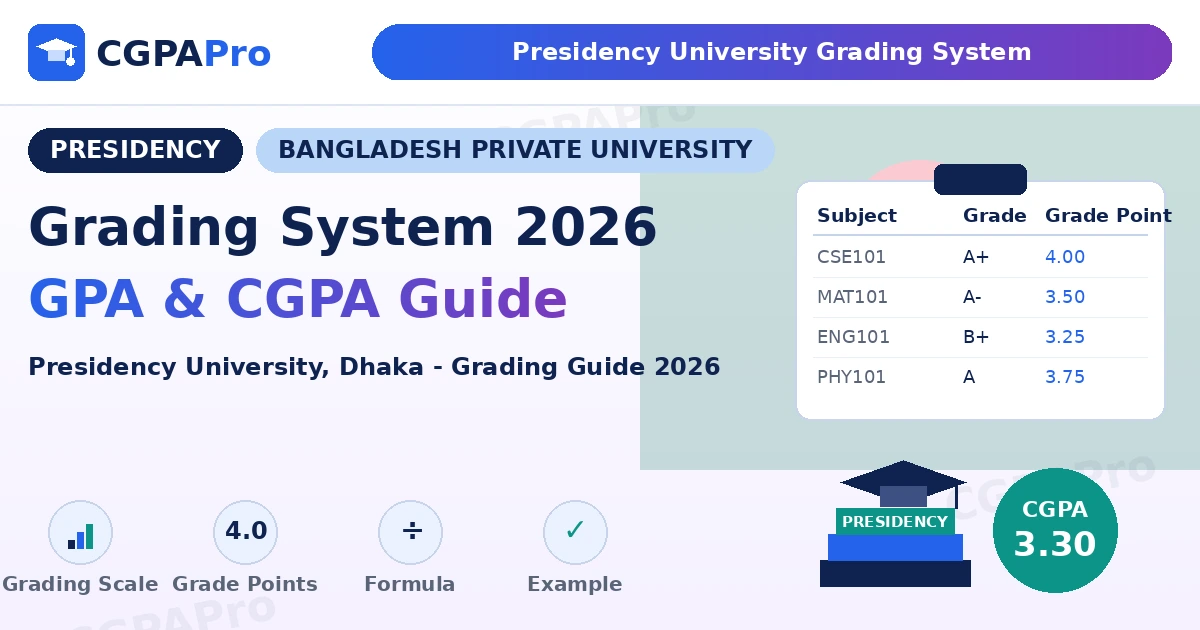
Quick answer: Presidency University in Dhaka follows the UGC-approved uniform 4.00 grading scale — A+ (80% and above) is 4.00, A (75–79%) is 3.75, A− (70–74%) is 3.50, B+ (65–69%) is 3.25, B (60–64%) is 3.00, B− (55–59%) is 2.75, C+ (50–54%) is 2.50, C (45–49%) is 2.25, D (40–44%) is 2.00, and F (below 40%) is 0.00. Your semester GPA is the credit-weighted average of your grade points: multiply each course’s grade point by its credits, add everything up, and divide by total credits. This guide gives you the full official table, a hand-verified worked example (SGPA 3.30), the SGPA and CGPA formulas, retake and probation rules, and the mistakes Presidency students make most often.
One important clarification before anything else: this article is about Presidency University, Dhaka, Bangladesh — the private university at House 11/A, Road 92, Gulshan-2, Dhaka 1212 (presidency.edu.bd), established in 2003. It is not Daffodil International University, not Dhaka International University, and not the University of Dhaka. And — this is where Google actively misleads students — it is also not Presidency University Kolkata (which uses a 10-point scale) or Presidency University Bangalore (which uses relative grading). Those two institutions dominate the search results for “Presidency University grading system” with completely different scales. If you study at the Dhaka campus, their tables are wrong for you. Everything below is the Bangladeshi system.
Calculate Your Presidency GPA in 30 Seconds
The fastest way to check your numbers is the free calculator on this site. It runs the exact UGC Bangladesh 4.0 scale that Presidency University follows — the same values as the official table below — so your results will match your transcript point for point:
- Open the CGPAPro GPA calculator.
- Add one row per course. Type the course code and credit hours, then pick the letter grade, not your marks. (Bangladeshi university transcripts show letter grades and grade points — no raw percentages — so this is exactly how the university sees your results.)
- Read your Semester GPA from the result. Feed in all your semesters’ courses the same way and it gives you the CGPA.
Here is a real example run, using the exact five courses from the worked example further down this page:
This calculator runs the same UGC Bangladesh 4.0 scale Presidency University follows, so the 3.30 shown here is exactly what Presidency’s own result sheet would show for these grades.
Presidency University Official Grade Table
Presidency University is a UGC-approved private university, and like every recognized university in Bangladesh it uses the uniform grading scale introduced by the University Grants Commission for public and private universities. The table below is the standard official scale — verified against the UGC uniform system published on multiple Bangladeshi university academic policy pages:
| Marks (out of 100) | Letter grade | Grade point |
|---|---|---|
| 80% and above | A+ | 4.00 |
| 75% to less than 80% | A | 3.75 |
| 70% to less than 75% | A− | 3.50 |
| 65% to less than 70% | B+ | 3.25 |
| 60% to less than 65% | B | 3.00 |
| 55% to less than 60% | B− | 2.75 |
| 50% to less than 55% | C+ | 2.50 |
| 45% to less than 50% | C | 2.25 |
| 40% to less than 45% | D | 2.00 |
| Less than 40% | F | 0.00 |
A note on verification, because you deserve honesty over confidence: Presidency University does not publish its grading table on a public webpage — its academic regulations sit behind the student portal — so this table is the UGC uniform scale, not a page scraped from presidency.edu.bd. Every UGC-approved private university in Bangladesh (IUBAT, ULAB, Primeasia, EWU, AIUB and the rest) runs this exact table, and Presidency’s degrees carry the same UGC-approved 4.00 scale. Still, confirm with your department handbook for any program-specific variation before you rely on it for something official like a scholarship appeal.
Three things about this table catch students out every semester. First, the bands run “to less than” the next boundary — 79.5% is an A (75% to less than 80%), and exactly 80% is an A+. There are no gaps. Second, D at 40% is a passing grade; only F fails. Third, the most-asked boundary question — “A+ at 80% or 90%?” — is settled here: 80%. Some private universities in Bangladesh start A at 90%, which is where the confusion comes from; Presidency follows the UGC scale where 80% is the top of the ladder.
Grades that don’t touch your GPA
Like other Bangladeshi universities, Presidency also uses a few non-graded marks:
- I (Incomplete) — when you can’t finish a course for a documented reason; clear it within the deadline or it typically converts to an F.
- W (Withdrawal) — for officially dropping a course within the academic-calendar deadline.
- R (Retaken) — what your earlier grade becomes when you repeat and improve a course.
None of these carry grade points, so none of them enter the GPA calculation — but an F from an unresolved Incomplete does.
How Presidency Computes GPA: The Formula
Presidency runs three full semesters a year — Spring (January–April), Summer (May–August) and Fall (September–December) — and every course carries credit hours. A typical theory course is 3 credits; lab courses are usually 1–2. Your total degree is 130–146 credits depending on the program (BBA is 132, CSE is 140, Civil Engineering is 146, LL.B Honours is 145).
Your semester GPA is the credit-weighted average of your grade points:
SGPA = Σ (Grade point × Credit hours) ÷ Σ (Credit hours)
And CGPA is the same formula stretched across your entire degree:
CGPA = Total grade points earned in ALL semesters ÷ Total credit hours in ALL semesters
That’s it — no separate formula for CGPA. Students sometimes think CGPA is the average of semester GPAs, and that only works if every semester has the same number of credits. With 3-credit theories and 1-credit labs mixed together, it rarely does. The correct method is always total points divided by total credits. For the full conceptual breakdown, see How to Calculate SGPA: Formula & Examples 2026.
Worked Example: A Real Presidency Semester, SGPA 3.30
Let’s take a realistic first-year CSE course load and run the numbers exactly the way the university does. Watch the grade-point values — this is where most students slip up (B+ is 3.25, not 3.3; A− is 3.50, not 3.7).
| Course | Credits | Letter grade | Grade point | Points (credits × point) |
|---|---|---|---|---|
| CSE101 Introduction to Computer Science | 3 | A | 3.75 | 3 × 3.75 = 11.25 |
| MAT101 Calculus I | 3 | B+ | 3.25 | 3 × 3.25 = 9.75 |
| ENG101 English Composition | 3 | A+ | 4.00 | 3 × 4.00 = 12.00 |
| PHY101 Physics I | 3 | B | 3.00 | 3 × 3.00 = 9.00 |
| CSE102L Programming Lab | 3 | C+ | 2.50 | 3 × 2.50 = 7.50 |
| Total | 15 | 49.50 |
SGPA = 49.50 ÷ 15 = 3.30
Check the division yourself: 15 × 3 = 45, leaving 4.50; 4.50 ÷ 15 = 0.30; so 3 + 0.30 = 3.30. The screenshot above shows this exact 3.30 — run the same five rows through the calculator and you’ll get the identical number.
Notice what the C+ in the 3-credit lab did here. It contributed only 7.50 of the 49.50 points, dragging the semester from a potential 3.50+ down to 3.30. That’s the whole logic of credit weighting: one weak grade in a 3-credit course costs far more than the same grade in a 1-credit lab. When you’re deciding where to spend your study hours before finals, spend them on the high-credit courses first — the math rewards you more.
Worked example 2: CGPA across two semesters
Suppose your second semester is stronger: 15 credits at SGPA 3.60, which is 15 × 3.60 = 54.00 grade points. Your CGPA is not the average of 3.30 and 3.60 (though here it coincidentally is). The correct calculation:
CGPA = (49.50 + 54.00) ÷ (15 + 15) = 103.50 ÷ 30 = 3.45
Verify: 30 × 3 = 90, leaving 13.50; 13.50 ÷ 30 = 0.45; so 3 + 0.45 = 3.45. Keep a running total of your points and credits each semester and you’ll never need to guess.
GPA vs CGPA: What Each One Is Actually For
Students use the two interchangeably, but they answer different questions. Your SGPA (semester GPA) measures one semester — it tells you whether your current study habits are working and whether you qualify for semester-based honors. Your CGPA (cumulative GPA) is your whole degree boiled down to one number, and it’s the one employers, scholarship committees, and foreign universities ask for.
The practical consequence: one bad semester early on doesn’t permanently sink you, because CGPA is cumulative — every new semester of 3-credit courses dilutes the old damage. But it also means a bad habit repeated across semesters compounds. A student who earns 3.30, 3.60, 3.70 and 3.80 across four equal semesters finishes at (49.50 + 54.00 + 55.50 + 57.00) ÷ 60 = 216.00 ÷ 60 = 3.60 — the trend matters, and improving early is worth more than improving late, because early credits stay in the denominator longer.
Common Mistakes Presidency Students Make
1. Using the wrong scale from Google. The single most expensive mistake. Search “Presidency University grading system” and the top results are Kolkata’s 10-point scale and Bangalore’s relative grading. A student who converts 80% to a 9-point “A+” and tells an employer their GPA is 9.0 is inventing a number no Bangladeshi institution recognizes. Dhaka = UGC 4.00, full stop.
2. Treating B+ as 3.3 or A− as 3.7. Those are American values. On the UGC scale B+ is 3.25 and A− is 3.50. Half a decimal here and there across 15 credits moves your SGPA by real amounts — 0.25 of a point per course in a 3-credit subject shifts the semester total by 0.75 points.
3. Averaging semester GPAs instead of weighting by credits. If semester one was 12 credits at 3.00 and semester two was 18 credits at 3.60, the simple average says 3.30 — but the real CGPA is (36.00 + 64.80) ÷ 30 = 100.80 ÷ 30 = 3.36. Uneven credit loads make the naive average wrong in both directions.
4. Forgetting that 80% is the top boundary. Students coming from institutions where A+ starts at 90% leave marks on the table mentally — they think an 82% is “just an A” when it’s actually the maximum 4.00. Celebrate the 82%; it’s worth exactly as much as a 99%.
5. Ignoring the “to less than” wording. 79.9% is an A, not an A+. One mark can cost 0.25 grade points — in a 3-credit course that’s 0.75 lost points. If you’re sitting at 78–79% before finals, that last push is the highest-value studying you’ll do all semester.
Retake, Improvement, Probation & Graduation Rules
Here is where I have to be straight with you: Presidency University keeps its detailed academic regulations inside the student portal, not on a public page, so the exact wording of its retake and probation clauses can’t be quoted from an official URL. What follows are the UGC-standard norms that govern Bangladeshi private universities — and they are the rules you should assume until your department handbook says otherwise:
- An F (below 40%) must be retaken. A failed course contributes 0.00 grade points and its credits don’t count toward your degree until you clear it. The retake grade is what enters your CGPA; the F stays visible on your transcript marked as retaken.
- Improvement retakes are generally allowed for low passing grades (typically C and below, sometimes up to B− depending on department), on payment of the retake fee. If your C+ in that 3-credit lab is dragging a 3.30, a retake to an A− would replace 7.50 points with 10.50 — lifting the semester to 52.50 ÷ 15 = 3.50. That’s the single highest-leverage move in this whole guide.
- Graduation floor: a minimum CGPA of 2.00 is the Bangladesh private-university norm for degree conferral. Below 3.00 you graduate with second-class standing; 3.00 and above is first class — the threshold most employers and BCS-adjacent recruiters actually screen on.
- Probation: a CGPA below 2.00 typically puts you on academic probation, with dismissal following if it isn’t recovered within the allowed semesters. Don’t wait until the warning letter — see your advisor the semester your CGPA dips under 2.50.
Two Presidency-specific rules that are verified from the university’s official FAQ: credit transfer requires a minimum grade of B, and at most 50% of your credits can transfer in. So if you’re arriving from another university, your A−s and above come with you; your B−s and Cs don’t. Check the official admissions FAQ for the current wording.
Tips to Raise Your GPA at Presidency
1. Attack the boundary grades first. Look at your current marks: anything sitting at 73–74%, 78–79%, 68–69% is one good final away from +0.25 grade points. A student with three courses on boundaries can lift a whole semester by 0.15–0.20 SGPA with targeted effort, which no amount of extra studying in an already-safe 85% course can match.
2. Weight your effort by credits. Presidency’s BBA is 132 credits and CSE is 140 — every 3-credit core course is worth three times a 1-credit lab in your GPA. Spend your final-week hours proportionally. The worked example above proved it: one C+ in a 3-credit lab cost 0.20 SGPA.
3. Retake strategically, not emotionally. Don’t retake a B out of pride — retake the C+ and C grades in 3-credit courses, where the replacement math gives you the biggest CGPA jump per taka of retake fee. And check your department’s improvement-grade ceiling before you register.
4. Use all three semesters. Presidency’s Spring–Summer–Fall trimester calendar means you get three GPA-building windows a year, not two. A light Summer semester of 2–3 courses is a legitimate CGPA-repair strategy — fewer courses, more attention per credit.
5. Protect the scholarship thresholds. Presidency offers up to 100% merit scholarships tied to SSC+HSC results at admission, and continuing students should know exactly which CGPA their departmental waivers require. A 3.50 versus a 3.49 can be worth tens of thousands of taka — know your number and defend it.
6. Track a running CGPA, not just the semester. Keep one line per semester: credits, points. After every result, update the two totals. Students who watch the running CGPA catch a slide in semester two; students who don’t notice until semester five have far less runway to fix it.
Frequently Asked Questions
Is Presidency University’s grading on a 4.0 or 5.0 scale?
4.0 — the UGC uniform scale (A+ = 4.00 at 80% and above). The 5.0 scale is for SSC/HSC board exams in Bangladesh, not universities. If a calculator or article gives you university grades on a 5.0 scale, it’s built for school exams, not your degree.
Does Presidency give A+ at 80% or 90%?
80%. This is the single most-asked question, and the confusion comes from stricter private universities where A starts at 90%. On the UGC scale Presidency follows, 80% and above is A+ (4.00), 75–79% is A (3.75).
What happens to my CGPA if I get an F?
The course contributes 0.00 grade points and its credits don’t count toward graduation until you retake and pass it. You must retake an F; when you do, the new grade replaces it in the CGPA calculation (the F remains visible on your transcript as retaken). One F in a 3-credit course is survivable — two or three in one semester is a probation risk, so clear them in the next available semester.
Can I improve a C grade, or only retake failed courses?
Improvement retakes for low passing grades (typically C and below) are the norm at Bangladeshi private universities, subject to your department’s rules and the retake fee. Confirm the eligible grade range with your advisor before registering — policies differ on whether B− qualifies.
Is a 3.0 CGPA first class at Presidency?
Yes. In Bangladesh, CGPA 3.00 and above is first-class standing; 2.50–2.99 is second class (upper), 2.25–2.49 second class (lower). Most competitive employers and graduate programs screen at 3.00 or 3.25, so treat 3.00 as your floor, not your goal.
Which Presidency University is this guide for?
Presidency University, Dhaka, Bangladesh (presidency.edu.bd, Gulshan-2 campus). Not Daffodil International University, not Dhaka International University, not the University of Dhaka — and not Presidency University Kolkata (10-point scale) or Presidency University Bangalore (relative grading), whose pages rank for the same search but describe different systems.
How do I convert my Presidency CGPA to a percentage?
There is no official UGC conversion formula — Bangladesh universities don’t publish one. A rough working estimate used by students is CGPA × 25 (so 3.30 ≈ 82.5%), but treat it as an approximation only. For job applications, report the CGPA itself; employers in Bangladesh understand the 4.0 scale.
Conclusion
Presidency University’s grading system is the UGC uniform 4.00 scale: learn the ten bands, remember that 80% is the top of the ladder, and do your GPA math with credit weighting instead of naive averaging. The worked example in this guide — 49.50 points over 15 credits for an SGPA of 3.30 — is the exact procedure your result sheet follows, and the calculator at the top of this page runs the same numbers. Your highest-leverage moves are boundary grades (73–79% and 68–69%), retaking C-range grades in 3-credit courses, and tracking a running CGPA every semester so a dip never surprises you. And whenever a search result shows you a 10-point scale or relative grading under the name “Presidency University,” check the city first — Dhaka, Kolkata and Bangalore are three different universities with three different systems, and only the Dhaka one is yours.