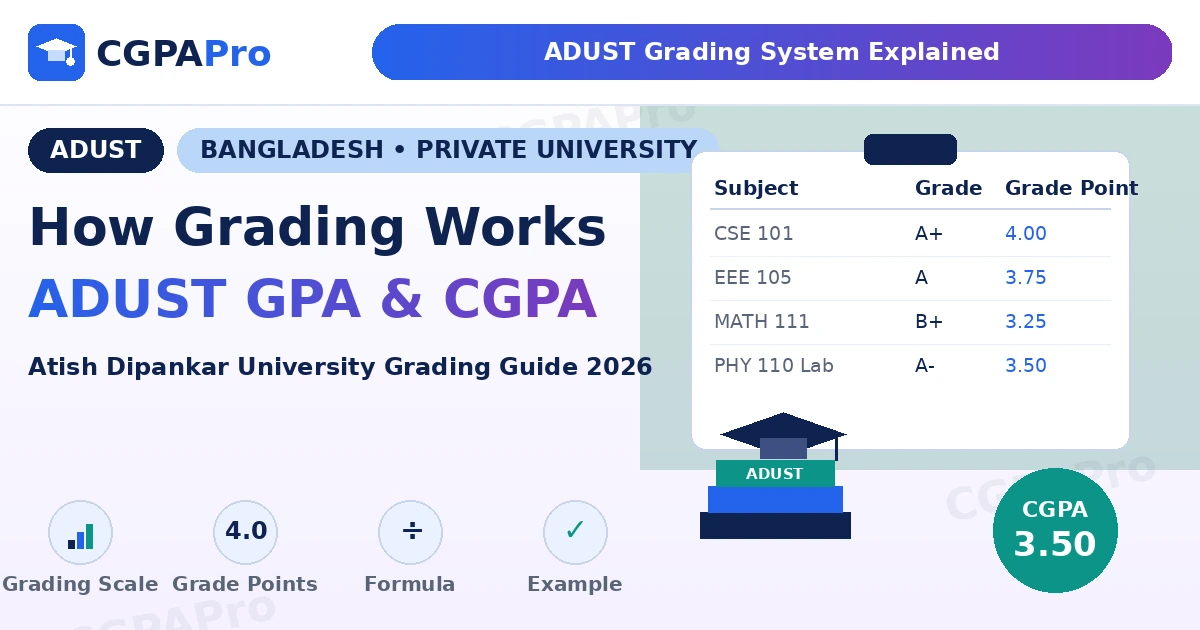
If you study at Atish Dipankar University of Science and Technology (ADUST) in Dhaka and you have ever wondered why one calculator says your 78 is an A− worth 3.67 while your university grade sheet treats it as an A worth 3.75 — you are not imagining things. Most online GPA calculators quietly use an American 4.0 scale, and ADUST does not use the American scale. It uses the UGC Bangladesh uniform grading system, where A is 3.75, A− is 3.50, and B+ is 3.25.
Here is the short version: ADUST is a UGC-recognized private university with its Permanent Sanad, so it follows the University Grants Commission’s Uniform Recommended Grading System (in force since the 2006–07 session). The grade table is A+ 4.00, A 3.75, A− 3.50, B+ 3.25, B 3.00, B− 2.75, C+ 2.50, C 2.25, D 2.00, F 0.00 — with 40 percent as the passing line. Your semester GPA is the credit-weighted average of your grade points, and your CGPA is the same idea accumulated across every semester you have completed.
This guide walks through the full official table, how to compute your GPA step by step, a hand-verified worked example that exactly matches the calculator screenshot below, the common traps ADUST students fall into (the dead university domain is one), and the questions students actually ask — answered from the primary sources.
Use the CGPAPro Calculator the Right Way
Before anything else, run your own numbers. The CGPAPro homepage calculator lets you pick the grading scale — for ADUST work, always select UGC Bangladesh from the scale dropdown. That is the scale your university effectively uses, so your screenshot below matches the university’s own table value for value.
Here is the screenshot, with our worked example already filled in (five courses, result 3.50 / 4.00 — the arithmetic is reproduced line by line in the worked-example section so you can check it):
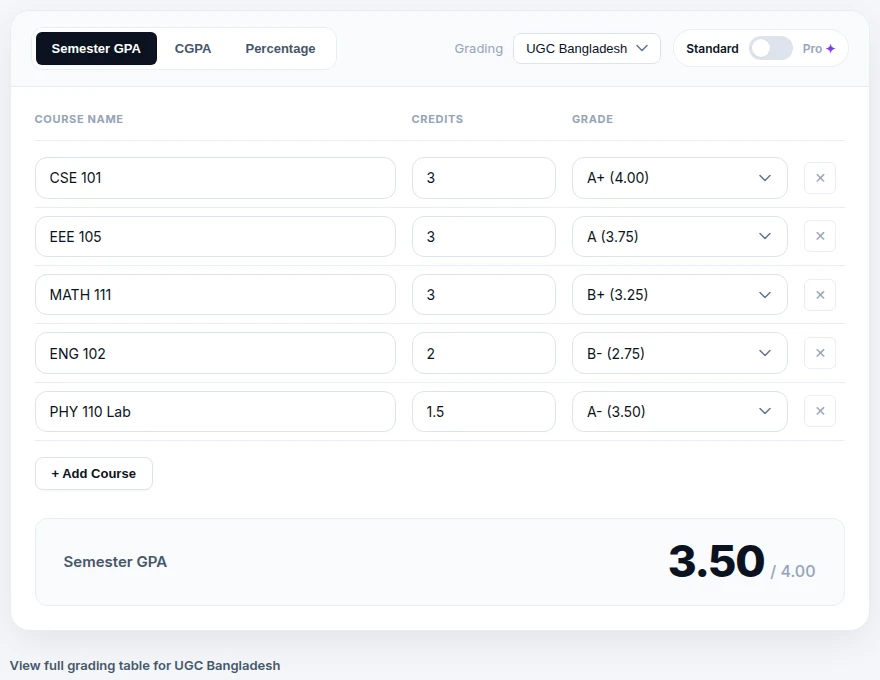
How to fill it in for your own semester:
- Set the scale dropdown to UGC Bangladesh (not the default US-style scale — the US one gives you 3.67 for A− and 3.33 for B+, which are wrong for ADUST).
- Type each course name in the course-name box, its credit hours in the credits box, and pick the letter grade your result sheet shows from the grade dropdown.
- Click + Add Course until every course of the semester is in. Note: credit-number fields can look filled but carry a zero value — type your number and confirm the total credits line looks right before trusting the result.
- Read the Semester GPA box. That number is your GPA for the semester.
For a full-semester CGPA across several terms, use the same calculator in CGPA mode (or add up each semester’s quality points — grade point × credits — and divide by total credits, which is exactly what the formula section below shows).
The Official ADUST Grading Scale
ADUST does not publish its own separate grade table on adust.edu.bd. (We checked the live site on 2026-10-16; the university’s old domain, atishdipankaruniversity.edu.bd, is dead — a note for anyone following outdated links.) Because ADUST is a UGC-recognized private university holding a Permanent Sanad, and because it is not among the private universities the UGC flagged for grading-scale non-compliance, the table that governs its grading is the UGC’s Uniform Recommended Grading System, recommended for every public and private university in Bangladesh. A faculty course outline from ADUST itself (CPP_302) uses exactly this table, and ADUST’s own job circulars quote CGPAs “out of 4”.
So here is the table that decides your grades at ADUST:
| Marks range (%) | Letter grade | Grade point |
|---|---|---|
| 80 and above | A+ | 4.00 |
| 75 – less than 80 | A | 3.75 |
| 70 – less than 75 | A− | 3.50 |
| 65 – less than 70 | B+ | 3.25 |
| 60 – less than 65 | B | 3.00 |
| 55 – less than 60 | B− | 2.75 |
| 50 – less than 55 | C+ | 2.50 |
| 45 – less than 50 | C | 2.25 |
| 40 – less than 45 | D | 2.00 |
| Less than 40 | F | 0.00 |
Key facts about this table that students routinely get wrong:
- Passing mark is 40. Score 40 and you have a D worth 2.00 grade points — a pass. Score 39.99 and it is an F worth zero.
- Band edges are hard. A 79.4 is an A (3.75), not an A+. The table reads “80 and above” for A+ — there is no rounding-up convention published by the university.
- A+ and A are not the same thing. A+ carries the full 4.00; an A carries 3.75. One A where you “deserved” an A+ costs you 0.25 grade points per credit.
- The plus/minus steps are 0.25. The whole scale moves in quarters: 4.00 → 3.75 → 3.50 → 3.25 → 3.00 → 2.75 → 2.50 → 2.25 → 2.00 → 0.00. Notice the F cliff: D is 2.00, F is 0.00 — two full points, not a quarter step. A single F drags your semester like an anchor.
- I and W are allowed. The UGC framework provides for Incomplete (I) and Withdrawal (W); neither carries grade points, but both need the university’s approval process — do not assume you can take one unilaterally.
How GPA and CGPA Are Calculated at ADUST
ADUST follows the standard credit-weighted method used across UGC institutions. There is exactly one formula to learn:
GPA = (sum of grade point × credit hours for every course) ÷ (sum of credit hours)
Each course contributes its quality points — grade point multiplied by the course’s credit hours. Add up all quality points, divide by all credit hours. That is your semester GPA. For CGPA, do the same across every course you have completed to date (including repeated courses’ treatment, which ADUST does not publish — see the honest-unknowns section below).
Step by step:
- List every course in the semester with its credit hours and your final letter grade.
- Convert each letter grade to its grade point using the table above.
- Multiply each grade point by the course’s credits → quality points per course.
- Add all quality points together.
- Add all credit hours together.
- Divide the total quality points by the total credit hours. Round to two decimals.
The most common mistake is step 6’s cousin: averaging the grade points directly instead of weighting by credits. A 3-credit A (3.75 × 3 = 11.25) counts three times as much as a 1.5-credit lab A− (3.50 × 1.5 = 5.25). Averaging letters without credits silently misprices every lab course.
Worked Example: Exactly How 3.50 Happens
Take a first-year ADUST engineering-style semester — five courses, 12.5 credits:
| Course | Marks | Grade | Point | Credits | Quality points |
|---|---|---|---|---|---|
| CSE 101 | 82 | A+ | 4.00 | 3 | 12.00 |
| EEE 105 | 77 | A | 3.75 | 3 | 11.25 |
| MATH 111 | 68 | B+ | 3.25 | 3 | 9.75 |
| ENG 102 | 58 | B− | 2.75 | 2 | 5.50 |
| PHY 110 Lab | 73 | A− | 3.50 | 1.5 | 5.25 |
| Total | 12.5 | 43.75 |
43.75 ÷ 12.5 = 3.50 — exactly what the calculator screenshot above shows.
Two things worth noticing in this example. First, EEE 105’s 77 sits inside the 75–79 band, so it is an A at 3.75 — a US-style calculator would hand you an A− worth 3.67 and undercount your semester by 0.08 points total before you even notice. Second, ENG 102’s B− at 2.75 is the single cheapest grade to fix next semester: moving one 2-credit B− to a B adds (3.00 − 2.75) × 2 = 0.50 quality points, which is more leverage per credit than improving any of the 3-credit courses’ already-high grades.
GPA vs CGPA: Which Number Goes Where
Your semester GPA covers one semester. Your CGPA (cumulative) covers everything you have taken so far, weighted the same way. On job applications and higher-study forms that ask for CGPA “out of 4”, write your cumulative number — ADUST job circulars themselves quote thresholds like 3.5 out of 4, which is the cumulative figure.
A practical consequence of the math: CGPA has inertia. If you finished 60 credits at 2.80 and want 3.00 after one more 15-credit semester, you need (3.00 × 75 − 2.80 × 60) ÷ 15 = (225 − 168) ÷ 15 = 57 ÷ 15 = 3.80 average on those 15 credits. Possible, but it tells you recovery plans must be built semester by semester, not by hoping one good term fixes everything.
The US-Calculator Trap (the #1 ADUST Mistake)
Most generic online GPA calculators ship with an American scale baked in: A− = 3.67, B+ = 3.33, B− = 2.67. At ADUST the correct values are A− = 3.50, B+ = 3.25, B− = 2.75 — a full 0.17 per-course error at the A− level. Run a five-course semester with two A− grades through a US calculator and your answer comes out roughly 0.08–0.10 too high on the semester GPA — and the error compounds across semesters because it feeds your CGPA.
The trap runs the other direction too. A student scoring 78% sees a US calculator print “A− (3.67)” and panics that they missed an A — when on ADUST’s table, 78 is squarely inside 75–79: a clean A worth 3.75. Knowing the band edges is worth real grade points, because the panic leads some students to chase improvement exams they never needed.
Rule of thumb: if a calculator’s grade list shows A− 3.67 / B+ 3.33, it is not built for Bangladesh. Use the UGC Bangladesh scale — which is why the CGPAPro screenshot in this article selected exactly that.
What ADUST Actually Publishes — and What It Doesn’t
Here is an honest accounting, because no other article about ADUST grading says this plainly:
Published and verified: the UGC uniform grading table (the governing document), the 40% passing line, I/W provisions, the tri-semester calendar (Spring, Summer, Fall — ADUST’s own admission materials use three semesters a year), admission floors (minimum GPA 2.5 in SSC and HSC, 2.00 minimum in any single exam, 6.00 combined), and the faculty course-outline assessment split seen at ADUST (attendance 10, assignment + presentation 10, mid-term 30, final 50).
Not published anywhere we could verify — confirm with your Registrar before acting: whether a repeated course’s old grade is replaced or averaged, the rules and caps on improvement exams, probation and dismissal CGPA thresholds, the minimum CGPA for degree award, attendance-percentage requirements, and any official degree-classification equivalences (first class, second class). If a random website quotes you an ADUST “probation at 2.00” rule or a “retake replaces the old grade” rule, treat it as rumor until the Registrar or the academic handbook confirms it.
Why does this matter for your GPA math? Because retake treatment changes everything: replacement means a retaken F becomes history; averaging means the F keeps dragging your CGPA forever. Until ADUST publishes its rule, build your recovery plans on the conservative assumption (averaging) and let good news surprise you.
ADUST vs the Name Traps
Three confusions waste ADUST students’ time every semester:
- ADUST ≠ ADTU. ADTU is Assam down town University in Guwahati, India — a different country, a different university, different rules entirely. Search results mix them up constantly.
- ADUST ≠ ATSU. ATSU is A.T. Still University in the US. It has nothing to do with Dhaka.
- The old domain is dead. If your bookmarks still point to atishdipankaruniversity.edu.bd, they lead nowhere. The live site is adust.edu.bd. Admission portals and old forum threads still quote the dead domain, so check the URL bar.
Tips to Keep Your ADUST CGPA Healthy
- Defend the band edges. The difference between 79 and 80 is a full 0.25 per credit — at 3 credits that is 0.75 quality points, worth more than a whole grade-step improvement on a 2-credit course. Know your running marks before finals.
- Never let an F happen. On the UGC scale the F cliff is 2.00 → 0.00 — a failed 3-credit course donates 3 full credits to your divisor while contributing zero quality points. One F in a 12.5-credit semester caps your ceiling at (4.00 × 9.5) ÷ 12.5 = 3.04, no matter what else you score.
- Prioritize by credit × gap. Improvement value = (target point − current point) × credits. A B− → B jump on a 3-credit course (0.75 QP) beats an A− → A jump on a 2-credit course (0.50 QP).
- Use three-semester planning. ADUST’s tri-semester calendar means you get three GPA events a year instead of two. A weak spring can be repaired by summer if you plan the course load — but it also means a careless summer can do damage faster.
- Verify, don’t trust, third-party tables. Scholaro’s ADUST grading page exists but its table does not render; several calculator sites show ADUST with the American scale. The table in this article is the UGC document ADUST is bound by.
- Keep your own spreadsheet. One column for credits, one for grade points, running totals for quality points and credits. When a semester result looks off by 0.01–0.03, you will catch the arithmetic error instead of arguing with the Controller of Examinations empty-handed.
Frequently Asked Questions
What is the grading scale at Atish Dipankar University?
ADUST follows the UGC Bangladesh uniform grading system on a 4.00 scale: A+ 4.00 (80+%), A 3.75 (75–79), A− 3.50 (70–74), B+ 3.25 (65–69), B 3.00 (60–64), B− 2.75 (55–59), C+ 2.50 (50–54), C 2.25 (45–49), D 2.00 (40–44), and F 0.00 (below 40). The university does not publish a separate ADUST-specific table.
Is 78% an A or A− at ADUST?
An A. The band is 75 to less than 80 for A (3.75); A− covers 70 to less than 75. Do not use American calculators here — they will tell you 78 is an A− worth 3.67, which is wrong for ADUST.
What is the passing mark at ADUST?
40%. That earns a D worth 2.00 grade points — a pass, though a low one. Anything below 40 is an F worth zero.
How do I calculate my ADUST GPA?
Multiply each course’s grade point by its credit hours (quality points), add them all up, and divide by total credit hours. Example: 43.75 quality points ÷ 12.5 credits = 3.50. The worked example and calculator screenshot above show this line by line.
Does ADUST replace grades when I retake a course?
ADUST does not publish its retake/replacement rule in any source we could verify. Some universities replace the old grade; others average both attempts. Confirm with the Registrar’s office before planning around either assumption.
What CGPA do I need to graduate from ADUST?
The university does not publish a degree-award CGPA floor in its public materials that we could verify. UGC norms in Bangladesh commonly sit at 2.00, but do not treat that as ADUST’s official rule — check your program handbook.
Is ADUST the same as Assam down town University (ADTU)?
No. ADUST is Atish Dipankar University of Science and Technology in Dhaka, Bangladesh. ADTU is a separate university in Guwahati, India. Their grading systems are unrelated.
The Bottom Line
ADUST grading is the UGC Bangladesh uniform scale, applied with hard band edges and a 40% passing line: A+ 4.00 down to F 0.00, in quarter-point steps, credit-weighted. Use a calculator set to the UGC Bangladesh scale — never a US one — and you will always match your official result sheet. The two highest-value habits are defending the band edges (79 → 80 is worth 0.25 per credit) and never absorbing an F if you can withdraw or repair in time. For everything ADUST has not published — retake treatment, probation lines, the graduation floor — the Registrar’s office is the only authority that counts.
Read More: