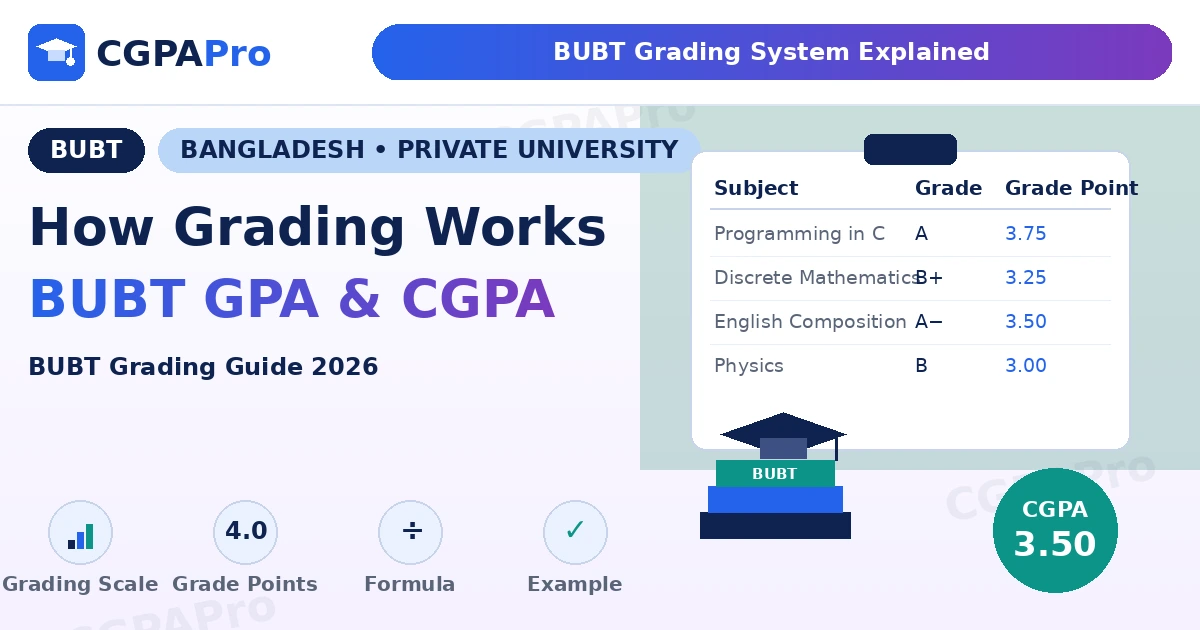
BUBT Grading System 2026: GPA, CGPA & Retake Rules Guide
Quick Answer: How BUBT Grades Work
If you study at the Bangladesh University of Business and Technology (BUBT) in Dhaka, your results run on a 4.00 CGPA scale with fixed marks bands — no curve, no relative grading. BUBT’s official “Academic Rules and Regulations for the Undergraduate Programs” (a 22-page PDF on bubt.edu.bd, fully read for this guide) uses the UGC Bangladesh uniform scale: A+ is 4.00, A is 3.75, A− is 3.50, B+ is 3.25, B is 3.00, B− is 2.75, C+ is 2.50, C is 2.25, and D — the lowest passing grade — is 2.00. Score below 40% and you get an F worth 0.00. Your semester GPA is the credit-weighted average of your grade points, and your CGPA is the same calculation stretched across every semester you have completed.
What makes this guide different from every thin “CGPA calculator Bangladesh” page is the part students actually ask about: the retake rules. BUBT does not average your retake with your old grade — the better grade fully replaces it, and the old grade is marked ‘R’ (retake) with zero effect on your GPA. That one sentence is worth real CGPA points to thousands of students, and almost nobody explains it properly. Below: the official grade table, the marks split behind each course, hand-verified worked examples, the retake-and-improvement playbook (including the 2-week deadline almost everyone misses), probation math, and the improvement-vs-Gold-Medal tradeoff you should know before you retake anything.
A quick identity check before we start: this guide is about the Bangladesh University of Business and Technology — private university in Dhaka, official site bubt.edu.bd, student portal “BUBT Annex” (annex.bubt.edu.bd). It is not BUET (Bangladesh University of Engineering and Technology — the public engineering giant), not IUBAT (International University of Business Agriculture and Technology — a different private university), and not BUP (Bangladesh University of Professionals). Search engines mix these names up constantly, so check the domain of every page you read: bubt.edu.bd is yours.
How to Calculate Your BUBT GPA With the Calculator
The fastest way to check your numbers is the CGPAPro calculator — and here is the good news, verified grade-by-grade against BUBT’s official rules PDF: the calculator’s UGC Bangladesh scale is identical to BUBT’s published table — same letters, same marks bands, same grade points, including the D band. So the numbers the calculator gives you are exactly right for BUBT, with no conversion needed:
- Open the CGPAPro CGPA calculator (its UGC Bangladesh scale matches BUBT’s official grading table exactly).
- For each course, enter the credit hours and select the letter grade you earned (A+ = 4.00, A = 3.75, A− = 3.50, B+ = 3.25, B = 3.00, B− = 2.75, C+ = 2.50, C = 2.25, D = 2.00, F = 0.00).
- The calculator multiplies each grade point by its credit hours, adds up the quality points, and divides by your total credits — that is your semester GPA.
- To track your CGPA across semesters, repeat for each past semester and combine them with the credit-weighted CGPA formula in the worked examples below.
BUBT’s Official Grading Table (2026)
This is the complete table from BUBT’s official Academic Rules and Regulations — it applies to every undergraduate program (BBA, CSE, EEE, Textile Engineering, English, Economics, LL.B (Hons)) and the Faculty of Law repeats the identical table for LL.B. Band edges are hard: 79.4% is an A, not an A+; 39.9% is an F, not a D. There is no rounding-up policy for individual course marks in the published rules — what you see is what you get.
| Numerical Marks | Letter Grade | Grade Point |
|---|---|---|
| 80% and above | A+ (A Plus) | 4.00 |
| 75% to less than 80% | A (A regular) | 3.75 |
| 70% to less than 75% | A− (A Minus) | 3.50 |
| 65% to less than 70% | B+ (B Plus) | 3.25 |
| 60% to less than 65% | B (B regular) | 3.00 |
| 55% to less than 60% | B− (B Minus) | 2.75 |
| 50% to less than 55% | C+ (C Plus) | 2.50 |
| 45% to less than 50% | C (C regular) | 2.25 |
| 40% to less than 45% | D | 2.00 |
| Less than 40% | F | 0.00 |
Two practical notes on this table. First, D (40%) is a passing grade — a D earns you its credits and contributes 2.00 × credits to your GPA. Only F is a failure: it earns 0 credits, and the course must be retaken for a minimum D before you can graduate. Second, your transcript shows letter grades, grade points and CGPA only — never the numerical marks. Employers and graduate schools see “B+ 3.25”, never “68%”. A 65.1% and a 69.9% are both a B+ — indistinguishable once the transcript is printed.
How Your 100 Marks Are Built (and the 5 Marks Students Forget)
Every non-law course at BUBT is evaluated on six components. Knowing the split matters because not all marks cost the same effort:
- Attendance — 5 marks. The five marks scale with your attendance percentage (bands from 50% up to 100% map to 1–5 marks). Attendance below 70% in a course means you cannot sit the exam at all — and no supplementary exam is allowed in that case. These are the cheapest marks of your degree: you earn them by showing up.
- Quizzes — 5 marks.
- Class tests & tutorials — 10 marks.
- Assignment / presentation / lab / project — 10 marks.
- Midterm examination — 30 marks.
- Final examination — 40 marks.
That is the whole 100. A student who sits the midterm, final, and every class test but skips the presentation walks in with a maximum possible score of 90 — and needs 88.9% of everything else just to reach an A. Do not hand away 10 marks for free. If you miss a midterm or final with valid grounds, BUBT allows supplementary exams — with fines of Tk 500 per course for a midterm and Tk 1,000 per course for a final, and only if your attendance qualified you for the original exam.
The Formula: GPA and CGPA at BUBT
BUBT’s official rules define both GPA and CGPA the same way — the formula is the credit-weighted average of grade points:
Semester GPA = Σ (course credits × grade point) ÷ Σ (course credits)
CGPA = Σ (credits × grade point for every completed course) ÷ Σ (all completed credits)
“Quality points” is the term for one course’s (credits × grade point). BUBT’s rules also state that GPA is rounded to 2 decimal places for reporting — so 3.506 becomes 3.51 and 3.504 becomes 3.50. And the crucial F detail: an F earns 0 credits, so a failed course contributes nothing to the numerator — but watch out, the attempted credits still sit in your denominator when computing the semester GPA. That is why F’s hurt: they add credits to the divisor while adding zero points. (On the retake, the old F is replaced under the ‘R’ rule explained below — the double-counting is temporary, not permanent.)
Step-by-Step: Computing a Semester GPA by Hand
- List every course you took this semester with its credit hours and your final letter grade.
- Convert each letter grade to its grade point using the official table above.
- Multiply credits × grade point for each course — those are the course’s quality points.
- Add up all quality points and all credit hours separately.
- Divide total quality points by total credit hours, then round to 2 decimals.
Worked Example 1: A 3.50 Semester
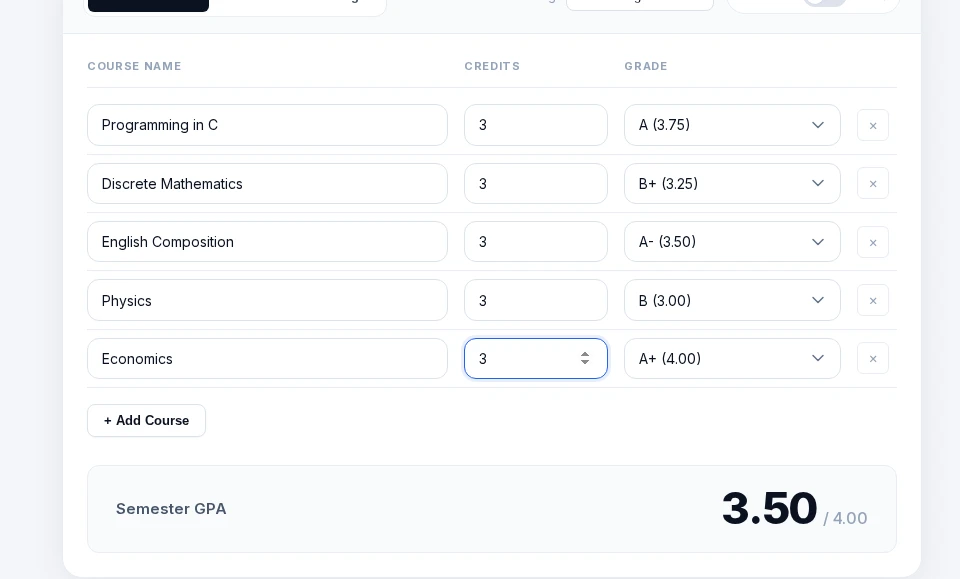
Here is a realistic BBA-style semester — five 3-credit courses. This is the exact example running in the calculator screenshot above, so you can cross-check every row:
| Course | Credits | Grade | Point | Quality Points |
|---|---|---|---|---|
| Programming in C | 3 | A | 3.75 | 11.25 |
| Discrete Mathematics | 3 | B+ | 3.25 | 9.75 |
| English Composition | 3 | A− | 3.50 | 10.50 |
| Physics | 3 | B | 3.00 | 9.00 |
| Economics | 3 | A+ | 4.00 | 12.00 |
Quality points: 11.25 + 9.75 + 10.50 + 9.00 + 12.00 = 52.50. Total credits: 15.
Semester GPA = 52.50 ÷ 15 = 3.50 exactly.
Notice how a single grade band works here: if Discrete Mathematics had scored 69.4% (B) instead of 65%+ (B+), that row would read 9.00 instead of 9.75 — the semester GPA would drop to 51.75 ÷ 15 = 3.45. One band edge in one course moves the semester GPA by 0.05. This is why the band edges (79.4 vs 80, 69.4 vs 70) are the most important rows in the grade table to understand.
Worked Example 2: Cumulative CGPA Across Two Semesters
CGPA is not the average of your semester GPAs — it is quality points over credits across all semesters. Say semester 2 was slightly rougher:
| Course | Credits | Grade | Point | Quality Points |
|---|---|---|---|---|
| Data Structures | 3 | A+ | 4.00 | 12.00 |
| Calculus II | 3 | A | 3.75 | 11.25 |
| Accounting | 3 | B+ | 3.25 | 9.75 |
| Business Statistics | 3 | B− | 2.75 | 8.25 |
| Digital Electronics | 3 | B+ | 3.25 | 9.75 |
Semester 2: 51.00 quality points ÷ 15 credits = 3.40.
CGPA = (52.50 + 51.00) ÷ (15 + 15) = 103.50 ÷ 30 = 3.45.
Note that 3.45 is not the midpoint of 3.50 and 3.40 here only because both semesters carry equal credits — if the semesters carried different credit loads, a naive average of the two GPAs would be wrong. Always go back to quality points over credits.
Read More:How Retaking a Course Affects Your CGPA (2026 Guide) — grade-replacement rules across Bangladeshi universities, and when a retake is worth the fee.
The ‘R’ Grade: Why Retakes at BUBT Replace, Never Average
This is the section most students are searching for, and the one almost nobody explains correctly. BUBT’s official rules are unusually generous here:
- Only the better grade counts. Under BUBT’s rules, “under all circumstances, the higher grade will be taken into account” in the transcript and the GPA/CGPA calculation.
- The old grade is marked ‘R’ (retake) and has ZERO effect on your GPA or CGPA. It does not average with the new grade. It does not linger as a drag. It is a zero-effect marker.
- A course can be repeated only once. There is no third attempt — make the repeat count.
- Failed courses: an F must be retaken within the next 3 consecutive semesters (prerequisite courses take priority), at full tuition fee, and you must earn at least a D.
- Improvement retakes (passed courses): you may retake any course graded below A — yes, even a B or a C — at half tuition fee. The application must go through the proper channel within 2 weeks of the result publication. Miss the window, lose the option for the year.
- The improvement tradeoff: any student who takes an improvement retake becomes ineligible for the Gold Medal or any Award — including the VC’s Certificate (semester GPA 3.90–4.00) and the Dean’s Certificate (3.80–3.89). Retake an F to survive; retake a B only after deciding the medal is not your fight.
The single most-asked question: “Do both grades count?” No. The ‘R’ replaces. A BUBT-built GPA browser extension and the student GitHub portals all model it the same way: best grade back into the calculation, the old grade erased from the math. That replacement mechanic — not averaging — is what makes retake-ROI math below so powerful.
Retake ROI: Which Courses Are Worth Repeating
Because only the better grade counts, a retake is a pure points-swap: you remove (old points) and insert (new points) for the same credits. The CGPA lift from a retake is:
CGPA lift = (new quality points − old quality points) ÷ total credits
Take the worked semester above (52.50 points / 15 credits = 3.50 GPA). Suppose Discrete Mathematics was a D (2.00 → 6.00 points) instead of a B+, and you retake it for a B (3.00 → 9.00 points):
- Points gained: 9.00 − 6.00 = 3.00 quality points.
- New semester total: 52.50 − 6.00 + 9.00 = 55.50 → 55.50 ÷ 15 = 3.70 (+0.20).
- If that semester is half your degree (15 of 30 credits): new CGPA = (103.50 − 6.00 + 9.00) ÷ 30 = 106.50 ÷ 30 = 3.55 (+0.10).
The general rule: rank your retake candidates by (points gained) per rupee of fee. A D→B on a 3-credit course gains 3.00 points; a B+→A on the same course gains only 1.50. The lowest grades on the highest-credit courses are always the first targets. And because the repeat is allowed only once, never burn it on a course you have not prepared to actually ace.
Read More:How to Improve Your CGPA: Proven Strategies for 2026 — recovery math, retake ranking, and study systems that actually move the number.
Academic Probation at BUBT: The Rules and the Recovery Math
BUBT’s official rules put academic standing in plain terms. After any semester, a student with CGPA below 2.00 is placed on academic probation:
- During probation you may register for a maximum of 4 courses, and registration requires your guardian’s consent.
- You have 3 semesters to pull the CGPA back to 2.00. Fail, and you are dismissed.
- If you are still below 2.00 after those 3 semesters and you have F grades in more than 4 courses, you may only register the failed courses — no new courses — before anything else.
- After a dismissal, readmission is possible once only, and credit transfer applies only to courses where you earned C+ or better before the dismissal.
Now the math, because this is where hope meets arithmetic. Suppose you are on probation with CGPA 1.85 on 30 completed credits (55.50 quality points). Over the next 15 credits at average grade g:
- New CGPA = (55.50 + 15g) ÷ 45 ≥ 2.00
- 55.50 + 15g ≥ 90.00 → 15g ≥ 34.50 → g ≥ 2.30
That means averaging about C/C+ (2.25–2.50) across 15 credits just clears the bar — and with only 4 courses allowed during probation, that is 4 courses at roughly C+ average. Painful but survivable. The trap is aiming only for 2.00: the moment you hit the floor, one more bad semester restarts the whole crisis. The honest target after probation is 2.50-plus cushion, which needs roughly a B− (2.75) average over those 15 credits: (55.50 + 41.25) ÷ 45 = 2.15 — still not cushion; in truth, escaping probation comfortably takes two semesters of B-average work. Start the retakes of your lowest F/D courses immediately, because a D→B swap (3.00 points on a 3-credit course) buys +0.067 CGPA on a 45-credit base — more than any single new course can.
Degree Requirements: What Actually Earns the Bachelor’s
BUBT’s rules set five non-negotiable lines for the undergraduate degree:
- CGPA ≥ 2.00 on all BUBT credits.
- Every F retaken for at least a D — no unresolved failures.
- Minimum C in the thesis/project/internship where applicable.
- Maximum 7 years to complete the bachelor’s program.
- Clearance of all financial and administrative obligations.
The 2.00 floor is the number that ruins semesters: a student sitting at 1.95 after the final year cannot graduate, and with the repeat-once rule, the retake menu is already thin. If you are under 2.10 in your final year, plan the retakes a year ahead — not in the last semester. (Graduate programs such as the MBA set the degree floor at 2.50; BUBT’s published undergraduate rules document does not detail a separate graduate grading scale, so check your program handbook if you are on an MBA/EMBA track.)
Gold Medal, VC’s Certificate, Dean’s Certificate: The Honors Ladder
BUBT’s honors rules are generous to consistent students and brutal to retakers:
- Gold Medal: 1st position with CGPA ≥ 3.75, degree finished within 4 consecutive years, no F ever, and no improvement retakes.
- Vice-Chancellor’s Certificate: semester GPA 3.90–4.00.
- Dean’s Certificate: semester GPA 3.80–3.89.
Read that Gold Medal line twice. An A− (3.50) is a fine grade — but it is also an improvement-retake candidate at half fee, and taking that option kills medal eligibility forever. If you are sitting at 3.8+ with one A− on the transcript, run the numbers: the medal requires ≥ 3.75 CGPA and no retakes. Improving the A− to an A may be worth more in CGPA than the medal risk costs — or not. Either way, decide before the 2-week improvement window closes, because after it closes the decision is made for you.
GPA vs CGPA (and SGPA): The Three Numbers, No Confusion
- GPA — your credit-weighted average for one semester.
- SGPA — the same thing as GPA; BUBT’s documents use GPA, but students say SGPA. Same number.
- CGPA — quality points ÷ credits across all completed semesters. This is the number on your degree, the number employers ask for, and the number that must stay ≥ 2.00.
The classic mistake is averaging semester GPAs. Semester 1: 3.50 (15 cr). Semester 2: 3.40 (15 cr). The average of the two GPAs happens to be 3.45 here — but only because the credit loads match. With unequal credit loads (12 credits one semester, 18 the next), the naive average is wrong. Always compute from quality points over total credits, or enter every semester into the CGPAPro calculator and let it do the weighting.
BUBT’s Tri-Semester Calendar (and the Civil Exception)
BUBT runs three semesters per year: Spring (February–May), Summer (June–September), Fall (October–January). The exception: Civil Engineering uses a bi-semester system (Spring + Fall) with make-up examinations between semesters.
Three semesters a year changes the pace of your CGPA life: you get three results a year, which means your CGPA moves in smaller steps but you also get three chances a year to repair it. Probation’s “3 semesters to recover” is therefore effectively one calendar year — not the 18 months a two-semester student might assume. And the F-retake deadline (“within 3 consecutive semesters”) is also one calendar year. Mark the result-publication dates on your calendar: the 2-week improvement window starts ticking the day results are published, not the day you check them.
Credit Load Rules Most Students Learn Too Late
- Minimum 12 credits per semester (9 in special cases with permission).
- More than 15 credits requires CGPA ≥ 3.5 and the department chair’s written permission — overloads are a privilege, not a right.
- Probation students: maximum 4 courses.
- Withdrawal: you may withdraw from a course within 15 days of the semester start with permission. Leaving a course without official withdrawal earns an F in every registered course — the harshest single line in BUBT’s rulebook. If you must stop attending, file the withdrawal.
Common Mistakes BUBT Students Make (and How to Avoid Them)
- Assuming retakes average. They don’t — the ‘R’ rule replaces. Students who assume averaging often don’t bother retaking a D, leaving the single biggest CGPA lift on the table.
- Missing the 2-week improvement window. The deadline runs from result publication, not from when you see your result. Set a reminder now.
- Chasing the Gold Medal and the retake at the same time. Improvement retakes forfeit all awards. Decide which you want before the window closes.
- Ignoring the 70% attendance floor. Below it you cannot sit the exam — and no supplementary exam is allowed. The 5 attendance marks are the cheapest marks of your degree.
- Unofficial dropouts. Stopping attendance without a formal withdrawal within 15 days of semester start earns an F in every registered course. Always file the paperwork.
- Treating the D band as safe. A D passes, but three D’s on 9 credits pull a 15-credit semester to 3.20 even if the other 6 credits are A’s. D’s are graduation-legal; they are not CGPA-neutral.
- Averaging semester GPAs for CGPA. Credit-weighted quality points, always. Use the calculator.
Tips That Actually Move Your BUBT CGPA
- Harvest the attendance marks first. 5 marks at near-zero effort — the best marks-per-minute deal in the rulebook.
- Rank retakes by points gained per fee: lowest grades × highest credits first. A D→B on a 3-credit course (+3.00 points) beats a B+→A (+1.50) at the same half-fee price.
- Use the retake within the same academic year. F’s must be cleared within 3 semesters, and the once-only rule means a sloppy repeat wastes your only shot. Prepare before you re-sit.
- Front-load improvement applications. The 2-week window is short; keep a scanned copy of the application channel ready before results come out.
- Watch the 3.5 line. CGPA ≥ 3.5 unlocks 15+ credit overloads with chair permission — the fastest legal way to add high-value credits to your transcript.
- Compare your scale only to BUBT. BUET, IUBAT and BUP have their own rules; advice from a BUET friend can be exactly wrong for you.
Frequently Asked Questions
Does BUBT average my retake grade with the old one?
No. BUBT’s rules state that under all circumstances the higher grade is taken into account, and the old grade is marked ‘R’ (retake) with no effect on your GPA or CGPA. The old grade is not averaged, not weighted, not dragged along — it is replaced. You may repeat a course only once.
What is the minimum passing grade at BUBT?
D (40%) is the minimum passing grade — it earns its credits and contributes 2.00 × credits to your GPA. F (below 40%) is the only failing grade: it earns 0 credits and must be retaken for at least a D within the next 3 consecutive semesters at full tuition fee.
Can I retake a course I passed to improve the grade?
Yes — BUBT allows improvement retakes for any grade below A at half tuition fee, but you must apply within 2 weeks of result publication, you may repeat a course only once, and you become ineligible for the Gold Medal and all awards (including the VC’s and Dean’s Certificates).
What happens if my CGPA falls below 2.00?
You are placed on academic probation: maximum 4 courses per semester, guardian’s consent required for registration, and 3 semesters to recover to 2.00 — otherwise dismissal. The recovery math is honest but survivable: at 1.85 on 30 credits you need roughly a 2.30 average over 15 new credits to clear 2.00.
Will employers see my actual marks or just grades?
Just the grades. BUBT transcripts show letter grades, grade points and CGPA only — never numerical marks. A 65.1% and a 69.9% both print as “B+ 3.25”.
Is the grading scale the same for MBA students?
BUBT’s published 22-page undergraduate rules document — the source for this guide — sets the UG degree floor at CGPA 2.00 (2.50 for graduate programs) but does not publish a separate graduate grading scale. The UGC uniform scale is presumed to apply, but MBA/EMBA students should confirm with their program handbook rather than assuming.
Is BUBT the same as BUET?
No — and this is the single most common search confusion. BUBT (Bangladesh University of Business and Technology, bubt.edu.bd) is a private university; BUET (Bangladesh University of Engineering and Technology) is a public engineering university with its own rules. Grading advice, calculators and Reddit threads for one do not transfer to the other. Always check the domain and the university name.
Conclusion
BUBT’s grading system is one of the more student-friendly frameworks among Dhaka’s private universities — the fixed UGC scale leaves nothing to guess, the ‘R’-grade retake rule fully replaces instead of averaging, and improvement retakes are open for any grade below A at half fee. The prices are printed on the other side: a hard 2-week application window, one repeat only, award ineligibility for improvers, and a 3-semester probation clock that runs on a tri-semester calendar.
Your three takeaways: (1) compute with quality points over credits — the CGPAPro calculator matches BUBT’s official table exactly; (2) rank retakes by points gained per fee, lowest grades on highest credits first; (3) put the result-publication dates and the 2-week improvement deadline on your calendar before you need them. For context on how retake mechanics differ across Dhaka’s private universities, compare the SEU grading guide and the Green University grading guide — both on the same UGC scale, with noticeably different retake economics.
Sources: BUBT “Academic Rules and Regulations for the Undergraduate Programs” (bubt.edu.bd, 22-page official PDF, read 2026-10-15); BUBT Faculty of EEE curriculum document (worked GPA example 42.25 ÷ 12 = 3.52); BUBT Faculty of Law outcome-based curriculum (identical grading table). Graduate-program grading scale unverified — MBA/EMBA students should confirm with their program handbook.