MIST Grading System 2026: GPA & CGPA Guide
Quick answer: The Military Institute of Science and Technology (MIST) grades on a 4.00 scale identical to the UGC Bangladesh standard: A+ (4.00) down to D (2.00, the lowest passing grade), with F (0.00) for anything below 40%. Your term GPA is the credit-weighted average of your grade points, and your CGPA is the weighted average of
Check Your MIST GPA With the Calculator
The Official MIST Grading Table (2026)
This is the grade table published in MIST’s own 2024 academic regulations and departmental syllabi. Your total marks in a course (out of 100) map to a letter grade, and each letter maps to a fixed grade point. There is no curve and no rounding across a boundary — 79% is an A (3.75), not an A+:
| Numerical Marks | Letter Grade | Grade Point | Status | ||||||||||||||||||||||||||||||||||||||||||||||||||||||||||||||||||||||||||||||||
|---|---|---|---|---|---|---|---|---|---|---|---|---|---|---|---|---|---|---|---|---|---|---|---|---|---|---|---|---|---|---|---|---|---|---|---|---|---|---|---|---|---|---|---|---|---|---|---|---|---|---|---|---|---|---|---|---|---|---|---|---|---|---|---|---|---|---|---|---|---|---|---|---|---|---|---|---|---|---|---|---|---|---|---|
| 80% and above | A+ | 4.00 | Pass | ||||||||||||||||||||||||||||||||||||||||||||||||||||||||||||||||||||||||||||||||
| 75% to below 80% | A | 3.75 | Pass | ||||||||||||||||||||||||||||||||||||||||||||||||||||||||||||||||||||||||||||||||
| 70% to below 75% | A− | 3.50 | Pass | ||||||||||||||||||||||||||||||||||||||||||||||||||||||||||||||||||||||||||||||||
| 65% to below 70% | B+ | 3.25 | Pass | ||||||||||||||||||||||||||||||||||||||||||||||||||||||||||||||||||||||||||||||||
| 60% to below 65% | B | 3.00 | Pass | ||||||||||||||||||||||||||||||||||||||||||||||||||||||||||||||||||||||||||||||||
| 55% to below 60% | B− | 2.75 | Pass | ||||||||||||||||||||||||||||||||||||||||||||||||||||||||||||||||||||||||||||||||
| 50% to below 55% | C+ | 2.50 |
| Term | Term GPA | Credits | Weighted Points |
|---|---|---|---|
| Level 1, Term I | 3.10 | 18 | 3.10 × 18 = 55.80 |
| Level 1, Term II | 3.25 | 19 | 3.25 × 19 = 61.75 |
| Level 2, Term I | 3.40 | 18 | 3.40 × 18 = 61.20 |
| Level 2, Term II | 3.55 | 20 | 3.55 × 20 = 71.00 |
| Total | — | 75 | 249.75 |
CGPA = 249.75 ÷ 75 = 3.33. The common mistake is to average the four term GPAs directly: (3.10 + 3.25 + 3.40 + 3.55) ÷ 4 = 3.325 — close here, but only because the credit loads are similar. When one term carries 20 credits and another 15, the simple average is wrong. MIST’s own regulations compute CGPA by weighting term GPAs with term credit totals, exactly as above.
Levels, Not Semesters: MIST’s Terminology
At MIST you do not have “Semester 1 through 8.” You have 4 levels × 2 terms (5 levels for architecture). This is not just vocabulary — several rules are written in levels, and misreading them as semesters changes their meaning. Students are classified by earned credit hours: Level 1 covers 0–36 credits, Level 2 covers 36–72, Level 3 covers 72–108, and Level 4 is 108 credits and above (architecture bands differ slightly).
Three promotion rules matter in practice. First, you are promoted to the second term of each level irrespective of your first-term results — a disastrous Term I does not hold you back a term. Second, if you repeat a level, you get exemption for subjects where you already earned B+ or better — strong courses survive the repeat. Third, you may repeat a particular level only once in your entire undergraduate program. There is no indefinite level-repeating; the clock described in the graduation section keeps ticking.
MIST also has no “probation” concept the way American or private universities use the word. Its equivalent is sharper and simpler, and it is written in levels: fail to secure a minimum CGPA of 2.20 in two consecutive levels and you are withdrawn from the program. The regulations do provide a “good standing” recovery path — students with GPA or credit deficiencies can make them up in subsequent terms and backlog courses, and “when the minimum GPA and credit requirements are achieved the student is again returned to good standing.” In plain terms: one bad level is a warning; two bad levels in a row ends the degree. If you are sitting at 2.15 after Level 2, the next level is not optional effort — it is the one that decides whether you stay.
The B+ Ceiling: Supplementary Exams Decoded
This is the section no competitor article covers, and it is the single most practical thing to know about MIST. Supplementary exams are held twice a year — Supplementary-I in the first week of the Spring/Fall term end-break, Supplementary-II in the first week of the other term’s end-break. They exist so you can clear failed courses or improve passed ones without waiting a full year. But the system has hard ceilings:
- Course limits: maximum 2 theory courses (failed or improvement) in Supplementary-I, maximum 1 in Supplementary-II. With the Commandant’s approval a department can flip this to 1+2 — but the yearly total can never exceed 3 courses.
- The B+ cap: the maximum grade you can earn in a supplementary exam is B+ (3.25) — even if you score 95% in the paper. This applies to failed courses being cleared and to improvements.
- 40% carry-forward: 40% of your marks are carried from your previous attempt (the best continuous-assessment marks are used if you failed the course more than once); the supplementary exam itself covers the 60% final-exam portion. No classes are condu
The Retake Ladder: Four Attempts, Then a Permanent Bar
MIST’s repeat rules for failed courses are a ladder with exactly four rungs — and the fourth rung ends in a wall:
Attempt What happens 1st & 2nd attempts Regular attempts — retake the course when offered (core courses must be repeated; for optional courses you may repeat or take a substitute). 3rd attempt Allowed only with Academic Council approval — you retake in a regular term. 4th (last) attempt Needs Academic Council approval plus an extra financial penalty. Fail the 4th time Barred from that course forever. If it is a core course, the degree path ends here. Two more facts complete the picture. A repeated course after an F is capped at B+ — the same ceiling as the supplementary system. And an F stays permanently on your grade sheet and transcript: it earns no credit and is excluded from GPA mathematics, but it is never erased. Before planning any retake-heavy strategy, read our retake and CGPA guide — the maths only rewards retakes when the new grade is meaningfully higher, and at MIST the B+ cap puts a hard ceiling on that reward.
Improvement Exams: The 6-Course Lifetime Limit
MIST lets you improve passed courses too — but this is the most misunderstood policy in the whole system, and the limits are severe:
- Only courses below B+ qualify. Earned a B+ or better? That course is locked forever — it can never be repeated for improvement.
- Once per course. Each course gets a single improvement attempt. Ever.
- B+ cap again. The maximum grade on improvement is B+ (3.25).
- 6-course lifetime limit. Across your entire degree you may improve at most 6 courses (7 for B.Arch students) — and at most 2 at a time.
- Best result counts, but both stay on your transcript. The better of the two grades is used in your GPA, yet all examination performances remain reflected on your transcript. Future employers and graduate schools will see both attempts.
The improvement maths, honestly computed: you have 60 completed credits at a 3.00 CGPA (180 quality points) and you improve a 3-credit C (2.25) to a B+ (3.25). You gain 3 × 1.00 = 3.00 quality points: 183 ÷ 60 = 3.05. That is +0.05 CGPA for one of your six lifetime improvement slots. Improvement is a scalpel, not a shovel — spend your slots on your worst passed grades (C and D range) where the gap to the B+ ceiling is widest, and never on a B, where the maximum possible gain is 0.25 grade points.
Attendance: Collegiate, Noncollegiate, Discollegiate
MIST polices attendance through three formal statuses — and the third one is effectively a fail:
Status Attendance band Consequence Collegiate Roughly 85–90%+ (varies by document) Normal student; may sit all exams. Noncollegiate Roughly 70–85% (varies by document) May sit exams on payment of a fee. Discollegiate Below ro Graduation: The 2.20 Floor and the Degree Clock
To earn your B.Sc. Engineering or B.Arch degree you need:
- CGPA of at least 2.20 — stable across a decade of MIST documents, from the 2013-14 syllabus to the 2024 regulations.
- Minimum credit hours set by your department (one older BME syllabus cites 160.0 credits; the exact number varies by department).
- Completion within 6 academic years of registration for engineering, 7 years for architecture.
- A graduation application routed through your Adviser to the Controller of Examinations; the provisional degree is awarded by BUP, MIST’s affiliating university.
There is also “irregular graduation”: if you clear your failed courses in a spring, fall, or supplementary exam, your graduation takes effect from the publication date of that result — not retroactively. And here is the 2.20 paradox every MIST student should understand. In Bangladesh’s traditional degree-classification norms, 3.00 and above is first class, 2.25–2.99 is second class, and 2.00–2.24 is third class (see Academic grading in Bangladesh). MIST’s graduation floor of 2.20 sits below the second-class line — a graduate at 2.20–2.24 holds a degree that maps to third class in the old terminology. Scraping the minimum is not a strategy; it is a trap. The recovery maths is unforgiving: 60 credits at 2.20 (132 quality points) with 60 credits remaining, aiming for 3.00, needs (3.00 × 120 − 132) ÷ 60 = 228 ÷ 60 = 3.80 average across every remaining credit. Possible — but it means near-A performance with no more slip-ups. For the general method behind targets like this, our CGPA improvement guide walks through semester-by-semester planning, and if you are near the floor, the honest assessment in our 2.0 CGPA guide applies to you almost verbatim.
Recognition: Dean’s List, Commandant’s List, and Medals
MIST recognizes top performers — but with a military flavor. Per MIST’s prospectus (note: these specifics come from an older prospectus; the 2024 documents say awards follow “existing rules and practices,” so confirm current thresholds with your department):
- MIST Medal: CGPA 4.0 at the end of the entire program, or the first-position holder in each department with a minimum CGPA of 3.8.
- Commandant’s List: CGPA of 3.8 or above at the end of each academic level (Levels 1–3), and for graduating students across the entire program.
- Dean’s List: CGPA between 3.7 and 3.8 at the end of each academic level (Levels 1–3), and for graduating students.
- Osmany Memorial Gold Medal: the best student among all MIST Medal holders.
Beyond these, MIST students can compete for Chancellor’s and Vice Chancellor’s (BUP) scholarships, MIST scholarships and stipends, and the Chief of Army, Navy, and Air Staff scholarships.
The Military-Discipline Layer (What No Civilian Guide Tells You)
This is the section that makes a MIST grading guide different from every other university guide on this site. MIST’s discipline code is written into the same regulations as its grading rules, and it bites:
- Cheating means expulsion. Using unfair means in an examination — communicating during the exam, copying from another script, a desk, or your palm, possessing incriminating documents whether used or not — leads to expulsion from the program and the institution, authorized by the Academic Council on the Disciplinary Committee’s recommendation.
- Influencing grades means expulsion. Approaching a teacher or authority to influence your grades can end in expulsion or withdrawal. The back-channel that students at some civilian universities take for granted does not exist here — attempting it is a disciplinary offence.
- No student politics. Students are forbidden from forming or joining any student organization, political party, club, or society other than MIST-authorized ones. There is zero tolerance for sexual abuse, harassment, and drug abuse, and conduct “detrimental to the image of MIST” can mean withdrawal or expulsion — with the Disciplinary Committee empowered to act immediately and get Academic Council approval after the fact.
- Dress code is enforced — prescribed dress and ID for civilian students, service uniform for military students.
The practical takeaway for your grades: at MIST, the downside of academic misconduct is not a failed paper, it is a failed degree. The 5% class-performance and 5% attendance marks are also behavior-adjacent — the continuous-assessment system rewards students who simply show up and participate, which in a military-run institution is not a suggestion.
Military vs Civil Students: Same Campus, Different Consequences
Most students are civilians, but the rules genuinely diverge for the military minority:
- A military student repeating a level needs approval from their respective Services Headquarters — a civilian just follows the academic process.
- After Level-4 referred exams, a military student who fails at most one course (and it is not a backlog subject) leaves MIST and may appear in the next scheduled referred exam without a short term — but that failure is recorded in the military officer’s dossier. A civilian’s transcript stays a civilian matter; an officer’s failure follows their service record.
- Both groups share the 6-year (engineering) / 7-year (architecture) completion clock and the 2.20 graduation floor.
If you are a civilian student, the main thing to take from this section is context: the strictness you feel on campus — the attendance policing, the exam discipline, the banned politics — is the same system, applied to everyone.
Common Mistakes MIST Students Make
- Treating the supplementary exam as a second full chance. It is not — the B+ cap means even a perfect paper gives you 3.25. The regular term is your only shot at an A.
- Wasting improvement slots on B grades. You have 6 lifetime improvements (7 for B.Arch) and a B+ ceiling. Improving a B gains at most 0.25 grade points; improving a C gains up to 1.00. Spend the slots where the gap is widest.
- Ignoring the attendance bands until exam season. Discollegiate status bars you from the exam and the subject counts as failed — and the bands vary between documents, so verify yours early.
- Letting a sessional failure slide. Failed labs cannot go through the supplementary system at all. They cost you a full regular term — plan for that immediately.
- Averaging GPAs instead of weighting by credits. (3.10 + 3.25 + 3.40 + 3.55) ÷ 4 looks right until the credit loads differ. Always weight by credits, as in Worked Example 2.
- Assuming an F disappears. It never leaves your transcript, and in a core course the repeat is mandatory and capped at B+. If the F-versus-retake maths is new to you, the distinction between GPA, CGPA, and SGPA is worth ten minutes of your time.
- Missing the two-level withdrawal trigger. One bad level is recoverable through the good-standing path; a second consecutive level below 2.20 CGPA ends the program. If your first bad level just happened, the next one is the most important of your degree.
Tips to Protect and Raise Your MIST CGPA
- Front-load the 40%. Class performance, attendance, class tests, and the mid-term are 40% of every theory course — and they are the most controllable marks in the system. A student who banks 35 of those 40 needs only ~45 of the final 60 to land a B+.
- Guard the band boundaries. The grade table is a cliff system: 69% is B+ (3.25), 70% is A− (3.50). Before finals, check your continuous-assessment totals and find which courses sit 1–2 marks below a boundary — one corrected marking error there is worth more than the same effort anywhere else.
- Use supplementary registration windows, not wishes. Supplementary-I registration closes in the 5th week after Fall Term completion; Supplementary-II registration is during the Spring Term mid-term break. Miss the window and you wait a full year.
- Plan improvements like a budget. Six lifetime slots, below-B+ courses only, once each, B+ cap. Rank your eligible courses by (3.25 − current grade point) × credits and spend slots top-down.
- Keep attendance collegiate. The bands are documented inconsistently, but the consequence of discollegiate status is not — barred from the exam, subject failed. When in doubt, attend.
- Track your CGPA against 2.20 every term. Not against 2.00, not against “passing” — against the withdrawal trigger. Two consecutive levels below it ends the program.
Read More: How to Improve Your CGPA: Proven Strategies for 2026 — target-GPA maths and semester planning that works within MIST’s B+ caps. AUST Grading System 2026 — the civilian private-university counterpart in Dhaka, with its own clearance and improvement rules.Frequently Asked Questions
What is the grading scale at MIST?
MIST uses the UGC Bangladesh 4.00 scale: A+ (4.00) for 80% and above, A (3.75) for 75–79%, A− (3.50) for 70–74%, B+ (3.25) for 65–69%, B (3.00) for 60–64%, B− (2.75) for 55–59%, C+ (2.50) for 50–54%, C (2.25) for 45–49%, D (2.00) for 40–44%, and F (0.00) below 40%. D is the minimum passing grade.
What is the minimum CGPA required to graduate from MIST?
2.20 CGPA, plus your department’s minimum credit hours, within 6 academic years of registration (7 years for architecture). Note that 2.20 sits below the traditional Bangladesh second-class threshold (2.25), so graduating at the minimum maps to third-class standing in the old degree-classification terms.
Can I be expelled from MIST for low grades?
MIST does not use “probation,” but the equivalent rule is blunt: a CGPA below 2.20 in two consecutive levels leads to withdrawal from the program. One bad level triggers the good-standing recovery path — make up the deficiencies in subsequent terms — but a second consecutive bad level ends the degree.
What is the maximum grade I can get in a MIST supplementary exam?
B+ (3.25) — even for a failed course you are clearing, and even if your paper scores 95%. The same B+ cap applies to repeated courses after an F and to improvement exams.
How many times can I retake a failed course at MIST?
Two regular attempts, then a third attempt only with Academic Council approval, then a fourth and final attempt with Academic Council approval plus a financial penalty. Fail the fourth time and you are barred from that course permanently — which ends the degree if the course is core.
Can I improve a B or C grade at MIST to raise my CGPA?
Only courses below B+ can be improved, each only once, with a maximum of 6 courses in your entire degree (7 for B.Arch) and a B+ ceiling on the improved grade. The better result counts for GPA, but both attempts stay on your transcript. A course you already passed with B+ or better can never be improved.
What happens if my attendance is too low at MIST?
MIST classifies attendance as collegiate, noncollegiate (exam allowed on fee payment), or discollegiate. Discollegiate students are barred from the term final exam and treated as failed in that subject — exceptions need the Commandant’s permission plus Academic Council approval. The exact percentage bands vary between MIST’s own documents, so confirm your current departmental cutoffs rather than relying on any single table.
Conclusion
MIST’s grading system is the familiar UGC Bangladesh 4.00 scale wrapped in an unfamiliar military rulebook. The scale itself — A+ at 4.00 down to D at 2.00 — is the easy part, and it is identical to the calculator at the top of this page. Everything that actually decides your degree lives in the rules around the table: the B+ ceiling on supplementary exams, retakes, and improvements; the 6-course lifetime improvement budget; the four-attempt ladder ending in a permanent bar; the two-consecutive-levels withdrawal trigger at 2.20 CGPA; the 6-year degree clock; and the discipline code that treats cheating and grade-influencing as expulsion-level offences.
The students who do well at MIST are not the ones who memorize the grade table — it is one table. They are the ones who internalize the ceilings early: bank the 40% continuous marks, guard the band boundaries, never let attendance slip into discollegiate territory, and treat every regular term as their only real shot at an A, because the supplementary system is damage control with a B+ lid. Compute your real numbers with the calculator above, measure every plan against the 2.20 floor and the degree clock, and spend your six improvement slots like the scarce resource they are.
Sources: MIST 2024 undergraduate regulations and 2024 departmental syllabi (grading tables, GPA/CGPA computation, attendance, withdrawal, discipline) via mist.ac.bd subdomains; MIST 2023 prospectus (improvement rules, attendance bands); MIST PROSPECTUS-ENGG (medal and list criteria — older document, confirm current thresholds); degree-classification context via Wikipedia’s Academic grading in Bangladesh. Where MIST’s own documents disagree (attendance bands, Dean’s/Commandant’s List currency, supplementary fees), this guide says so and advises confirming with your department.
ughly 70–75% (varies by document)
Barred from the term final exam — treated as failed in that subject. Exceptions need the Commandant’s permission plus Academic Council approval. An important honesty note: MIST’s own documents give internally inconsistent bands for these statuses — the 2024 general regulations cite 90%+ collegiate with a 70–80% noncollegiate band that overlaps its own below-75% discollegiate line, while the 2023 prospectus uses 85% / 70–85% / below-70%, and older syllabi use 90% / 75–90% / below-75%. Do not trust any single table (including this one) as your personal cutoff — check your current departmental regulations and your own attendance record with your course teacher before the exam season. What is consistent across every document is the consequence: discollegiate students do not sit the exam and the subject counts as failed. Missing the term final exam for any unexcused reason is recorded as an F, and missing more than 40% of classes (or the final) due to illness requires a medical certificate and a formal term withdrawal — after which you repeat the whole level in the next session.
cted for supplementary courses.
- Sessional courses are excluded: a failed lab cannot be taken in supplementary — it must be repeated in a regular term.
- Registration windows are tight: Supplementary-I registration happens within the 5th week after Fall Term completion; Supplementary-II registration is during the Spring Term mid-term break. Fees are payable (MIST’s documents confirm fees exist but publish no amounts — confirm the current fee at your exam section), and there is no add or drop after registration.
Now the cost of the ceiling, in numbers. Suppose you failed a 3-credit course, then in the supplementary exam you perform at an A+ level (4.00) — you still receive B+ (3.25). The cap costs you 0.75 grade points × 3 credits = 2.25 quality points you can never recover. Across a 60-credit degree that is nearly 0.04 of CGPA, gone, for one course. And Level-4 students get one break: they may clear up to 3 courses in the referred exam, within 6 years of registration. The strategic lesson: never treat the supplementary as “I will ace it later” — treat the regular term as your only real shot at an A, and the supplementary as damage control.
| Course | Credits | Grade | Grade Point | Quality Points |
|---|---|---|---|---|
| Calculus I | 3 | A | 3.75 | 3 × 3.75 = 11.25 |
| Physics I | 3 | A− | 3.50 | 3 × 3.50 = 10.50 |
| Chemistry | 3 | B+ | 3.25 | 3 × 3.25 = 9.75 |
| English | 3 | B | 3.00 | 3 × 3.00 = 9.00 |
| Engineering Workshop | 3 | B− | 2.75 | 3 × 2.75 = 8.25 |
| Total | 15 | — | — | 48.75 |
GPA = 48.75 ÷ 15 = 3.25. Two things to notice. First, every course here carries the same 3 credits, so the GPA is just the straight average of the five grade points — (3.75 + 3.50 + 3.25 + 3.00 + 2.75) ÷ 5 = 3.25. When credit loads differ, the heavier courses pull harder: always weight by credits, never take a plain average of grades. Second, look at the asymmetry of the grade table: the single A pulled the average up by less than the single B− pulled it down, because the gap between A+ and A− (0.50) is larger than the gap between B+ and B (0.25). One weak course costs more than one strong course gains.
d>Pass
D (2.00) is the minimum passing grade. Below 40% you get an F, which earns zero grade points and — critically — the course “shall not be regarded as earned credit hours for the calculation of GPA.” MIST also records special non-letter marks: AB (Absent), DC (Discollegiate — the attendance failure explained below), VW (Voluntary Withdrawn), X (Project/Thesis Continuation), E (Expelled), S (Satisfactory), and I (Incomplete).
The scale itself is the same one used across Bangladeshi public universities, which is why MIST grades translate cleanly to other institutions. What is genuinely MIST-specific is everything wrapped around the table — the supplementary system, the improvement caps, the attendance regime, and the discipline rules. Those are the sections other guides never cover, and they are where MIST students get surprised.
The fastest way to check your numbers is the CGPAPro calculator. It runs on the exact UGC Bangladesh 4.00 scale that MIST follows, so the grade points match MIST’s official table value for value:
- Open the CGPAPro GPA calculator and select the “UGC Bangladesh” grading system.
- For each course, type the course name, enter its credit hours, and choose the letter grade you earned (A+ = 4.00, A = 3.75, all the way down from the table below).
- The calculator multiplies each grade point by its credit hours, adds up the quality points, and divides by total credits — that is your term GPA.
- For your CGPA, repeat this for every term and combine them using the credit-weighted CGPA formula in the worked examples below.
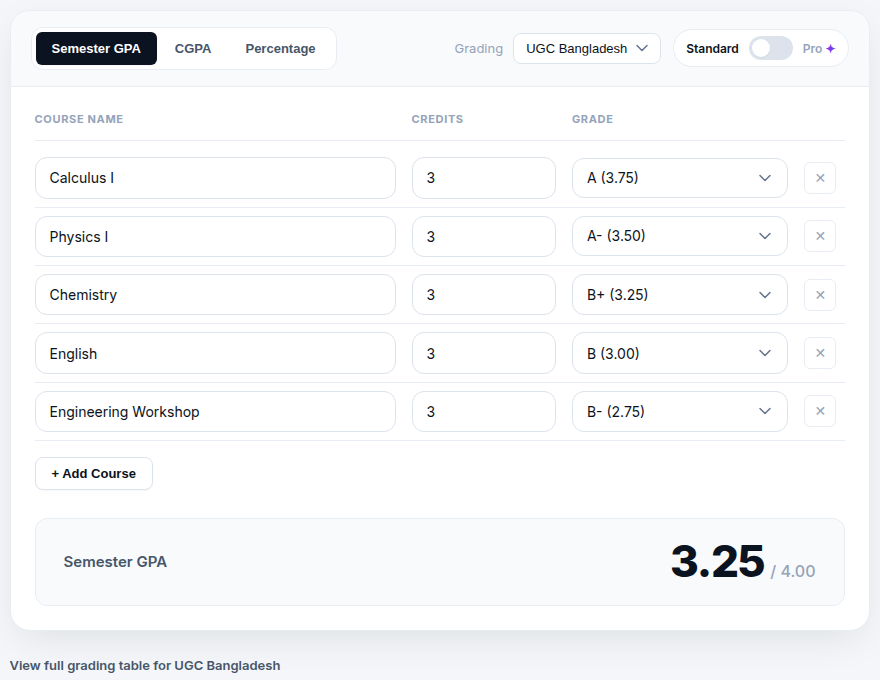
Screenshot: the CGPAPro calculator running a MIST-style semester — Calculus I (A), Physics I (A−), Chemistry (B+), English (B), Engineering Workshop (B−), all 3 credits. Semester GPA 3.25 out of 4.00. The UGC Bangladesh scale it uses is identical to MIST’s official scale, so no conversion is needed.
What MIST Is — and Why Its Grading Feels Different
MIST is the engineering and technology institute of the Bangladesh Armed Forces, located at Mirpur Cantonment in Dhaka. It was established in 1998, opened its doors to civilian students in 2002, and operates under the Ministry of Defence while its degrees are awarded through affiliation with the Bangladesh University of Professionals (BUP). Roughly 85% of students are civilians and about 15% are military officers (around 12% of seats are reserved for the military).
That military ownership is not decoration — it shapes the grading system. MIST runs on levels, not semesters (four levels of two terms each for engineering, five for architecture). Attendance is policed through formal statuses with real exam consequences. Cheating in an exam does not earn you a zero on that paper — it can end your entire degree. And some rules genuinely treat military and civilian students differently, from who approves a level repeat to where a final-year failure gets recorded. If you are choosing between MIST and a civilian engineering university like BUET, this guide shows you exactly what you are signing up for.
all your term GPAs. To graduate you need a CGPA of at least 2.20 within 6 years (engineering) or 7 years (architecture). But MIST is not a normal university: failed courses cleared in supplementary exams are capped at B+, grade improvement is limited to 6 courses in your entire degree, a fourth failed attempt bars you from the course forever, and attendance discipline is enforced with military strictness — cheat once and you face expulsion. This guide explains every rule, with worked examples you can copy for your own maths. Where MIST’s own documents disagree with each other, we say so plainly instead of picking one version and pretending it is certain.