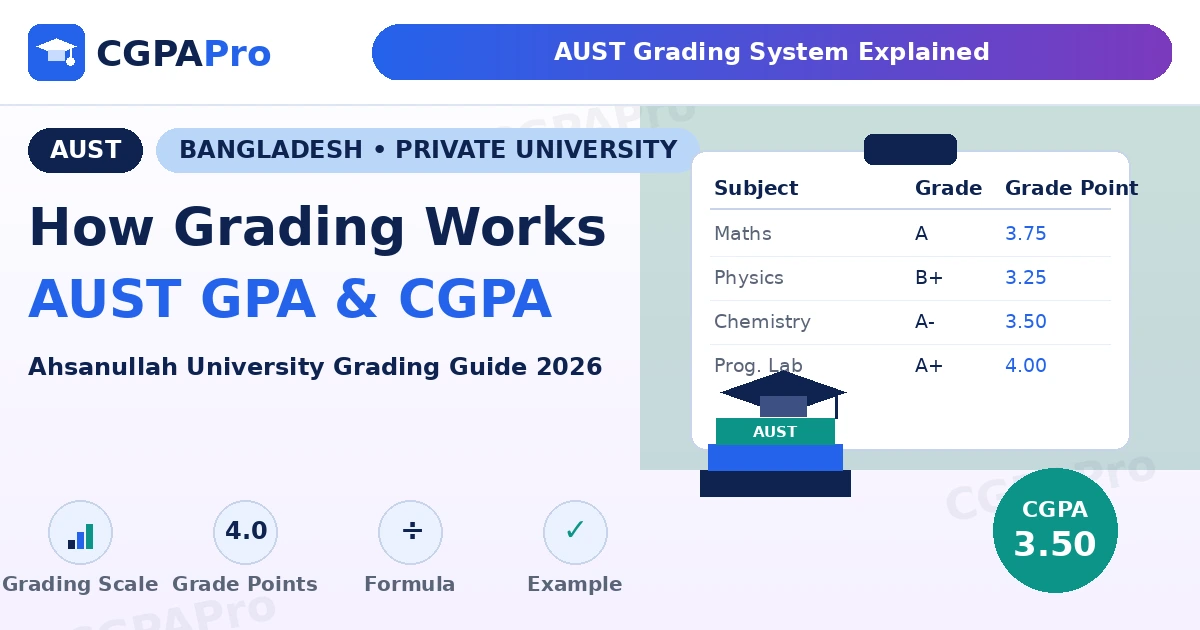
Quick Answer: How AUST Grades Work
If you study at the Ahsanullah University of Science and Technology (AUST) in Dhaka, your results run on a 4.00 CGPA scale with absolute marks bands — no curve, no relative grading. Every course gives you a letter grade from A+ down to F, each worth a fixed grade point: A+ is 4.00, A is 3.75, A− is 3.50, B+ is 3.25, B is 3.00, B− is 2.75, C+ is 2.50, C is 2.25, and D — the lowest passing grade — is 2.00. Score below 40% and you get an F worth 0.00. Your semester GPA is the credit-weighted average of your grade points, and your CGPA is the same calculation stretched across every semester you have completed.
That is the whole system in one paragraph — but the part that actually decides students’ futures at AUST is not the grade table. It is the machinery around it: the Clearance Examination that caps your grade at B no matter how well you score, the Improvement Examination that caps you at A− and makes you cancel your old grade first, and the carry-over rules that decide whether you get promoted after failing. This guide explains all of it with worked examples, checked against AUST’s own published Examination & Grading System. Where a rule varies by department or is not published, we say so instead of guessing.
A quick note before we start: “AUST” is also the acronym of the American University of Science and Technology in Lebanon. This guide is about Ahsanullah University of Science and Technology, Dhaka, Bangladesh — founded by the Dhaka Ahsania Mission in 1995, one of the first private universities in the country, with programs in engineering, architecture, business, and arts and sciences.
How to Calculate Your AUST GPA With the Calculator
The fastest way to check your numbers is the CGPAPro calculator. Here is the good news, verified grade-by-grade against AUST’s official table: AUST’s official grading scale is identical to the calculator’s UGC Bangladesh scale — same letters, same grade points, same D band. So the numbers the calculator gives you are exactly right for AUST, with no conversion needed:
- Open the CGPAPro CGPA calculator (its 4.00 scale matches AUST’s official table exactly).
- For each course, enter the credit hours and select the letter grade you earned (A+ = 4.00, A = 3.75, A− = 3.50, B+ = 3.25, B = 3.00, B− = 2.75, C+ = 2.50, C = 2.25, D = 2.00, F = 0.00).
- The calculator multiplies each grade point by its credit hours, adds up the quality points, and divides by your total credits — that is your semester GPA.
- To track your CGPA, repeat for each past semester and combine them with the credit-weighted CGPA formula in the worked examples below.
What AUST Is — and Why Its Exam System Feels Different
AUST runs its academic year in two semesters, and each semester a student typically takes around five theory subjects plus one to four sessional (practical/lab) courses. Each course carries credit hours that reflect its weight: a theory course’s credit hours equal its contact hours per week, while a sessional course’s credit hours equal half its contact hours per week. That half-weighting for sessionals is easy to miss and it changes your GPA maths — a 3-contact-hour lab is only 1.5 credits.
Your percentage in a theory course is built from two parts: continuous assessment (30%) — class participation, attendance, and class performance (10%) plus quizzes and/or assignments (20%) — and the semester final examination (70%), a 3-hour exam on the full 100 marks. The quiz rule is student-friendly in a specific way: a course with n credit hours ordinarily holds (n + 1) quizzes or assignments, and only your best n count. So in a 3-credit course you get 4 quizzes and your worst one is dropped automatically. Sessional courses are assessed differently — attendance, performance, quizzes, assignments, reports, practical exams, and jury viva — with the exact distribution set by the teachers concerned.
But the distinctive part of AUST is what happens after the regular examination. AUST gives you three additional exam types on top of the regular semester final: the Clearance Examination (to clear courses you failed), the Carry Over Examination (to clear backlogs from previous semesters), and the Improvement Examination (to improve a passing grade). Each comes with caps and limits that most students only discover when it is too late. They are the heart of this guide.
The Official AUST Grading Table (2026)
This is the grading scale published on AUST’s own website. The bands are absolute and fixed: your total percentage in a course maps to one letter grade, and that letter maps to one grade point. There is no curve and no rounding across a boundary — 79.9% is an A (3.75), not an A+.
| Marks Obtained | Letter Grade | Grade Point | Status |
|---|---|---|---|
| 80% and above | A+ | 4.00 | Pass |
| 75% to < 80% | A | 3.75 | Pass |
| 70% to < 75% | A− | 3.50 | Pass |
| 65% to < 70% | B+ | 3.25 | Pass |
| 60% to < 65% | B | 3.00 | Pass |
| 55% to < 60% | B− | 2.75 | Pass |
| 50% to < 55% | C+ | 2.50 | Pass |
| 45% to < 50% | C | 2.25 | Pass |
| 40% to < 45% | D | 2.00 | Pass (lowest) |
| Below 40% | F | 0.00 | Fail |
Three things about this table deserve emphasis. First, D is a pass — the lowest passing grade at 2.00. Only F fails. Students who grew up hearing “D means fail” from other systems get this wrong every year. Second, the table is the same standard UGC 4.00 scale used across most Bangladeshi universities, so AUST grades compare cleanly with BUET, Dhaka University, BRACU, CUET, and KUET. Third — and this is the useful part — because the table matches the CGPAPro calculator’s scale exactly, the calculator needs no adjustment for AUST. We verified every value.
Apart from letter grades, AUST uses three status grades: W (withheld result), E (exemption or waiver of a course — needs your Head of Department’s recommendation plus the Vice-Chancellor’s approval), and P (passed in a previous semester). Your GPA is computed without W, E, and P grades — they do not enter the calculation at all.
AUST GPA Formula: The Step-by-Step Method
AUST’s own grading page explains GPA as the weighted average of grade points across the credit hours you completed. It is the standard credit-weighted formula:
- Step 1 — Quality points per course: multiply the grade point you earned in each course by that course’s credit hours.
- Step 2 — Total quality points: add up all the course quality points.
- Step 3 — Total credits: add up the credit hours of all the courses.
- Step 4 — Divide: semester GPA = total quality points ÷ total credits. CGPA uses the same formula across all semesters.
Formula: GPA = Σ (Grade Point × Credit Hours) ÷ Σ Credit Hours
CGPA formula: CGPA = Σ (Semester GPA × Semester Credits) ÷ Σ Semester Credits — equivalently, total quality points across every semester ÷ total credits across every semester. Both give the same answer.
Two details matter. First, the weighting is by credits, not by number of courses: a 3-credit A+ moves your GPA half as much again as a 2-credit A+. Second, sessional credits are half their contact hours — so always use the credit figure on your registration, not the weekly class hours. A widely shared student post about AUST gets this wrong by adding up “CGPAs” of theory and sessional groups instead of weighting every course by credits; do not follow that formula.
Worked Example 1: One Semester’s GPA (Matches the Screenshot)
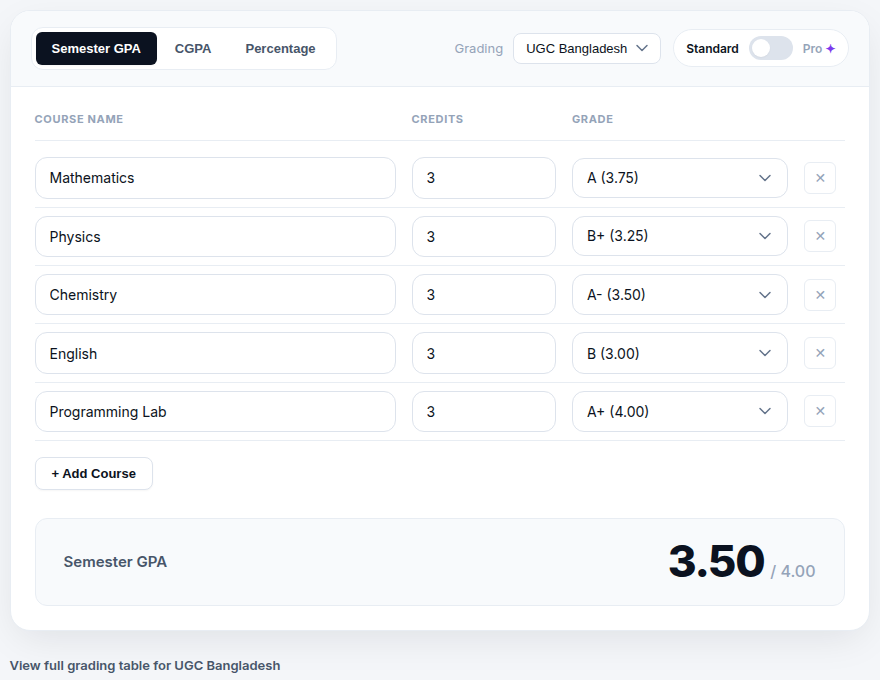
Suppose an AUST CSE student finishes a semester with these five courses — the same example shown in the calculator screenshot above:
| Course | Credits | Grade | Grade Point | Quality Points |
|---|---|---|---|---|
| Mathematics | 3 | A | 3.75 | 3 × 3.75 = 11.25 |
| Physics | 3 | B+ | 3.25 | 3 × 3.25 = 9.75 |
| Chemistry | 3 | A− | 3.50 | 3 × 3.50 = 10.50 |
| English | 3 | B | 3.00 | 3 × 3.00 = 9.00 |
| Programming Lab (sessional) | 3 | A+ | 4.00 | 3 × 4.00 = 12.00 |
| Total | 15 | — | — | 52.50 |
GPA = 52.50 ÷ 15 = 3.50. Notice the asymmetry of the table: the single B+ (9.75) drags the average down more than the A+ (12.00) lifts it, because the gaps between grade points are not symmetric. One slipped course hurts more than one great course helps — which is exactly why the improvement exam rules below matter so much.
Worked Example 2: AUST’s Own Published Example
AUST’s grading page includes its own worked example. Reproducing it here (it is the university’s own arithmetic, and it is correct): a student completes five courses — 3 credits with A+ (4.00), 3 credits with B (3.00), 3 credits with A (3.75), 2 credits with B+ (3.25), and 1 credit with A− (3.50).
Quality points: 12.00 + 9.00 + 11.25 + 6.50 + 3.50 = 42.25. Total credits: 12. GPA = 42.25 ÷ 12 = 3.52 (3.5208…, shown to two decimals). This is a useful template for mixed credit loads — note how the 1-credit A− barely moves the result while the 3-credit B anchors it.
Worked Example 3: CGPA Across Three Semesters
Now stretch one student across three semesters:
| Semester | Semester GPA | Credits | Weighted Points |
|---|---|---|---|
| Semester 1 | 3.20 | 16 | 3.20 × 16 = 51.20 |
| Semester 2 | 3.50 | 15 | 3.50 × 15 = 52.50 |
| Semester 3 | 3.72 | 17 | 3.72 × 17 = 63.24 |
| Total | — | 48 | 166.94 |
CGPA = 166.94 ÷ 48 = 3.48. The classic mistake is averaging the three GPAs directly: (3.20 + 3.50 + 3.72) ÷ 3 = 3.47. Here the error is only 0.01 because the credit loads are similar — but when one semester carries 20 credits and another carries 12, the simple average is simply wrong. Always weight by credits. If the distinction between the three averages is still fuzzy, our GPA vs CGPA vs SGPA comparison and What Is CGPA guide spell it out with examples.
The Clearance Examination: Your Grade Is Capped at B
This is the single most misunderstood rule at AUST. If you get an F in a theory course, you can sit the Clearance Examination — held over 1 to 2 weeks right after the semester final examinations. The clearance exam carries 70% of the course marks, and the remaining 30% comes from the continuous-assessment record you earned earlier in the semester (your class participation, quizzes, and assignments are not wiped).
Here is the catch, stated plainly on AUST’s grading page: whatever your total mark, the highest grade you can earn in a Clearance Examination is B (3.00). Score 95% in the clearance exam and you still get a B, not an A+. The clearance grading table is:
| Marks in Clearance Exam | Letter Grade | Grade Point |
|---|---|---|
| 60% to 100% | B | 3.00 |
| 55% to < 60% | B− | 2.75 |
| 50% to < 55% | C+ | 2.50 |
| 45% to < 50% | C | 2.25 |
| 40% to < 45% | D | 2.00 |
| Below 40% | F | 0.00 |
What the cap costs you — a worked demo. Take a 3-credit course. In the regular exam, 82% would earn A+ (4.00) → 12.00 quality points. After an F, scoring 82% in the clearance exam earns B (3.00) → 9.00 quality points. The F-turned-clearance costs you 3.00 quality points on that course — 0.20 GPA on a 15-credit semester — even with an excellent clearance performance. The strategic lesson: your continuous-assessment 30% is banked and safe, so the clearance exam is about crossing 60% to lock in the B, not about chasing marks that cannot convert into a higher grade.
Two more clearance facts. Only students who obtained an F in the Regular Examination may sit it — you cannot use a clearance exam to improve a passing grade (that is what the improvement exam is for). And being absent from the semester final also lands you an F: the exam mark is entered as zero. If you miss a final for a genuine emergency, talk to your department immediately — an unrecorded absence becomes an F, and the F then has to go through the clearance machinery.
Carry Over: The 2-and-4 Rule That Decides Promotion
If you cannot clear everything, AUST’s carry-over system decides whether you move to the next semester. The rule has two numbers — 2 and 4:
- A student who fails a maximum of 2 theory courses in a semester is promoted to the next class, carrying those failed courses forward — provided the cumulative number of failed courses, including carry-overs from previous semesters, does not exceed 4.
- Carry-over backlogs are cleared in the Carry Over Examinations of the relevant semester, which work exactly like Clearance Examinations (same B cap).
- If you fail more than 2 courses in one semester, or your cumulative failed + carry-over count exceeds 4, you are not promoted. You must re-register for the failed course(s) and bring the counts back within the 4-and-2 limits before you can move up.
- Final-semester students get no leniency on the arithmetic: in the last semester of a 4-year or 5-year program, exceeding the limits means re-registering for that semester’s failed courses.
A worked scenario. Rafi fails 1 course in semester 2 and clears it later via carry-over. In semester 3 he fails 2 courses. His cumulative failed + carry-over count is now 3. 2 in the semester ≤ 2, cumulative 3 ≤ 4 → promoted with carry-over. In semester 4 he fails 2 more while still carrying 2 uncleared from semester 3: cumulative 4 ≤ 4 → still promoted, but he is now at the absolute ceiling. One more uncleared failure and he stops being promoted until he re-registers and clears the backlog. Students who track only “how many did I fail this semester” and ignore the cumulative count are the ones who get surprised.
Re-registration is a formal process: apply on the prescribed form at the Registrar’s office within 2 weeks of classes commencing. The grade you earn in the re-registered course counts for that semester’s result and GPA; the old grade stays on the previous semester’s transcript and tabulation sheet “only for chronological sequence.” To sit a Carry Over Examination at all, you must apply for enrolment on the Controller of Examinations’ form within due time — confirm the dates and any fees with the Controller’s office, because the published page does not list them.
The Improvement Examination: Capped at A−, and You Cancel Your Old Grade
AUST lets you improve a passing grade — but the mechanism has teeth. If you earned a passing grade lower than A− in a theory course’s Regular Examination, you may sit the Improvement Examination for that course by cancelling the grade you already earned. Read that twice: the old grade is cancelled first, and the grade you earn in the improvement exam counts — even if it is lower than the one you cancelled.
The improvement exam carries 70% of the marks (the other 30% comes from your earlier continuous-assessment record, same as clearance), and it has its own cap: the highest attainable grade is A− (3.50), no matter your total. The improvement table:
| Marks in Improvement Exam | Letter Grade | Grade Point |
|---|---|---|
| 70% to 100% | A− | 3.50 |
| 65% to < 70% | B+ | 3.25 |
| 60% to < 65% | B | 3.00 |
| 55% to < 60% | B− | 2.75 |
| 50% to < 55% | C+ | 2.50 |
| 45% to < 50% | C | 2.25 |
| 40% to < 45% | D | 2.00 |
| Below 40% | F | 0.00 |
What the cap costs you — a worked demo. You earned a B (3.00) in a 3-credit course → 9.00 quality points. You sit the improvement exam and score 88% — in a regular exam that would be A+ (4.00). In the improvement exam it is A− (3.50) → 10.50 quality points. Net gain: 1.50 quality points, or +0.10 on a 15-credit semester GPA. Worth doing if you are confident — but note the ceiling: you can never improve to an A or A+ through this route, and you cannot improve a grade of A− or above at all.
The trap. Because the old grade is cancelled and the new one counts unconditionally, a bad improvement day can hurt you. Suppose you hold a B (3.00) and score only 55% in the improvement exam → B− (2.75). You just traded 3.00 for 2.75 and paid an exam for the privilege. Only attempt improvement when your preparation is genuinely stronger than your first attempt — not as a lottery ticket.
The lifetime limit. This is the rule almost nobody knows until it is too late: a 4-year-program student may sit improvement exams in a maximum of 4 courses in their entire AUST career; a 5-year-program student (architecture) in a maximum of 5 courses. Spend these on the courses where the grade-point gain per credit is largest — typically a C+ or B− in a 3-credit course, not a B+ you might nudge to A−. To appear, apply on the Controller of Examinations’ form at least 4 days before the exam date.
One discrepancy to know about. AUST’s official grading page sets the improvement eligibility at a passing grade “lower than A−”. However, at least one departmental syllabus document (the MPE program syllabus) circulating online states a stricter threshold — a grade “lower than B”. Departmental documents can and do differ, so treat the university-wide page as the primary rule and confirm the exact threshold in your own department’s current syllabus before applying. If your department enforces “below B”, a B or B+ improvement application may be rejected.
Sessional Courses, Attendance, and the Degree Clock
Three rules that end academic careers quietly:
1. Failing a sessional/practical course means repeating the semester. There is no clearance-exam escape for sessionals. The one published exception is Surveying Practical: a student who fails it may still be promoted if otherwise eligible, and a student absent from its classes for a reason the authority accepts gets another chance with a different batch in the next relevant semester. Everything else — fail a lab, repeat the semester.
2. The 60% attendance bar. You must attend at least 60% of the classes held in each course of a semester. Fall below it in any course and you are barred from that course’s Semester Final, Clearance, Improvement, and Carry Over Examinations. The university authority can condone a shortage on acceptable grounds — but “I didn’t know” is not a ground. Track your attendance per course, not as an overall average.
3. The degree clock. A 4-year degree must be completed within a maximum of 7 years; a 5-year degree within 8 years. Failing to finish inside the window can disqualify you from continuing at AUST at all. Combined with the carry-over limits, this means backlogs compound: every repeated semester consumes clock time you cannot get back.
Also note the Project/Thesis rule: if you do not submit your project or thesis report during the semester, you must enrol for the course again in the subsequent semester of your submission. It does not simply roll over.
GPA vs CGPA at AUST
Students mix these up constantly. GPA is one semester: the credit-weighted average of that semester’s courses. CGPA is cumulative: the credit-weighted average across every semester so far, recomputed as you complete each semester. A strong final semester lifts your CGPA but cannot erase earlier semesters — it can only dilute them, because every past credit stays in the denominator. That is why early semesters matter more than students expect: a weak first year is not a disaster, but it takes several good semesters to wash out. Before you plan a rescue, run the target maths honestly:
Reality check. You have completed 60 credits with a CGPA of 3.20 and want 3.50 after one more 15-credit semester. Required semester GPA = (3.50 × 75 − 3.20 × 60) ÷ 15 = (262.50 − 192.00) ÷ 15 = 70.50 ÷ 15 = 4.70. Above the 4.00 maximum — mathematically impossible in one semester. The honest conclusion is to plan across two or three semesters, where the target becomes reachable. Our CGPA improvement guide walks through semester-by-semester planning, and the retake and CGPA guide covers the general maths of replacing grades.
What AUST Does Not Publish: Probation, Dean’s List, Graduation CGPA
An honest section, because most “AUST grading” pages on the internet invent these numbers. AUST’s published Examination & Grading System sets no probation CGPA threshold, no Dean’s List cutoff, and no minimum graduation CGPA — and no other official page we could find states them either. What the published rules do enforce is the promotion machinery (the 2-and-4 carry-over limits), the sessional-failure semester repeat, and the 7/8-year completion clock. If a senior, a Facebook group, or a calculator blog quotes you a “2.00 probation” or “3.50 Dean’s List” figure for AUST, ask for the source document — and check your current program handbook, because faculty-level regulations can add standing rules the university-wide page does not show. Do not plan your academic life around an invented threshold.
Common Mistakes AUST Students Make
- Averaging semester GPAs without weighting by credits. The simple average is wrong whenever semesters carry different credit loads. Always weight by credits.
- Adding up “CGPAs” of theory and sessional groups. A viral student formula for AUST sums group CGPAs and divides by total credits — that double-counts. Weight every course by its own credits in one calculation.
- Thinking D is a fail. D (40–44%, 2.00) is a pass at AUST — the lowest passing grade. Only F fails. Do not retake a D out of panic; check whether an improvement exam is even available for it first (it is — D is lower than A− — but the A− cap and lifetime limit apply).
- Assuming a clearance exam can earn an A+. The clearance cap is B (3.00), full stop. Students who “study hard for the clearance to get an A+” are optimizing for a grade that does not exist.
- Sitting an improvement exam as a lottery ticket. Your old grade is cancelled and the new grade counts even if it is lower. A B turned into a B− is a real outcome. Only improve when you are genuinely better prepared.
- Burning the lifetime improvement limit early. Four courses (4-year programs) or five (5-year) for your whole degree. Spending one to nudge a B+ to an A− in first year can cost you the chance to fix a C+ in final year.
- Ignoring the cumulative carry-over count. Students track “I failed 2 this semester, that’s allowed” and forget the cumulative-4 ceiling across semesters. The ceiling is what stops promotions.
- Letting attendance slip below 60% in one course. The bar is per course, and missing it bars you from every exam type for that course. An overall “fine” attendance average does not save the one course you skipped.
- Confusing this AUST with Lebanon’s AUST. Search results for “AUST grading system” are polluted by the American University of Science and Technology (Lebanon), which uses a totally different scale (A = 90–100, D = 60–69). If a page mentions Beirut or Lebanese campuses, it is the wrong AUST.
- Trusting a random calculator’s exam rules. Student-built AUST calculators get the grade table right but know nothing about the B/A− caps, the 2-and-4 rule, or the lifetime improvement limit. Use calculators for the arithmetic; use this guide (and your handbook) for the rules.
Tips to Protect (and Raise) Your AUST CGPA
- Bank the 30% continuous assessment. Class participation (10%) plus quizzes/assignments (20%) is the most controllable part of your percentage — and the (n+1)-quizzes-best-n rule means one bad quiz is free. A strong 30% means the final only has to hold your band, not rescue it. The same 30% is also what carries into clearance and improvement exams.
- Play the band cliffs. At AUST, 79% vs 80% is A (3.75) vs A+ (4.00) — a 0.25 jump for one mark. The same cliff sits at 74/75, 69/70, 64/65, 59/60, 54/55, 49/50, 44/45, and 39/40. If you are sitting just below a boundary, one more quiz mark or one corrected marking error is worth more than the same effort anywhere else in the band.
- Weight your effort by credits. A 3-credit course is worth twice a 1.5-credit sessional. When time is short, protect the high-credit theory courses first.
- Use improvement exams surgically. The maths favours improving low grades in high-credit courses: turning a C+ (2.50) into an A− (3.50) on 3 credits gains 3.00 quality points; turning a B+ (3.25) into an A− gains only 0.75. And remember the lifetime cap — save your four (or five) for the biggest gains.
- Clear Fs through clearance exams immediately. The B cap means a cleared F can never become better than 3.00 on those credits, and every uncleared failure counts toward the cumulative-4 promotion ceiling. Clear it in the 1–2-week clearance window right after finals.
- Plan targets backwards. Required next-semester GPA = (target CGPA × total credits after − current CGPA × credits done) ÷ next semester’s credits. If the answer is above 4.00, stretch the plan over more semesters instead of chasing an impossible term.
- Keep your department’s syllabus. The university-wide grading page is the primary rule, but departmental syllabi can set stricter thresholds (like the “below B” improvement rule in at least one program document). A rule that was true for a senior’s batch may not be true for yours.
Frequently Asked Questions
What is the highest CGPA at AUST?
4.00 — a straight-A+ average across every course, theory and sessional. Note that grades earned in Clearance Examinations (capped at B) and Improvement Examinations (capped at A−) can never be A+, so a single F or a single improvement makes a perfect 4.00 impossible afterward. It is rare precisely because every course counts and every band boundary is a cliff.
Is D a passing grade at AUST?
Yes. D (40% to less than 45%, grade point 2.00) is the lowest passing grade at AUST — only F (below 40%) is a fail. You do not need to retake or clear a D. You may choose to improve it through an improvement exam (D is lower than A−, so it is eligible), subject to the A− cap and your lifetime course limit.
Can I get an A+ in a clearance exam at AUST?
No. Whatever your total mark, the highest grade attainable in a Clearance Examination is B (3.00) — even at 100%. The clearance table runs B (60–100%), B−, C+, C, D, F. If you need better than a B on those credits, the clearance route cannot give it to you.
Which grades can I improve at AUST, and what is the highest I can get?
You can sit an improvement exam for a theory course in which you earned a passing grade lower than A− — so B+, B, B−, C+, C, and D are eligible; A−, A, and A+ are not. The highest grade attainable is A− (3.50). You must cancel your existing grade first, and the improvement grade counts even if it is lower. Warning: at least one departmental syllabus states a stricter “lower than B” threshold — confirm your department’s rule before applying.
How many courses can I improve at AUST?
A maximum of 4 courses in your entire degree if you are in a 4-year program, or 5 courses if you are in a 5-year program (architecture). This is a career cap, not a per-semester allowance. Apply to the Controller of Examinations at least 4 days before the exam date.
How many courses can I fail and still be promoted at AUST?
A maximum of 2 failed theory courses in a semester, and your cumulative failed + carry-over count must not exceed 4. Exceed either limit and you are not promoted — you must re-register for the failed courses and bring the counts back within limits. Fail a sessional/practical course and you repeat the semester (except the published Surveying Practical exception).
Do W, E, and P grades affect my AUST GPA?
No. Withheld (W), Exemption (E), and Passed-in-previous-semester (P) grades are excluded from the GPA calculation entirely. Note there is no standard “I” (Incomplete) grade in AUST’s published system — a withheld result is recorded as W.
What is the maximum time to finish my degree at AUST?
4-year programs must be completed within 7 years and 5-year programs within 8 years of enrolment. Missing the window can disqualify you from continuing at AUST, so repeated semesters and uncleared backlogs are more dangerous than they look.
Where can I verify AUST’s official grading rules?
Start with AUST’s own site: the Examination & Grading System page at aust.edu/academics/examincation_and_grading_system carries the official grade tables, the clearance/improvement/carry-over rules, and the worked GPA example. Your department’s program syllabus carries any stricter departmental thresholds. If a blog post (including this one) and your handbook disagree, the handbook wins.
The Bottom Line
AUST’s grading system is a fixed 4.00 table with absolute bands — simple on the surface. What makes it demanding is the machinery around the table: clearance exams capped at B, improvement exams capped at A− with your old grade cancelled and a lifetime limit of four or five courses, carry-over promotion gated by the 2-and-4 rule, sessional failure that repeats the semester, a 60% attendance bar per course, and a 7-to-8-year degree clock. The students who do best at AUST are not the ones who cram hardest before finals; they are the ones who bank the 30% continuous assessment, watch the band cliffs, weight effort by credits, clear Fs in the clearance window immediately, and spend their few improvement chances where the grade-point gain is largest. Run your numbers through the calculator, check them against the worked examples above, and keep your handbook within reach. Your CGPA is just arithmetic — but at AUST, it is arithmetic with rules, and now you know them.